Austrian MP Calls for Further EU Sanctions Against Iran's IRGC
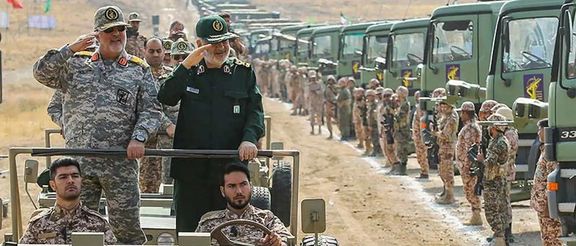
Helmut Brandstätter, a member of the Austrian parliament, has urged the European Union to sanction Iran’s IRGC.

Helmut Brandstätter, a member of the Austrian parliament, has urged the European Union to sanction Iran’s IRGC.
In a statement, Brandstätter revealed, “I met with the sister of Mahmoud Mehrabi, a man sentenced to death in Iran over a social media post advocating for justice and anti-corruption,” highlighting the plight of Iran’s citizens under the oppressive regime.
Mehrabi, arrested last year, faces execution for charges of "corruption on earth"—a term frequently used by Iranian courts to prosecute various alleged offenses.
The IRGC plays a central role in suppressing dissent by leading crackdowns on protests and unrest, utilizing both its regular forces and the Basij militia to monitor public activities.
The United States designated the IRGC as a foreign terrorist organization in 2019 and last year, the UK admitted that Iran was among the country’s biggest foreign threats with multiple IRGC plots foiled on British soil.
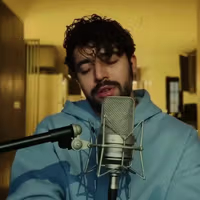
Brandstätter’s call for EU sanctions gains further gravity with the mention of Toomaj Salehi, a dissident rapper sentenced to death for his involvement in the 2022 anti-regime protests. Brandstätter has taken up sponsorship and advocacy on Salehi’s behalf.
“Mehrabi is in the same prison as Toomaj Salehi, for whom I took a sponsorship. Toomaj was also sentenced to death, only because he stood - and stands, even in prison - in solidarity with those who want to live in freedom in Iran,” wrote Brandstätter on X.
Amnesty International reported that 853 people were executed in Iran in 2023, the highest number in eight years as executions stepped up in the wake of the 2022 uprising.
In 2011, the EU initiated a sanctions regime targeting Iran due to severe human rights violations. The sanctions have been renewed annually and are currently extended through 13 April 2025.
Since October 2022, the EU has intensified the measures, implementing 10 new packages of sanctions in response to the worsening human rights situation in Iran.

Iran will pose a significant threat to the upcoming US elections, Director of National Intelligence Avril Haines said on Wednesday, predicting that Tehran will intensify its cyber and influence activities.
“Iran is becoming increasingly aggressive in their efforts,” Haines told the US Senate Select Committee on Intelligence. “[They] seek to stoke discord and undermine confidence in our democratic institutions, as we have seen them do in prior election cycles.”
Influence by “foreign actors” has been a source of apprehension in recent US elections, especially since 2016, when ‘Russian meddling’ became a major theme, with people on both parties accusing the other of having benefited from it.
Haines in his Senate briefing Wednesday also singled out Russia as the “most active foreign threat” to US elections, adding that China and Iran were also “significant actors” in trying to leave their mark.
On Iran, specifically, he said: “They continue to adapt their cyber and influence activities, using social media platforms, issuing threats, and disseminating disinformation. It is likely they will continue to rely on their intelligence services in these efforts and Iran-based online influencers to promote their narratives.”
There seems to be a growing consensus in Washington that the ‘influence’ offensive from the regime in Tehran has to be taken seriously, even though it’s not yet as serious as threats from Moscow and Beijing –and perhaps not on the same global scale.
This was pointed out Wednesday by the president of the US Council on Foreign Relations, Michael Froman, who suggested in an interview with CNN’s Christian Amanpour that the outlook is not all gloom, as those worried about or affected by such threats rally to fend them off.
“There’s a concerted effort by Russia, China, Iran, and North Korea to challenge the rules-based international order…but it has strengthened, in many respects, alliances around the world. So there’s been an action and a reaction.”
Russia, China, and Iran deny all such accusations, punching back with allegations of American influence campaigns –and direct interventions– across the world. This is a game to which Iran seems to be a new but fast-learning player, attempting to shape not just public opinion and discourse, but also high-level decisions and policy.
“There is evidence that some think tanks, advocacy organizations, and universities are uncomfortably close to a U.S. enemy,” Policy director at United Against Nuclear Iran, Jason Brodsky, posted on X.. “ Some of them do so unwittingly, others perhaps wittingly. They risk becoming components of an information operation benefitting Tehran.”
This has been well documented by Iran International and Semafor in a number of exclusive, investigative reports.
Interestingly enough, the Iranian regime is no longer hiding its intentions, even publishing research papers on the subject of ‘influence’.
In a 128-page report published recently, an Iranian think tank (SARAMAD), recommends a number of measures to be considered after the 2024 US elections, including establishing “a network of elite lobbyists” to indirectly “advance” the regime’s interests in “policies and US public opinion."
The report calls for the creation of a "special network" in the US that would “put Iran's interests first” and are able and willing to express their views to "restore Iran's image”.
This, of course, has been pursued before –and with some success– in such measures as the Iran Expert Initiative, whose affiliates worked tirelessly to promote the regime’s stance during and after the negotiations that led to the 2015 nuclear deal. A key figure in that initiative, Arianne Tabatabaei, is now a high-ranking official at the Pentagon, while her mentor, Robert Malley, President Joe Biden’s former Iran envoy is being investigated by the FBI for potentially criminal mishandling of official documents.
The US Congress has been trying to learn more about Malley’s case for months–including the reasons his security clearance was suspended– but the State Department has refused to offer information.
Some Biden critics accuse him of ‘appeasing’ Iran. They say he has been paralyzed by fear of ‘escalation’ that he thinks could lead to an “all-out war” in the Middle East, failing to confront, even to recognize the magnitude of threats posed by, the Iranian regime.
“Many US media and think tankers refuse to believe that Iran would seek to run sophisticated info operations on US soil,” former national intelligence manager on Iran Norman Roule posted on X. “It's past-time for the kid gloves and denials to drop.”

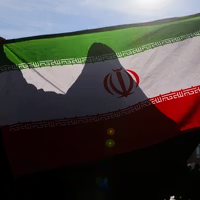
The true essence of Iranian patriotism is occasionally obscured or mischaracterized in Western media, contributing to a lack of understanding about its distinctive qualities.
This article explores the unique aspects of Iranian nationalism, which has often been misunderstood as akin to the xenophobic and racist right-wing movements prevalent in Western discourse. Understanding this distinction is crucial for a deeper appreciation of Iran's socio-political landscape and its historical resistance against both Eastern and Western hegemonies.
Nationalism, or 'patriotism,' is known as the most liberal political discourse in contemporary Iranian history. This cultural and political discourse stood firmly against totalitarian ideologies like Marxism and Islamist ideologies, preventing Iran from falling into the Communist trap during the turbulent decades of the Cold War. Nevertheless, this movement was defeated in 1979 by an alliance of Communists and Islamists, leading to the overthrow of Mohammad Reza Shah Pahlavi.
Opponents of Iranian nationalism consisted mainly of two anti-Western currents: political Islam and Marxism. Khomeini vehemently condemned nationalism and ordered the removal of nationalist symbols from institutions and political currents. Iranian Marxists, prior to the 1979 revolution, had carried out terrorist attacks against symbols of Western influence. These groups contributed to the overthrow of the Pahlavi regime, which had granted significant freedoms to women and religious minorities. During the Pahlavi era, women and religious minorities enjoyed extensive freedoms, and positive relations existed between Iran and Israel. However, Pahlavi's opponents targeted American diplomats and fought against women's rights, while many nationalists continued to promote Western culture and the country's development.
To better understand the profound differences between Iranian nationalism and xenophobia, it is necessary to consider the ideas of the Constitutional Revolution era and the years that followed. Mirza Aqa Khan Kermani and Seyed Hassan Taqizadeh, two prominent Iranian thinkers, were committed to structural reforms and modern Western teachings. Kermani, a pioneer of the Constitutional movement, emphasized the need for Iran to distance itself from tyranny and superstitions, while Taqizadeh advocated modernization inspired by Western democracies. Both emphasized the importance of education, freedom of expression, and the media as foundations of democracy. This line of thought, after a relatively long hiatus during the 1960s and 1970s, under the intellectual influence of leftists and Soviet enthusiasts, has been revived in recent decades among Iranians and has become the focus of their struggle against the Islamic Republic.
Western nationalism arose after the collapse of the Holy Roman Empire and the establishment of nation-states in Europe, but Iranian patriotism is the result of thousands of years of nation-state existence in Iran and the peaceful coexistence of different ethnic groups side by side. This type of patriotism, unlike Western nationalism, which was aggressive in the age of post-Renaissance nation states, has been defensive and not only served as a barrier against extremist Islamism, but also a factor for Iran's territorial unity and national sovereignty.
During the Pahlavi era, which was founded on Iranian patriotism, religious minorities such as Jews, Christians and Baha'is enjoyed extensive freedoms that were unparalleled in the Middle East. These freedoms were significant as they demonstrated a unique aspect of tolerance and progressive policies in the region. These minorities were not only free in worship but many entrepreneurs belonging to these communities also held prominent economic positions in Iranian society. The Family Protection Law, enacted during the Pahlavi era, was one of the most progressive laws in the Muslim world regarding divorce and the age of marriage in favor of women, and Iranian women obtained the right to vote before they did in some European states, including Switzerland. In the field of arts, women often had more rights than men. The Iranian LGBT community also enjoyed significant freedoms and played an active role in the artistic field. For example, a year before the Islamic revolution in 1978, when the famous gay designer Bijan Safari got married, Empress Farah Pahlavi sent a bouquet of flowers on her behalf as congratulations.
In the past 15 years, the sense of Iranian patriotism has grown significantly, and nationalists have re-emerged as a central force in recent protests against the Islamic Republic. Since December 2017, Iran has witnessed five major nationwide uprisings during which people have widely chanted nationalist slogans. These slogans include: "From Kurdistan to Tehran, my life for Iran," "Reza Shah! Bless your soul," "Woman, Life, Freedom; Man, Homeland, Prosperity," "Sanandaj, Zahedan, the luminaries of Iran," "We fight, we die, we take back Iran," "Neither Gaza, nor Lebanon, my life for Iran," and "An Iranian dies but does not accept humiliation." These slogans reflect the spread of nationalist sentiment and patriotism among the Iranian people and their desire to preserve their national identity and the independence of their country.
In conclusion, Iranian patriotism, deeply rooted in a rich cultural and historical heritage, contrasts sharply with the often reductive and skewed portrayals found in Western media. This patriotism is marked by its defensive and inclusive nature, reflecting a nationalism that promotes unity and resists hostile pressures rather than fostering exclusion. By appreciating these nuances, the international community can engage in a more informed and respectful dialogue about Iran, recognizing its unique national identity and the aspirations of its people for freedom.

Taleghani Hospital in Tehran declared it can no longer accept dialysis patients from Evin Prison, citing contamination of its facilities with bedbugs.
Former political prisoner Mehdi Mahmoudian claims the hospital has sent a sample can of bedbugs to the head of Evin's medical department to substantiate the claims.
In a post on social media platform X he warned that if the government denied the issue, more evidence will be revealed, including “videos of bedbugs parading in prison."
Zia Nabavi, a student activist and political prisoner currently in Evin Prison, wrote an open letter detailing the horrific conditions surrounding the infestation including prolonged periods without sleep.
In response to the accusations, the Mizan news agency, affiliated with the judiciary, denied the presence of bedbugs in Evin Prison, proclaiming the facility as one of the nation's “cleanest and most orderly prisons.”
According to Mizan, an unnamed source from the prison organization accused Nabavi of fabricating the claims to exert pressure on prison authorities for unspecified illegal demands.
Nabavi, a student activist, was imprisoned for his role in a protest in March last year against chemical attacks and the serial poisoning of students. Thousands of students were affected with hundreds in need of medical care.

Reza Rasaei, a young Iranian man facing execution for the killing of a high-ranking IRGC Colonel, was not involved in the clash that resulted in the official's death, Iran International has learned.
In late 2022, while the Islamic Republic’s security forces were in the throes of their violent crackdown on unprecedented anti-regime protests, news spread that a senior IRGC intelligence official had reportedly been stabbed to death.
In response to Nader Bayrami's killing in the province of Kermanshah, authorities arbitrarily detained dozens of protesters in retaliation.
Days later, they would single out Kurdish man Reza Rasaei, blaming him for the alleged crime.
Exclusive interviews with eyewitnesses to the killing of the IRGC official and sources close to Rasaei’s family cast complete doubt on the regime’s narrative.
According to new information, Rasaei was not involved in the altercation that led to the death of the IRGC official and was ultimately forced to confess to Bayrami's murder under extreme torture.
Rasaei, 34, was sentenced to death by the Supreme Court of Iran in December 2023 and is currently imprisoned in Dizel Abad prison in Kermanshah, where he faces the imminent threat of execution.
‘Rasaei Absent from Clash Leading to IRGC Officer’s Death’
In the wake of Iranian-Kurdish woman Mahsa Jina Amini's death in September 2022, at the hands of the regime's so-called morality police, nationwide protests were sweeping across Iran.
Authorities were on high alert to stifle any gatherings that could escalate into larger demonstrations, often targeting Iran’s Kurdish population.
In mid-November, eyewitnesses reported that nearly 3,000 people attended a commemoration ceremony in western Iran.
It was during this event that senior IRGC official Nader Bayrami reportedly lost his life.
The gathering honored Seyed Khalil Alinejad — an influential Kurdish and Yarsan figure believed to have been killed by regime agents. Originating in 14th-century Iran, Yarsan is one of the Middle East's oldest faiths, with over one million followers in the country. The Islamic Republic refuses to recognize Yarsan as a legitimate faith, labeling it a "false cult" and regularly persecuting its followers.
Rasaei, hailing from the Kurdish and Yarsan minority, received a call from state security agents before the gathering to get a commitment that he would not engage in protests and chanting of slogans. He attended the ceremony anyway, holding up a photo of his cousin Khairullah Haqjoyan, who was in custody at the time.
One of Rasaei's friends, who was also in attendance, reported that the crowd suddenly began chanting anti-regime slogans like "Death to the child-killing government" and "Woman, Life, Freedom."Authorities quickly began beating people with batons. After a gunshot was heard, security forces released tear gas to disperse the crowd.
"We were all running towards the houses [nearby]. Security forces and plain-clothed security agents surrounded the ceremony. A voice was heard from the crowd saying that one person had been killed," Rasaei's friend recounted.
The killings of several young teens and children days prior, by security forces, had ignited a furious atmosphere among Iranians – and the anger among the gathering was reportedly palpable.
According to an eyewitness, the IRGC’s Bayrami and his companions were dressed in civilian attire – with their identities unknown during the altercation.
Bayrami was giving a warning to a woman refusing to wear the hijab, when a group of individuals confronted him and eventually began beating him. In retaliation, Bayrami reportedly used pepper spray.
Two sources with direct knowledge of the events emphasized that Rasaei was not present at the altercation. They noted that he was absent from all published pictures of the clashes that led to Bayrami’s death and was not wearing a mask to conceal his identity.
A source familiar with the case revealed to Iran International that Bayrami sustained nine stab wounds. Word spread after the altercation, that the individual who had been killed was the IRGC Intelligence Chief of Sahneh.
‘Rasaei Was Tortured, Framed, and Sentenced to Death’
Following Bayrami’s death, Iranian security forces arrested close to 60 individuals from the city, a resident told Iran International.
About 6 days later, Rasaei was detained in Shahriar, Tehran province and subsequently subjected to "extremely brutal" torture.
According to two informed sources, Rasaei was forced to confess to the murder of Bayrami under torture.
Sources say what followed Rasaei’s arrest was a non-independent and predetermined judicial process, marred by numerous violations of legal procedures and Rasaei’s basic human rights.
For four months following his arrest, Rasaei was denied phone privileges and visitations from his family. When his family was eventually allowed to visit him, they reportedly barely recognized him.
“His fingers were broken as a result of him being beaten, and his shoulder was broken and oddly mended, leaving his body contorted and he could not walk. The impacts of mental torment were evident on his face. He could barely speak a few words. It seemed as though a different Reza was sitting in the visitation room. It was as if he didn’t know anyone,” a source close to the family disclosed.
Following what Amnesty International called a “grossly unfair trial on 7 October 2023”, Rasaei was arbitrarily convicted of “murder” and sentenced to death – admitting his “torture-tainted forced confessions as evidence”.
Rasaei’s forced confessions, Amnesty said, were “obtained under torture and other ill-treatment, including beatings, electric shocks, suffocation, and sexual violence”.
According to sources, judicial authorities at Branch 2 of Criminal Court 1 of Kermanshah province, had handed him the sentence of "Qisas" for the charge of "participation in murder" and classified the case under security categories.
The judiciary repeatedly denied his family and his lawyers the right to appeal the sentence.
In December 2023, the Supreme Court upheld the death sentence.
The Dadban legal group, which monitors the legal proceedings of imprisoned protesters and political prisoners in Iran, also declared on social media that the death sentence against Rasaei is unlawful.
They noted that the court selectively accepted testimony from certain defendants while disregarding evidence that could have exonerated Rasaei. Despite the prosecutor's report highlighting flaws in the case, the judges persisted in issuing a guilty verdict.
Furthermore, the group of legal experts said, the court ignored the opinions of forensic experts regarding the cause of death and the weapon involved.
Dadban emphasized the influence of powerful institutions in Rasaei's case, suggesting that the verdict was predetermined despite numerous contradictions and flaws.
This month, Amnesty International issued a call for urgent action, warning that Rasaei is at imminent risk of execution.
Rasaei's mother has released three videos pleading for help and urging people to prevent the Iranian government from taking her son's life.

Iran International was awarded with the 2024 Geneva Summit Courage Award on Wednesday for "fearlessly” uncovering the daily “abuses of the Islamic Republic of Iran."
Executive editor Aliasghar Ramezanpoor and television host Pouria Zeraati accepted the Award on behalf of the news network.
“This is an award to Iranian people who are the voice of what is happening inside,” Zeraati said.
After receiving the award, Ramezanpoor and Zeraati spoke on a panel with Brandon Silver, Director of Policy and Projects at the Raoul Wallenberg Centre for Human Rights (RWCHR).
During that conversation, they discussed Iran's grave humanitarian situation and why the Islamic Republic branded Iran International a terrorist organization.
“I think the reason the regime is against Iran International as a media organization is that they are afraid of the free flow of information, which cannot be stopped in the 21st century,” Zeraati said.
He explained the reason is twofold: the regime does not want people to know what they are deprived of, namely the social democratic values people desire, and it does not wish the rest of the world to know about the atrocities they commit inside their country.
Ramezanpoor drew attention to the grave situation of journalists inside Iran who bravely reported what was happening, particularly Elahe Mohamadi and Niloufar Hamedi, who broke the story of Mahsa Jina Amini for the first time.
22-year-old Mahsa Jina Amini died at the hands of the so-called morality police in September 2022. Her death sparked a monthslong nationwide protest, often dubbed the Woman, Life, Freedom movement, during which authorities killed at least 550 protesters and tens of thousands were detained – including scores of journalists.
The two female journalists were jailed for over a year for covering the death of Amini. While they were released on bail in January, they “technically are under house arrest and cannot do their work”, Ramzanpoor said.
During the panel discussion, Zeraati, who was stabbed while leaving his London residence in late March, said that what happened to him showed that the Western government's policy of diplomacy and negotiating with the regime doesn’t work.
“What they can do [the Western governments] is send a clear message to Tehran that if this is repeated, there will be severe and more serious consequences for you,” Zeraati said.
Pointing out to the sanctions the UK government imposed on the Islamic Republic after ITV revealed that there was a plot against two of Iran's International journalists that was foiled by British Security Services in 2022, Zeraati said: “What happened to me was about three months after those sanctions, That shows that those sanctions were not impactful enough.”
On the opening day of the summit, Zeraati also called for the designation of the Islamic Revolutionary Guard Corps (IRGC) as a measure to reduce the regime’s international impact.
Iranian government threats have targeted Iran International for years. After risks to staff reached a point where domestic security services could not ensure their safety, the news network temporarily relocated its London offices to Washington last year.
During the summit, which raises awareness about human rights situations that require urgent global action, Kylie Moore-Gilbert, an academic previously jailed in Iran for over two years, described her harrowing ordeal inside the Islamic Republic's prisons.
She also called on Western governments to stop their “empty words” and take action to support Iranians.
Moore-Gilbert said that shortly after the 2022 Woman, Life, Freedom movement in Iran was suppressed by the authorities, Western governments “rushed right back into business as usual mode in their dealings with Tehran” and “turned a blind eye to enforcing oil sanctions. Unfreezing Iranian assets to the tune of billions, issuing sanctions waivers, which enrich the regime by further billions.”
The Australian-British academic was arrested at Tehran Airport by Iran’s Islamic Revolutionary Guard (IRGC) on September 12, 2018. She was subsequently convicted of espionage in a closed-door trial, and sentenced to 10 years in prison.
Moore-Gilbert, a University of Melbourne lecturer in Islamic studies, was released in November 2020 in a prisoner swap with three Iranian prisoners in Thailand, two of whom had been convicted in connection with a bombing plot in Bangkok in 2012.
She also criticized the UK, Canada, and Australia for not designating the IRGC as a terrorist entity, in its entirety.
“To the Western governments, I say it's not too late to stand by the Iranian people in a meaningful, impactful way in their quest for freedom. Woman Life Freedom is not over. It's still boiling away. It will erupt again, and when it does, we can be ready.”
US-based advocate Gazelle Sharmahd shared her speech via video after she was informed that the regime in Iran may target her should she travel to Switzerland for the summit.

Sharmahd, the daughter of German-American prisoner Jamshid Sharmahd, who has been sentenced to death in Iran, has long advocated for the release of her father.
“I wish I could be there with you today in person, but unfortunately, we live in a world where terrorists are invited on the red carpets and activists have to fend for their own lives. I was told it's not safe for me to travel because the Islamic regime is watching my every step, and I could be assassinated or kidnapped like my father.”
A 69-year-old California resident, Jamshid Sharmahd, was abducted by Iranian agents while visiting the United Arab Emirates in 2020. Iranian authorities sentenced him to death for “endangering national security” in February 2023, a verdict that the Supreme Court upheld.
Sharmahd, who holds German and Iranian citizenship, was convicted of heading a pro-monarchist group named Tondar, responsible for a deadly bomb attack that killed 14 people and injured 215 in Shiraz in 2008.
Sharmahd and his family deny the charges, and Iranian authorities have not provided evidence to support their accusations. Amnesty International has branded the Iranian judicial system’s trial a sham.
Gazelle Sharmahd also criticized Western governments for not supporting the Iranian diaspora, saying, “More activists and journalists are facing death threats as a nation plots kidnapping plots stabbings on American and European soil.”
“And when they ask their Western governments for protection, they're told to stop their activism. Don't go to rallies. Don't go to conferences or go into witness protection. So, in other words, shut up or protect yourself from terror plots,” Sharmahd added.