Houthis Claim to Have Shot Down US Drone
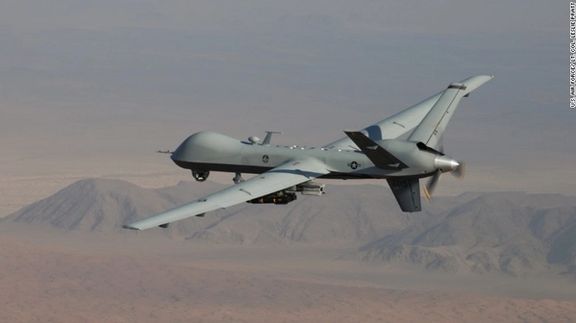
Yemen's Iran-aligned Houthis said they downed a US MQ9 drone on Thursday evening over the southeastern province of Maareb, the group's military spokesman said on Friday.
Yemen's Iran-aligned Houthis said they downed a US MQ9 drone on Thursday evening over the southeastern province of Maareb, the group's military spokesman said on Friday.
The Houthis said that they had targeted the drone using a locally made surface to air missile.
The US military has not issued any statement confirming or denying the Houthi claim at the time of this publication. In February, another US military drone crashed in Yemen, that later officials said it appeared to have been shot down.
Houthis are armed with Iranian weaponry, including anti-air missiles. Some observers claimed on social media that on Thursday Houthis used an Iranian model 358 anti-drone missile.
The United States and Britain have targeted Houthi military installations numerous times in recent month, after the Iranian backed group began targeting commercial vessels in the Red Sea from mid-November.


Turkish and Azerbaijani energy ministers signed a comprehensive deal in Istanbul on May 15 on capacity expansion for several natural gas pipelines as well as Turkmen gas transit.
Turkey's energy and natural resources minister Alparslan Bayraktar said that the deal would allow for additional gas volumes from Azerbaijan and Turkmenistan to Turkey and Europe by 2030, although the exact volumes are yet to be announced.
Ankara and Ashgabat had already signed a gas purchase deal in March 2024.
Bayraktar also said that the Igdir-Nakhchivan gas pipeline would be operational soon.

Ilham Shaban the head of Baku-based Caspian Oil Research Center told Iran International that Turkmenistan can deliver a restricted amount of gas (2-3 bcm/y) to Azerbaijan by constructing a short subsea pipeline, connecting Turkmen offshore gas fields to Azerbaijan’s Azeri-Chirag-Guneshi block, or a significant amount of gas by constructing the 300-km Trans Caspian pipeline.
During last two decades Azerbaijan has been supplying gas to its Nakhchivan territory, a region geographically separated from the mainland, by swapping gas with Iran that has a border with the small Azerbaijani region. After launching the Igdir-Nakhchivan pipeline Baku can deliver its own gas to the landlocked exclave of the Republic of Azerbaijan through Turkey.
Currently two gas pipelines connect Azerbaijan and Turkey through Georgia: Southern Gas Corridor and Baku-Tbilisi-Erzurum.
Azerbaijan exported 24 billion cubic meters of gas in 2023, of which 2.5 bcm went to Georgia, 9.5 bcm to Turkey and 12 bcm to Europe via the Southern Gas Corridor.
EU and Baku sealed a memorandum of understanding in July 2022 to double Azerbaijani gas intake by 2027.

Iran is excluded from transit routes
Although Iran does not have any dedicated and direct pipeline to connect Turkmenistan to Azerbaijan or Turkey via its territory, it has a vast pipeline network for gas swap operations. Iran had already swapped about 4 bcm of Turkmen gas to Azerbaijan during December 2021 to January 2024, but Baku and Ashgabat recently stopped the deal. Iran was getting 15% of gas volume as swap fee; three times more than gas transit fees through Georgia or Turkey. Tehran was receiving gas from Turkmenistan that it used in its northern and northeastern regions, while delivering the agreed amount of gas from its northwestern regions.
Alongside Russia and Azerbaijan, Iran is also a natural gas supplier to Turkey, but in the past three years, deliveries have been interrupted frequently in winters due to Iran’s own severe domestic shortages. Iran is unable to boost its output due to lack of investments and Western technology, restricted by sanctions.
As a result, Turkey halved Iranian gas intake to 5.2 bcm in 2023.
The 25-year gas deal between Turkey and Iran will expire in 2026.
Last year, Turkmenistan exported 40 bcm of gas also to China and more limited volumes to Central Asian states, but with deep discounts.
According to Iran International’s calculations based on Chinese and Azerbaijani customs statistics, China imported Turkmen gas at $240/1000 cubic meters, or less than a half of Azerbaijani gas prices in European markets.


Iran's unprecedented attack overnight between April 13 and 14, repelled by Israel's multi-tiered defense shield with the help from allies, included more than 100 ballistic missiles.
The Arrow system, according to Israel's air force, "carried out the main part" in their interception. Nearly 99% of Iran’s 300-plus projectiles were shot down, with negligible damage inflicted on the ground.
That success immediately drummed up global interest, Boaz Levy, CEO at state-owned Israel Aerospace Industries ISRAI.UL (IAI), the project's main contractor, told Reuters.
The US is a partner in the Arrow project and Boeing BA.N is involved in its production.

"A number of countries have approached us asking for information," Levy said. "I'm very optimistic that there will be more deals for the Arrow system, especially after the very special demonstration we did."
He declined to name any of the countries since talks are in the early stages.
Arrow is the upper layer of Israel's missile defenses, together with the Iron Dome, which takes out short-range threats like mortars and rockets, and mid-range defender David's Sling.
Arrow-2 has been around for years and intercepts ballistic missiles at long range. The newer Arrow-3 specializes in knocking out missiles while they are still outside Earth's atmosphere. The main threat to Israel emanates from Iran and its armed proxy groups in the region. Iran has developed an array of missiles, some with a range of up to 2,000 kilometers.

Israel, with US approval, agreed last year to sell the Arrow-3 system to Germany in a $3.5 billion deal, its biggest ever defense sale. The agreement comes as Germany and its neighbors in Europe are boosting defense spending in the wake of Russia's war in Ukraine.
The Germany deal took almost two years to sign, Levy said, and that would likely be the time frame of new deals in the works. The process is handled between governments and again would need US approval, he said.
Each Iron Dome interceptor, used frequently to shoot down rockets from Gaza and Lebanon, is estimated to cost about $50,000. The Arrow missiles are on a different level.
"The cost of the Arrow interceptor is on par with similar interceptors around the world, even cheaper. The amount passes a million dollars," Levy said, without elaborating.
Iran's attack spurred IAI to boost both production of current Arrow systems and also the development of its next generation, the Arrow-4, which will replace Arrow-2.
"It's in a very accelerated process towards the start of production. And we are doing this in full coordination with the security establishment here in Israel and the Missile Defense Agency in the United States," Levy said.
With reporting by Reuters