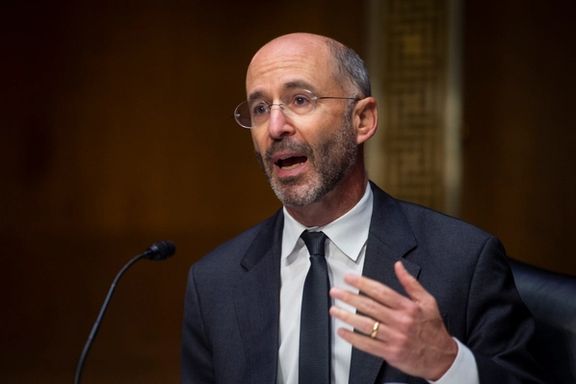
Robert Malley testifying in the Senate in May 2022
Senator Jim Risch, Ranking Member of the Senate Foreign Relations Committee, suggested Thursday that his committee might issue a subpoena to get details about what led to the downfall of former Iran envoy, Robert Malley.
Malley was appointed by President Joe Biden in early 2021 as the administration announced its plans to begin talks with Iran to revive the 2015 JCPOA nuclear deal. For many years, he had been an advocate of engagement –and not isolation– of the Islamic Republic.
After 18 months of multi-lateral talks with Iran in Vienna it became finally apparent that Tehran was not inclined to accept Western proposals, and the talks broke down.
In April 2023, Malley was noticed to be absent. Iran International was first to report two months later that Malley had been placed on compulsory leave and had his security clearance suspended.
For more than a year now, members of US Congress have been trying to figure out “what he did, when he did it, and how much damage he has cost US national security,” in the words of Risch, who grilled the Deputy Secretary of State, Rich Verma, during a committee hearing on Thursday.
“The Rob Malley saga has been wildly out of control,” Senator Risch said. “Your department has failed to respond for months… We can’t help but conclude there’s an orchestrated effort to obscure the facts from Congress… and we probably won’t get answers until we agree to issue a subpoena.”
Last week, two influential congressmen suggested that Malley had lost his security clearance because he had transferred classified documents to his personal email and cell phone, and the documents were then stolen by a hostile “cyber actor.”
•
•
“Can you confirm that a malign cyber actor actually gained access to Mr. Malley’s personal email,” Senator Risch asked Verma –to which Verma replied, “I’m not in a position to speak to the status of the investigation or anything related to it.”
The Malley ‘saga’, as Risch put it Thursday, is set against the backdrop of growing concerns over Iran’s “influence” operations in the US. In fact, Rob Malley’s case seems to be a significant factor in such concerns.
Only a day before the SFRC hearing, US Director of National Intelligence Avril Haines predictedthat the Iranian regime would intensify its cyber and influence activities in the run up to the 2024 elections in November.
“Iran is becoming increasingly aggressive in their efforts,” Haines told the US Senate Select Committee on Intelligence on Wednesday. “[They] seek to stoke discord and undermine confidence in our democratic institutions, as we have seen them do in prior election cycles.”
President Biden has been widely attacked for not being assertive enough in dealing with Iran and its anti-US activities. Biden critics say his ‘soft’ approach and his fear of a regional war has only emboldened the Islamic Republic to pursue its ambitions more aggressively, increasing the risk of the large-scale war that he’s fearing.
More pertinent, the critics say Biden's Iran policy may have been influenced by individuals, including Rob Malley, who seem to take too much note of Iran’s positions due to their political views or longstanding and extensive relationship with individuals linked to Iranian officials.
“We deserve to know whether Mr Malley’s crimes impacted US-Iran policy, influenced nuclear discussions, or swayed the President’s decisions to unfreeze cash for wrongfully detained Americans. Or importantly, misinformed us as we tried to formulate foreign policy,” Senator Risch said in the hearing Thursday.
Iran's interior minister has raised an outcry not only for approving the violent arrest of a woman for hijab violation but also claiming that catching the woman in a blanket, was “according to protocols”.
Ahmad Vahidi made the statement in response to a reporter’s question after a cabinet meeting this week, who asked him about the viral video of the arrest of the woman on a street in central Tehran Monday.
The video shows two black-veiled women dragging, a woman with uncovered hair, shoving her and pushing her to the ground before taking her away in an unmarked van accompanied by a police car.
The woman’s top came off during the scuffle after which one of the enforcers fetched a blanket from the van to throw it over her and push her into the vehicle.
Vahidi claimed that the woman had “disrobed” herself so she had to be covered up with the blanket.
The use of blankets to cover women at the time of their arrest has been reported in a few other instances in the past few weeks.
Video showing the incident that the interior minister commented on
“I have a daughter and cried so much after seeing the video. I cried even more when the minister confirmed that catching girls using blankets in the manner that we saw is protocol. Please don’t give birth to girls. Having a daughter here is the greatest calamity. Being a woman in Iran is the hardest of things, particularly now that we know they have a ‘blanket protocol’ for hunting us,” a woman posting as Sousan on X wrote.
Even some moderate regime supporters have condemned the violence on social media.
“What does the law say about [using] blankets [in this manner]? Who would dare do such things if General [Qasem] Soleimani were alive. He would say girls with unsatisfactory hijab were his daughters too. There’s a difference between gold and copper!”, an X user tweeted.
Another video showing a male hijab enforcer throwing a blanket over a woman resisting arrest in Tehran
In recent years, many Iranian women have protested mandatory hijab, leading to arrests and imprisonment. Authorities have also impounded thousands of cars and closed businesses for failing to enforce hijab rules.
Many Iranians, including some women who wear the hijab themselves, believe that wearing or not wearing the hijab is a personal decision. Eighty four percent of the over 12,000 respondents to an online poll by the reformist Shargh daily in October said they were opposed to mandatory dress code and headscarves.
This very recent video shows police violently arresting a woman for hijab
Hardliners, particularly the small but very influential Paydari Party which is positioned at the extreme end of the fundamentalist camp in the Islamic Republic, have been looking for ways to strengthen the enforcement of hijab. Their ‘morality police’ tactic of arresting women for “improper hijab” backfired with the death of Mahsa Amini in September 2022, triggering nationwide Woman, Life, Freedom protests that lasted for months and shook Iran's ruling establishment to its core. More than 550 civilians were killed by security forces and around 22,000 arrested.
Consequently, the morality police largely disappeared from the streets as authorities feared further backlash from the populace.
In March 2023, hardliners attempted to end women's increasing defiance of compulsory hijab and reclaim lost ground through various instructions to government bodies, but their efforts failed as the number of women who refuse to abide by the current rules only kept increasing.
On April 13, the infamous morality patrols returned to the streets. Since then, extensive violence including sexual harassment has been reported by the few relatively independent newspapers and websites that are aligned with reformists and moderate conservative as well as social media citizen reports.
Hassan Rouhani has accused the Khamenei-appointed Guardian Council of undermining democracy and diminishing the people's role in elections by vetoing candidates with disapproved political views.
“This is not a defense of myself, but the defense of the system's republican (and Islamic) foundations, a defense of the institution of presidency which as the direct representative of all Iranians should not be weakened any more than this,” the former president who was barred from running in the March 1 elections of Assembly of Experts has written in an open letter.
The Guardian Council comprises twelve members, half of whom are clerics with expertise in Sharia laws and appointed by the Supreme Leader. The remaining six members, who may be laymen or clerics versed in civil law, are appointees of the chief justice, who is also appointed by Khamenei. They require parliamentary approval and over the years have expanded their role in disqualifying election candidates.
Opponents of the clerical regime and dissidents have always been barred from running in the elections, but now prominent insiders are being disqualified. Hundreds of candidates running for parliament and the Council were disqualified this year. The pattern was that those who are not members of hardliner factions or have been tossed out of Khamenei’s inner circle were barred.
Centenarian Ahmad Jannati, head of the Guardian Council
Rouhani has been challenging the decision since February without any result. He said in his open letter that he has not received a satisfactory response form the Council. The reasons cited so far do not constitute legal violations on his part to warrant disqualification.
Rouhani said the “classified letter” he received from the Council’s Secretary, Ahmad Jannati, amounted to “an indictment” not only against him and his government but also against “the institution of presidency” and refuted all the reasons cited, namely insolence against the Judiciary and the Council itself, “lack of political insight”, failing to comply with the Constitution, and “contradicting pure Islamic beliefs.”
The contents of Jannati’s letter prove that the president who is the “highest directly-elected official” of the country does not have the right to freedom of speech even as much as an ordinary citizen and his statements about other institutions of the country, including the Guardian Council, Judiciary, and the Parliament can always be turned into an indictment against him, Rouhani argued.
“The Council uses my presidential record as the legal as reasons for not having been convinced of my qualification to run, as if the second highest official of the country is an opposition figure,” Rouhani said while pointing out that the Council itself had twice before found him qualified to run for the presidency and three times to run in the elections of the Assembly of Experts.
He also pointed out that he had served as the secretary and chairman of the Supreme National Security Council (SNSC) for 24 years and represented Khamenei in the National Security Council the whole time.
The Guardian Council, originally empowered to interpret the Constitution, review legislation, and supervise elections, bestowed upon itself discretionary supervisory powers in 1991, giving it the final say on candidate eligibility. Over the past two decades, it has used these powers to eliminate various political factions, targeting reformists, moderates, and even some conservatives.
The pattern of candidate disqualification has turned into a serious concern about the transparency and fairness of Iran's electoral process for over a decade resulting in continuous decline of election turnout in the past few years.
The Council, however, always cites other reasons for disqualifying candidates or argues that it could not “confirm the candidate’s qualifications” due to lack of sufficient evidence. Religious jurisprudence (ijtihad), required for running in elections of the Assembly of Experts, for instance, has often been cited for disqualification of candidates in its elections.
Larijani, for instance, repeatedly called on the Council to publicly announce the reason he was barred but was told it would not be “in his interest” if they did so.
Kioumars Heydari, the commander of Iran's army ground forces, has once again warned Israel against military action amid the ongoing shadow war between the two nations.
According to the Tasnim News Agency, closely linked with the Revolutionary Guards, Heydari declared, "If a threat against us originates from the Zionist regime, it will be responded to from the Islamic Republic."
In a detailed account of military actions, Heydari highlighted the April 13 operation where Iran launched hundreds of projectiles at Israel, though nearly all were intercepted by the Israeli Defense Forces (IDF) and a US-backed coalition.
In the latest state propaganda against Israel lauding the attack, he claimed that this operation “advanced the prospect of Israel's destruction”, rhetoric repeated for many years as Iran has waged a proxy war against the Jewish state, funding terror groups across Israel’s borders.
The ongoing tension between Iran and Israel is marked by a series of alleged cyber-attacks, assassinations of key figures, and missile strikes, reflecting a deep-rooted shadow war going back years.
It is speculated that Israel carried out two major acts of sabotage in 2020 and 2021 targeting Iran’s substantial nuclear facility in Natanz, situated in the heart of the country.
Most recently Iran has been at the heart of the Middle East conflict which saw Iran-backed Hamas invade Israel on October 7. Since then Iran’s proxies have joined the war from countries including Syria, Lebanon, Yemen and Iraq, targeting both Israel and the US.
Four Nobel Peace Prize laureates condemned the escalating executions in Iran on Wednesday as numbers continue to soar.
The statement signed by Shirin Ebadi, Jody Williams, Tawakkol Karman and Leymah Gbowee, said Iran's regime is using capital punishment as a “political intimidation tool to spread fear, silence opposition and desperately hold on to power.”
They noted that “on average, one person a day is executed in Iran on trumped up drug-related or vague religious infringement charges.”
An average of one execution occurred every five hours over the course of two weeks, between April 16 and April 30, according to data presented by the Iran Human Rights organization (IHR).
Between January and April 2024, 171 people, including six women, were executed.
Since the Women, Life, Freedom protests broke out in 2022, during which over 550 protesters were killed, the Iranian government has increased the pace of executions significantly. In 2023 alone, the country saw at least 834 executions– more than half of which were carried out for drug-related offenses and disproportionately affected minorities such as Kurds.
Amnesty International called the drug-related offenses trials “grossly unfair”. “further entrenching discrimination against marginalized communities” as Iran continues to persecute the country’s minorities.
They also called on the UN Human Rights Council, the Special Rapporteur on Iran, and the investigative fact-finding mission "to prioritize the incorporation of a gender lens in their continuous efforts to accurately reflect the extent of gender persecution and gender apartheid in Iran."
Iran's Interior Minister Ahmad Vahidi has defended the country’s morality police after a new video emerged of officers violently arresting a woman on the street.
Vahidi argued on Wednesday that the police acted correctly because the woman who was warned: “resisted and stripped herself.” “The officers have acted according to the regulations.”
In the video, the female agents try to drag a woman who does not seem to be wearing a headscarf into a van and are seen throwing a blanket over her as they bundle her into the vehicle.
In an attempt to force her into the police car, they pull her shirt off while she resists, yanking it off with force, in echoes of the death in custody of Mahsa Amini, arrested for not wearing her hijab properly and the trigger for the ongoing uprising.
On Wednesday, Mohsen Borhani, a professor of criminal law at Tehran University, wrote on X: “Whether unfortunate or fortunate, we are not blind. We can differentiate between "being undressed by yourself," "being undressed by someone else," and "being undressed during a conflict." Make the uncut film available for everyone to watch and judge. Also, legally, you cannot prevent people from filming.”
Tehran police on Thursday defected the blame, claiming the woman threw a "cup of hot coffee" at the officers, leading to her violent arrest and blanket smothering.
The police released a video along with their statement claiming that she confessed. The video shows that the woman refused to wear a headscarf even after being arrested.
On Thursday, Ex-MP Ahmad Alirezabeigi criticized the police, saying the “force's resources should be spent on issues that provide the greatest possibility for peace and comfort. In policy-making, the issue of hijab is given priority, not the public's demand. People suffer from economic problems such as inflation, high prices, unemployment, and the frustration of the young generation."
The incident is one in a long line as conditions for women worsen since last month’s new Noor regulations enforced tougher hijab crackdowns, surveillance and more police patrols.
Just days ago, a video surfaced on social media showing a regime's hijab enforcement police officer beating and violently arresting a woman. During the assault, a woman whose face is not visible says, "Let go of me... you've broken my neck."
In addition to 22-year-old Mahsa Amini, the violent crackdowns have seen the death of Armita Geravand, 16, who fell into a coma and later died after an altercation with hijab enforcers in the Tehran subway in October. Reports suggest a female agent pushed her, but details of the incident remain unclear as the regime continues to cover its responsibility.
Iran's crackdown on hijab and oppression of women was branded 'gender apartheid' by the UN, and women's rights groups continue to fight for their rights in a country where laws are being toughened against women and girls as the regime fights for its legitimacy.