Unprecedented Volcanic Activity Observed at Iran’s Mount Taftan
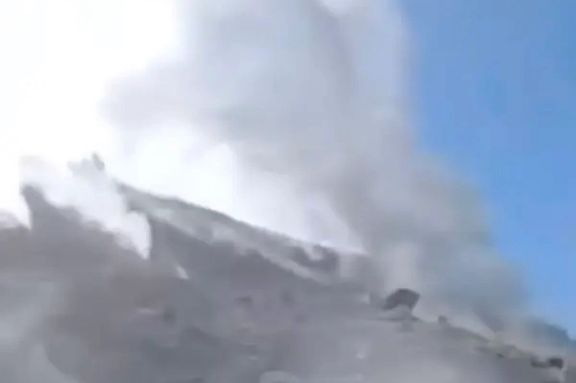
Mount Taftan, an active stratovolcano located in Iran’s Sistan-Baluchestan province, has shown increased volcanic activity with visible smoke and ash emissions from its crater.
Mount Taftan, an active stratovolcano located in Iran’s Sistan-Baluchestan province, has shown increased volcanic activity with visible smoke and ash emissions from its crater.
Local reports confirm that the phenomena can be seen as far away as the city of Khash.
The increase in activity follows historical patterns, although the current level is notably higher than in previous years.
The residents of Khash have consequently suffered health issues from the natural phenomenon, including hospitalizations due to allergic reactions triggered by the unpleasant sulfur smells emanating from the volcano during periods of activity.
Alireza Shahnavazan, the governor of Taftan, discussed the seasonal trends of the volcano earlier this year, noting, "Almost every year, following snowfall and rain in the Taftan area, we witness steam escaping from the peak of the Taftan volcano."
Mount Taftan rises approximately 4,000 meters (13,000 feet) above sea level, making it the tallest mountain in southeastern Iran. The region around Taftan is geothermally active, characterized by numerous hot springs, indicative of ongoing subterranean activities.
The volcano forms part of a volcanic arc that includes Bazman in Iran and Koh-i-Sultan in Pakistan, originating from the subduction of the Arabian plate beneath Iran at the Makran trench.

The spokesman for Iran’s Revolutionary Guards dismissed the exodus of doctors as "enemy pretexts for psychological operations" against Iran in a bid to downplay the crisis.
Speaking on Sunday, Ramadan Sharif said “They [enemies] overlook tens of thousands of doctors who have been active from the time of the [Iraq] war through the peak of sanctions, the COVID era, and other sectors up to today.”
Earlier in the month, Iraj Fazel, president of the Iranian Society of Surgeons and former Minister of Health, issued a warning, saying Iran might soon need to import medical specialists and send patients abroad for treatment if the trend of doctor migration continues.
Fazel highlighted the economic crisis plaguing medical students and noted a troubling decline in medical degree applications.
The migration of healthcare professionals has reached alarming levels with Hossein Ali Shahriari, head of the parliament’s Health and Medical Commission, reporting that around 10,000 specialists have sought employment abroad over the past two years, predominantly in Arab countries. The situation prompted calls for an official ban on doctor migration last December.
The crisis is compounded by the economic hardships faced by healthcare workers, many of whom earn a meager $200 to $300 a month in long hours and poor conditions, significantly impacting their mental health. The Iranian Psychiatric Association has reported an increase in suicide rates among medical residents, with 16 known suicides occurring in the past year alone.

The Iranian mission to the United Nations confirmed that indirect talks between the US and Iran in Oman are an "ongoing process."
According to representatives from the mission, the discussions are part of a series that "neither are the first nor will they be the last."
Biden administration officials including the President’s top Middle East adviser, Brett McGurk and the acting US envoy for Iran, Abram Paley, are part of the discussions tackling core issues with the country the US last year branded the world’s number one state sponsor of terror.
Since the Iran-backed Hamas attack on Israel last October, proxies supported by Iran have carried out over 200 attacks against US forces, blaming the US for supporting Israel’s right to defend itself following the invasion which killed 1,200 in a single day.
The talks in Oman also touched on Iran's nuclear ambitions, with recent threats from Tehran to potentially pursue atomic weapons adding urgency to the discussions. The UN’s nuclear chief recently said Iran was weeks rather than months from a nuclear weapon.
Similar discussions took place in January between the same parties. During that period, tensions were escalating between Israel and Iran, with Tehran-supported Yemeni Houthi forces launching attacks on international commercial vessels in the Red Sea.

In recent events at Princeton University, a stark contrast emerged between the peaceful protest by a group of Iranians—who have personally suffered under the brutality of the Islamic ruling system—and a sit-in by some US students.
Just like other students on US campuses, these students displayed flags of Hamas and Hezbollah and labeled these entities as "resistance groups." This troubling endorsement starkly clashes with the profound grievances of those who have experienced the true nature of such groups first-hand.
The Iranian protest at Princeton was not just a demonstration against Seyed Hossein Mousavian, a former Iranian ambassador to Germany and a figure deeply intertwined with Tehran’s oppressive apparatus. It was a plea for recognition of the agonies inflicted by the Islamic Republic, which has left deep scars on the Iranian people through relentless suppression of dissent and promotion of terrorism.
Mousavian’s tenure in the 1990s coincided with some of the darkest days of repression and external terrorist activities orchestrated by Tehran, including the systematic assassinations of 24 Iranian intellectuals and activists across Europe. His current academic position at Princeton starkly contrasts with his past, serving as a painful reminder to the victims' families of the injustice that continues to elude the international community’s full recognition and response.
Simultaneously, a group of US students conducted a "solidarity sit-in," with Hamas mirroring similar demonstrations across numerous college campuses. This perspective reveals a concerning disconnect from the historical and ongoing realities these organizations represent.
Historical Context and the Impact of Designating Terrorists as 'Resistance'
Hamas and Hezbollah are officially designated as terrorist organizations by the United States and several other countries. This designation is based on a history of violent actions that include suicide bombings, rocket attacks, and other forms of terrorism aimed at civilian populations. Their activities have contributed to the destabilization of regions and inflicted severe suffering upon countless innocents.
Moreover, Hezbollah’s involvement in the 1983 Beirut barracks bombing, which killed hundreds of US and French military personnel, is a grim exemplar of the group’s long-standing hostility towards Western nations and their regional allies. This act of terrorism, along with numerous others, underscores the inherent danger in romanticizing groups that actively undermine peace and security.
The Plight of Women and LGBTQ+ Under Islamist Regimes
The endorsement of Islamist groups by some Western students overlooks the severe implications these regimes have for human rights, particularly concerning women and the LGBTQ+ community. Wherever these Islamist groups have gained power, the result has been chaos, the erosion of civil liberties, and the imposition of draconian laws that strip away the rights and freedoms of women and LGBTQ+ individuals. The Iranian "Woman Life Freedom Movement" exemplifies the courageous struggle of Iranian women against a brutal regime that systematically oppresses them. This movement highlights the stark contrast between the aspirations of these brave women and the harsh realities imposed by theocratic governance. Furthermore, in groups like Hamas and Hezbollah, there is a conspicuous absence of women or LGBTQ individuals in any positions of leadership, reflecting a broader ideology that views women as lesser beings and severely restricts the rights and freedoms of the LGBTQ+ community. This fundamental disrespect for equality and human dignity underlines the dangers of supporting such groups under the guise of political resistance.
Complicity in Academia: The Role of Educators in Shaping Perceptions
Compounding the issue is the stance of some academics within Western universities, whose endorsement or passive acceptance of extremist ideologies under the guise of intellectual debate contributes significantly to the normalization of groups like Hamas and Hezbollah. Professors and educators entrusted with shaping young minds play a pivotal role in either challenging or perpetuating dangerous misconceptions about what constitutes legitimate resistance versus terrorism.
In several academic circles, a troubling trend exists where the lines between critical discussion and outright support for militant actions blur. By framing these groups as legitimate resistance movements and focusing predominantly on their opposition to Western policies without equally scrutinizing their methods of violence and governance, these educators foster a one-sided narrative that ignores the broader, often devastating implications of these groups’ actions on civilians.
This academic endorsement can give unwarranted legitimacy to extremist views, making it crucial for educational institutions to maintain a balanced perspective that rigorously examines all aspects of such groups. Universities must encourage critical thinking and promote a comprehensive understanding of geopolitical issues, one that respects human rights and rejects any form of violence targeting innocents under the guise of political struggle.
Educational leaders and faculty members are responsible for guiding their students toward informed, ethical viewpoints on international politics, emphasizing the importance of peace, security, and respect for all human lives. By doing so, they can help prevent the spread of misinformation and the glorification of violence, ensuring that the next generation of leaders and thinkers advocates for genuine justice and peace, not masked by the banners of terror.
As the world continues to grapple with the complexities of international relations, terrorism, and the struggle for human rights, the need for clear-eyed scrutiny of all entities that purport to fight for justice but employ terror and suppression cannot be overstated. The future of global security and the preservation of fundamental human rights depend on our ability to discern true resistance from oppressive terror.
Opinions expressed by the author are not necessarily the views of Iran International.

Syria's signature on the Arab League Summit declaration in Bahrain, which included the UAE's claim over three Iranian islands, has sparked a backlash in Iranian media, with one commentator calling it a "stab in the back."
Iran’s leading ‘reformist’ daily criticized Tehran's ally Syrian President Bashar Assad for signing the declaration, and Iran's leading economic newspaper, Donyaye Eghtesad (World of Economy), said the declaration “disregarded the historical facts that demonstrate Iran's ownership of the three islands."
The Arab League summit statement this week included a clause reaffirming "the sovereignty of the United Arab Emirates over its three islands (Greater Tunb, Lesser Tunb and Abu Musa)."
The three islands in the Persian Gulf have been in dispute since the British withdrew their armed forces in 1971 from what today is the United Arab Emirates. Iran's Mohammad Reza Shah ordered the Iranian navy to secure all three in November of that year. Iranian forces remain on the islands, with only Abu Musa having much of a civilian population of several thousand.
Influential Iranian commentator and former senior lawmaker Hesmatollah Falahatpisheh wrote on Sunday that he had warned in 2019 about the likelihood of Assad "stabbing Iran in the back."
Although Iran has sent thousands of fighters to Syria during the Syrian war and provided intelligence to keep Assad in power, his latest move suggests he doesn’t share Iran’s sentiment.
After pro-democracy protests erupted in 2011 in Syria, President Bashar Assad turned the tide of civil war with the help of Iranian proxy militias and a significant military intervention by the Russian government in 2015.
Regional powers such as Saudi Arabia took a different approach, supporting rebel groups to overthrow Assad and suspending Syria's membership in the Arab League.
In recent years, Tehran has grown its economic influence in the war-torn country by providing credit lines to Assad's government and trying to win lucrative contracts.
The conflict has claimed the lives of nearly half a million people since March 2011 and displaced half the country's pre-war population. However, many Iranians are highly critical of Tehran's involvement in the Syrian war that has cost nearly $50 billion for Iran, according to some estimates.
Nevertheless, this is not the first time an Iranian ally has taken a position supporting the rival.
China, which Iran counts as an ally, issued a similar joint statement in 2022 during a meeting with the leaders of the Gulf Cooperation Council (GCC) countries.
The statement contained several clauses that directly dealt with Iranian affairs, its nuclear program, and the issue of three Iranian islands in the Persian Gulf was mentioned as a claim pursued by the UAE.
Iranians reacted strongly to the joint statement as soon as it was reported by the media, accusing the Islamic Republic of being so weak that its ally China was subtly endorsing the UAE claim.
Last December also, media in Tehran strongly criticized Russia for endorsing the UAE claim. The sixth Russian-Arab Cooperation Forum in Morocco concluded with a statement reiterating the UAE’s claim over the islands. Moscow had previously voiced its support for UAE’s claim back in July 2023 during a joint summit between the Persian Gulf Cooperation Council (GCC) and the Russian Federation.

President Ebrahim Raisi's recent remarks describing Iran's abortion statistics as "alarming," have sparked accusations of hypocrisy.
Critics argue that his administration, despite heavy investment, has failed to provide accurate data on abortion rates, contradicting his public stance.
On Saturday, Raisi advocated for measures to reduce voluntary pregnancy terminations, emphasizing the need for greater control. However, the irony lies in his government's inability to accurately track or report the very figures.
The National Population Headquarters, established under the controversial 2021 Family and Youth Population Support Law, has yet to release any concrete statistics on abortion types and numbers, despite a significant budget of nearly $750 million allocated for population initiatives over the past two years.
In contrast, informal estimates suggest that between 350,000 and 530,000 abortions are performed annually, with some figures suggesting numbers as high as 650,000. The majority of these procedures reportedly occur illegally without medical supervision, putting women’s health and even lives, in serious danger.
The regime's strict policies on abortion and contraception, aimed at rapidly doubling the Shiite population, face strong resistance from the public. Many Iranians continue to choose smaller family sizes, directly undermining Supreme Leader Ali Khamenei's demographic goals. The widespread non-compliance illustrates a clear rejection of the government's intrusive reproductive policies.
Despite a younger generation that is well-versed in contraception methods, the government has removed the options from all public health facilities, effectively limiting access to necessary family planning resources.
Such disconnect between the government's authoritarian reproductive policies and the actual reproductive behaviors of its citizens highlights a significant challenge to Raisi's administration, questioning its ability to govern effectively while respecting the personal freedoms and health of its people.