TV Series on Iran's Last Monarch in the Making
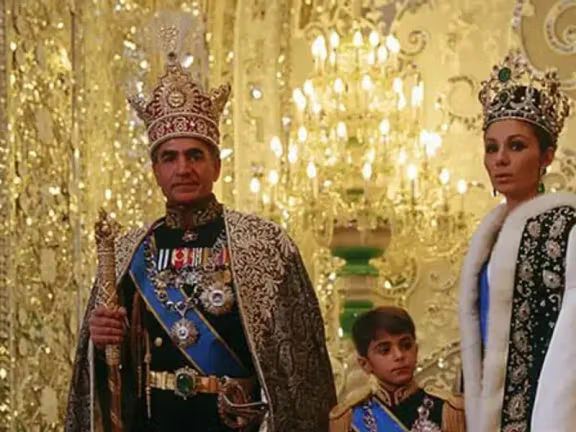
A new series will explore the life of Iran's last monarch, Mohammad Reza Shah Pahlavi, in the upcoming series The Last Shah, Variety has learned.

A new series will explore the life of Iran's last monarch, Mohammad Reza Shah Pahlavi, in the upcoming series The Last Shah, Variety has learned.
Spanning over four decades, it begins with the Shah's rise to power during World War II and continues until the 1979 Islamic Revolution and the subsequent US embassy hostage crisis.
The series coincides with the current internal turmoil, which began in 2022, such unrest not seen since 1979.
Morrie Rosmarin, who crafted the pilot and serves as the series’ primary writer, emphasized the significance of remembering Iran’s more Western-oriented days before the Islamic Revolution when women had more freedom and life in Iran was more like Europe than the Islamist regime of today.
"Many people today are not aware that prior to the 1979 Islamic Revolution, during the reign of the Shah, Iran was one of the most Westernized countries in the Middle East.
“In contrast to the belligerent policies of the current religious theocracy of the Islamic Republic, Iran under the Shah was the strongest ally in the region of both the United States and Israel," she said.

Under the shadows of the helicopter crash that killed President Ebrahim Raisi and other high-ranking officials, Iran’s Cyber Police of have intensified their surveillance and repression.
Iran's Cyber Police Chief Vahid Majid has declared the initiation of criminal proceedings against numerous individuals for allegedly disseminating "false and insulting" content on social media and online platforms about President Raisi and other officials who perished in Sunday's helicopter crash.
Majid reported that within the last 36 hours, "550 specialized observations" have been made, resulting in the identification of 80 websites and the execution of 35 enforcement measures, including the issuance of summons and court referrals.
The Iranian regime has been secretive about the details surrounding President Ebrahim Raisi's helicopter crash, maintaining tight control over the information that is released to the public. The opacity includes limiting media access to the crash site and closely monitoring the narrative circulated through official channels.
Shaghayegh Mohammadi, the wife of Esteghlal FC player Mohammad Hossein Moradmand, has reported receiving threats of arrest following an Instagram post she made, which featured a poem by the Iranian poet Hafiz that foretells the downfall of oppressors.
In response to the threats she posted defiantly, "I desire nothing but freedom, which is the right of all humans."
Likewise, journalist and translator Manizheh Moazen is embroiled in a fresh legal conflict due to her reporting on Raisi's death. She recently reshared a tweet highlighting Raisi’s involvement in the 1988 mass executions.
Iran's government has declared five days of mourning, calling on the public to attend the commemorative ceremonies. Attendance is typically mandatory for government workers and students, while other citizens do not participate.
In Iran, media control tightens significantly during times of crisis, as the government seeks to manage public perception and maintain stability. Authorities routinely restrict access to the internet and block social media platforms to curb the spread of information that could incite public unrest.

Iran's President Ebrahim Raisi, a leading candidate to succeed the Supreme Leader of Iran, was killed in a helicopter crash, the details of which remain unclear.
In the wake of Raisi's death, the recently elected sixth Assembly of Experts for Leadership convened as scheduled on May 21.

The Assembly of Experts is the only constitutional body in Iran endowed with the authority to appoint and dismiss the Supreme Leader. Each term spans eight years, and given that Khamenei is 85 years old, it is highly probable that this assembly will be tasked with selecting his successor.

The body consists of 88 members, all Islamic scholars. President Ebrahim Raisi and Ali Al-Hashem, elected members of the sixth term, were both killed in a helicopter crash, resulting in two vacancies.
The Assembly of Experts operates like an enigmatic vault. Before 1989, its sessions were completely shrouded in secrecy. However, under Khamenei's leadership, detailed minutes from these sessions have been classified as either confidential or highly confidential.

The most important components of the structure of the Assembly of Experts are the Board of Directors, the Investigation Committee responsible for overseeing the Leader, and the Committee of Article 107 and 109 of the Constitution, tasked with determining the next leader of the Islamic Republic of Iran. In practice, the Investigation Committee has never challenged the Supreme Leader.
With no strong rivals, Raisi was in a prime position to become the president of the Assembly of Experts, making his future leadership a distinct possibility.
Raisi and Mojtaba Khamenei, the Supreme Leader's own son, were frequently regarded as the top candidates to succeed Khamenei.

Speculations Around Raisi's Sudden Death
Although not prominently, there have been some speculations surrounding the sudden death of Raisi.
Some argue that he may have been assassinated to clear the path for Khamenei's son to ascend to leadership. This argument aligns with the pattern of candidate disqualifications observed during Khamenei's tenure as Supreme Leader.

The trend of increasing disqualifications of candidates for the Assembly of Experts has been noticeable since Khamenei assumed leadership in 1989.
The impact of disqualifications has also affected high-ranking officials of the Islamic Republic. Notable individuals whose eligibility to participate in the Assembly, which selects the next leader, was rejected include Hassan Rouhani, the former president and ex-member of the same Assembly, and Hassan Khomeini, the grandson of the founder of the Islamic Republic.
Until 1989, the eligibility of candidates for the Assembly of Experts elections was determined by senior Shia clerics.
After a revision of the Assembly's internal regulations during Khamenei's leadership, the authority to approve candidates became the exclusive domain of the Guardian Council. This 12-member body consists of six members directly appointed by the Supreme Leader and six selected by the head of the judiciary, who is also appointed by the Supreme Leader.
The revision exemplifies Khamenei's perpetual cycle of control in the so-called elections of the Islamic Republic.
Minimal Competition for Assembly's 88 Seats
These disqualifications have turned the Assembly of Experts elections into sham exercises.

In the most recent round of elections held in March, 144 candidates competed for 88 seats in the Assembly of Experts. On average, there were approximately 1.6 candidates contesting each seat. This indicates that many seats had only one or very few candidates running for them.
In essence, across all rounds of the Assembly of Experts elections, there has never been genuine competition between even two candidates. It is fair then, to say that these elections are the least competitive within the Islamic Republic.
Next chapter of the Islamic Republic’s rule
The Assembly of Experts has, in its history, elected a Supreme Leader only once. Following the death of Ruhollah Khomeini, Ali Khamenei was chosen as the next Leader of the Islamic Republic in June 1989.

The commencement of the Assembly of Experts for Leadership, which will most likely select the next Supreme Leader of the Islamic Republic of Iran, began with a message from the current ruler, highlighting the selection of the future leader.
Read by his chief of staff, Khamenei’s message stated that “the selection of the leader according to Islamic criteria is the responsibility of [the] Assembly, which is itself elected and chosen by the people”.
Participation in the Assembly of Experts elections, according to the Islamic Republic's own statistics, has been decreasing. Furthermore, according to the law, the decision made by the Assembly of Experts to appoint the Supreme Leader is more authoritative and final than the majority opinion of the general population.
Now, a new chapter in the era of the Islamic Republic has begun. With the death of Ebrahim Raisi, one of the main contenders to succeed Khamenei, the country’s powerful players will enter a new and likely tense phase of political competition for Iran’s future leadership.

A tale of two narratives emerged on social media, after Iran's president Ebrahim Raisi, foreign minister Hossein Amir-Abdollahian and several other senior officials died Sunday in a helicopter crash.
While Iranians opposed to the government rejoiced at the news of their deaths, messages of condolences, and even a moment of silence at the United Nations Security Council (UNSC) took place for a man whose legacy has him known as "the Butcher of Tehran."
Iranian-Canadian human rights lawyer Kaveh Sharooz says Raisi's hands are "covered in blood."
"He's a man of no particular talent, frankly, except, following the regime's line and carrying out its dirty work," said Shahrooz.
Just after the 1979 Islamic Revolution, the clerical regime began killing its political opponents and dissidents, most famously in 1988. Sharooz said that year became known as the 1988 massacre when then Supreme Leader Ayatollah Ruhollah Khomeini issued a fatwa, ordering the execution of imprisoned opponents, including those who had already been tried and serving a prison sentence.
Raisi was instrumental in that, said Sharooz.
"Raisi himself, was a member of what came to be known among the prisoners as a death commission. You know, he would conduct 2 or 3 match trials where political prisoners that had already gone through trials several years earlier, would be retried, and most of them were actually sent to hang. And from then on, he sort of continued his policy of murder and torture," said Shahrooz.
Despite having committed what many critics allege are crimes against humanity, the leader of the democratic, free world, the United States officially sent their condolences.
When asked about reports of Iranian people celebrating the death of President Raisi, the State Department's Spokesperson said Monday, "I can certainly understand why people inside Iran would feel that way when you look at the brutal repression that happened under President Raisi's tenure, especially when you look at his abuse of women and girls, I can see why the people in Iran would feel that way in response to his death, but I obviously can't speak for them."
Shahrooz told Iran International "it's shocking to me, that so many democratic countries, are not just giving condolences to the regime, but there are actually saying condolences to the people of Iran as if the people of Iran are in mourning, when in fact, you know, we have evidence that they're actually out there celebrating."
On X, NATO's Spokesperson offered their "condolences to the people of Iran" for the death of Raisi.
Many readers were outraged by the tweet, and responded by adding the following 'context note' below the statement: "Iranian President Ebrahim Raisi killed thousands of innocent people for no reason, earning himself the nickname “The Butcher of Tehran.”"
The US Senate Chaplain offered a prayer for Iran's President, saying "Lord, we pray for the Iranian people who mourn the death of their president."
When asked what could explain such a disconnect or potential failure in diplomacy with the people of Iran, Shahrooz said the West mistakenly believes Iran's regime will change its behavior based on carrots.
"It's a continuation of a policy of appeasement that we've seen for far too long. You know, Iran's regime has been able to get away with quite a lot without, substantial pushback, from the West. They've, attacked Western countries. They recently attacked Israel. And regrettably, the Western policies have simply been to go along in the hopes that, Iran will also play along," said Shahrooz.
Meantime, Iranians inside the country set off fireworks to celebrate Raisi's death and diaspora Iranians took to street parties from the Netherland to Canada.
It's not just Iranians celebrating, said Shahrooz.
"I've seen reports of, Syrians, for example, celebrating because they recognize that the Islamic regime and people like Raisi have been responsible for their misery as well," said Shahrooz.
Victims of the Islamic Republic and their families also posted videos to social media rejoicing at the demise of Raisi and his entourage.
Speculations and morbid jokes about the circumstances and the cause of the crash flooded the online world. From puns about helicopter crashes to jokes about the succession race like this one posted by Israel-Iran journalist and analyst Jonathan Harounoff.
"Iranian social media has simply lit up with both jokes and humor, but also very poignant messages," said Shahrooz.
Shahrooz said "the jokes are simply a way for people to exert some power because they've been powerless for decades."
A striking image of a women's braided hair taking down a helicopter is also being shared widely on social media.
Commentators online say the image has become a symbol of women taking down the President who enforced discriminatory laws that led to the torture and demise of many Iranians for decades.

Members of the Assembly of Experts, a body tasked with choosing the Islamic Republic's next supreme leader elected senior cleric Ayatollah Mohammad Ali Movahedi Kermani as the Assembly's chairman on Tuesday.
Before his death in a helicopter crash on Sunday, former President Ebrahim Raisi was the most likely candidate for the post.
Following his death, the Assembly, and in fact Supreme Leader Ali Khamenei were in difficulty to choose someone trustworthy from among the elderly clerics at the Assembly. There is no absolute guarantee that they chose the right person for one of the most sensitive periods in the Islamic Republic's history, although they did choose one of the most capable.
Iranian politicians and analysts agree that the new session of the Assembly of Experts is particularly significant, as it may be the one tasked with deciding Khamenei's succession. Some former members, such as Hassan Rouhani, have spoken bitterly about the inevitability of this decision, given Khamenei's age and illness. Ironically, however, Khamenei is about ten years younger than both the previous and the new chairmen of the Assembly.
Born in 1931, Movahedi Kermani is 93 years old, but looks relatively fit compared to other aging and ailing members of the Assembly.
Movahedi Kermani, an old guard figure in the Islamic Republic, is essentially the candidate they wanted, despite not having maintained a high profile in the Assembly before. Seyyed Hashem Hosseini Bushehri and Alireza Erafi, the head of Iran's seminaries, have been elected as deputy chairmen. Erafi who is also trusted by Khamenei, might have been a better choice for the position in terms of leadership capabilities.
The Assembly's previous chairman Ayatollah Ahmad Jannati is past 100 and too old to be able to walk, talk, and take care of himself independently. He did not run for the election on Tuesday, although he still keeps his powerful position at the Guardian Council where he determines who can and who cannot run for Parliament or Presidency, albeit based on Khamenei's suggestions.
Movahedi Kermani is a right-wing conservative with a background in the Militant Clerics Society and the former Islamic Republic Society. He was elected to the Majles five times and has been a member of the AoE since the very beginning. He is also a member of the Expediency Council.
He has taken tough stances on certain cultural issues, including declaring the messaging service Telegram as haram (religiously prohibited). However, it is possible that he has little understanding of what Telegram actually is and made the statement as a formulaic pronouncement.
Movahedi Kermani was close to the IRGC during the first years of the Islamic Republic but his links to the new generation of the Revolutionary Guard officers are not clear.
Of the 86 members of the Assembly, 83 were present at Tuesday's meeting, some with assistance from male nurses. Movahedi Kermani received 55 votes and will chair the Assembly's meetings for the next two years. Managing meetings where over 30 percent of the attendees do not support his leadership could prove challenging.
Unless all decisions are prearranged and the stage is set by Khamenei himself by naming his successor(s), the new chairman of the Assembly may struggle to achieve consensus on succession when the Islamic Republic needs it most. This uncertainty leaves the future unclear for many, insecure for some, and unstable for others.

A team of search and rescue motorcyclists from the operation to find Iranian President Ebrahim Raisi, have revealed that the wreckage of the helicopter was "completely exploded and everything was burned."
They also reported finding the bodies of Raisi and foreign minister Hossein Amir-Abdollahian close together but were barred from publishing any videos for "security reasons."
The search operation, which lasted over 15 hours, only concluded successfully with the aid of a night-vision drone provided by Turkey. The long delay in locating the helicopter, which also carried six others, intensified criticism of the Iranian government's efficiency, even in handling crises involving its top leaders.
Speculation about the cause of the crash is rampant, with theories ranging from an outlandish plot by Israel to more credible possibilities such as severe weather conditions.
Mohammad Javad Zarif, Iran's former foreign minister, controversially attributed the crash to US sanctions that restrict Iran’s access to essential aviation parts. In a Monday interview, Zarif stated, "One of the culprits behind the tragedy is the United States."
The helicopter, a 1970s-era US Bell chopper, had been in service since the monarchy, later confiscated by the government for official use. Observers point out that despite Iran's strong ties with nations like Russia and China, the regime has failed to modernize or adequately maintain its aviation fleet, raising questions about the true state of its domestic military and governmental transport capabilities.
The issue comes while Iran continues to fund billions of dollars to proxies around the region including arming and training Yemen’s Houthis and Lebanon’s Hezbollah with state-of-the-art missiles.