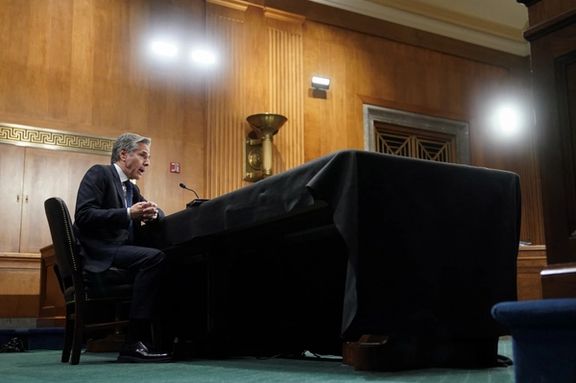
US Secretary of State Antony Blinken testifies before a Senate Foreign Relations Committee hearing on Capitol Hill in Washington, May 21, 2024.
The Biden administration’s Iran policy came under intense scrutiny Tuesday, as Republican senators grilled Secretary of State Antony Blinken over a message of condolence for Ebrahim Raisi’s death, and the failure to enforce existing oil sanction.
Leading the field in a Senate Foreign Relations Committee (SFRC) hearing was Senator Ted Cruz (R-TX) whose simmering and relentless attack seemed to have caught the seasoned diplomat off guard.
“You have presided over the worst foreign policy disaster of modern times,” was Senator Cruz’s opening line. “We now have two simultaneous wars waging: the worst war in Europe since World War Two, and the worst war in the Middle East in 50 years. Both I believe were caused by this administrations’ consistent weakness.”
‘Weakness’, ‘soft’, even ‘appeasement’, are some of the words that have been used more or less regularly by Republicans in Congress when discussing the Biden administration’s foreign policy, especially with regards to Iran.
Joe Biden had made clear before the election in 2020 that he’d scrap Donald Trump’s 'Maximum Pressure' doctrine against Iran, if he won. Many of Biden’s critics believe that that announcement essentially signaled to the Iranian regime that they’d have more breathing space during a Biden presidency. And that’s what many believe has happened, especially with regards to Iran’s oil exports.
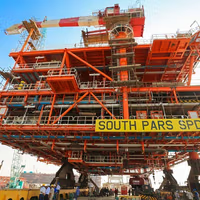
Why Iran's oil sales have increased from 300,000 during the Trump administration to 2 million barrels a day today, the Sneator asked Blinken. Because they're determined to try to do that, we're determined to cut them off, Blinken replied. Cruz continued his relentless questions: They weren't determined when Trump was president?
“When you became secretary of state, how much oil Iran was selling a day,” Cruz asked Blinken. He didn’t know. “How much oil are they selling today,” Cruz continued. Blinken didn’t know, or did not want to respond. “It’s gone up from 300,000 [barrels per day] to 2 million,” Cruz put to Blinken, adding that during the same period, Iran’ ghost fleet –which helps the Iranian regime sell sanctioned oil under the radar.
Blinken stated that the Biden administration had in fact added to Iran’s sanctions, explaining the rise in Iran’s oil revenue by its determination to circumvent sanctions. But the answer did not satisfy Cruz, who had a simpler explanation. “This administration desperately wants a new Iran deal,” he wrapped up his remarks addressing Blinken. “You have been showering cash on Iran from day one.”
It is estimated that Iran has sold around $80 billion of oil during Biden’s presidency, far more than what it used to earn during the era of Maximum Pressure. Biden critics say this has happened because existing sanctions have not been enforced, with the hope that a more lenient approach would persuade Iran to cooperate on other issues of interest to the United States, most notably, the nuclear program.
“The administration's policy is fatally flawed,” Senator Jim Risch, Ranking member of SFRC said in the hearing. “Outreach and accommodation have failed… Iran has doubled down on its support for terrorists and flooded Russia with drones and missiles… I’m proud this committee passed the most significant Iran sanctions legislation we’ve seen in years… Is the admin actually going to enforce them? Recent history suggests it won’t.”
Curiously, Blinken did not even mention Iran in his opening statement, perhaps because he anticipated the bumpy road ahead. He also doubled down on his department’s decision to “express official condolences” on Monday for Raisi’s death, stating that it had been done “many times in the past” in various administrations. It was something the US Department of State does as “a normal course of business,” he said, adding that Iranians were “probably better off” without the man known as the Butcher of Tehran.
“It’s shocking that this administration would mourn the death of the Butcher of Tehran,” Senator Barrasso said at the hearing. “He’s responsible for death, rape, torture. [It was] a terrible mistake.”
This is a sentiment that has been echoed by many Iranians who have gradually grown more critical of the Biden administration for what they see as its ‘embrace’ of the regime in Tehran and ‘betrayal’ of ordinary Iranians. Many say the Islamic Republic “responds only to force,” warning the US government that its aversion to confronting the Islamic Republic would blow out in its face –harming others in the region and in the West.
The General Staff of Iran's Armed Forces has officially denied Turkey's claim that its Akinci drone located the crash site of the helicopter carrying the late President Ebrahim Raisi.
In a statement released on Wednesday, it asserted that “the exact location of the helicopter crash was determined by Iranian armed forces' ground rescue teams and drones.”
Despite Turkey sending a drone equipped with night-vision and thermal cameras, Iran insists that due to the lack of "under-cloud point detection and control" capabilities, the Turkish drone failed to accurately pinpoint the crash site and subsequently returned to Turkey.
While Turkish President Recep Tayyip Erdogan declared a day of national mourning in solidarity with Tehran and touted the drone’s success as a demonstration of Turkey's unmanned aerial capabilities, Iranian media and military figures have labeled his claims as "inaccurate."
Over 2.5 million people tracked the operational data and flight path of the Akinci drone involved in the operation in Iran live.
Meanwhile, in response to reports criticizing the safety conditions of President Raisi's flight, Nournews—a website previously affiliated with Iran's Supreme National Security Council—denied any negligence. It highlighted that the aged helicopter dating back decades, had been under the command of an experienced flight crew and had undergone all necessary weather condition checks, asserting that all essential safety measures had been taken to secure the flight.
However, despite all precautions, "unexpected weather conditions overpowered the forecasts based on technical and security protocols," Nournews added, responding to the criticisms raised about the weather conditions on the day of the crash and the decision to allow the flight despite the circumstances.
Iran’s president killed in a helicopter crash Sunday was given a a grand send-off on Wednesday in Tehran with prayers led by the supreme leader.
Thousands of pro-regime supporters gathered in the Tehran University campus to pay their respects to the delegation who were all killed in a freak accident on the Azerbaijan border.
Iran’s Supreme Leader Ali Khamenei led the prayers for the delegation which Included foreign minister Hossein Amir-Abdollahian, due to be buried Thursday.
Dressed in black, attendees held photos of Raisi, a president whose tenure was marked by increasing authoritarian measures from hijab crackdowns to internet bans in addition to massive economic decline.
His legacy will remain one of brutality having been responsible for mass state-sanctioned killings in the 1980s. Thousands of dissidents were murdered and later, under Raisi’s presidency, more than 500 protesters were murdered by state forces during the uprising of 2022 and 2023 a record year for executions.
The ceremony saw Raisi and the delegation’s coffins journey from Tabriz to Tehran, and then on to the religious city of Qom before returning to Tehran as the regime paid homage to one of its loyal servants, having given over 40 years to the government as he climbed the ranks.
Raisi was being groomed to become the next supreme leader by the current dictator, Ali Khamenei, but under his failing policies he was increasingly pushed aside in recent months.
Raisi will be laid to rest in the religious city of Mashhad, his hometown, but Amir-Abdollahian will be buried in Shahr-e Rey, southern Tehran on Thursday.
Vice-president Mohammad Mokhber has stepped in as caretaker with presidential elections announced for June 28.
Members of Canadian parliament heard testimony Tuesday from Iranian human rights advocates, dissidents, victims and an exiled artist on the brutality of the Islamic Republic, and called on Ottawa to take more action.
Human rights advocate and founder of Stop Child Execution Nazanin Afshin-Jam and actress and human rights activist Nazanin Boniadi both told the House of Commons Subcommittee on Human Rights that Iran is "waging a war on women and girls."
"Girls are beaten, dragged, screaming into police vans and raped for not wearing a hijab," said Afshin-Jam via remote video.
"There's a surge in executions of peaceful protesters. And there's a crisis in Turkey where bona fide Iranian refugees like Shilan Mirzaee are sent notices of deportation back to Iran despite lethal outcomes," said Afshin-Jam.
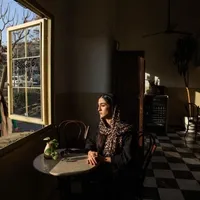
Shilan Mirzaee, a human rights and political activist
Mirzaee is an Iranian activist based in Turkey who was forced to flee for being an outspoken critic of the Iranian regime. She's supported other Iranians seeking asylum in Turkey since 2016, but now she's in danger of imminent deportation to Iran where she could face the death penalty.
Authorities in Turkey have yet to explain why this activist was arrested and transferred to a Turkish detention center.
Afshin-Jam made reference to the results of the UN fact-finding mission on Iran's response to the Woman, Life, Freedom movement, which was presented on March 18 to the UN Human Rights Council during its regular session in Geneva.
The council established that the fact-finding mission in Iran to document the deteriorating situation of human rights two months after the in-custody death of Mahsa Jina Amini sparked nation-wide anti-regime protests.
The UN fact-finding mission said it uncovered murders, torture, and rape amounting to "crime against humanity" during Iran's brutal crackdown on protestors following Amini's death.
Afshin-Jam encouraged Canada to exercise its universal jurisdiction, where a state can investigate and prosecute crimes that happened in another country, committed by people of a different nationality against victims of a different nationality.
She said it gives "an international crime grounds for the International Criminal Court and grounds for UN member states with universal jurisdiction, like Canada, to try the perpetrators of these crimes in a tribunal. The report recommends this to open structural investigations for these crimes against humanity."
"It's a gender apartheid state that is waging a war on women and girls," said Boniadi who echoed Afshin-Jam's calls to end gender apartheid.
Repress, Deflect and Divide
"These woman-life-freedom protests were yet another reminder that the Islamic Republic is incapable of reform. Instead, it stays in power using a three pronged survival strategy repress, deflect, and divide. Repression is at the core of the strategy," said Boniadi via remote video.
The antidote, she said, is to have ‘resolve, accountability and unity.’
She said the Islamic Republic holds the "appalling record of having the highest per capita execution rate in the world, and ranks 177 of 180 countries on the World Press Freedom Index."
"Domestic repression includes censorship, blinding, rape, torture and arbitrary detention. Ethnic, religious and sexual minorities face systemic persecution and discrimination."
Iranian parliament, she said, has allocated $2.9 billion to a government institutions responsible for intensified hijab enforcements.
Iran has seen an intensive crackdown on policing women bodies, with the UN Fact finding mission confirming that the regime uses AI technology to track and monitor women.
Canada: A Safe Haven for Regime Affiliates
Iranian human rights activist Atena Daemi testified in person in parliament.
She spent six years in prison for her activism, where she said she was tortured both physically and mentally. In 2022, after being diagnosed with multiple sclerosis (MS) she escaped illegally to seek medical care abroad, taking her from Tehran to St John's, Canada.
Daemi described to members of parliament, though a translator, her perilous journey to escape Iran through Kurdistan and how she found smugglers to take her to Iraq.
She's grateful to be in Canada but said "agents of the regime view Canada as their sanctuary."
Boniadi and Afshin-Jam agree.
Canada, they said, has become a safe haven for the Iranian regime.
"Global News did an investigative piece revealing 700 such regime affiliates in Canada, nine of which have been called to be deported. But instead of deportation, they could be on trial. Setting the precedents for accountability," said Afshin-Jam.
A recent year-long Global News investigation uncovered upwards of 700 regime-linked associates operating on Canadian soil and threatening the lives of some Iranian dissidents.
In February, Canada's Immigration and Refugee Board (IRB) ordered the deportation of Majid Iranmanesh, who was director general of Iran's Vice-Presidency for Science and Technology.
A month later, the (IRB) ordered the deportation of Salman Samani, Iran's deputy minister of interior during Hassan Rouhani's administration.
"With each of these regime affiliates comes a trail of dirty, laundered money and evidence of foreign interference, including threats to Iranian Canadians and political interference," said Afshin-Jam.
Afshin Jam, who is the member of the Iranian Justice Collective (IJC) announced a disturbing revelation during Tuesday's session.
"My organization, Iranian Justice Collective, was here a couple of weeks ago on the Hill providing policy recommendations on foreign interference. The PS752 file upping the number of Iranian refugees, actions on listing the IRGC on the terrorist list, and expansion of sanctions. We called to much sanctions. Shortly after the trip to Ottawa, my colleague received a call by a regime official in her family's home in Iran, threatening how she would end up like the woman she was trying to defend if she continues with her activism."
Repression of Iranian artists
The repression of Iranian artists, in particular Toomaj Salehi, who faces death for his rapping critical of the regime, was a topic brought up by all speakers testifying.
A poster with Toomaj's photo in a protest in Toronto
Arash Sohrabi, an artist now living in exile in the West, said the targeting of Iranian artists has been part of a "cultural purge" in Iran since the 1979 revolution.
"Between 1988 and 1999, aged over 80, writers, translators, poets, political activists and ordinary citizens were killed in what became known as the 'Chain Murders'," said Sohrabi.
Since nationwide protests erupted in 2022 sparked by Amini's death, Sohrabi said more than "100 Iranian filmmakers, actors, and musicians have been detained, banned from working or face travel bans for supporting the 2022 protest."
Boniadi referenced Mohammad Rasoulof, a dissident filmmaker who was sentenced to eight years in prison by the Islamic Revolution Court, and escaped the country earlier this month.
She said he "issued a defiant message to the regime if geographic Iran suffers under the boot of your tyranny, cultural Iran is alive in the collective mind of millions of Iranians who are forced to leave Iran because of your oppression and barbarity."
Boniadi said that repression extends beyond Iran's borders.
"Human rights abuses are among the regime's primary exports, including assassination plots, abductions and hostage taking of dual and foreign nationals," she said.
In January, two Canadian men with ties to Hells Angles were charged in what US authorities called "a murder for hire" plot allegedly coordinated by Iran.
Recommendations Made to Canada
What can Canada do?
Everyone who gave their testimony urged Canada to follow the lead of the US and proscribe the Islamic Revolutionary Guard Corps (IRGC) as a terrorist entity.
"To echo my fellow witnesses, Canada should immediately implement the motion to brand the IRGC, a terrorist organization, and expel Islamic Republic agents," said Boniadi.
Earlier this month, the Canadian House of Commons unanimously adopted a Report to designate Iran’s IRGC as a terrorist entity, but the motion is not binding.
Afshin-Jam also stated the Government of Canada can exercise universal jurisdiction to prosecute perpetrators of the regime on Candian soil.
Both Afshin-Jam and Boniadi called on Canada to recognize Iran as a gender apartheid state.
"We hope you support our campaign to end gender apartheid in Iran and Afghanistan, as Canada did, to end racial apartheid in South Africa," said Afshin-Jam.
Another recommendation made by Boniadi is to support Iranian civil society by "establishing a dedicated immigration stream to annually provide refuge to at least 200 Iranians fleeing the regime's persecution."
Boniadi concluded with a message to the people of Iran to stand united.
In the words of Toomaj, she said, "if you and I become us, we are limitless."
Beijing will continue to deepen its relations with Tehran and safeguard mutual interests, after a helicopter crash that killed President Ebrahim Raisi and his foreign minister, Wang Yi, China’s foreign minister said on Tuesday.
“Regardless of how conditions change, Beijing will continue to deepen its strategic partnership with Tehran, safeguard the shared interests of both countries, and continue its efforts for peace in the region and the world,” Wang Yi told Mahdi Safari, Iran’s deputy foreign minister.
China and Iran say they are “strategic allies” with close diplomatic and economic ties. Tehran, which openly declares its enmity with the United States and Europe has built its foreign policy on the basis of close ties with Russia and China.
Expressing condolences on the deaths of Raisi and foreign minister Hossein Amir-Abdollahian the Chinese diplomat said, “In this incident, Iran lost prominent leaders, and China lost good friends and partners.”
China is the main byer of Iran’s crude oil despite US sanctions that prohibit third parties in importing Iranian oil. Estimates indicate Beijing is buying more than a million barrels per day of discounted crude from Tehran, providing billions of dollars to the sanctioned country which is in desperate need of foreign currency.
The United States, the European Union and NATO also expressed official condolences to the Islamic Republic on Monday, prompting strong criticism from some Western politicians and human rights defenders who pointed to Raisi record as a top rights violator who was known as the “Hanging Judge”.
The untimely death of the Islamic Republic’s president and its foreign minister in a mysterious helicopter crash on May 19 has come at the worst time for Supreme Leader Ali Khamenei but the best time for Iranian dissidents inside and outside the country.
The incident will have significant implications for Iranian domestic politics, although it is expected to have a much smaller impact on the foreign policy of the theocratic regime.
Whether the fatal crash in a remote, fog-covered mountainous region in East Azerbaijan was the work of the divine, or caused by a technical malfunction or even an act of sabotage involving foreign or domestic elements, one thing is clear:
The Islamic Republic has suffered yet another political setback. But, more than anything, it has suffered a consequential moral defeat as, contrary to the regime’s propaganda, the majority of Iranians were in a festive mood over the death of the “Butcher of Tehran” and foreign minister Hossein Amir-Abdollahian.
Meanwhile, speculations about the real cause of the incident and its near and long-term implications on Iran’s foreign and domestic politics are likely to continue.
Men stand as they offer condolences over the deaths of Iran's President Ebrahim Raisi and others, at the representative office of Iran's Supreme Leader Ayatollah Ali Khamenei in Mosul, Iraq May 21, 2024.
As for the cause of the crash: three main scenarios are moot
Technical failure
In this scenario, given the significant toll that US-led sanctions have taken on Iran’s aviation industry, the aging Bell 212 helicopter carrying the 63-year-old Raisi might have encountered a serious mid-air malfunction, which was further complicated by poor weather conditions.
If you believe in karma or divine retribution, you might see the invisible hand of God at work here, suggesting that Raisi finally faced his comeuppance for his role in sending hundreds of Iranian political prisoners to the gallows as a member of the “death committee” in the 1980s.
Among Iranians both inside the country and in the diaspora abroad, conspiracy theories about the causes and consequences of the helicopter crash are flourishing. It is important to acknowledge that the helicopter crash could be attributed to various factors, such as bad weather or mechanical issues, just as easily as to external actors like Israel.
The realm of possibilities is vast, and only time will reveal which explanation is closest to the reality of what happened.
Act of sabotage by a foreign, and/or domestic element
In this scenario, the possibility of foul play and possible third-party involvement — be it Israel or one of its allies or a domestic actor — cannot be ruled out with certainty.
Israel’s Mossad has a track record of successful kinetic and non-kinetic campaigns inside Iran, including espionage, targeted assassinations, sabotage, drone strikes, and cyberattacks. The likelihood of Israel's involvement in assassinating Raisi and Amir-Abdollahian, however, is low for several reasons. Historically, the Mossad rarely targets political leaders of the country, instead focusing on military leaders of the IRGC or Iranian assets related to its drone, missile, and nuclear programs. There is little strategic benefit for Israel in targeting someone like Raisi, making it difficult to find a cogent explanation for such an action.
One can allude to a deliberate act of sabotage or a possible assassination plan by a domestic element, including a technician tampering the GPS system or turning off transponder prior to the flight, or a terrorist group as possible causes of the crash.
Mention must be made however that these are only hypothetical explanations over possible cause of the crash not final or definite conclusions.
Inside job
In this scenario, an act of sabotage might have been carried out by rival elements within the power structure. These could include factions associated with Khamenei’s son Mojtaba, a serious contender for the leadership; elements close to Mohammad Bagher Ghalibaf, the hardline speaker of parliament with ties to the IRGC; or those linked to Housing and Transportation Minister Mehrdad Bazrpash, who was in one of the helicopters that returned safely. The point here is that Raisi was a potential successor to the Supreme Leader of the Islamic Republic, Ali Khamenei, and a formidable rival to Mojtaba for the position.
Impact of the Crash on Iranian Politics
Without a doubt, the sudden death of Raisi and Amir-Abdollahian creates a temporary yet volatile power vacuum within the political structure. Yet, this vacuum is unlikely to significantly hamper the daily functioning of the state, either domestically or in foreign policy, because in Iran, it is the Supreme Leader who holds ultimate authority, not the president or any other government official.
Khamenei sits atop a highly nepotistic and corrupt political power structure that is more likely to frail or fall with the demise of the 85-year-old Supreme Leader himself, rather than the absence of Raisi or other officials.
However, to say that Raisi’s death has no meaningful impact on Iranian politics would be an overstatement.
The incident has two immediate and long-term impacts:
Concerning the near-term impact, the country unexpectedly finds itself faced with having no choice but to hold elections to appoint a successor and even form a new government. For the time being Iran's first vice president, Mohammad Mokhber, will take over as interim president with Khamenei’s approval, as per Article 131 of the Islamic Republic's constitution until elections are held in less than two months.
It is very unlikely that foreign and domestic policies undergo any ground-breaking changes in this period. Nor is it likely that people would seize on the opportunity and stage massive public protests in the country. It is unlikely, but not entirely impossible.
The state's sudden focus on hastily planning for an early election detracts from Tehran's bandwidth to address other pressing issues, particularly in foreign policy, such as its confrontation with Israel. This situation might inadvertently empower the Jewish state to escalate pressure on Iran regarding its nuclear program and regional interventions.
Regarding its long-term impact, it's crucial to recognize that the incident primarily inflicts a significant psychological and moral blow on the regime. The country is currently engulfed in deep-seated public anger and frustration towards the regime, stemming from its extensive suppression of women and its failure to address the socio-political and economic stagnation gripping the nation.
The populace harbors immense dissatisfaction with the regime, yet appears incapable of overthrowing it through street protests. Despite its apparent resilience against public demonstrations, the Islamic Republic is perceived as vulnerable and fragile in the face of average Iranian reactions to the deaths of its leaders and officials.
Raisi’s death sparked celebrations in Tehran with fireworks and social media was rife with jokes and humorous content over his demise. Lack of legitimacy is one of the symptoms of state decline, a major contributor to state fragility because it undermines an authoritarian state authority, and further aggravates the hitherto bellicose nature of relations between the state and society.
Another important long-term impact of the fateful helicopter crash is related to the succession crisis in the post-Khamenei era. With Raisi out of the picture, it appears that the road to power has been paved for Mojtaba to succeed his father once he is gone.
Nevertheless, Mojtaba’s power grab is no easy feat. Raisi’s death has a double-edged sword effect. On one hand, it can, at least on paper, give him an easier path to take up the mantle of Supreme Leader. On the other hand, Raisi’s absence can exacerbate the ongoing power struggle within the establishment among various rivaling actors who jockey for higher positions or even among the elements within the security and intelligence apparatus.
This dangerous power struggle is likely to evince itself in the medium to long term.
The assertion here is that such bitter infighting is dangerous for Khamenei and his kleptocratic structure of power he has managed to erect and consolidate in Iran. If this happens, this has the potential to impede an orderly power transition in Iran in the post-Khamenei era, resembling the chaos that followed Lenin’s and Stalin’s deaths in the Soviet Union.
In sum, the death of Raisi has presented the Islamic Republic with its most formidable and dangerous challenge since its inception 45 years ago.
While Khamenei was mulling over plans to create, in the best-case scenario, an orderly power transition after his death, the regime is now faced with twin succession crises.
The outcome of the initial crisis will determine the parameters of the subsequent one, and between these two crises lie numerous elements of surprise and a chain of unpredictable events that could unfold in an ever-turbulent Iran.