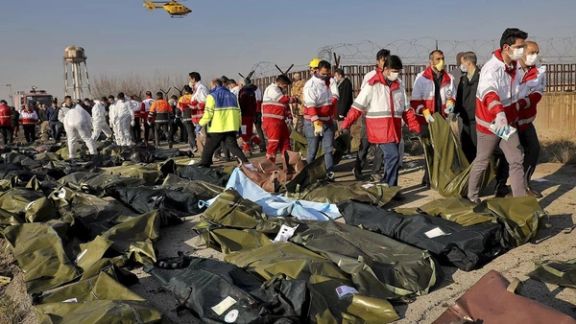
The crash site of flight PS752 near Tehran on January 8, 2020
Navaz Ebrahim, who lost her sister and brother-in-law on the Ukraine International Airlines flight that was shot down in Tehran in 2020, said a recent Ontario court ruling is being used by Iran's cyber army to create misinformation and lies.
A court in Ontario earlier this week found that Ukraine International Airlines failed in its duty to cancel flight PS752 in 2020 that took off from Tehran amid military activity and was downed by the IRGC killing 176. On January 8, 2020, as Iran fired ballistic missiles at US bases in Iraq, flight PS752 took off from Tehran and minutes later was shot down by two missiles.
"Lies are spreading," said Ebrahim, who is also the president of the Association of Families of Flight PS752 Victims.
"It seems to be systematic. A lot of it coming from the Islamic Republic," she said.
There have also been a lot of accusations on social media that suing the Ukrainian airline helps the Islamic Republic to cover its tracks and lessen its guilt and responsibility.
Ebrahim said "this court ruling does not diminish in any way, the IRGC’s and the Islamic Regime’s responsibility in the downing of flight PS752 but further emphasizes it.
State media in Iran, for example, has claimed that the ruling shows the Ukrainian airline is responsible, which is incorrect.
Ebrahim said Monday's court ruling was significant and actually helped the families in their fight to get to the truth.
"It was actually very emotional to hear how much they [Ukrainian Airlines] did not follow even basic, safety protocols that night. That's not lifting the responsibility off of the Islamic Republic of Iran and the IRGC shoulders in any way," said Ebrahim.
In March 2021, Iran's civil aviation authority report concluded that the Boeing 737-800 passenger plane was shot down accidentally after being "misidentified" by an air defense unit as a "hostile target" but Monday's ruling referred to Iran's human error claims as "implausible."
Mohammad Nourizad, a well-known writer, filmmaker, and political detainee, has been moved to solitary confinement after protesting against the rising food prices in prison, as reported by his wife.
In an audio clip circulating on social media, Fatemeh Maleki, his wife, said that Nourizad's objections to the increased prison food costs over the past two months led to his solitary confinement. She expressed concern about his health, having had no contact with him since Saturday. Detailed information about his transfer remains unknown.
"It's unjust for prisoners, many struggling to meet basic needs, to endure blatant theft, even within their ranks. While some voiced their protest, it seems others have grown indifferent to their plight," she said.
In February, Iranian authorities extended Nourizad's sentence by 61 months due to his participation in protests while in prison. He cited his refusal to remain silent "in the face of injustices" as the primary reason for this additional punishment.
Since 2019, Nourizad has been serving a 15-year prison sentence for allegedly insulting Iran's Supreme Leader Ali Khamenei.
In June 2019, Nourizad and fourteen other dissidents signed a petition demanding Khamenei’s resignation. Subsequently, they were all arrested, and eight of them were tried in court without proper legal proceedings. In February, they were collectively sentenced to 72 years in prison.
The United States on Thursday threatened to respond to Iran if it further accelerates its uranium enrichment, hours after the UN nuclear watchdog, the IAEA warned that Tehran has increased its capacity.
The US State Department issued a statement warning Iran of its response. “The report issued today by the IAEA makes clear that Iran aims to continue expanding its nuclear program in ways that have no credible peaceful purpose. These planned actions further undermine Iran’s claims to the contrary. If Iran implements these plans, we will respond accordingly.”
The International Atomic Energy Agency issued a report on Thursday saying Iran has responded to last week's UN nuclear watchdog censure resolution by expanding its uranium enrichment capacity at two underground sites. Iran has rapidly installed two more cascades, or clusters, of uranium-enriching centrifuges at its Fordow site and begun work on more while also planning others at its underground plant at Natanz.
"On 9 and 10 June ... Iran informed the Agency that eight cascades each containing 174 IR-6 centrifuges would be installed over the next 3-4 weeks in Unit 1 of FFEP (Fordow Fuel Enrichment Plant)," the confidential International Atomic Energy Agency report sent to member states on Thursday said.
"On 11 June 2024, the Agency verified at FFEP that Iran had completed the installation of IR-6 centrifuges in two cascades in Unit 1. Installation of IR-6 centrifuges in four additional cascades was ongoing," the report said, referring to one of one of Iran's most advanced centrifuge models.
The resolution was tabled by Britain, France and Germany, which the United States reportedly opposed but later endorsed. Only Russia and China voted against the measure.
The US statement further stated: Iran must cooperate with the IAEA without further delay to fully implement its legally binding safeguards obligations. Until Iran does so, the IAEA Board of Governors will continue to hold Iran to account. We remain in close coordination with our partners and allies and are prepared to continue to increase pressure on Iran should its non-cooperation with the IAEA continue.
Ali Shamkhani, a senior aide to Iran's Supreme Leader, who has been reportedly put in charge of Iran's nuclear negotiations, had warned that Iran would deliver a "serious and effective response" if European nations pursue the resolution.
Iran’s enrichment of uranium to 60% purity in the past two years has no credible civilian use and is viewed as a steppingstone to 90% weapons grade enrichment. The time needed to produce the fissile material for a bomb by further enriching from 60 to 90 percent is just a few weeks, putting Iran in the position of an early nuclear threshold country.
The 2015 nuclear agreement between Iran and world powers had capped enrichment to less than 5% for more than a decade, but former US President Donald Trump withdrew from the agreement known as the JCPOA in 2018 and imposed sanctions on Iran. He argued that that 2015 deal was weak and had a limited restraining life span, demanding a tougher agreement.
Iran’s response during the remaining two years of the Trump term was relatively limited, increasing enrichment to just 5%. However, after President Joe Biden’s election and his declaration to strive for the restoration of the Obama-era agreement, Iran hardened its position, demanding the lifting of US sanctions and accelerating enrichment first to 20% in early 2021, and then 60% later.
Multi-lateral negotiations lasting 18 months to restore the JCPOA failed once Russia invaded Ukraine and Iran began supplying drones to Moscow in mid-2022.
The US military announced on Thursday that it destroyed two Houthi patrol boats, an uncrewed surface vessel, and a drone over the Red Sea in a move to weaken the Iran-supported group’s capabilities.
“This ongoing malicious and reckless behavior by the Iranian-backed Houthis threatens regional stability and endangers the lives of mariners across the Red Sea and Gulf of Aden,” stated US Central Command (CENTCOM).
The Houthis, an Iranian proxy group, began targeting maritime commercial traffic in mid-November following a call by Iran’s Supreme Leader Ali Khamenei for Muslim countries to blockade Israel. Initially confined to the Red Sea, these attacks have since extended to other crucial waterways, including the Indian Ocean.
“The Houthis claim to act on behalf of Palestinians in Gaza, yet they are targeting and endangering the lives of nationals from third countries who are unrelated to the Gaza conflict,” said CENTCOM.
According to Yahya Saree, the Iran-aligned group's military spokesman, the Houthis attacked the Verbena in the Arabian Sea as well as the Seaguardian and Athina in the Red Sea.
The attack on the Palau-flagged cargo ship Verbena resulted in a fire and severely injured one crew member, as reported by CENTCOM.
The rebels also launched two anti-ship ballistic missiles from a Houthi-controlled area in Yemen into the Red Sea. However, CENTCOM confirmed that these missiles caused no damage or injuries.
The United States and Britain have bombed Houthi military installations several times since January, but the Iran-backed group has accelerated attacks in the past two weeks, as Israel continues operations in Gaza and attacks Iran-backed Hezbollah targets in Lebanon.
The Houthi campaign has disrupted global shipping, forcing firms to re-route to longer and more expensive journeys around southern Africa. It has also stoked fears that the Gaza war - in which the local health ministry says over 37,000 have been killed - could spread and destabilize the wider Middle East.
The Secretary of the Seminaries' Intelligent Technologies Department has urged Iranian presidential candidates to utilize Artificial Intelligence (AI) to shape public opinion amid apparent voter apathy.
“No candidate in this election or others can succeed without integrating AI,” Mohammadreza Ghasemi asserted in an interview with state-affiliated IRNA news on Thursday.
Although there are no reliable polls about the electorate's mood ahead of the June 28 snap election, the trend in the past three national elections in Iran has shown a declining turnout.
With the regime handpicking which candidates are allowed to run, a large segment of the public has lost interest in voting.
Ghasemi noted that countries like the US and Russia, amid their power struggles, employ AI tools to sway public opinion. “Managing public opinion is a crucial aspect of AI application,” he emphasized.
“AI in elections involves managing public opinion. Suppose we fail to coordinate the management of big data within social networks and influence algorithms shaped by society's general understanding”. In that case, the official added, “We will not succeed in the elections.”
He didn't elaborate on what he meant by "succeed in the election," but it likely refers to mobilizing voters for the upcoming snap elections. Following former president Ebrahim Raisi's death, the ruling establishment must re-engage an electorate disillusioned by recent elections.
Official statistics show that 40.6 percent of eligible voters participated in the first round of parliamentary elections on March 1. In Tehran, only 24 percent of the population voted, marking the lowest turnout in the Islamic Republic's history.
Even lower turnout was recorded in the recent run-off elections, with only seven percent of eligible voters in Tehran casting their ballots.
Ghasemi also pointed out that despite Iran’s "significant challenges with AI", the seminary's "robust capabilities that candidates should leverage". “Presidential candidates should harness the unique AI strengths of seminaries, which are key national players,” he stated.
"AI will significantly impact future global management and is a strategic, power-creating technology," the official added.
Ghasemi also urged candidates to reveal their AI strategies, stressing that the seminary, as a “proactive institution in AI technology,” will “hold them accountable.”
The seminary tech official predicted that the world will soon be divided into AI users and developers, reducing the relevance of geographical boundaries.
He also mentioned AI's drawbacks, particularly the spread of fake news, which he attributed to 30% of the protests in 2022.
“AI reflects real news, but it also plays a role in creating, distributing, and engineering fake news,” he added.
In 2022, the nationwide protests, known as Woman Life Freedom, sparked by Mahsa Amini's death in police custody, resulted in over 550 deaths and severe social crackdowns. Women and minorities continue to face severe persecution, with executions reaching record levels.
In March, the UN's fact-finding mission concluded that Amini's death in the custody of Iran's morality police was unlawful and caused by violence and that Iranian women still suffer systematic discrimination.
According to the fact-finding mission, there were extrajudicial executions, arbitrary arrests, torture, and ill-treatment, as well as rapes and sexual violence during the protests which followed.
Despite gross government underreporting, a children’s rights activist and lawyer says official estimates suggest that the actual number of child laborers in Iran exceeds three million.
In October 2022, during Iran's nationwide protests, one of the country's largest independent anti-poverty charities reported that many minors were recruited to attack protesters in exchange for essential food supplies. Over 500 members and supporters of Imam Ali's Popular Student Relief Society (IAPSRS) stated that authorities employed children as part of their forces against anti-government protesters.
During the peak of the uprising, as the Islamic Republic’s repressive forces faced fatigue and shortages, it became increasingly evident that impoverished children were recruited to suppress the protests. Images of children, some not even wearing shoes and teenagers in anti-riot uniforms of the Basij and Revolutionary Guards surfaced on social media, sparking widespread outrage among users.
At the same time, the Association for the Protection of Children's Rights issued a statement condemning the use of children to suppress street protests, as well as the killing and arrest of children and teenagers during the nationwide uprising in Iran.
Garbage Collecting Mafia and Child Labor in Iran
Many working children are taken advantage of by organized crime groups in the streets to do dirty and odd jobs for small compensation.
Speaking at a meeting in Tehran on the role of public awareness in ending child labor, held on the eve of the World Day Against Child Labor, Farshid Yazdani, a children's rights activist, criticized Iranian authorities for wrongly emphasizing that child laborers are involved in "gangs and mafia." He stated, "Our studies show that the maximum level of coordination is that child laborers do these jobs [garbage collecting], as a family," as reported by Hammihan on Tuesday.
In this meeting, Reza Shafakhah, the secretary of the children's rights committee of the human rights working group of the National Union of Bar Associations, emphasized that child labor is a phenomenon that does not have a mafia, but garbage collection has a mafia.
Shafakhah added: "Even if it is a mafia, it still does not reduce the duties of government organizations."
Inaccurate Government Statistics of Child Laborers in Iran
In another part of this meeting, Yazdani discussed the government's varying and inaccurate statistics on the number of child laborers and stated: "In 2018, we identified about 4,800 garbage-picking children in the city of Tehran.
At the meeting, Mohammad Saleh Noghrehkar, head of human rights at the Bar Association, cited former Minister Ali Rabiei's claim at a Child Labor Convention in Brazil during Hassan Rouhani's presidency that "We don't have child scavengers in Iran." Noghrehkar countered, noting that the IAPSRS had identified 120,000 child scavengers that same year.
Shafakhah further stated that there are 19 million marginalized people in Iran and emphasized that the latest official number of working children is "three million."
According to him, IAPSRS had 44 centers that covered 6,000 children all over the country before its dissolution.
Iran’s Crackdown on NGOs and Children’s Rights Activists
In 2020 Iranian security forces detained the founder and director of IAPSRS Sharmin Meymandinejad and two of the managers of IAPSRS following a complaint filed by the Islamic Revolutionary Guard Corps (IRGC).
Susequently, the Ministry of Interior of the Rouhani government filed a complaint with the judiciary, requesting the dissolution of this organization by the judicial authorities.
The court hearing of the IRGC complaint was held on 2 March 2021, and in a rare move, a day later, on 3 March 2021, the court issued a ruling to dissolve IAPSRS.
The Rouhani government's Ministry of Interior requested the dissolution of this organization, citing accusations such as "issuing political statements during critical times in the country and engaging in anti-religious activities."
Shafakhah, heading the legal team of IAPSRS, stated that the indictment presented to the court regarding IAPSRS and its members began with the assertion that "NGOs are seeking a velvet and colorful revolution."
In the indictment, civil activists were referred to as "informers of international organizations" because "in international forums and UN Committee on the Rights of the Child, they provide statistics about Iran's social harms that lead to the approval of resolutions against Iran."
"Given the capabilities of the SAM system, the Iranian explanation of human error is implausible," the court ruling stated.
Ebrahim called Iran the 'perpetrators' who shot down the flight on January 8, 2020 killing all 176 people on board.
The Ontario court ruling that Ukraine International Airlines failed in its duty to cancel flight PS752 in 2020 does not absolve Iran, and is not about monetary compensation, said Paul Miller, one of the lawyers representing the PS752 families.
Just 10 minutes before the trail began, Miller contacted his wife, because he was overcome with emotion.
It's a unique case, unlike any other, he told Iran International.
"There was probably 15 to 20 people in the courtroom, family members, and they were all wearing pins with the faces of family members who died. And that brings it very real, you know, a very different way. And it became a very emotional trial," said Miller.
Several families of PS752 victims have told Iran International that they have endured bullying and harassment on social media after the verdict on the Ukrainian airlines came through.
For their protection and to prevent further bullying, they have decided not to speak out, but wanted the public to know that this case is not about money, and is just one step in their journey towards justice.
The backlash received by several PS752 families over this court judgement, Miller said is horrific and misguided.
He stated that the majority of victims of PS752 were highly educated and accomplished. At least 19 universities in six provinces lost researchers, professors and students after the Islamic Revolutionary Guard Corps (IRGC) shot down the passenger plane.
Many of the victims, he said, were breadwinners of their families.
There was a total of 138 passengers that were part of this specific lawsuit, according to Miller. The ruling states that under the Montreal Convention, UIA cannot limit compensation to $180,000 USD per passenger but must pay full compensatory damages, which Miller said is up to 230,000 dollars per family.
"It's absolutely crucial that families get that compensation so that they can manage and not have financial stress going forward. This is trying to make life easier for people who have endured one of the most horrific events possible," said Miller.
David Matas, a legal advisor to the Association of the Families of the Victims of PS752, said the families are not about compensation, and are trying to find out what happened in their quest for justice.
Matas said the judgement by the Ontario court does not prove the Ukrainian airlines was negligent, rather the case he said only shows that the airline can't prove that it wasn't negligent under the Montreal Convention.
"Because of the wording the Montreal convention, the Ukrainian airline had to prove that they were not negligent. In other words, instead of the prosecution proven guilt, the defendant had to prove innocence," explained Matas, an international human right lawyer, on the case.
Matas, who is a senior fellow at the Raoul Wallenberg Centre for Human Rights, said Iran is covering up its own responsibility.
Iran has prevented an independent investigation from taking place. On January 14, 2020, Iran promised to investigate the attack, but they have not shared details about their investigations, and they did not show key evidence to Ukraine or other countries whose citizens were killed.
The judgement on Monday found, that despite the IRGC's deliberate firing of two missiles at the airliner, the company could not prove that it acted according to standards to cancel the flight amid potential military activities in the early hours of January 8, 2020.
Miller said he and the rest of the legal team consider the PS752 families to be "special" and that they will never "forget" them. As for the Islamic Republic of Iran, Miller said he "I just can't fathom. Your country. The country you came from killed your family."
The families of PS752 victims, like Ebrahim, want the online bullying to stop.
"It's just very difficult and emotional for the families. It's not easy to be attacked and to listen to all the lies and misinformation," she said.