Toomaj Sanctions Pass Unanimously in Canadian Parliament

The Canadian parliament, across all three main party platforms, has unanimously passed the Toomaj Sanctions, related to the death sentence issued for a dissident Iranian rapper.
Iran International

The Canadian parliament, across all three main party platforms, has unanimously passed the Toomaj Sanctions, related to the death sentence issued for a dissident Iranian rapper.
The motion, proposed by the Iranian Justice Collective (IJC), sanctions 31 judicial officials involved in the death sentence of rapper Toomaj Salehi.
The IJC compiled the names of 31 judges, prosecutors and investigators of the Islamic Revolutionary Court across its 70 branches, including the judge who sentenced Toomaj Salehi to death, to be added to the existing list of sanctioned Islamic Republic officials.
Monday morning members of the IJC Nazanin Afshin-Jam and Tara Dachek joined Senator Julie Miville-Dechêne, and MPs Ali Ehsasi and Heather McPherson in Ottawa to present the motion before the vote.
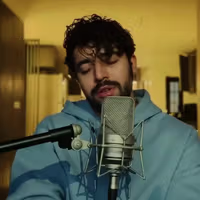
Toomaj, a beloved dissident rapper, was sentenced to death for his lyrics criticizing the Islamic Republic. The artist and his song became popular in 2022 during nationwide anti-government protests in Iran.
He was initially arrested in October 2022 for his support of the Woman- Life- Freedom movement.
After his release, Toomaj described being "severely tortured" during his time in prison. Just two weeks after his release, he was arrested again in late 2023, and charged with "corruption on earth" - a crime punishable by death.
Speaking in Ottawa Monday, human rights activist Nazanin Afshin-Jam asked people to imagine if Canadian rapper Drake was sentenced to death simply for his lyrics.
"Canadians would be outraged," she said, "And that's the horror Iranians feel."
"He [Toomaj] was tortured. He had his legs and arms broken and they injected him with unknown substances while he was in detainment in the prison cells in Iran to to extract false confessions," said Afshin-Jam.
Fellow IJC member Tara Dachek knows the struggles the Iranian people face living under a repressive regime. She came to Canada just five years ago to escape the authoritarian laws that Amnesty International has labelled a "war on women and girls" and as a "gender apartheid" state.
"His bravery inspired me so deeply. Imagine knowing that rapping is illegal in Iran, yet choosing to use your legal name and voice to fight against one of the most brutal regimes in the world," said Dachek.

Reza Pahlavi, Iran's exiled prince, condemned the recent exchange of Hamid Nouri, a man he labeled a "war criminal," for two Swedish citizens, calling it "an irresponsible and unethical action."
In a statement released on social media, Pahlavi criticized the move as “detrimental not only on moral grounds” but also for the interests of Sweden and Western countries, describing it as a “harmful act.”
Nouri, who had been imprisoned in Sweden since 2019 and was sentenced to life for his involvement in the execution of political prisoners in Iran in 1988, was released on Saturday. The exchange has sparked outrage among human rights activists and families of the victims.
The two Swedish citizens released by Iran were arrested on trumped-up charges and detained without due process of law. Iran often engages in the practice to use the detainees as bargaining chips in its dealing with Western countries.
Pahlavi linked the timing of Nouri's release to the upcoming presidential elections in Iran, suggesting it was orchestrated to demoralize opposition voices and mislead the public into participating in what he described as an electoral "circus." He asserted that the Iranian regime employs such tactics to project a facade of inclusivity and democracy, which he vowed would meet with a resolute “no” from the “freedom-loving Iranian populace.”
Furthermore, Pahlavi argued that “although the exchange of this criminal is a damaging and unconstructive action, it actually makes us Iranians abroad more determined to organize and mobilize for maximum pressure on the regime and maximum support for the people of Iran.”

Golrokh Iraee, a political prisoner currently held in Tehran’s Evin Prison, has expressed her strong disapproval of the 'reformists' participating in the upcoming June 28 presidential elections.
In a letter from prison on Sunday, she stated: "The reformists should know that we, the people of Iran, remember their betrayal from the first day and we will not forget it."
In her letter, Iraee condemned the 'reformists', accusing them of working to "destroy youth and future generations."
Iraee’s letter is a vehement critique of the political faction within the Islamic Republic's system known as 'reformists', accusing them of betraying the Iranian people and recalling the brutal history of political repression and violence in the country.
Iran's 'reformists' emerged in the 1990's advocating for social and political freedoms and the rule of law. However, from the early 2000s, hardliners loyal to Supreme Leader Ali Khamenei reacted by systematically curbing their influence. The election of populist neo-conservative Mahmood Ahmadinejad in 2005 further marginalized 'reformists' from critical government positions.
During the 2009 presidential election, 'reformists' rallied behind their candidate, Mir Hossein Mousavi, who controversially lost to Ahmadinejad. This sparked widespread protests against Ahmadinejad's re-election, met with harsh repression including hundreds of arrests and intimidation. Many opponents of the Islamic Republic argue that the clerical system of government, has been beyond reform all along and that the reformists gave false hope to the people that religious dictatorship can be improved and reformed to address Iran's pressing issues.
Iraee's letter begins by detailing the harrowing history of cultural purges, the expulsion of students and professors, and the systemic use of torture and forced confessions in prisons during that era. She condemned the reformists for their complicity and inaction during these times, as well as their role in the chain murders.
"We will not forget the cultural revolution and the expulsion and house arrest of students and professors, the elevation of ignorance over merit, the killings, torture, rape, forced confessions, and coercing political prisoners to execute their friends in the prisons of the 1980s."
In her statement, Iraee highlighted the mass executions of political prisoners in the 1980s, a period marked by severe human rights abuses. "We will not forget the consolidation of power of the Islamic Republic and the catastrophic killing of young people in the 1980s; in the days when you Hezbollites and followers of the Imam's line were at the head of affairs," she wrote.
"When nearly a thousand people were slaughtered in the chain murders within a few years, you became mere logistical support to avoid accountability," Iraee stated.
Turning to the repression of protestors, Iraee accused the reformists of abandoning the people during the 2009 Green Movement protests and the bloody crackdown on demonstrators in 2019.
"In Ashura 2009, when the protests escalated beyond your controlled narratives and crossed the boundaries of your slogans, you abandoned the people who had come to the streets due to the atmosphere you created and your claims of lost votes, leaving them to be killed, sentenced to execution, and tortured in prisons," she charged.
Iraee criticized the reformists for their repeated failures to stand by the people, instead using them as pawns in their political games. "We, the people on the streets, were always your extras to pressure from below while you negotiated from above to re-enter the power game," she wrote. She continued, "When people came to the streets in 2017 with the slogan 'Reformist, Hardliner, The Game Is Over,' you, as usual, changed your skin and color."
She lambasted the 'reformists' for their role in perpetuating economic hardships and social inequalities, accusing them of exploiting the working class and ignoring their struggles. "You are the continuators of Mohammad Khatami's policies and Akbar Hashemi Rafsanjani's economic policies; symbols of exploitation of the lower class. How dare you speak of the lower class and their struggles when you have reached your positions by feeding off their diminishing resources," Iraee asserted.
In a particularly vivid passage, Iraee declared, "We have passed beyond reform. You continue to recycle the promises of Mohammad Khatami, who in 2019, after the massacre of protesters, called us destructive waves and thanked the Supreme authorities. Now you have returned to once again destroy the youth of future generations just as you did to us. With the people who have not only passed through Khatami but also set fire to the shroud of reforms. Put on the uniform of fundamentalists and shoot from the front."
Iraee’s letter underscores a deep sense of betrayal felt by many Iranians towards the reformists, accusing them of failing to deliver on promises of civil rights and social justice, highlighting their role in sustaining the oppressive regime.
"You have always spread despair in society, and your existence has been an opportunity for the regime's survival,” Iraee added.
Iraee further criticized 'reformists' for standing alongside someone who says, 'We won't introduce new policies because Khamenei sets the general directives.'"
She was referencing Masoud Pezeshkian, the sole approved 'reformist' candidate who in his first interview following his approval from the Guardian Council to run for presidency stressed that his government would not introduce any new economic strategies and policies.
"The people of Iran will not forget your loyalty to the Islamic Republic. The day the people on the streets settle accounts with the Islamic Republic, they will also deal with you, the regime's enablers," Iraee warned. She concluded with a vision of accountability: "When the people of Iran decide the fate of the Islamic Republic on the streets, they will also settle accounts with you, the opportunists and apologists whose names are etched in infamy on the political history of Iran."
Iraee's letter is a testament to the ongoing struggle for justice and accountability in Iran, reflecting the deep-seated grievances of a populace long subjected to political repression and betrayal. Her statement reflects a deep mistrust and resentment towards the Islamic Republic, including the reformist faction.

The head of the UN's nuclear watchdog says Iran’s 2015 nuclear agreement to limit its nuclear program "exists only on paper and means nothing."
In an interview with Russian newspaper Izvestia, the International Atomic Energy Agency Director General Rafael Grossi said: “Nobody applies it, nobody follows it. There have been attempts to revive it here in Vienna. But unfortunately, although they were relatively close to success, they failed for reasons unknown to me, because I was not involved in the process.”
The statement comes just weeks after Grossi admitted the agency "has lost continuity of knowledge in relation to the production centrifuges, rotors and bellows, heavy water, and uranium.” He recently also admitted that Iran is “weeks not months” away from a nuclear weapon, with enrichment reaching alarming levels.
He said “the parties mutually blame each other for the failure - mainly the United States and Iran”, referencing the breakdown in progress since the US withdrew from the nuclear agreement under former President Donald Trump.
“ I continue to tell my Iranian colleagues that we must provide the agency with at least minimal access to help return to the second version of the JCPOA or any other agreement,” he stressed, but noted it is not an easy road to deal with Tehran.
“There are problems, I’ll be honest with you. We do cooperate with Iran. I don't deny this. This is important for inspection. My Iranian colleagues often say that Iran is the most inspected country in the world. Well, it is, and for good reason. But this is not enough,” he warned.
On Saturday, France, Germany, and Britain, original signatories of the 2015 nuclear deal with Iran, condemned Tehran’s latest actions to further expand its uranium enrichment.
"Iran has taken further steps in hollowing out the JCPOA, by operating dozens of additional advanced centrifuges at the Natanz enrichment site as well as announcing it will install thousands more centrifuges at both its Fordow and Natanz sites," the joint statement said.
During the interview with Izvestia, Grossi also highlighted the importance of Russia's collaboration with Iran, as Moscow "can influence compliance with a peaceful nuclear order”, the two nations firm allies in the field of military cooperation. Iran has been providing Russia with drones for its war on Ukraine, with manufacturing facilities for Russia being built with Iranian assistance.
“I think this is our shared responsibility. And Russia plays a very important role in this diplomacy, trying to keep the Iranian program within a predictable and peaceful framework,” he noted, reiterating that “if we cannot verify everything, we cannot give the guarantees that the international community expects from us.”
Grossi added that since signing the agreement in 2015, Iran’s program “has expanded significantly”. He said: “They are capable of producing the latest generation centrifuges, building new facilities and much more.”
Iran’s nuclear chief insists the country is adhering to the Nuclear Non-Proliferation Treaty (NPT) agreements, but is “in the process of reducing its nuclear obligations from the 2015 agreement." Mohammad Eslami maintained Tehran is still following the NPT Safeguards Agreement and is only reducing the obligations it had under the 2015 nuclear deal, known as the Joint Comprehensive Plan of Action (JCPOA).
Iran has responded to an IAEA Board of Governors’ censure resolution, passed in early June, by expanding its uranium enrichment capacity at two underground sites.Iran has rapidly installed two more cascades, or clusters, of uranium-enriching centrifuges at its Fordow site and begun work on more while also planning others at its underground plant at Natanz, a UN nuclear watchdog report said.
"On 9 and 10 June ... Iran informed the Agency that eight cascades each containing 174 IR-6 centrifuges would be installed over the next 3-4 weeks in Unit 1 of FFEP (Fordow Fuel Enrichment Plant)," the confidential International Atomic Energy Agency report sent to member states on Thursday said.
"On 11 June 2024, the Agency verified at FFEP that Iran had completed the installation of IR-6 centrifuges in two cascades in Unit 1. Installation of IR-6 centrifuges in four additional cascades was ongoing," the report said, referring to one of one of Iran's most advanced centrifuge models.
While non-binding, resolutions by the International Atomic Energy Agency's 35-nation Board of Governors anger Tehran, which typically responds by accelerating its nuclear activities.
Admitting that Iran's uranium enrichment continues to intensify, Grossi said, "We know that Iran is considering a number of activities which require construction of new facilities, installing new cascades, among other things". In the Monday press conference, Grossi stressed the severity of the situation as the program continues unabated. "They should be informing us of these changes," he said.
Grossi pointed out that it has been over three years since Iran ceased applying its Additional Protocol, restricting the IAEA’s ability to perform comprehensive inspections. "There has been no progress in resolving the outstanding safeguards issues," he stated, mentioning unresolved queries regarding traces of uranium found at undeclared sites in Varamin and Turquzabad.
On Saturday, ahead of the International Atomic Energy Agency (IAEA) Board of Governors meeting, Iran issued a warning regarding a possible censure resolution. Ali Shamkhani, a senior aide to Iran's Supreme Leader and reported head of Iran's nuclear negotiations, declared that Iran would deliver a "serious and effective response" if European countries advanced a resolution criticizing its nuclear program.

Tehran Municipality has disbursed 250 million rials ($400) for "arrears salaries" of each employee as presidential candidate Alireza Zakani, the city mayor, bids to win the public's support.
Deputy mayor Majid Bagheri praised the payment as "unprecedented support for colleagues' livelihood," during the intense campaigning by presidential candidates for the snap election on June 28, triggered by the unexpected death of President Ebrahim Raisi.
However the action is seen simply as a financial reward to sway votes for the June 28 presidential election.
In reality, it will make little difference to the 140,000 employees who will receive $400 at a time when one third or more of Iranians now live below the poverty line. But the amount is substantial for most employees who make around $200 a month.
Bagheri emphasized the historic nature of the piecemeal salary reform within the municipality, marking it as a first in its history while many in the city are facing record levels of unemployment.
Zakani earlier sparked controversy by appointing his deputy for financial affairs, Lotfollah Forouzandeh, as the head of his campaign team.
Despite such moves and various promises from the six contenders in the race, voter turnout is expected to remain low, mirroring the dismal participation seen in the last parliamentary elections in March.
The public's growing skepticism towards political promises and the effectiveness of such pre-election strategies are telling of the broader discontent and political fatigue among the electorate.

A week after the start of the election campaign in Iran, almost no one speaks about three of the five hardliner candidates: Amir Hossein Ghazizadeh Hashemi, Tehran Mayor Alireza Zakani, and former Justice Minister Mostafa Pourmohammadi.
Nearly all of the official and unofficial polls are about the election chances of the other three: Majles Speaker Mohammad Bagher Ghalibaf, Member of Parliament Massoud Pezeshkian and former nuclear negotiator Saeed Jalili.
Hadline lawmaker Amir Hossein Sabeti mentioned the results of a poll last week by an undisclosed government agency in a post on the social media platform X. This poll has shown that ultraconservative Jalili has a 23 percent chance to get elected as Iran's next President while Ghalibaf has a 21 percent and Pezeshkian has a 13 percent chance.
Meanwhile, a poll conducted by Iranian journalist Maryam Shokrani on her Instagram page, among a statistical sample of 3,374 users, some 88 percent of Instagram users have said that they are not going to vote in the presidential election.
Another poll she conducted on her X account with a sample of 6,433 users, some 73.99 percent have said they are not going to vote. These results are close to the figure that has leaked from the incumbent government, a legacy of former President Ebrahim Raisi's administration which puts the number of those who say they are not willing to vote at a sharp 80 percent.
Government polling agencies in Iran include those that belong to the Culture Ministry, Intelligence Ministry, Interior Ministry, the state television and major government-owned news agencies such as IRNA and ISNA. Results are usually confidential and not released to the public unless politically expedient.
Some social media users have questioned the validity of the poll about the chances of the three candidates. One wrote a long series of 16 posts on X to prove that between Jalili and Ghalibaf, the former has a chance of more than 80 percent to be the forerunner.
The Iranian press have their own ways of assessing the candidates' chances while being cautious about revealing what they know. The government has been arresting journalists and harassing the media, pressuring them to report a welcoming but otherwise uneventful election. Authorities seem wary of any reports that convey a sense of competition or the extent of support for individual candidates.
At the same time, the smear campaigns previously seen in Iranian media during past elections have now shifted to social media. Users, writing under aliases to avoid repression, are engaging in these attacks.
Meanwhile, the IRGC that has been a key player in the controversial elections since 2005, sent its spokesperson out last week to insist that the Revolutionary Guard will not interfere in the election in any way. Ramazan Sharif said that the IRGC will not take part in any activity in support or against any candidate.
However, none of those figures and statements can be relied upon. The Iranian media and politicians have proven that they have no notion of accuracy when using figures. As an example, ultraconservative candidate Jalili has said that "he is going to compensate several centuries of Iran's backwardness in a matter of a few years." Meanwhile, over the past years, he and other hardliners have regularly praised the Islamic Republic for turning Iran into an advanced country.
Social media user Darius who quoted the statement, said "One who thinks several centuries of backwardness can be compensated for in a few years, is an disillusioned and errant individual who needs to be hospitalized.
Dachek described Toomaj's voice and his rap music as his only weapon, and she vowed to be his voice now.
Toomaj sanctions in Canada follow the Toomaj Act in the United States last month, which passed a bipartisan act calling also for targeted sanctions for certain judges, prosecutors, and investigators of across branches of the Islamic Revolutionary Courts of Iran. It also codified the position of the United States that judgments issued by Islamic Revolutionary Courts against political prisoners are a violation of human rights.
The Canadian motion, spearheaded by NDP Foreign Affairs Critic Heather McPherson also condemns gender apartheid, violations of civil liberties, killings and acts of violence committed by the Islamic Republic of Iran against its own people.