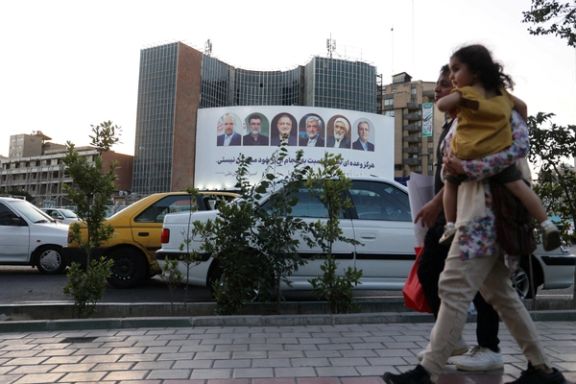
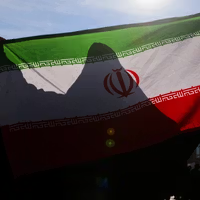
A billboard with a picture of the presidential candidates is displayed on a street in Tehran, Iran, June 17, 2024.
Whether it is a football championship or a presidential election in Iran, the outcome is always uncertain. There are many ifs and buts, with analysts, pundits, and spin doctors further complicating the scene.
In the absence of accurate and unbiased polls and surveys, predicting what might happen—even in the short term—is always challenging. This lack of reliable data makes it difficult for anyone to have a clear understanding of imminent events.
A few days before the voting day in Iran's snap presidential election, it remains uncertain who will stay in the race. Four of the six candidates—Majles Speaker Mohammad Bagher Ghalibaf, Tehran Mayor Alireza Zakani, former nuclear negotiator Saeed Jalili, and Martyrs Foundation Chief Amir Hossein Ghazizadeh Hashemi—are from the same camp. If they all remain in the competition, no one in the conservative camp is likely to win.
None of them is meaningfully more popular than others in the same camp, although Ghalibaf and Jalili are the two forerunners. The other two are so sure about their unpopularity that they do not do any campaigning, other than the free campaigning the state television offers all candidates.
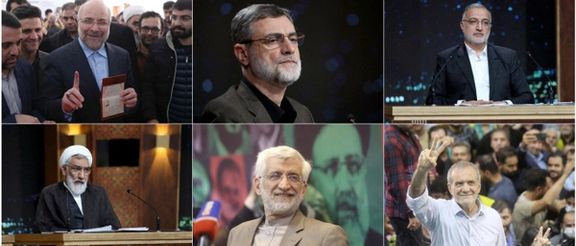
Combination picture shows Iranian presidential candidates Mohammad Baqer Ghalibaf, Amir Hossein Ghazizadeh Hashemi, Alireza Zakani, Mostafa Pourmohammadi, Saeed Jalili and Masoud Pezeshkian in Tehran, Iran.
Although none of the polls and surveys can be fully trusted at this time, all available figures—both genuine and fabricated—indicate that turnout will significantly impact the candidates' standings. Most suggest that a lower turnout increases the likelihood of a conservative victory, while a high turnout would favor the pro-reform candidate, Massoud Pezeshkian.
A turnout under 40 percent gives Jalili a strong chance of winning, potentially even in the first round. A 50 percent turnout puts Ghalibaf, a slightly less hardline candidate, in a better position. A 60 percent turnout would likely ensure Pezeshkian's victory in the first round, eliminating the need for a runoff election.
The reason is that over 60% of voters have shunned the ballot box in the last two elections due to deep disillusionment. The more this disillusioned majority votes, the more support relative moderates are likely to receive.
However, despite all the fuss about a consolidated conservative camp, they are badly divided. Their combination in the election, shows that it is every man for himself. Some journalists say there will be a conservative figureheads' gathering on Tuesday or Wednesday and three of the conservative candidates will withdraw in the interest of the more popular individual. No one yet knows for sure whether Jalili or Ghalibaf will remain in the race.
From the perspective of Supreme Leader Ali Khamenei, Ghalibaf is the preferable choice because, unlike Jalili, he lacks an ideological agenda and political party affiliation. Jalili's domestic and alleged foreign connections make him a suspect in Khamenei's eyes, as he leaves no room for doubts regarding his men's loyalty.
During the past days, while mudslinging against Ghalibaf has been diminishing, videos surfaced on social media in which former presidents Ebrahim Raisi and Hassan Rouhani showed Jalili in a bad light. Raisi said in his video that he offered many jobs to Jalili but he did not accept any one of them. These comments are extremely damaging as Raisi' is being treated like a saint following his death.
Rouhani on the other hand said that all members of the Supreme Council of National Security endorsed Former Foreign Minister Javad Zarif's way out of the diplomatic impasse over Iran's nuclear deal with big powers, but Jalili obstructed the plan and the negotiations failed.
The two videos could have not surfaced in a worse time. Many social media figures believe that they ruined Jalili's chances and brought Ghalibaf to a position to be one of the main two contestants in the upcoming election.
Current estimates of a low turnout might prove wrong. As Qom Seminarian Mohammad Taqi Akbarzadeh has noted, if officials misinterpret the people's votes as wholehearted support for government policies and fail to implement necessary changes, the public is likely to express their opposition through street protests and rebellion.
Iran's judiciary has warned citizens that using foreign messaging platforms by candidates and their supporters during elections constitutes a severe electoral offense punishable by law.
The Social Affairs and Crime Prevention Department of the Judiciary emphasized the gravity of this offense, particularly during the campaign silence period (24 hours preceding elections).
State-run IRNA news reported Tuesday that “The Judiciary has forged alliances with three telecommunications operators to heighten public awareness and advocate responsible technology usage, aimed at mitigating criminal activities.”
It further noted, “For the past three years, citizens have received cautionary text messages as part of an initiative to bolster awareness regarding their societal rights.”
Over the last twenty years, Iran has enacted comprehensive censorship policies, blocking tens of thousands of websites. The advent of social media and messaging apps has further restricted platforms such as Facebook, YouTube, Viber, WeChat, Telegram, and Twitter. Traditional media, literature, and cinema also face rigorous scrutiny, which is assessed against Islamic principles and political content.
To navigate around these online constraints and evade filters, individuals often resort to Virtual Private Networks (VPNs) to gain unimpeded access to the Internet. While in more liberal societies, VPNs are primarily used to protect user anonymity, in Iran, they serve as crucial tools for accessing unrestricted information.
The security officer who fatally shot 19-year-old protester Sepehr Beiranvand in 2022, has been acquitted of the murder charge.
"The plain clothes officer who fatally shot this teenager in the neck before bystanders was acquitted of the charge of intentional homicide by the central province court after one year and eight months," a person close to Beiranvand's family told Iran International.
According to this source, in June 2023, the officer was formally accused of deliberate homicide in an indictment issued by the Lorestan Military Court.
He added, "Following the case referral to the Supreme Court for confirmation of the punishment, the judges ordered a reexamination of the evidence by experts familiar with the case."
Beiranvand was writing slogans on a street in Khorramabad, in western Iran, when plainclothes officers noticed him. He attempted to escape by climbing a municipal gas pipe, but he was shot in the neck and died as a result.
According to the source, after Biranvand's death, the government insisted on holding a funeral without any relatives present before releasing his body. They also demanded money from his family to send experts to investigate the case. Witnesses to Beiranvand's killing emphasized that he was unarmed and just writing slogans when he was identified and shot.
The nationwide protests of 2022, known as the Woman Life Freedom movement, were sparked by the death of 22-year-old Mahsa Amini while in the custody of the morality police. The protests resulted in the deaths of over 550 protesters, including minors.
After a thorough investigation spanning 18 months, a UN fact-finding mission in March issued its report, determining that the Iranian government bears responsibility for the "physical violence" leading to the death of Amini.
According to the report, the regime perpetrated extensive and persistent human rights violations that contravened international laws, disproportionately affecting women, girls, children, and members of ethnic and religious minorities during the protests.
The Australian Iranian Community Alliance (AICA) has called on the Australian government to designate the Islamic Revolutionary Guard Corps (IRGC) as a terrorist organization.
The appeal, addressed to Prime Minister Anthony Albanese, Foreign Minister Penny Wong, and Attorney General Mark Dreyfus, was published on Tuesday, in the wake of Canada's recent designation.
AICA, which consists of 26 organizations and groups in Australia, made the call in response to a letter from the Australia-Iran Friendship Association that protested Canada's designation of the IRGC as a terrorist organization.
The AICA said the group is a supporter of the IRGC and the Islamic Republic and urged the Australian government to recognize the true nature of the IRGC and align with international allies to take a firm stance against activities that threaten global security.
The US designated the IRGC in 2019 and last year, the UK said Iran was among the country's number one foreign threats, though has not yet designated the group, in spite of calls from lawmakers.
In their letter of appeal, the AICA stated, "We write to express deep concerns regarding assertions recently made in an open letter that argues against the designation of the Islamic Revolutionary Guard Corps (IRGC) as a terrorist organization. This letter underplays the documented history and ongoing actions of the IRGC that unequivocally undermine global peace and security."
Dozens of plots against Iranian dissidents and Jewish and Israeli targets have been unveiled in the last two years, hatched by the IRGC, in countries spanning the globe.
AICA highlighted the IRGC's involvement in international terrorism, including bombings, rocket attacks on bases in Iraq, and the downing of civilian airliner PS752. They criticized the claim that the designation would serve foreign agendas, noting that many countries, including the European Union and the United States, have recognized parts or all of the IRGC as a terrorist entity.
Individuals such as dissident journalist Mahsi Alinejad and members of Iran International's news team have also been targets of plots to kill and abduct Iranians abroad.
The letter also condemned the friendship group's suggestion that such a designation would impact votes within Muslim constituencies in Australia, describing it as a manipulative tactic resembling hostage diplomacy.
The AICA asserted that Australian policy should be guided by facts and a commitment to national and international security, rather than speculative electoral implications.
The Australian Department of Foreign Affairs on Friday told Iran International that the current framework within Australia's Criminal Code does not allow for the listing of the IRGC as a terrorist organization. Several states claim that as a state body, designation is legally fraught.
However, they noted that the government has imposed targeted financial sanctions on more than 80 IRGC-linked individuals and entities since Iran's violent suppression of protests in September 2022.
Iran’s Supreme Leader Ali Khamenei says high voter turnout in Friday's presidential election is crucial for the survival of the Islamic Republic, amid what many have long described as a crisis of legitimacy of the ruling establishment.
“We place great importance on high participation because the most significant effect of high participation is the honor of the Islamic Republic,” Khamenei stated in a speech on Tuesday.
In what some experts said was an attempt to rally Iranians behind the regime's rhetoric of 'foreign enemies', he said, “The Islamic Republic has enemies. One of the things that can defeat these enemies is the election. If high participation of the people is observed in this election, it will be a source of honor for the Islamic Republic.”
A recent poll by the Netherlands-based Gamaan Institutesuggest that at least two thirds of eligible Iranian voters have decided to abstain from casting a ballot.
In the 2021 presidential election in Iran, the voter turnout was notably low, recorded at around 48.8%, which was the lowest in the history of the Islamic Republic's presidential elections.
The upcoming election is expected to face similar challenges, with projections of low turnout due to increasing social repression and the ongoing economic crisis facing the country.
The country's snap presidential election is set to be held on June 28 following the sudden death of Ebrahim Raisi in a helicopter crash last month.
Khamenei’s speech, delivered on Eid al-Ghadir—a significant Shiite Islamic holiday—emphasized the connection between religious duty and civic participation. Many observers noted that this was a transparent attempt to reinforce Tehran’s faltering legitimacy amid increasing internal and external pressures. He asserted, "Iran's strength does not lie in possessing an array of missiles, but fundamentally in the active participation of its citizens in the electoral process."
Additionally, Khamenei subtly indicated his favored presidential candidate by firmly rejecting any negotiations with the United States. He stated, "Some of our politicians believe they must align themselves with one power or another, or that the path to progress necessarily leads through the US; this is a grave misconception. Those who look beyond our borders fail to recognize and value our inherent capacities; naturally, they lack the vision to utilize them."
This stance would potentially appear to disqualify three of the six approved presidential candidates, including Mohammad Bagher Ghalibaf, Mostafa Pourmohammadi, and Masoud Pezeshkian. Pezeshkian, in particular, is seen as disadvantaged due to his association with former Foreign Minister Mohammad Javad Zarif, the so-called architect of the 2015 nuclear deal (JCPOA), who advocates for dialogue with other countries, including the US, to lift current sanctions.
Khamenei's speech also suggested the Supreme Leader’s ongoing efforts to “purify” the political landscape by narrowing down the circle of trusted regime insiders. He even urged the future president to vow, "Make a solemn pledge before God that you will refrain from appointing individuals and agents who deviate even slightly from the revolutionary path.
Despite mounting criticism of the country’s isolationist foreign policy, Khamenei appeared steadfast in his "Looking East" strategy, emphasizing relations with China and Russia over the West. He attempted to deflect any criticism saying, "Contrary to popular misconceptions, we are not pursuing isolation or severing our global ties. Except for a few nations, we are open to fostering connections with the broader international community."
Dissident Ahmadreza Haeri has written a letter from prison, urging Iranians to boycott the upcoming presidential election, arguing that participation legitimizes those who have stripped the Iranian people of their freedom.
In the letter, a copy of which was obtained by Iran International, the political prisoner asserts that Iranians now recognize the ruling power in the Islamic Republic seeks votes "only as a decoration for its authoritarian religious regime," with the president serving merely as a "facilitator for implementing orders."
Haeri is currently jailed in Ghezel Hesar Prison in the city of Karaj, serving a three-year, eight-month sentence. He received an additional prison sentence of about three months last July for his human rights activities during imprisonment.
A special election will be held on June 28 to replace former President Ebrahim Raisi, who died in a helicopter crash in May. Six candidates, who have been handpicked by the Islamic Republic's Guardian Council, are vying to replace Raisi.
Ahmadreza Haeri
In his letter, Haeri pointed to the decline in electoral legitimacy and public support for the current regime, referring to the record-low voter turnout in the recent parliamentary and Assembly of Experts elections. According to the state news outlet IRNA, about 25 million of Iran's 61 million eligible voters cast their ballots.
"The grandeur of this massive non-violent struggle for the right to self-determination has permanently changed the political landscape of the country," Haeri wrote.
Haeri emphasized that from 1997 to 2017, the “oppressed people of Iran” went to the polls out of fear and desperation to bring about change, but their participation yielded no lasting benefits.
According to a new survey, conducted by the Netherlands-based Gamaan Institute, 22% of respondents in Iran confirmed they would definitely vote, while 12% remain undecided.
The survey highlighted deep-seated dissatisfaction with the current political system, with roughly 68% of respondents citing "opposition to the overall system of the Islamic Republic" as their primary reason for not voting. Other notable reasons included "the limited power of the president".
Voter participation has been on a steady decline in Iran, with over 50% of eligible voters staying home for the election of now-deceased President Raisi in 2021. That election saw about 3.7 million invalid ballots cast, that were likely to have been mostly blank or protest votes.
Meanwhile, hundreds of teachers, union activists, and prominent cultural figures in Iran have publicly announced their decision to abstain from voting in the upcoming presidential elections. They assert that participation is futile and risks legitimizing the government while intensifying the suppression of dissent.
Haeri was released from Greater Tehran Prison in October 2020 after serving a previous sentence and receiving 74 lashes. In December last year, he was handed arbitrary new charges for writing letters against the death penalty, sham elections, and violations of fair trial rights for prisoners, and spent time in solitary confinement in June.
Other prisoners who have spoken out against participation in the upcoming elections include Nobel-laureate Narges Mohammadi and Golrokh Iraee.
Mohammadi wrote from Tehran’s Evin Prison that she would not participate in the "illegal elections of the oppressive and illegitimate government." Iraee criticized the factions of the so-called reformists for encouraging participation, calling it a betrayal, writing that "Reformists should know that we, the people of Iran, remember their betrayal from the beginning and will not forget."