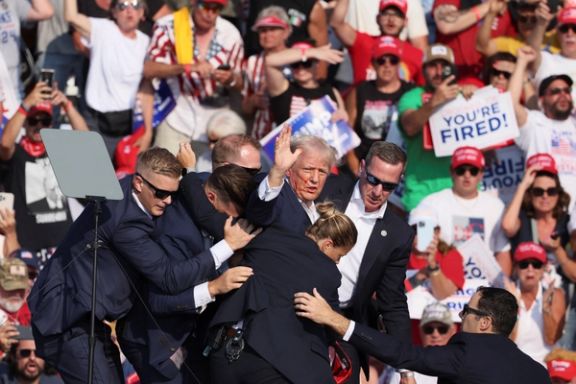
Former President Donald Trump is surrounded by US Secret Service agents at a campaign rally, Saturday, July 13, 2024, in Butler, Pa.
Trump's former aide John Bolton told Iran International that a reported Iranian plot to assassinate the former president during the US election campaign would be surprising, as anyone in that situation would take it "personally."
The former US national security adviser and long-time proponent of regime change in Iran told the ‘Eye for Iran’ podcast that despite the reported plot, there’s no indication Tehran had any involvement with Trump’s assassination attempt in Pennsylvania on Saturday.
Iran has vowed revenge for the killing of Qasem Soleimani, the commander of the Islamic Revolutionary Guard Corps (IRGC), who was killed in a US air strike in January 2020 on orders from then-President Trump.
Many of the Trump administration officials, as well as the former US president himself, were threatened by high ranking Iranian officials, including the Supreme Leader Ali Khamenei in January 2021.
Threats continued to come as late as February 2023, when Amir Ali Hajizadeh, the IRGC Aerospace Commander, appeared on Iranian TV to say, “God willing, we will kill Trump, Pompeo, [Frank] McKenzie, and the military commanders who ordered [Soleimani’s assassination].”
"We've known of the threat against President Trump... but this [plot] is surprising" Bolton told podcast host Negar Mojtahedi on Wednesday.
"This seems to be the first indication of the regime in Tehran actually taking some step toward going after Trump. And to do it in the middle of a presidential election campaign where Trump was at least competitive as they began planning a possible assassination, I do find surprising," Bolton added.
When asked about Iran's apparent silence to the news of Trump's attempted assassination, Bolton said it was "at least indirect confirmation" that Tehran was seeking to target the US president.
"Maybe the regime is trying to come up with creative new ways to go after its enemies... I think it's appropriate to take it seriously and it's potentially not simply a threat."
A significant IT outage has disrupted travel, banking, and healthcare services worldwide, while in Iran industrial, public and private systems appear to be running normally except government's intentional interference with Internet.
What happened globally?
A global IT outage hit various industries, including airlines, hospitals, retailers, and other businesses. Nearly 1,400 flights were canceled on Friday, and essential banking, healthcare, and retail services were also affected.
Elon Musk, CEO of Tesla and X, has described Friday’s incident as the "biggest IT failure in history."
What caused the crisis?
Two significant issues involving Microsoft's widely used cloud systems have occurred in quick succession. First, an outage affected Microsoft clients using the Azure cloud service. Second, Windows devices experienced problems shortly after due to an update from CrowdStrike's Falcon antivirus software, designed to protect against malicious attacks.
Microsoft said it has addressed the root cause, but some services still face residual issues. Despite the fix, cyber-security experts warn that restoring full functionality will require significant effort.
Why is Iran unaffected by this global crisis?
Iran is unaffected by the global IT outage mainly because it uses a different system to control, monitor, and analyze industrial devices and processes.
Iran relies on SCADA (Supervisory Control and Data Acquisition) systems, which are crucial for managing infrastructure like power grids, water treatment facilities, and the petroleum industry, Sahar Tahvili, an AI researcher, told Iran International.
What exactly is SCADA, and how does it differ from a cloud system?
SCADA focuses on the local, real-time control and monitoring of physical systems. It operates within a limited connectivity framework, typically confined to a local or regional network, processing data in a central computer system to manage and optimize operations. Tahvili, the co-author of “Artificial Intelligence Methods for Optimization of the Software Testing Process,” told Iran International.
Conversely, a cloud system emphasizes remote access, extensive data storage, and powerful computing capabilities over the Internet. It easily scales to handle large volumes of data and users, providing broad connectivity and resource flexibility that extends beyond the constraints of local networks.
Passengers wait at the Benito Juarez International Airport due to a worldwide tech outage that caused flight delays, in Mexico City, Mexico July 19, 2024. REUTERS/Luis Cortes
But why is Iran using a different system?
According to Tahvili, Iran relies on SCADA systems for industrial and facility-based processes primarily due to international sanctions and the lack of advanced infrastructure and technology management options.
Do other countries utilize SCADA systems?
Other countries might use SCADA mostly for managing the manufacturing process but not as the main system for managing and monitoring their industrial and infrastructure processes.
Is SCADA a domestic system? If not, how can Iran utilize it despite sanctions?
The expert explained that SCADA is not Iran's invention. It consists of hardware and software components that can be sourced from various international suppliers. In response to sanctions, Iran might have developed its own SCADA systems or adapted existing ones to meet its needs.
“This involves using local expertise to design, manufacture, and maintain SCADA components. Iran might procure SCADA components and software through third-party suppliers from countries that do not adhere to the same sanctions or through indirect channels, making it possible to bypass certain restrictions,” according to the AI researcher.
Iran seems to have deftly navigated the recent global IT chaos, but what is the unseen factor at play here?
Iran's National Center for Cyberspace presented the situation positively, stating, "No damage or disruption in services to the public has been reported in Iran. Due to Western sanctions, Iran has been barred from receiving these services for years. Consequently, local, alternative services were developed by the country's youth and experts and are currently operational."
The statement further highlighted, "Additionally, the country has developed robust capabilities in providing indigenous cloud services, which are now ready for export to other countries. Iran is prepared to share its expertise and export products in this field."
However, Tahvili holds a different perspective.
She remarked, "SCADA systems are often considered outdated and face several challenges, particularly regarding integration and compatibility with newer technologies such as cloud computing." As industries increasingly move towards advanced data analytics and cloud-based solutions, "the compatibility of SCADA systems becomes a significant concern," Tahvili explained. This integration challenge can "lead to inefficiencies and limit the ability to leverage cutting-edge technological advancements fully."
She further highlighted that "the connectivity of SCADA systems to corporate networks and the internet introduces severe security vulnerabilities." While remote monitoring and control are essential, this connectivity "exposes SCADA systems to external threats, including cyber-attacks and malicious software like the Stuxnet worm." Referring to the infamous Stuxnet incident in 2010, Tahvili pointed out that it "specifically targeted SCADA systems and caused substantial damage to Iran's nuclear program."
Tahvili emphasized the critical need for robust cybersecurity measures, stating, "Several security breaches have highlighted the need to protect these critical infrastructures." Despite SCADA systems being essential for Iran's industrial processes due to sanctions and limited infrastructure, their "outdated nature and compatibility issues with new technologies pose significant challenges." Additionally, she warned that "the security vulnerabilities arising from their connectivity to broader networks underscore the urgent need for enhanced security protocols to safeguard against potential threats."
A former Iranian diplomat has made an odd statement, asserting that it doesn't matter to Iran who leads the next US administration, just one day after Donald Trump was nominated as the Republican presidential candidate.
Saying this in an interview with Khabar Online website in Tehran Fereidoun Majlesi added: "We have had enough tensions. It is now time for peace." In another odd statement the former diplomat said that political parties do not determine American foreign policy, perhaps hinting that Washington’s position regarding Iran transcends Republican or Democratic administrations.
The centrist website noted that the United States currently shows little interest in political changes in Iran or nuclear negotiations with Iranian officials. At the same time, Iran's President-elect Masoud Pezeshkian, in his latest statements, welcomed negotiations with Europe but expressed no interest in talks with the United States.
The discussion about what will follow the recent presidential elections in Iran is a recurrent theme in Tehran’s government-controlled media, that mostly tries to highlight Pezeshkian’s positive statements about the need to have good relations with other countries. But media outlets rarely mention his back-and-forth messages of support for Iran’s militant proxy forces.
Former Iranian diplomat Fereidoun Majlesi
Highlighting that Iran has lagged behind in development for 45 years, Majlesi stated that Iran needs to reduce tensions with the United States and Israel and demonstrate goodwill to reach a compromise and normalize the situation. Additionally, Iran should accept international banking protocols and conduct transactions using US dollars to facilitate international trade.
However, no media outlet mentions that this requires a drastic change in foreign policy that only Supreme Leader Ali Khamenei can authorize.
Meanwhile, in an interview with the Iranian Labor News Agency (ILNA), international relations analyst Reza Nasri said that if the Pezeshkian administration is looking for economic development, it should first seek security and stability in the region.
Iranian foreign policy analyst Reza Nasri
Nasri added that like Saudi officials, Pezeshkian believes that regional countries should not waste their financial resources on attritional conflicts. Majlesi had also pointed out that so far, Iran has been wasting its resources in wars against other regional and Muslim countries.
Nasri explained that Pezeshkian's declared foreign policy is based on the three pillars of balanced relations with regional states, constructive interaction to facilitate development and adopting policies that would not be costly for the people's livelihood. He also pointed out that Tehran and the United States should conduct negotiations at one point as both are major players in the region and cannot ignore each other.
To this end, he said, Pezeshkian should put together an agile foreign policy team of pragmatic officials mindful of the fact that unpredictable situations might be awaiting us six months later. The new Iranian foreign policy team should be prepared to face any scenario, he added.
Nonetheless, speaking about the support Pezeshkian has expressed for the "axis of resistance," – or Iran’s proxies - Nasri said that a solid and strong diplomacy by Iran as well as international support for the Palestinian cause, could turn the resistance into a legitimate "liberation movement."
Meanwhile, former ambassador to the United Kingdom Mohammad Hossein Adeli told the press in Tehran that "Iran is playing a game at the edge of a cliff," and added that "those who still talk about circumventing the sanctions are in fact thinking of the continuation of sanctions." He was likely referring to influential insiders who are widely believed to be profiting from the US oil export and international banking sanctions.
Adeli warned that "The slightest error in foreign policy can drag Iran into an instability that might affect the country's existence." He urged Pezeshkian to adopt a realistic approach and carefully assess the regional and international situation.
Adeli further cautioned that regional developments could lead Iran into a war benefiting Israel and the United States. He stressed the need for Pezeshkian to assemble a foreign policy team capable of navigating and avoiding such dangerous scenarios.
Iran has secretly agreed to support Al-Qaeda fighters in Afghanistan and fund the group's operations in the Middle East, according to Afghanistan United Front (AUF), an opposition group.
The AUF’s report detailed an October 2021 meeting in Tehran, where IRGC Quds Force commander Esmail Qaani, Al-Qaeda leader Saif al-Adel, and a senior Taliban representative agreed on cooperation between Al-Qaeda and IRGC-affiliated groups in the Middle East and Africa. This marked the first recorded in-person meeting of these senior officials. The agreement involved the Taliban providing training space and tools for Al-Qaeda fighters in Afghanistan, while the IRGC covered their expenses and funded operations.
The alleged meeting took place just two months after the Taliban overran Afghanistan and the US hastily withdrew from the country after a 20-year military and political presence.
According to UAF, Qaani congratulated the Afghan Taliban and Al-Qaeda on their success in Afghanistan, stating, "We all have done a great job; now we need to chase the Americans out of the Middle East as well."
The report noted that the first important point they agreed on was that all Al-Qaeda branches, affiliate groups, and the IRGC in the Middle East and Africa would collaborate, with both sides working to broker peace among them.
“The first peace was brokered between the Houthis and Al-Qaeda in the Arabian Peninsula, which still holds, and coordination with Hezbollah and groups in Iraq and Syria is now operational" the report said. “The second point was that the Afghan Taliban should provide space and tools for training the Al-Qaeda fighting force."
“The last point was that the IRGC is willing to pay for all their expenses in Afghanistan and their overseas operations in the Middle East as well,” the document added.
The report by the AUF, led by Sami Sadat, former commander of the Afghan army's special forces and based in the US, sheds light on the funding and extensive cooperation between the IRGC, Al-Qaeda, and the Taliban, extending to the Arabian Peninsula. Previous reports have also revealed Iran's close ties with Al-Qaeda.
In February, the US State Department told Iran International that Tehran has permitted Al-Qaeda to facilitate terrorist activities and transfer funds and fighters since 2009 while also harboring its leaders within its borders.
In January 2021, then US Secretary of State Mike Pompeo publicly accused the Iranian government of permitting Al-Qaeda to establish a "new home base" within its borders, asserting that "Al-Qaeda today is operating under the hard shell of the Iranian regime's protection."
In February 2023, the UN reported that Seif al-Adel, the apparent new leader of Al-Qaeda, was residing in Iran, a claim later confirmed by US authorities.
A large, long-range drone hit the center of Tel Aviv in the early hours of Friday, in an attack claimed by the Iranian-backed Houthi militia that killed one man and slightly wounding four others, the Israeli military and emergency services said.
The explosion, which did not trigger air raid alarms, occurred hours after the Israeli military confirmed it had killed a senior commander of the Iran-backed Hezbollah militia in southern Lebanon.
"An initial inquiry indicates that the explosion in Tel Aviv was caused by the falling of an aerial target, and no sirens were activated. The incident is under thorough review," the military said in a statement.
It was not clear how a relatively slow-moving drone evaded extensive Israeli air defenses. In April when Iran fired nearly 350 drones and missiles, 99% were intercepted and no real damage was reported.
Iran’s Tasnim website affiliated with the Revolutionary Guard published the news of the attack, quoting Houthi officials praising the operation, and saying the “one Zionist was killed and eight others injured.” Other Iranian government-controlled media relayed the news insisting that the Houthis were able to inflict “great damage” on Tel Aviv.
The attack on Tel Aviv is likely to fan fears about further fallout from the Gaza war, as the Houthis and other Iranian proxies side with the Palestinian militant group Hamas.
It said air patrols had been increased to protect Israeli airspace but said it had not ordered new civil defence measures, however the mayor of Tel Aviv said the city, Israel's economic centre, had been moved to a state of heightened alert.
A spokesman for Yemen's Houthi militants, which like Hezbollah are backed by Iran, said the group had attacked Tel Aviv with a drone and would continue to target Israel in solidarity with Palestinians in the Gaza war.
In a televised speech, spokesperson Yahya Saree called Tel Aviv a primary target "within the range of our weapons".
Israel's emergency services said the body of a 50-year-old man was found in an apartment close to the explosion and said the circumstances were being investigated.
Four people were taken to hospital with slight shrapnel injuries and four others were treated for shock. All of them were later released, the hospital said.
Footage from the site showed an apparent impact on a building located close to U.S. embassy premises in Tel Aviv. Broken glass could be seen strewn across the city pavements as crowds of onlookers gathered nearby. The site was sealed off by police tape.
Israeli media said fragments from a drone of a kind widely used by Iranian-backed militia groups in the region had been recovered nearby.
Israel has been exchanging daily missile and artillery fire with Hezbollah along its northern border and in southern Lebanon since the start of the war in Gaza, prompting fears of a wider regional conflict if the situation escalates.
The Houthis have also stepped-up attacks against Israel and Western targets, saying they are acting in solidarity with the Palestinians.
Israel invaded the Gaza Strip following an attack by Hamas militants on southern Israel in October last year.
Former US President Donald Trump blamed the Biden administration for Iran edging close to nuclear weapons at the fourth and final night of the Republican National Convention (RNC) Thursday evening.
He made his keynote address, appearing somber and bandaged, accepting the GOP presidential nomination at the RNC convention in Milwaukee just five days after an assassination attempt that could have ended his life.
When it came to Iran, from its advancements on the nuclear front to its proxies multi-front campaign against Israel, the presidential candidate didn't hold back, taking strong aim at President Biden and his administration.
"Iran is very close to having a nuclear weapon, which would have never happened. This is a shame...the damage that this administration has done," said Trump to a cheering crowd.
Iran has enriched enough uranium to 60% purity for at least three bombs, according to the International Atomic Energy Agency (IAEA). Iran could convert uranium enriched to 60% to bomb-grade fuel in just a matter of days.
Iran's nuclear gains under Biden's administration, according the FDD's Behnam Ben Taleblu, are irreversible and his approach has led to a "credibility crisis."
"The contradictory approach under Biden of trying to de-escalate and establish deterrence has led to a credibility crisis exploited by US adversaries," he said.
Trump reiterated his claim that Iran was on the verge of agreeing to negotiate a new deal to more strictly curb its nuclear program before Trump lost the 2020 election.
He also said that the Oct 7 atrocities would have never happened on his watch.
"Iran was broke. Iran had no money. Now Iran has $250 billion. They made it all over the last two and a half years. They were broke," said Trump.
Trump's logic being that if Iran is financially struggling, the clerical establishment would find it tough to finance its proxies committing acts of terror.
“I told China and other countries if you buy from Iran, we will not let you do any business in this country.”
In April, President Joe Biden signed into law new sanctions aimed at reducing the flow of Iranian oil to China, which purchases about 90 percent of Iran's oil exports.
A bipartisan group of over 40 US House lawmakers called on the Biden administration to “expeditiously implement” stringent new Iran sanctions targeting the country’s oil exports to China in June.
The FDD's Taleblu told Iran International that the data is clear, under Trump's policy, the Islamic Republic, struggled to pay its proxies like Hamas and Hezbollah.
"Trump's Iran policy drove down both Iranian oil revenues and exports. Through his strategy of cost imposition Tehran struggled to pay its proxies and even keep some of its propaganda stations afloat," said Taleblu.
Trump's statement that the attack on Israel would not have happened with him as president is not new.
Speaking on Iran International's podcast Eye for Iran, which aired before the final night of the RNC, Trump's former National security advisor, John Bolton, said nobody knows what would have happened.
"It's one of those Trump statements that's neither provable nor disprovable. Nobody knows because he wasn't president," said Bolton.
Jason Brodsky, the policy director of United Against Nuclear Iran said Trump understands how to make US adversaries fear the American president.
"There is an important strategic logic to that dynamic. This is something that President Biden has struggled with. This can be seen after Biden warned Iran with “Don’t,” Tehran still launched the first direct attack on Israel since 1979," said Brodsky.