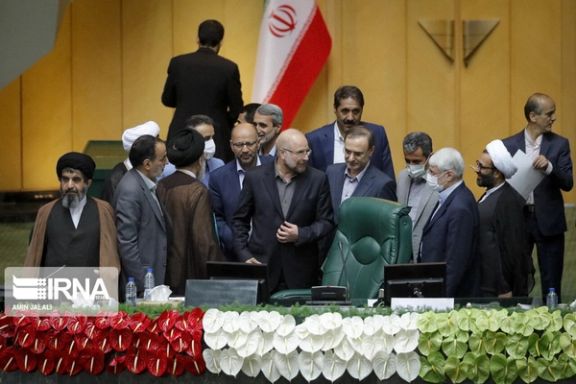
Iran's Masoud Pezeshkian has two weeks to present his cabinet to a parliament dominated by hardliners and ultra-hardliners who supported his rivals in the recent presidential election.
At Pezeshkian’s endorsement ceremony Sunday, Supreme Leader Ali Khamenei said the selection of the cabinet is the “joint work of the administration and the parliament” and stressed that the cabinet should be formed as soon as possible.
Khamenei’s emphasis on the need to speed up the formation of the new government means two things, the ultra-hardliner lawmaker Ahmad Rastineh saidSunday: Pezeshkian should present his proposed cabinet to the parliament quickly, and while “cooperating” with the new president, the Parliament should approve those ministerial appointments that confirm with Khamenei's criteria, as quickly as possible.
Referring to reformists’ possible influence in Pezeshkian’s cabinet, Rastineh declared that the President should not consider himself aligned with a “certain political current”.
The so-called ‘Principlist’ majority of the 12th Parliament is divided into two major factions, hardliners who support the Speaker Mohammad-Bagher Ghalibaf and ultra-hardliners who fielded Saeed Jalili in the elections.
The two groups have diverged in the past few years and the umbrella term ‘Principlist’ which once defined all conservatives as opposed to ‘reformists’ no longer defines a united front.
The conflict between Ghalibaf and Jalili's supporters on social media during the parliamentary elections earlier this year significantly escalated when Jalili refused to allow Ghalibaf, who had a better chance against Pezeshkian, to represent the 'revolutionary front' in the presidential runoff elections in July.
Pezeshkian may manage to get some support from Ghalibaf’s faction which considers Jalili a much bigger threat than the reform-oriented Pezeshkian. After Ghalibaf lost in the first round of the presidential vote, many of his supporters openly supported Pezeshkian in the runoff election to prevent Jalili's victory.
It remains to be seen how likely Ghalibaf is to cooperate with Pezeshkian and steer his faction to protect him and his cabinet from Jalili’s ‘revolutionaries’.
“Mr. Ghalibaf ought to do everything in his power as the head of the legislature to prevent the radicals in the parliament from blocking the government’s path with their insistence on radical behaviors,” Gholam-Ali Jafarzadeh-Imanabadi, a former ‘Principlist’ lawmaker,said Sunday.
Jafarzadeh-Imanabadi argued that it is time for Ghalibaf to repay the favor to the parliament’s independent faction, of which Pezeshkian was a leading figure. Without their support, Ghalibaf would not have been re-elected as speaker of the 12th Parliament in March.
There are also two smaller groups of ‘Principlists’ in the parliament consisting of moderate conservatives and conservatives. These groups consist of the supporters of former President Hassan Rouhani, former Speaker Ali Larijani, the Islamic Coalition Party, and the Association of Combatant Clerics led by presidential candidate Mostafa Pourmohammadi.
These two groups have been eliminated from centers of power by hardliners and ultra-hardliners in the past few years and many among them cast their votes for Pezeshkian in the runoff elections. Ghalibaf can also get their support in helping Pezeshkian cabinet.
‘Principlist’ lawmakers make up more than two-thirds of the Parliament’s 290 lawmakers.
There are less than 100 ‘reformists’ and independents, mainly from smaller constituencies, whom Pezeshkian can also count on to support his proposed ministers.
Of Ebrahim Raisi’s nineteen ministers, only one was rejected by a sympathetic parliament in 2021. In contrast, hardliner and conservative lawmakers refused to endorse several of the ministers proposed by Hassan Rouhani during his two presidential terms in 2013 and 2017. However, reformist Mohammad Khatami managed to secure a vote of confidence for all his ministers from a conservative-majority parliament during his first term in 1997.
As the Iranian state is determined to display its strength in the Middle East, not least by confronting Israel through its various proxies – it ultimately faces mounting challenges in sustaining its authority within its own borders.
Neither its reported logistical support for the October 7 attack by Hamas on Israel, the attacks by the Houthis on ships in the Red Sea, nor the launch of six thousand rockets by Hezbollah towards Israel from October 8th, 2023, can obscure this reality.
In 2024, serious questions have arisen regarding the government's authority, which is typically demonstrated through organizing government-sponsored gatherings, ensuring insider cohesion and cooperation, maintaining essential public services, and supporting internal forces.
The state’s waning influence to mobilize
On July 26, the state attempted to stage a celebration of the mandated Islamic hijab in Tehran’s Azadi Stadium, which has a capacity of one hundred thousand. Despite extensive promotion through government propaganda outlets and the provision of free entry, transportation, and amenities for attendees, over 70% of the seats remained empty. This event not only highlighted a significant lack of public interest but also exposed the government's diminishing power to politically mobilize and demonstrate popular support for its policies.
Following that, the Muharram mourning ceremony, which commemorates the martyrdom of the Islamic Imam Hussein, was notably uneventful this year despite being primarily funded by municipalities. Previously a ten-day event, it was reduced to just two days, with fewer mourning tents in populous neighborhoods and a significant drop in attendance.
Overall, the state’s heavy-handed enforcement of Islamic practices and suppression of the population have had a counterproductive effect. Mosques across Iran have become less frequented and have lost their sense of community connection. The latest official numbers indicate that at least two-thirds of the country's mosques (50,000 out of 75,000) have been closed, and the number of worshippers has significantly diminished.
A fractured executive branch
The administration of President Ebrahim Raisi had such a seemingly indefensible track record that, after his sudden death in a helicopter crash, Supreme Leader Ali Khamenei and his appointees in the Guardian Council allowed former Health Minister Masoud Pezeshkian and the “reformists” supporting him to enter the executive branch.
Despite the mistrust Khamenei almost certainly harbors for the “reformist” camp, he likely felt he had no choice but to turn back to them. He gave them enough room to campaign and reassured them with favorable statistics to encourage their participation in the executive branch.
This development unfolded while the chief editor of Kayhan, a newspaper under Khamenei’s direct management, described Pezeshkian’s colleagues in charge of selecting cabinet members as follows: "Most of the members of the Steering Council and its sub-committees are those who, in their records, are associated with the enemy's intelligence services, have security convictions, corruption, defense of homosexuality, disbelief in the system and revolution, alignment and association with the American, British and Israeli triangle, have been involved in seditions and riots, secretly meeting with the enemies of Iran in America and receiving instructions to create sedition in the country, [and] asking America to apply crippling sanctions against Islamic Iran.”
In his desperation to avoid another largely unpopular presidency, Khamenei has caused his once-unified executive branch to visibly fracture.
Infrastructure failures fuel growing discontent
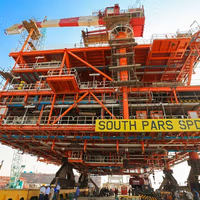
The government’s failure to invest in and maintain infrastructure, coupled with inadequate public services, has heightened the risk of public protests. Issues such as power, water, and gas outages, along with potential increases in gasoline prices, have fueled growing discontent.
The number of power outages in the country, exceeding 50 per month, has now reached levels seen in failed and weak states such as Yemen and Niger.
According to Pezeshkian, gasoline imports have reached approximately $8 billion annually, a cost the government cannot sustain long-term without raising prices. Such increases could lead to public unrest similar to the November 2019 protests, where demonstrations over hiked fuel prices quickly turned into calls for regime change.
Rifts deepen in Khamenei’s top circles
In addition to other internal rifts, there have been notable internal conflicts within the top circles around the Supreme Leader.
One example of the internal tensions within Khamenei's inner circle is the July 8 edition of Jam Jam Daily. This newspaper, published by the state-owned TV and Radio Organization directly managed by the Leader, used Photoshop to remove Gholamhossein Mohseni Ejei and Mohammad Baqer Qalibaf—heads of the judiciary and legislative branches—from a photo of Pezeshkian’s approval ceremony in Khamenei's office.
Additionally, the support for Pezeshkian from several of Khamenei's close associates, such as his bodyguard Vahid Haqqanian, along with the early resignation of numerous IRGC members, signals a growing distance between the original leaders of the Islamic Republic and the regime's more hardline elements.
Iran’s permanent mission to the United Nations said Tehran will not hesitate to exercise its right to self-defense, pointing a finger at Israel for the assassination of Hamas leader Ismail Haniyeh on Iranian soil.
Haniyeh, who had traveled to Tehran to participate in the inauguration of President Masoud Pezeshkian, was targeted in the early hours of Wednesday at a highly guarded compound at the foothills of high mountains in northern Tehran.
In a letter to the United Nations on July 31, Ambassador Amir Saeed Iravani described the attack as "a severe infringement on [Iran's] sovereignty" that violated international law.
"This rogue and terrorist regime and its accomplices bear responsibility. The Islamic Republic of Iran will not hesitate to exercise its inherent right to self-defense, as enshrined in Article 51 of the United Nations Charter to respond decisively and promptly.”
In letters to the United Nations in April, Iran used the same article as a basis for self-defense, before launching a missile and drone attack on Israel on April 13.
During that attack, Iran launched a volley of missiles and drones at Israel, claiming it was in retaliation for Israel's suspected deadly attack on its embassy compound in Damascus on April 1. However, nearly all of the projectiles were intercepted and shot down.
Denying the bombing scenario
IRGC-affiliated Fars news agency rejected on Wednesday a report by the New York Times about the assassination of Haniyeh, which said he was killed by an explosive device hidden in his room two months before the hit.
"These lies are being propagated while the results of the experts' investigation indicate that Haniyeh was struck by a projectile, in which involvement of the Zionist regime cannot be ruled out,” Fars said.
Iran's leadership has been clear about its intention to retaliate. Iran’s Supreme Leader Ali Khamenei said Israel “martyred our dear guest in our house … and prepared the ground for a harsh punishment for itself.”
General Mohammad Baqeri, Chief of Staff of Iran's Armed Forces, on Thursday said, "The Zionist regime will undoubtedly regret it."Baqeri also noted that Tehran is currently deliberating on the appropriate response to avenge the assassination of Haniyeh.
Ali Akbar Ahmadian, the secretary of Iran's Supreme National Security Council, told Iran's semi-official Mehr news agency, "All fronts of the resistance will take revenge for Haniyeh's blood."
Khamenei was present at the meeting, which also included officials from Hezbollah, Iraqi militant groups and other armed forces allied with Tehran, the report said.
The Biden administration is confident that Iran plans to retaliate against Israel for the recent assassination of Hamas political leader Ismail Haniyeh in Tehran and is preparing measures to counter such an attack, according to three US officials who spoke to Axios.
The Thursday report also added that US officials anticipate any Iranian retaliation will follow a similar pattern to their April 13 attack on Israel but could be larger in scale. They suggest that the response may involve the Lebanese Hezbollah.
"The Biden administration is concerned it may be more difficult to mobilize the same international and regional coalition of countries that defended Israel from the previous Iranian attack because Haniyeh's assassination is in the context of the Israel-Hamas war, which has drawn sharp anti-Israel sentiments across the region," added Axios.
In a call between President Joe Biden and Israeli Prime Minister Benjamin Netanyahu on Thursday, the White House reaffirmed its unwavering support for Israel’s security against threats from Iran and its proxies, including Hamas. According to a readout released by the US, they discussed enhancing Israel’s defense capabilities, including deploying new military defenses.
Senator Lindsey Graham shared the readout on X saying that "it is always good for any American administration to reassure Israel that we have their back against Iran and their proxies and will provide the necessary defensive capability."
However, he argued that "it is long past time to start talking about offense when it comes to Iranian threats against Israel, the United States, and the world."
The Middle East has recently witnessed a series of security and military developments, including targeted assassinations carried out by Israel, aimed at prominent leaders of Iran-backed armed movements.
These events come at a time of rising fears of a full-scale regional war, with escalating tensions between Israel and Iran's proxies in Lebanon, Iraq, Syria, and Yemen. This escalation coincides with a coordinated and forceful American move in Iraq.
The assassination of Ismail Haniyeh, one of Hamas' most prominent leaders, in Tehran was the most spectacular of such attacks. Haniyeh, who was leading the political operations of the movement while living abroad, was the second leader of an Iran-backed armed group to be killed in less than 24 hours.
Hamas accused Israel of carrying out the attack after Haniyeh attended the inauguration of the new Iranian president. The assassination comes at a critical time, coinciding with escalating tensions between Israel and Hezbollah and rising fears of a wider regional war.
In the same context, Israel carried out an attack in the Lebanese capital, Beirut, on Tuesday resulting in the death of Fuad Shukr, Hezbollah’s top military commander, accused of carrying out a deadly attack in the occupied Golan Heights that killed 12 children.
The Israeli retaliation against Fuad Shukr, the second-in-command in Hezbollah and one of Hassan Nasrallah's top advisors, known as “Hajj Mohsen,” eliminated a prominent military figure in Hezbollah, with a $5 million bounty placed on him by Washington.
Haniyeh (R), and two other Iranian proxy leaders (L & center L) attending Pezeshkian's inauguration on Tuesday
He was often described as the “Qasem Soleimani of Hezbollah” due to his significant role in planning and executing Hezbollah’s military operations, making his death a significant loss for the terror group.
The latest escalation is the most serious since the clashes between Hezbollah and Israel began last October following the outbreak of the Gaza war, sparked by the Iran-backed Hamas invasion of Israel. Hezbollah has since launched over 6,400 projectiles towards Israel in support of Hamas in Gaza.
Although Israel has not commented on Haniyeh’s death, it has previously called him “a dead man walking” and amid sensitive hostage negotiations, had to agree not to assassinate him in Doha, one of his foreign bases.
Haniyeh was the point contact for the negotiations moderated by the United States, Egypt and Qatar to release 114 Israeli hostages still held in Gaza after Hamas took 250 or more captive on October 7. Questions now linger as to who will take his place.
The double assassination comes at a time when Israel faces multiple challenges on several fronts, including Syria, Iraq, Lebanon, and Yemen, Iran’s proxies acting in allegiance with Hamas in Gaza.
By attacking Haniyeh in Tehran, Israel aims to send a direct and clear message to the Iranian regime, led by Ali Khamenei, indicating that Israel can reach its targets whenever and wherever it wants.
Hezbollah chief Nasrallah speaking via video link in Beirut, with Khamenei picture in background
Israel’s decision, seen as a move to strengthen deterrence against the Tehran axis, also included targeting Ismail Haniyeh on the day of the new Iranian president's inauguration, a carefully timed move to deliver a precise political and security message.
Simultaneously and possibly not by coincidence, the United States carried out a defensive airstrike in Iraq this week on a base south of Baghdad which resulted in the death of four and injury of four members of the Iran-backed Iraqi Popular Mobilization Forces.
While the Popular Mobilization Forces did not directly accuse anyone, the United States indicated that the strike targeted militants planning drone attacks threatening US and coalition forces. Since October 7, over 200 attacks by Iranian proxies have targeted US troops across the region with multiple deaths and scores of injuries.
A spokesman for the Iraqi armed forces condemned the attack, calling it an "atrocious crime" that could undermine joint efforts to combat ISIS. These developments come at a sensitive time for Iraq, which is experiencing increased reciprocal attacks between armed factions since the war between Israel and Hamas.
With 2,500 American troops in Iraq, the US-led coalition is expected to begin withdrawing in September, with some forces possibly remaining in an advisory capacity until 2025.
The recent assassinations of prominent leaders in Hamas and Hezbollah indicate a new Israeli strategy that relies on preemptive and direct strikes to enhance deterrence and send clear messages to Tehran and its allies. This escalation occurs amid broad geopolitical shifts, with both the United States and Israel aiming to reduce Iran's influence in the Middle East.
In Iraq, the American attack on Popular Mobilization Forces reflects growing tensions between Washington and Iran's proxies, showcasing US readiness to take strong measures against threats to its forces. These strikes come at a time when Iraq is experiencing political and security turmoil, further complicating the situation and placing the Iraqi government in a difficult position between maintaining its relationship with Washington and containing internal anger from Iran-backed armed factions.
The Iranian government, along with its regional proxy groups, is preparing to respond to Israel for the embarrassing assassination of Hamas's Ismail Haniyeh in Tehran, who was supposed to be well protected.
As the Middle East teeters on the brink of a broader conflict, Iran's rhetoric has reached fever pitch, with top officials and media demanding revenge.
Five sources told Reuters that a high-level meeting has been scheduled in Tehran, drawing representatives from Iran's regional proxies. These include factions from Lebanon, Iraq, and Yemen, signaling a united front under the "Axis of Resistance" banner.
Among the attendees will be figures from Hezbollah, the Houthis, and various Iraqi resistance groups, all gathering to deliberate on the nature and scale of the response to Haniyeh's killing.
According to the report, Supreme Leader Ayatollah Ali Khamenei and senior officials from the Revolutionary Guards are expected to lead the discussions.
"Iran and the resistance members will conduct a thorough assessment after the meeting in Tehran to find the best and most effective way to retaliate against the Zionist regime (Israel)," said a senior Iranian official, with direct knowledge of the meeting.
Iranians attend the funeral procession of assassinated Hamas chief, Ismail Haniyeh in Tehran, Iran, August 1, 2024.
However, CNN reported that US Secretary of State Antony Blinken sent a message through Qatar asking the Islamic Republic not to retaliate for the assassination of Haniyeh.
According to the report, the United States has asked Mohammed bin Abdulrahman Al Thani, the Prime Minister and Minister of Foreign Affairs of Qatar, to send messages to the Islamic Republic and Hezbollah, urging de-escalation and refraining from retaliatory actions.
The conflicting reports on the cause of Haniyeh's death have further fueled the charged atmosphere. The New York Times reported that Haniyeh was killed in a bomb explosion.
According to the report, the bomb was secretly brought into the guesthouse where Haniyeh was staying almost two months earlier.
Other media outlets reported an airstrike on Haniyeh's residence. The Fars News Agency, affiliated with the Islamic Revolutionary Guard Corps, had written that Haniyeh was targeted with a "projectile from the air."
This photo released by IRGC-affiliated media apparently shows the Hamas chief's residence in Tehran where he was assassinated
Amidst this confusion, Iran's leadership has not hesitated to voice its intent to retaliate. "The Zionist regime will undoubtedly regret it," stated General Mohammad Baqeri, Chief of Staff of Iran's Armed Forces, highlighting the Iran's determination to exact a reprisal. Bagheri also mentioned that Tehran is currently considering the appropriate response to avenge the assassination of Haniyeh.
The escalation comes on the heels of another Israeli strike, which targeted a senior Hezbollah commander near Beirut, killed just hours before Haniyeh. The dual assassinations have exacerbated fears of a broader conflict encompassing Israel, Iran, and their respective allies.
Israeli officials, meanwhile, have remained tight-lipped, neither confirming nor denying involvement in Haniyeh's assassination. However, Israeli air force chief Tomer Bar reiterated Israel's readiness to defend its citizens.
Iranians gather for the funeral procession of assassinated Hamas chief, Ismail Haniyeh in Tehran, Iran, August 1, 2024.
"We are also strongly prepared in defense. Hundreds of aerial defense soldiers, along with air control personnel, are stationed across the country with the best systems, ready to carry out their mission," said Bar.
The funeral for Haniyeh in Tehran on Thursday, attended by significant figures from Hamas, Islamic Jihad, and other Iran-funded militant groups, further underscored the deep ties between Iran and its proxy forces.
Hamas's armed wing declared that the assassination of Haniyeh would "take the battle to new dimensions and have major repercussions."
An Iraqi militia local commander stated, "Iran asked key commanders of the Iraqi resistance groups to travel to Tehran on Wednesday to attend an urgent meeting to discuss retaliation against recent Israeli strikes, including in Lebanon and Iran and the US strike in Iraq." The US had intercepted an attack en-route to Israel.
Iranians attend the funeral procession of assassinated Hamas chief, Ismail Haniyeh in Tehran, Iran, August 1, 2024.
Another source from the militia indicated that these commanders went to Tehran not only to attend Haniyeh's funeral but also to participate in a "top urgent meeting" aimed at planning the next steps for retaliating against Israel and the United States.
On Thursday, Iranian President Pezeshkian also reaffirmed support for Palestine. Pezeshkian conveyed to Hamas deputy chief in Gaza, Khalil Al-Hayya, that both his government and the leader of the Islamic Republic "will not waver in their support for Palestine."
He further emphasized, "We will continue to support and back the axis of resistance with even greater determination."
The "axis of resistance," a term coined by the Islamic Republic, refers to its coalition of proxy forces in the region. This coalition includes Palestinian militant groups, the Syrian regime, the Lebanese militant organization Hezbollah, and various other factions.
Ali Akbar Ahmadian, the secretary of Iran's Supreme National Security Council, stated to Iran's semi-official Mehr news agency, "All fronts of the resistance will take revenge for Haniyeh's blood."
Abdollah Ganji, the former editor of the IRGC-linked Javan newspaper, posted on X that the Islamic Republic has officially warned Arab countries in the region that if they allow Israel to use their airspace, they will become a "legitimate target."
Some media outlets attributed this warning to Ali Bagheri Kani, the acting foreign minister, who emphasized, "This action will undoubtedly take place. A range of measures must be implemented, and the Zionists will inevitably come to regret it."
On April 13, Iran launched over 350 missiles and drones toward Israel, claiming it was a response to Israel's alleged deadly strike on Iran's embassy compound in Damascus on April 1. However, almost all of the barrage was intercepted and shot down.
Former senior Revolutionary Guards Commander Esmail Kosari told state TV that "Iran's response to the assassination of Martyr Haniyeh will be stronger than before."
At Haniyeh's funeral, Amir-Hossein Ghazizadeh Hashemi, head of the Foundation of Martyrs and Veterans Affairs, emphasized the need for effective deterrence through proportionate actions. He remarked, "When a Hamas leader is martyred, one of the main leaders of Israel must be eliminated."
Iran's media landscape has also been vocal, with publications like Kayhan, which is closely aligned with the Supreme Leader, calling for a robust response. The newspaper suggested that Iran and its allies should consider striking American assets, implicating the United States as a complicit actor in the assassination due to its support for Israel.
"Now, with just a glance around, one can see dozens of strategic hubs and American intelligence and military centers that are easily within our reach. Ain al-Assad was one example. The base of the US Fifth Fleet on the shores of Bahrain is another example. American vessels carrying fuel and goods in the Persian Gulf and the Gulf of Oman could also be potential targets," added Kayhan.
Palestinian Islamic Jihad chief Ziad al-Nakhala and Palestinian group Hamas' top leader Ismail Haniyeh attend Iran's new President Masoud Pezeshkian's swearing-in ceremony at the parliament in Tehran, Iran, July 30, 2024.
Amid the developments, there are calls within Iran for a reassessment of security protocols. Criticism has surfaced regarding the apparent lapses that allowed such a high-profile assassination to occur on Iranian soil. Conservative voices like Jomhouri-e Eslami daily have demanded a thorough purge within the country's intelligence and security agencies to prevent future breaches and ensure accountability.
The IRGC-affiliated media has vehemently rejected a report by the New York Times regarding the assassination of Hamas leader Ismail Haniyeh, which claimed he was killed by an explosive device hidden in his room two months before the hit.
"These lies are being propagated while the results of the experts' investigation indicate that Haniyeh was struck by a projectile, in which involvement of the Zionist regime cannot be ruled out,” read a report by Fars news agency.
Citing five Middle Eastern officials, the New York Times report claimed the bomb was hidden in the Islamic Revolutionary Guards Corps-run guesthouse in the Neshat compound in northern Tehran, the report states.
The newspaper detailed that the explosion, which occurred around 2am local time, was triggered remotely and caused significant damage. It shook the building, shattered windows, and partially collapsed an exterior wall.
It is not clear who the Middle Eastern officials are, and if they are from countries friendly with Iran, that would have an interest in offering a scenario less damaging to the IRGC or the Iranian regime. Some Iranian journalists and activists shed doubt on the veracity of the report, saying that the Iranian regime does not want to appear totally unable to defend itself against foreign missile or drone attacks. However, the Fars News insistence that a projectile hit the building appears to weaken this argument.
The assassination of Haniyeh, who was in Tehran for the inauguration of President Masoud Pezeshkian, has sparked speculation about the method of his killing.
Earlier, most observers had said that the killing was done by a projectile hitting the specific part of the building where Haniyeh was spending the night.
However, the NYT article says the meticulous planning behind the attack was such that, despite the proximity of Ziyad al-Nakhalah, leader of the Palestinian Islamic Jihad, who was staying next door, his room sustained minimal damage, as claimed by two Iranian officials.
Reports, including those from Iranian state media, suggest he may have been targeted by a drone or a precision-guided missile, with special forces in Tehran directing the strike from nearby windows.
Another theory posited by Iranian media suggests that spyware was installed on his phone, enabling his location to be monitored and ultimately leading to his tracking and assassination.
To date, Iranian officials have not commented on the specific circumstances surrounding the death of the figure who had been the key bridge between Iran and Hamas since 2017.
The report lacks several key explanations, including why Haniyeh, who had stayed at the guesthouse multiple times during his visits to Tehran, was targeted on this occasion without clarifying the specific reasons for the timing of the attack.
The NYT's report contradicts statements by Pezeshkian’s supporters who have insisted that the attack was aimed at his new administration. If the bomb was placed two months ago, at that time Pezeshkian was not even a presidential candidate.
‘Reformist’ journalist and political activist Ahmad Zeidabadi stated on Thursday that the "primary objective" of the attack on Haniyeh was to "destabilize and potentially paralyze the Pezeshkian government from the outset."
Regardless of the method employed, it is evident that even Iranian officials acknowledge a significant failure on Iran's part to protect Haniyeh, reflecting a profound lapse in adequate security.
According to three Iranian officials speaking to the New York Times, such a breach "was a catastrophic failure of intelligence and security for Iran and a tremendous embarrassment for the Guards, which use the compound for retreats, secret meetings, and housing prominent guests like Mr. Haniyeh."
Some officials such as IRGC commander Qasem Soleimani’s deputy and former MP, Mansour Haqiqatpour, have even suggested that a purge within the security forces is necessary.
He condemned the assassination for the impact it will have on Iran's security apparatus, telling Rouydad 24 that the killing "casts a negative light on Iran's security officials". He called for accountability among certain political, military, and security officials, suggesting that "some may need to be dismissed."
The conservative Iranian newspaper Jomhouri-e Eslami also criticized the security forces for failing to eliminate infiltrators within their ranks.
The article condemned the focus on "getting revenge" rather than preventing terror acts and recommended a "comprehensive purge of intelligence and security agencies" to safeguard against such assassinations.