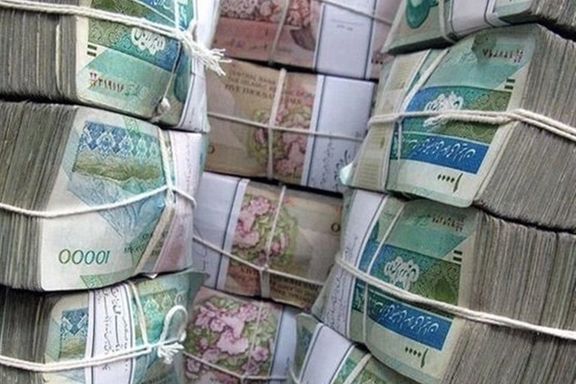
One key indicator of Iran’s prolonged economic struggles is the government’s reliance on borrowing from its own banks and printing money, a practice that intensified after the re-imposition of U.S. sanctions in 2018.
Iran's state debt to the banking system has surged by 138% over the past three years, reaching 15,600 trillion rials (approximately $32 billion at the official exchange rate and $26 billion at the open market rate), according to Central Bank statistics.
During his presidential campaign, Ebrahim Raisi—who died in a helicopter crash on May 19, 2024—had pledged not to borrow from the country's banking system. However, Central Bank data reveals that government borrowing from banks nearly doubled, increasing 2.5 times since Raisi assumed office in August 2021.
Raisi administration officials repeatedly claimed that the administration ceased borrowing from the Central Bank. However, statistics from the institution show that government debt to the Central Bank has not only continued but surged by 72% year-on-year as of June 2024 in the last year of his presidency.
In addition, the government has intensified its indirect borrowing from the Central Bank. This approach involves the Central Bank providing substantial loans to domestic banks, enabling the government to borrow extensively from these institutions alongside its direct borrowing.
For example, borrowing by domestic banks from the Central Bank in June 2024 was 2.7 times higher than in the same month the previous year and nearly 5.5 times higher compared to when President Raisi's administration took office.
During this period, the Central Bank lent 5,440 trillion rials (approximately $9 billion at the open market exchange rate) to the country’s banks, which then loaned 6,260 trillion rials to the government.
The potential consequences remain uncertain, especially given that the Iranian rial has lost more than half of its value over the past three years. The cycle of loans between the Central Bank and domestic banks, eventually funneling to the government, could have significant repercussions. A substantial portion of the funds received by the government has effectively diminished in value due to the severe devaluation of the rial during this period.
Moreover, seven of Iran's major banks have collectively accumulated losses totaling 4,600 trillion rials, casting doubt on their future stability.
In summary, despite the Raisi administration's pledge to avoid borrowing, the government has taken out loans exceeding 9,000 trillion rials from the Central Bank and other domestic banks over the past three years. Most of this borrowing was done directly by the government, with the remainder undertaken by state-owned companies and organizations.
•
•
The primary driver of this extensive borrowing is the persistent and severe budget deficit. While the Central Bank has stopped publishing reports on the government’s budget performance since June 2022, its latest available data indicates that in the first year of Raisi’s presidency, the government faced an operational deficit of approximately 4,730 trillion rials ($8 billion). Even after accounting for the sale of capital assets, the budget deficit remained at 2,160 trillion rials ($3.6 billion).
The government's reliance on borrowing to cover budget deficits is not unique to the Raisi administration; it has been a common practice since the imposition of U.S. sanctions in 2018, dating back to President Hassan Rouhani's tenure.
Liquidity and Inflation
The extensive borrowing in recent years has resulted in a staggering liquidity level of 83,540 trillion rials (approximately $139 billion at the open market exchange rate), which has doubled since 2021. This surge in liquidity has contributed to an annual inflation rate exceeding 40% in Iran in recent years.
It’s important to note that only a few countries worldwide experience such high and persistent inflation. For context, the global average inflation rate last year was 6.8%, while Iran’s was 41.5%. The relatively high global inflation rate is largely attributed to Russia’s invasion of Ukraine and ongoing tensions in the Middle East; otherwise, it has typically hovered around 3% in previous years. The International Monetary Fund (IMF) forecasts global inflation to decrease to 4.5% next year, while Iran's inflation is projected to remain high at 32.5%.
Additionally, the National Development Fund of Iran reports that the government has borrowed $100 billion from this institution and is currently unable to repay it. The total debt owed by the government to banks and the National Development Fund now amounts to three years' worth of the government's general budget, with no clear plan for how these debts will be settled.
Beyond these borrowings, the government also owes significant amounts to private companies across various sectors, including construction, pharmaceuticals, private electricity plant owners, and wheat farmers.
According to the Central Bank's report, the Raisi administration has managed to settle approximately $4.5 billion in external debt. As of June this year, Iran's foreign debt stands at around $4.363 billion, with commitments to repay $2 billion of this debt in the short term and the remainder in the medium term.
Prime Minister Benjamin Netanyahu has dared Iran and its Lebanese proxy group, Hezbollah, to attack Israel and face the consequences.
Speaking at the start of a weekly cabinet meeting on Sunday, Netanyahu issued a warning to Iran and Hezbollah, signaling Israel's readiness to defend itself against any threats from these adversaries.
"We are determined to defend ourselves, and we are also determined to extract a very heavy price from any enemy that dares to attack us, from any theater," Netanyahu stated.
He also underscored Israel’s commitment to its security principles, which he said will remain non-negotiable despite the complex nature of the peace talks. “We are conducting very complex negotiations,” Netanyahu said. “But I want to emphasize: We are conducting negotiations, and not give-and-give. There are areas where we can show flexibility, and there are areas where we can’t show flexibility — and we are standing firm on them. We know quite well how to distinguish between the two.”
These comments come as Israel continues to engage in indirect negotiations with Hamas, mediated by Qatar, the United States, and Egypt. The talks, held in Doha over the past week, are aimed at securing the release of Israeli hostages taken by Hamas during the October 7 attacks that killed approximately 1,200 Israelis. However, significant gaps remain between the two sides, particularly on the key issues of the Philadelphi Corridor, the Rafah Crossing, and the deployment of Israeli Defense Forces (IDF) in Gaza if an agreement is reached.
Netanyahu’s firm stance is consistent with the outline laid out by the White House in May, which has since been the basis for Israel’s negotiating position. Central to these principles is Israel's demand for control over critical border areas to prevent the smuggling of weapons into Gaza and ensure its long-term security. This demand has been a major sticking point in the talks, with Hamas refusing to agree to any arrangement that would allow Israeli forces to remain in Gaza after a potential ceasefire.
Despite the complexities of the negotiations, there has been some optimism among mediators. US Secretary of State Antony Blinken, who arrived in Israel on Sunday for another round of talks, is expected to push for progress, especially since Joe Biden urgently needs the ceasefire as a legacy of his presidency.
However, Hamas has already cast doubt on the prospects of a breakthrough. In a statement released shortly after Blinken's arrival, the militant group accused Netanyahu of setting new conditions to deliberately sabotage the negotiations. “We hold Netanyahu fully responsible for thwarting the mediators’ efforts and obstructing an agreement,” Hamas declared.
US Secretary of State Antony Blinken walks after his arrival in Tel Aviv, Israel, August 18, 2024.
Meanwhile, the situation on the ground remains volatile. Israeli fighter jets struck a Hezbollah rocket launcher in southern Lebanon on Sunday evening, in response to an attack on the Upper Galilee. The Israeli Defense Forces (IDF) have also reported ongoing rocket fire from Lebanon into northern Israel, further escalating the conflict with Hezbollah, an Iranian-backed militant group allied with Hamas.
The broader regional implications of the conflict are becoming increasingly apparent. Iran, which has been a key supporter of both Hamas and Hezbollah, has threatened retaliation following the assassination of senior Hamas and Hezbollah figures in Tehran and Beirut, which it attributes to Israel. This escalation comes at a time when the international community is growing increasingly concerned about the potential for the conflict to spill over into a broader regional war.
Iran has reportedly postponed its retaliatory strike on Israel to avoid derailing the ceasefire talks aimed at ending the Gaza war. However, the Islamic Republic has tried to avoid expressing public support for the negotiations and even downplayed the US-led mediation efforts arguing that Washington cannot be an “impartial” mediator as it backs Israel.
Iranian authorities are also skeptical about the support expressed by some Western countries for the people of Israel. A report by the Tehran Times, an Iranian newspaper fully owned and controlled by the government, even claimed that France, Germany, and Britain are considering recognizing Palestine as a state, contingent on significant concessions from Iran, including its recognition of Israel and a halt to support for resistance groups in the region.
“The initiative proposed by Paris and endorsed by London and Berlin aims to offer additional protections for Israel but does not establish any conditions to safeguard Palestinians against Israel's apartheid policies in the occupied territories, its massacres in Gaza, the abuse of Palestinian prisoners, or the growing number of illegal settlements in the West Bank,” the report added.
If the initiative is implemented, wrote the Tehran Times, the European trio will join Norway, Ireland, and Spain, who earlier this year became the latest group of European countries to recognize Palestine as a state.
Growing criticism of Masoud Pezeshkian’s cabinet selections has sparked a wave of public distrust in the Islamic Republic’s political process, with citizens accusing officials of deceiving the electorate.
The backlash follows remarks from Iranian lawmaker Qasem Osmani, who acknowledged during Saturday’s parliamentary session, which marked the first day of cabinet approval debates, that people feel betrayed by the election results.
Osmani, a Pezeshkian supporter, directly criticized Pezeshkian during the session, accusing him of abandoning the electorate after the elections. "People say you deceived us in the elections," Osmani said. "You spoke about our pains, we thought you sympathized, but after the elections, you forgot all our pains."
Iran International asked its audience for their thoughts on Osmani’s statement. The responses reveal widespread frustration, with citizens viewing the entire political system as fundamentally deceptive.
One citizen responded with a voice message, stating, "The Islamic Republic regime is founded on corruption, and the corrupt are running it."
Another citizen stated, "Anyone who has voted in any election in the Islamic Republic has been deceived."
A third citizen traced the roots of this deception to the early days of the Islamic Republic, stating, “Ruhollah Khomeini, the founder of the Islamic Republic, began deceiving the people in 1979,” a pattern that, they believe, persists to this day.
A fourth citizen expressed even deeper disillusionment, arguing that the Islamic Republic’s deceit extends beyond just elections. "To say they’ve been deceived is an understatement; it’s much worse than that," he remarked.
"The Islamic Republic is committed to nothing but fulfilling its own desires, which have always been in direct opposition to the will of the people."
Pezeshkian, who was supported by the 'reformist' wing of Islamic politicians, promised voters that his government will be composed of experts and that he would address some of the electorate's main grievances. But when he announced his cabinet, people realized it was stacked with the same former officials and IRGC generals.
The parliamentary debates over Pezeshkian's cabinet nominees are set to continue through Wednesday, August 21.
As the debates unfold, the widening divide between the state and the people highlights the escalating tension, raising critical questions about the future direction of the Islamic Republic. Pezeshkian’s leadership, shaped by the directive of Supreme Leader Ali Khamenei and emerging from a heavily boycotted election, faces increased scrutiny amid ongoing anti-regime sentiment.
The British and French foreign ministers have warned about the mounting danger of a full-scale regional conflict due to Iran's escalatory rhetoric, calling on all parties to show restraint.
In a joint op-ed published in the Guardian on Saturday, UK Foreign Secretary David Lammy and French Foreign Minister Stéphane Séjourné stress that Iran's threats of escalation could trigger a wider and more destructive war in the Middle East.
“Iranian threats of further escalation mean the risks of a full-scale regional war are rising,” the ministers cautioned. They described the current situation as a “destructive cycle of violence,” with the potential for a single miscalculation to ignite a deeper and more unmanageable conflict.
Since the assassination of Hamas leaderIsmail Haniyeh in Tehran on July 31, Iran has been threatening retaliation against Israel. However, recent media reports suggest that internal divisions within Iran are causing hesitation regarding further escalation. Additionally, it appears that pressure from the Biden administration may be influencing Iran to reconsider its stance.
The European ministers underscored the implications any Iranian aggression could have, potentially undermining ceasefire negotiations related to Gaza. They emphasized that “it’s never too late for peace” and warned that an all-out regional conflict would serve no one's interests. "All parties must exercise restraint and focus on diplomatic solutions," they argued.
The situation in Gaza remains critical, with the ongoing war leading to civilian casualties. Hostages taken by Hamas during the October 7 attack are still held captive, including several French and British nationals. Meanwhile, the conflict between Israel and Hezbollah has intensified, further complicating the regional stability.
In response to these threats, the foreign ministers visited Israel in a joint diplomatic mission, marking the first time in over a decade that British and French top diplomats traveled together to the region. Their visit to Israel underscores a renewed commitment to collaborative action aimed at enhancing regional and European security.
As permanent members of the UN Security Council, the UK and France called for engagement with US-led diplomatic discussions, emphasizing the importance of adhering to UN Security Council Resolution 1701.
The ministers also acknowledged the role of American, Egyptian, and Qatari mediators in facilitating ongoing negotiations. They stressed that only “a deal can restore communities’ sense of security. Only a deal can open up the space for progress towards a two-state solution – the only long-term route to safety, security and dignity for Israelis and Palestinians alike.”
“There can be no delays or excuses,” the foreign ministers declared. “We must all come together and reconnect in the interests of peace.”
The annual 'Arbaeen Walk,' a significant Shiite pilgrimage to Iraq for the Arbaeen ceremony, has commenced, with over a million pilgrims crossing the border from Iran.
Arbaeen marks the end of a 40-day mourning period following Ashura, the religious observance that commemorates the killing of Imam Hossein, the grandson of Prophet Mohammad, in 680 AD.
Majid Mirahmadi, the director of Iran's Central Headquarters of Arbaeen, announced Thursday that more than 1.5 million Iranian and foreign pilgrims have departed the country through six border crossings with Iraq.
He further emphasized that over 2.6 million Iranians have registered for the pilgrimage, typically attracting up to 20 million Shia Muslims from Iran, Iraq and elsewhere annually.
Iran’s clerical establishment is founded on a religious ideology that venerates Ali, the fourth Caliph after Prophet Mohammad, and his son Hossein as the rightful successors to Mohammad as leaders of Muslims. Consequently, religious symbolism is deeply interwoven with the political fabric of the Islamic Republic.
The Shiite leadership places significant emphasis on Ashura and other religious observances as pivotal moments for mobilizing public support and reinforcing its political authority through various ceremonies.
The "Arbaeen walk," while now a prominent event, is acknowledged even by Iran's hardliners as a phenomenon that has only gained significant momentum in the past decade rather than being rooted deeply in history.
Iran's Supreme Leader Ali Khamenei has placed considerable emphasis on Arbaeen, describing it as "beyond description, utterly unparalleled," and a "vast and astonishing demonstration of unity" with no equivalent worldwide.
He has criticized Western observers who often fail to comprehend this event's significance, leading their media to maintain years of silence—a calculated "conspiracy of silence."
“Not only in our era but throughout history, there is no record of a gathering like this [the Arbaeen procession], where such an event occurs annually, each year with even greater zeal than the last; it is truly unparalleled,” Khamenei said during a speech in 2019.
In the years following the fall of Saddam Hussein's regime, and particularly after the rise of ISIS, which precipitated Iran's intervention in Iraq, the Islamic Republic has meticulously orchestrated efforts to maximize participation in this ceremony, which many say never existed in history.
Observers note that Tehran leverages this strategy as a means to project the influence of the Shia-led Islamic Republic within Iraq, serving political objectives.
The head of the Central Arbaeen Committee announced in July that 12 trillion tomans (approximately $230 million) had been allocated to facilitate the Arbaeen pilgrimage.
Meanwhile, amid an economy crippled by sanctions and mismanagement, Iran faces severe budget constraints, with one-third of its population living in "extreme poverty."
Additionally, newly appointed Vice President Mohammadreza Aref authorized the allocation of 4 trillion rials (approximately $760k) to support the event, which will culminate in ceremonies in the Iraqi cities of Karbala and Najaf in late August.
The funds are earmarked to "mitigate unforeseen incidents, prevent the spread of contagious diseases, and address heat-related health risks at border crossings and along the pilgrimage route." But this is just a negligible part of what Iran spends in feeding, transporting and supporting the pilgrims. Although there are no official figures, it is estimated that the government spends at least $500 million annually.
This is while one of the most pressing crises currently facing Iran—an escalating electricity shortage that is crippling businesses and homes during an intense heatwave—the CEO of the Kermanshah Province Electricity Distribution Company announced that the electricity supply for Arbaeen pilgrims in the province has been secured, with 90 billion rials (approximately $172k) allocated to ensure reliable lighting along the pilgrimage routes and at related facilities.
These decisions have intensified public criticism of the Iranian authorities, with many questioning their decisions and priorities and arguing that these challenges further exacerbate the nation's already dire circumstances.
Parliamentary committees gave their seal of approval to Abbas Araghchi, the foreign minister-designate, as he vowed to uphold the Supreme Leader's policies and continue supporting Iran’s "Axis of Resistance."
During the second day of hearings for President Masoud Pezeshkian’s proposed cabinet, two key ministers received votes of confidence from relevant parliamentary committees. First was Intelligence Minister Esmail Khatib, and during the afternoon session, former nuclear negotiator Abbas Araghchi.
The 63-year-old diplomat, who has served for almost 40 years in the foreign ministry, left no doubt that his duty is to carry out the Islamic Republic’s policies under Ali Khamenei’s direction. "The 'Diplomacy of Resistance,' which is derived from the 'School of Resistance' and the result of the heroic efforts of Martyr Qasem Soleimani in designing the 'Axis of Resistance,' will be at the forefront of the foreign policy of the fourteenth government,” he said.
Araghchi emphasized: We will not lose our way, and unwavering, continuous, and comprehensive support for the cause of Palestine and the Lebanese Resistance, as well as other resistance movements fighting against the oppressive and criminal policies of the Zionist regime, will be at the top of our agenda.
He also vowed to "utilize all our political and diplomatic capacities to…garner support from regional countries and achieve the recognition of the Axis of Resistance actors on the international stage as popular and liberation movements."
Araghchi informed lawmakers that during the six rounds of nuclear talks with the West in 2021, he strictly adhered to Khamenei’s directives and the December 2020 parliamentary law requiring the lifting of US sanctions. He emphasized that, in line with Khamenei’s guidance, his foreign ministry would pursue "an honorable path" to lifting the sanctions. Notably, the foreign minister-designate consistently referred to these efforts as "sanctions-lifting talks" rather than nuclear negotiations.
He also vowed to do his utmost to circumvent sanctions or work to have them lifted. “Regarding sanctions, our policy is based on the recent guidance of the Supreme Leader in his meeting with the honorable members of parliament, focusing on neutralizing the impact of sanctions while simultaneously working to have them lifted. Foreign policy efforts aimed at neutralizing and rendering sanctions ineffective will support the government's objectives,” he stated.
Some regime politicians in Iran have argued that Araghchi’s appointment signals Tehran’s readiness for negotiations with the West. In an earlier meeting with parliamentary committees last week, Araghchi made two points: the 2015 nuclear deal (JCPOA) is beyond revival, and Iran should temper its hostility toward the United States.
However, there was another angle in Araghchi’s remarks last week. He did not mention the need for reaching any agreement that could address the concerns of the United States. Instead, he underlined that diplomatic and military pressure is needed to have the sanctions lifted.
On Sunday, Araghchi emphasized that he will be Khamenei’s “soldier” and expressed pride that Iran’s power has increased in the region and beyond. He also indicated his full agreement with Khamenei’s policy of alliance with China and Russia. "China, Russia, and other countries that have stood by us during difficult times and sanctions, as well as emerging powers and new arenas in Africa, Latin America, and East Asia, will be priorities in the foreign relations of the fourteenth government.”
Regarding relations with Europe, Araghchi repeated Tehran’s position, which aims to de-couple the Europeans from the United States. “If Europe corrects its improper and hostile behavior towards the Islamic Republic of Iran, it will be included in our list of priorities. Finally, our policy toward the United States will be one of 'managing hostility’."