Several organizations in Iran's power industry warn of a 26,000 MW electricity deficit next summer, exceeding 30% of peak demand, compounded by natural gas shortages affecting both industries and households.
Ali Nikbakht, Chairman of the Board of Directors of the Iran Power Plants Association, reported this summer's electricity shortage at 19 to 20 GW. He warned that if immediate action isn't taken, the deficit could reach 26 GW next year. Similar concerns were echoed by Hamidreza Salehi, Chairman of the Federation of Energy Exports and Associated Industries, and Hassan Ali Taghizadeh, Chairman of the Electricity Syndicate.
All three officials agreed that not only is it unrealistic to resolve the electricity deficit in the short term, but there is little hope of even sustaining the current level of imbalance.
Aging power plants
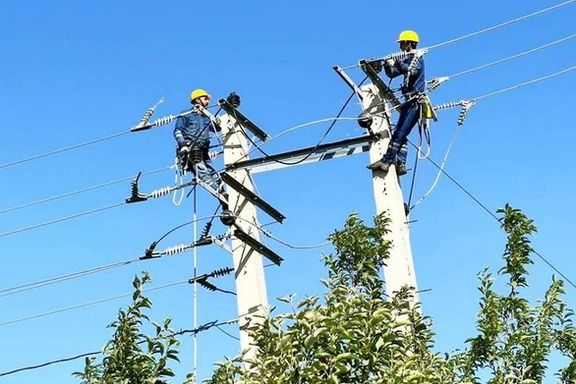
Nikbakht also emphasized the aging and deterioration of a significant portion of the country's power plant capacity. He pointed out that one major power plant has already halted operations for repairs, stating, “The spare parts for this plant should have been ordered two years ago, but that didn’t happen, exacerbating the electricity shortage.”
He further explained that while the total nominal capacity of Iran's power plants is over 92 GW, much of it is outdated. “Of the 15 GW nominal capacity of steam power plants, about 12 GW are over 30 years old. In the case of gas power plants, 2.7 GW have also exceeded 30 years of age,” he said.
As a result, 80% of steam power plants and 11% of gas power plants are effectively outdated. These low-efficiency thermal plants account for 43% of the country's nominal power plant capacity.
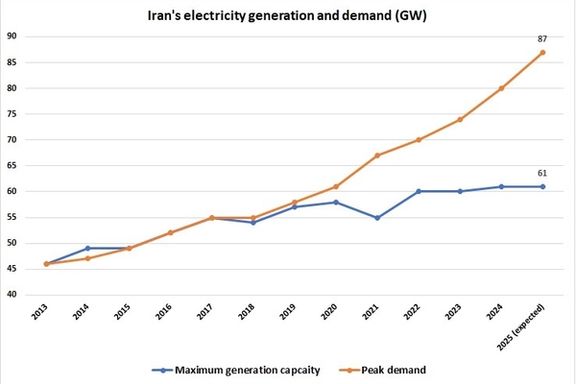
This aging infrastructure, combined with a steep drop in hydropower generation due to drought, has significantly reduced Iran's actual power production. Despite having around 93.3 GW of installed nominal capacity, the country's real power generation is only about 61 GW, meaning that 30% of Iran's power generation capacity is currently offline.
Growing electricity deficit
Iran should have increased its power production by at least 7% annually for over a decade to meet the growing demand. However, the last time this goal was achieved was in 2010. Since then, the country's electricity consumption has grown at twice the rate of its production. As a result, Iran, which had a net export of 8 terawatt-hours of electricity annually until the mid-2010s, is now facing a massive power shortage.
The issue is that Iran now faces electricity deficits year-round, not just during the summer. Since last spring, the Ministry of Energy has stopped releasing its monthly statistics. However, a report obtained by Iran International earlier this summer revealed that even in the final month of spring, the country faced a 5 GW deficit during peak nighttime hours and a 10 GW shortfall during peak daytime hours.
This deficit surged to 20 GW during this summer's peak demand and is projected to reach 26 GW by next summer. To put this into perspective, this deficit is 1.5 times the total electricity generation of Iran’s northern neighbors—Azerbaijan, Armenia, and Turkmenistan—all of whom export electricity to Iran.
With such a vast imbalance between supply and demand, coupled with ongoing annual growth in consumption, it’s unlikely that Iran will resolve this shortage within the next decade, even if it triples its investment in the power sector. The country needs $20 billion in investment just to cover the current electricity deficit, plus at least $4 billion annually to support the 7% growth in power production needed to meet rising demand.
The primary driver behind Iran’s increasing electricity consumption is the addition of about one million new subscribers to the grid each year, with three-quarters being residential consumers and the remainder from industry, agriculture, and commercial sectors.
Moreover, hundreds of millions of dollars are required annually for the maintenance and repair of aging power plants. Nikbakht noted that the annual maintenance cost for each power plant is approximately $3 million.
A critical concern is the government’s growing debt to private power plant owners, which has quadrupled over the past three years. By the beginning of this year, it surpassed 900 trillion rials ($1.5 billion based on the open market exchange rate or $2.1 billion at the official rate). This mounting debt makes it unlikely that the private sector will continue to invest in the power industry.
Government Deflection
Hassan Ali Taghizadeh, Chairman of the Board of Directors of the Electricity Syndicate, recently warned, "With the current approach, we will face a 25 GW electricity imbalance next year." He also criticized Iranian authorities for blaming the public for excessive electricity consumption, pointing out that the average household consumption in Iran is not only below the global average but nearly half of that in Europe. "Why accuse people of being wasteful? Don’t blame the public for the electricity imbalance."
Statistics reveal that the average household electricity consumption per capita in Iran is under 1,200 kilowatt-hours, compared to about 1,800 kilowatt-hours in the European Union. In countries like the United States and the Arab Gulf states, consumption is several times higher than in Iran.
Blaming the public becomes even more misplaced when considering that 13% of Iran’s electricity is lost in its outdated transmission and distribution network, which the government has neglected to modernize for two decades. This loss is equivalent to 40% of the country’s household electricity consumption, translating into a staggering $4 to $5 billion annual loss at current regional electricity prices.
Additionally, over the past decade, Iran has failed to convert its low-efficiency steam and gas power plants into combined-cycle plants, which boast a 45% efficiency rate. Currently, combined-cycle plants account for just 39% of Iran’s nominal power generation capacity, while low-efficiency steam and gas plants together still make up 43%.
Meanwhile, the share of nuclear and renewable energy in Iran’s power generation capacity remains just 1% each, with the remainder made up by hydropower plants.
The exiled son of Iran's Shah ousted in the 1979 Islamic revolution warned against agreements with the theocratic government that replaced his father's rule or its armed Islamist allies, citing Tehran's rights abuses and role in conflicts throughout the region.
Reza Pahlavi was speaking in Washington at a gathering of the Israeli American Council, a top advocate for Israeli interests where former President Donald Trump also spoke on Thursday evening.
"No deal can be made with such a regime and no accommodation with its proxies," the exiled prince told the crowd to cheers, adding that its Islamic system was doomed to fail and a new government could make peace with Israel.
The remarks came as tensions in the Middle East ramped up sharply this week after back-to-back blasts targeting communications devices carried by Hezbollah members rocked Lebanon beginning on Tuesday.
Israel said on Friday an air strike had killed a top Hezbollah commander and other leaders of an elite unit from the Iran-backed group.
Pahlavi, who lives in the United States and has a substantial following among Iran's diaspora, expressed hope that normalization accords reached between some Arab states and Israel under the Trump administration could be extended to include Iran.
"If we work together, we can secure prosperity and dignity for our people and stability and security for our world and expand from the Abraham accords to the Cyrus accords", he said.
President Trump also expressed his hope that Iran would join in agreements recognizing Israel when addressing the same event the previous evening.
"I gave (Israel) the Abraham accords, which is amazing - nobody thought that was possible. Four strong powerful countries signed. Think of it: I would've had every country sign, I might've even had Iran sign, as crazy as that sounds".
Once the largest saltwater lake in the Middle East, Lake Urmia has again dried up completely after briefly refilling earlier this spring.
The lake, which received nearly one billion cubic meters of water during the winter and spring, has now evaporated, leaving behind an environmental and public health crisis for the nearly five million residents in the surrounding areas.
This marks the second time in recent years that the lake has nearly disappeared. The latest drying occurred despite seasonal efforts to replenish its water levels. Satellite imagery shows a vast white salt crust in both the northern and southern sections of the lake, a sign of extreme evaporation.
The crisis stems from a combination of prolonged droughts, overuse of water by local communities, and poorly planned dam construction along the lake's tributaries, all worsened by the government’s handling of the situation.
Experts attribute the shrinking of Lake Urmia, which has lost nearly 95 percent of its volume over the past 20 years, to excessive and illegal groundwater extraction, as well as diverting water from the once bountiful Zarrineh Rud—one of the lake’s main sources—to irrigate apple orchards.
Earlier, reports had surfaced about a change in the lake’s color. According to Lida Shojaifar, head of the Wetlands Conservation and Restoration Department of West Azarbaijan’s Environmental Protection Agency, the shift was attributed to high temperatures, increased evaporation, and heightened activity of salt-loving bacteria. Shojaifar described the phenomenon as natural and not alarming.
A photo of dried-up Lake Urmia
However, the complete drying of Lake Urmia raises concerns about the impact on local agriculture and tourism, which has already been damaged by the lake’s decline. Additionally, dust and salt storms from the lake bed now threaten the health of millions in the region.
The lake’s water level has been in steady decline for years, hitting a historic low of less than 1,270 meters in September 2023, eight meters lower than its peak level recorded in May 1995.
Despite earlier attempts to restore the lake, Arezou Ashrafizadeh, Director of the Wetlands Protection Office, warned in June that the situation remained fragile, even after seasonal water intake. "Despite adequate water intake this spring, Lake Urmia’s condition remains unstable and fragile," Ashrafizadeh said.
The drying of the lake has also reshaped its landscape. The evaporation has caused four of the lake’s southern islands to merge, forming land bridges and disrupting the habitat of local wildlife, including the Persian gazelle and Armenian wild sheep. This new landmass poses risks to both the animals and the delicate ecological balance of the lake’s former islands.
Additionally, the 1,250-meter-long Shahid Kalantari Highway, which bisects the lake, has been cited as a factor exacerbating the lake’s drying. The highway, built across the lake, divides it into northern and southern sections, potentially disrupting its natural flow and ecosystem.
A photo of dried-up Lake Urmia
Efforts to restore the lake’s water levels have thus far failed to meet expectations. Earlier plans projected that the water level would reach 1,274.1 meters by 2026. However, its fluctuating levels over the past two decades, driven by inconsistent rainfall and the management of water resources, have affected the lake's depth and topography.
Geological studies indicate that the fluctuations could also be impacting the region’s seismic activity. Two earthquakes, both with a magnitude of six, struck near Salmas in February 2020. More recently, a series of tremors hit Khoy between 2022 and 2024, coinciding with the lake’s drying out. Researchers are investigating the possible link between the seismic events and the lake’s water level changes.
Several journalists and political activists in Iran have alleged to a local newspaper that their SIM cards have been blocked and deactivated by order of security agencies in recent months.
A journalist, using the pseudonym Amir, told Shargh in a lengthy article on the subject that after his SIM card was deactivated, he could no longer make emergency calls and was left without any explanation. Upon inquiring with the prosecutor’s office, he was asked whether he had been previously arrested.
“They mentioned my prior arrests and limited political activity, telling me I would likely be contacted and required to sign a commitment (to desist). They said this could take up to a month,” Amir said. He also noted that all his digital services, including banking, had been disabled, upending his daily life.
This comes as Iran International reported on intensifying security measures around the first anniversary of the death of Mahsa Amini, whose death in police custody in 2022 ignited the largest ever nationwide protests against the Islamic Republic.
A photo of Mahsa Amini is pictured at a condolence meeting organised by students and activists from Delhi University in support of anti-regime protests in Iran following the death of Mahsa Amini, in New Delhi, India, September 26, 2022.
Another journalist, using the pseudonym Sepideh, shared with Shargh that her SIM card was deactivated in June following her posting of political content on social media. She said that after contacting the prosecutor’s office, she was compelled to delete several political posts and images of herself without a hijab and to sign a pledge. Her SIM card was then reactivated after three weeks.
A student activist, Shahram, also reported his SIM card was deactivated. Despite his efforts, he remains unaware of the specific reason for the block, suspecting the involvement of authorities.
Additionally, a journalist and writer, using the pseudonym Susan, told the daily that her SIM card was blocked for about two weeks ago without prior notice.
After reaching out to the Deputy of Cyberspace at the Prosecutor General’s Office, she was given another phone number and eventually summoned. She added that when she visited a security agency follow-up office, she was informed that her Instagram activity had been classified as “propaganda against the state,” and she would be contacted regarding her phone line or potential charges.
“Some prosecutors have issued broad directives to enforcement agents, allowing them to summon individuals by phone. If they do not comply, their bank accounts are first frozen, followed by the deactivation of their mobile services.” Dorafshan added that this practice forces citizens to comply with enforcement agencies, which act under judicial orders.
Dorafshan also pointed out that according to Iran’s legal framework, fundamental principles of fair legal proceedings, and the Islamic Penal Code, no citizen should be deprived of a fair trial process before a final ruling is issued. He said that blocking phone numbers can have far-reaching consequences, including the denial of basic civil rights and essential services like access to healthcare.
Shahla Orouji, a lawyer and member of the Central Bar Association, said that such punishments are not permitted by Iranian law.
“According to Article 36 of the Constitution, punishment must be issued by a competent court and according to the law. A judicial officer has no right to impose punishment.”
Since the establishment of the Islamic Republic, journalists, students, and civil activists critical of the government have faced various forms of pressure, including arrests, torture, imprisonment, and executions. The crackdown has intensified since the nationwide protests against the Islamic Republic erupted in September 2022.
A Taliban official has apologized after refusing to stand for Iran’s national anthem during the opening of an international Islamic conference in Tehran, attended by Iran’s president.
Taliban official Azizorrahman Mansoor's refusal to rise during the playing of the Islamic Republic's anthem on Thursday had sparked backlash from Iranian officials.
Since then, Mansoor has apologized through a formal video statement.
"In our homeland, we sit when the song is played, and I have acted according to this custom," Mansoor stated in the video, expressing his remorse.
Following the incident, Iran's Foreign Ministry summoned the ambassador overseeing the Afghan Embassy. According to reports from Iranian domestic media, the acting head of the Afghan mission underscored his nation's deep respect for the Islamic Republic of Iran, clarifying that the act in question was purely personal and did not reflect the official stance of Afghanistan.
Tehran's special representative for Afghanistan, had also condemned the Taliban official's actions, calling it a "disrespect to diplomatic principles."
"Disrespecting diplomatic principles under the pretext of a Sharia-based prohibition on music has no foundation or validity," Hassan Kazemi Qomi wrote on X.
Mansoor, a member of the Islamist militant group's Ministry of Guidance, Hajj, and Endowments, led the Taliban's delegation to Tehran for the 38th "International Islamic Unity Conference."
A similar incident took place in Peshawar, Pakistan, where Taliban diplomats remained seated during Pakistan’s national anthem at an official ceremony.
Pakistan's Ministry of Foreign Affairs strongly condemned the act, with a spokesperson stating, "We will convey our strong protest to Afghan authorities in Islamabad and Kabul."
The acting Taliban ambassador in Islamabad was summoned and warned that Pakistan would respond firmly to such "offensive behavior."
The Taliban’s Consul General in Peshawar later explained that he remained seated during the anthem due to the inclusion of music, insisting there was "no intent to disrespect or demean Pakistan's national anthem."
The backlash from Iranian politicians included a sharp response from Mohammad Ali Abtahi, a prominent "reformist" and senior aide to former President Mohammad Khatami.
Writing on X, Abtahi stated, "The Taliban's disrespect towards the national anthems of Pakistan and Iran, and their refusal to stand, has ideological roots." He further warned, "When we say that the Taliban's ideology is more dangerous than the thousands of weapons they have, this is what we mean."
Abtahi described the Taliban's rigid mindset, which views music as entirely forbidden, as one that "destroys religion and people's lives wherever it spreads," adding that "geography doesn't matter."
He emphasized that "the majority of Muslims everywhere, including in Iran, do not seek unity with the Taliban." Criticizing the Unity Conference in Tehran, he declared, "The organizers have no right to allow the Taliban, whether in the front or the back rows, to participate in this conference."
Reports from Iran reveal growing class divides and declining trust in the new government's foreign policy. Meanwhile, a leading economist criticizes the government for straying from constitutional principles and abandoning rational policymaking.
The Statistical Center of Iran, a government agency, has reported a growing income gap between social classes in urban areas. According to the data, cited by Etemad newspaper, income inequality has been rising since the beginning of the current Iranian year, which started in late March.
Iran has been struggling with a deep economic crisis since 2018 when the United States withdrew from the JCPOA nuclear deal and imposed sanctions. Monthly incomes for ordinary workers, teachers and nurses has fallen to $200 per month.
According to the report, the income gap between the rich and poor has been widening since 2022. Jomhuri Eslami, a critic of the government's policies, remarked, "The government certainly did not promise to increase the disparity between the rich and poor." The conservative newspaper added that this growing inequality is the result of the cumulative actions of various Iranian governments over time.
In another development, reformist commentator and former pollster Abbas Abdi wrote on Etemad Online that public support for Iran's foreign policy has significantly declined. According to him, while surveys in previous decades showed up to 60% support for the country’s foreign policy, this figure has dropped to as low as 35% in the current decade.
President Masoud Pezeshkian's new government has pledged to improve Iran's global relations and seek an understanding with the West. Despite low voter turnout, hopes for reform and a more pragmatic foreign policy helped him defeat hardliner Saeed Jalili in the July election. Abbas Abdi stressed that rhetoric from officials and diplomats won’t change foreign policy, arguing that national interests should guide it. He emphasized, "There are no permanent friends or foes—only permanent national interests."
The commentator further criticized Iran's official policy for failing to effectively convey its values and stances, calling this a major shortcoming. He explained that the decline in public support for foreign policy is due to the lack of visible impact on people's daily lives and livelihoods, despite periodic statements in support of dialogue and peace. Additionally, he noted that the rise of radical opinions advocating unconditional compromise with the West stems from the perceived ineffectiveness of foreign policy over the past decade.
The decline in support for the official foreign policy is a combination of the government's inefficiency and people's distrust in the official’s political behavior that has led to sanctions and resolutions against Tehran.
Iranian economist Kamal Athari, in an interview with Shargh newspaper’s economic editor Maryam Shokrani, criticized the government for straying from the Constitution's definition of governance. He emphasized that officials are meant to serve as representatives of the people, avoiding despotism and the monopolization of power and resources. The government should focus on providing welfare, education, housing, and healthcare while promoting individual growth. However, Athari argued that the current government has deviated from these principles and abandoned rational governance in practice.
He added that Iran's seventh development plan is designed to serve only one political faction and give it power, wealth and ownership of resources. He added: "With such an approach, development becomes meaningless."