The Islamic Republic should close the Strait of Hormuz in the Persian Gulf and build a nuclear bomb, Iran's ultra-hardliners have been demanding on social media in the wake of Israel’s killing of Hassan Nasrallah.
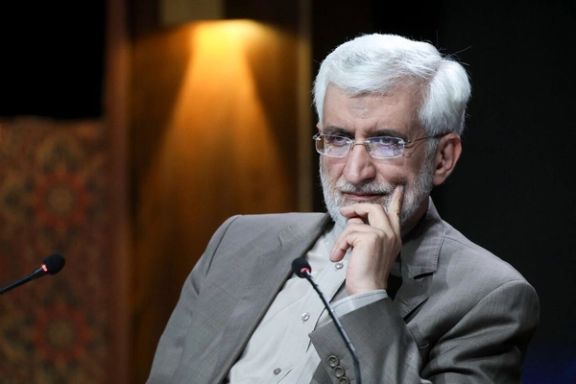
In recent days, ultra-hardliner social media activists, largely supporters of former nuclear negotiator Saeed Jalili, have been criticizing President Masoud Pezeshkian and his government for their "inaction" against Israel, despite its recent deadly operations in Gaza and Lebanon. They have suggested that Iran is avoiding confrontation with Israel.
Ultra-hardliners have, however, remained conspicuously silent on the fact that the decision to launch a military response against Israel ultimately rests with Supreme Leader Ali Khamenei, as commander-in-chief of the Armed Forces, not with the president or parliament.
In a series of X posts Saturday after Nasrallah’s demise was confirmed, Khamenei called on all Muslim nations to stand by the people of Lebanon but fell short of vowing revenge by Iran for his killing and the killing of Ismail Haniyeh in Tehran in July as hardliners and ultra-hardliners had expected.
“Only breaking red lines [by us] can stop [the enemy from] breaking [our] red lines,” a Jalili supporter tweeted while suggesting that the Islamic Republic should end its so-called “strategic patience” and build a nuclear bomb, threaten to leave the UN and refuse to allow the passage of Western commercial vessels through the Strait of Hormuz for a week by holding a week-long naval drills.
Former nuclear negotiator Saeed Jalili
“Why can Yemen block the main passageway of oil [in the Bab al-Mandab Strait] but we are not doing the same in the Strait of Hormuz?” an ultra-hardliner asked in a tweet Saturday.
Another ultra-hardliner suggested that Iran must target the economic interests of the Western, Israeli, and Arab countries in the region before taking any other action.
“Iran's first step should be closing this strategic passageway to prevent an all-out war in the region,” he tweeted while suggesting that failing to take such a step may bolden Israel to make the “strategic mistake” of attacking Iran.
Iranian officials have on many occasion in the past threatened to close the Strait of Hormuz, but this can lead to a clash with the US and other naval forces, leading to a regional war.
“Whether we like it or not, Iran must direct its military doctrine towards building a nuclear bomb. Iran has wasted the cards it held in the past and the only card that it holds now is a nuclear bomb. This is the only means to bring the West to the negotiation table,” Sohrab Salehi, a university professor of medicine who also supports ultra-hardliners on social media tweeted Saturday.
“You gentlemen in charge, one must have nuclear power against such an enemy. Test the first nuclear bomb for the sake of Iran's security and in reaction to the actions of the notorious regime [of Israel],” Mohammad-Mehdi Dehghannejad, an ultra-hardliner social media activist tweeted.
These demands have drawn criticism from other netizens, who argue that closing the Strait of Hormuz would only escalate tensions. They also point out that building a nuclear bomb, despite the official claim that Khamenei has issued a religious ban on weapons of mass destruction, including nuclear arms, would not shield the Islamic Republic from Israel.
“In the highly unlikely case that we succeed [in building a bomb], how can a system that can’t protect its highest officials manage to guard that bomb? Or let’s say you built it...how are you going to make a deal using the nuclear bomb card?” a netizen on X askedthe advocates of Iran becoming nuclear to protect itself against Israel.
Anetizen on X contended that ultra-hardliners will brag about the closure of the Strait of Hormuz for some time but their ruckus will soon be forgotten as in the past.
Meanwhile, Abdolreza Davari, a former ultra-hardliner and close confidante of Mahmoud Ahmadinejad, who supported Pezeshkian over Saeed Jalili in the presidential election, offered a surprising assessment of the situation and Hamas's role in it following Nasrallah’s death.
Highlighting the upcoming anniversary of the October 7 attack that ignited the latest round of conflict, Davari argued in a tweet that an analysis of the “cost-benefit of the operation and its impact on the Resistance Front and the Zionist enemy” reveals that the operation resulted in “nothing but pure damage.”
In another tweet, Davari suggested that Iran should reassess the factors behind the “devastating blow” to the Resistance Front and prioritize “pursuing Iran's interests” in line with the shifting dynamics of the region in the post-Nasrallah era.
The 64-year-old leader of Hezbollah, Hassan Nasrallah, was killed Friday in an Israeli airstrike on southern Beirut, 42 years after he became the representative of Iran’s ruler, Ruhollah Khomeini, in Lebanon at the age of 21.
“His eminence Sayyed Hassan Nasrallah, Hezbollah’s secretary-general, has joined his fellow great martyrs whom he had led for 30 years from one victory to another,” Hezbollah said in a statement.
Nasrallah’s death occurs amidst an escalation in the nearly year-long conflict between Israel and Hezbollah that intensified in September after Israel indicated it could no longer tolerate insecurity in its border region with Lebanon.
Hezbollah has been launching rockets, missiles, and drones into northern Israel in support of Palestinians in Gaza and Hamas, which is an allied Iran-backed militant group. In response, Israel has intensified its airstrikes and conducted targeted killings of Hezbollah commanders while threatening a broader military operation.
The past ten days marked the deadliest period in Lebanon since the grueling month-long conflict between Israel and Hezbollah in 2006.
Initially, thousands of pagers and walkie-talkies used by Hezbollah members exploded across various locations in Lebanon, resulting in scores of fatalities and nearly 3,000 injuries. Lebanon attributed the explosions to Israel, although Israel did not confirm or deny involvement. Nasrallah vowed to retaliate but he was killed before he could implement any counterattack plan.
Nasrallah was born on August 31, 1960, in Lebanon. His father was a fruit vendor, and he was the eldest child in a family of 11. His birth and childhood were marked by the conflicts between Israel and Lebanon. In 1974, Musa Sadr and Mustafa Chamran, two Iranian supporters of Khomeini in Lebanon, initiated the Amal movement, and Nasrallah joined the movement in 1975 at the age of 15.
At 16, he went to Iraq. In 1979, coinciding with the Iranian Revolution, Nasrallah completed his preliminary religious studies in Najaf. This period coincided with pressure from Saddam's government on Shia clerics. Nasrallah returned from Najaf to Baalbek, Lebanon.
After the 1979 revolution in Iran, Nasrallah met with Khomeini in 1981. Khomeini granted him permission to engage in religious and civil affairs. At this time, Nasrallah was only 21 years old.
In 1982, amid the Iran-Iraq War, Hezbollah was formed with the planning and support of the Islamic Republic. Tehran's propaganda apparatus presented this group as one influenced by the Islamic Revolution of 1979 in Lebanon from the outset.
Nasrallah joined Hezbollah at its inception. In 1989, around the time Ali Khamenei was selected as Supreme Leader, he traveled to Iran to study at the Qom seminary.
From the establishment of Hezbollah until 1991, Sobhi Toufaily was the secretary-general of Hezbollah. In 1991, the executive council of Hezbollah removed him from his position and replaced him with Abbas al-Musawi, Nasrallah's former teacher.
Sobhi Toufayli (white turban) with Hassan Nasrallah (black turban)
Musawi was the secretary-general of Hezbollah for less than a year. In February 1992, he was killed in an Israeli helicopter attack. The 31-year-old Hassan Nasrallah succeeded him in Lebanon.
Immediately after his appointment, Nasrallah traveled to Tehran and met with Ali Akbar Velayati, the then-foreign minister of the Islamic Republic. During this meeting, Velayati emphasized that the relationship between the Islamic Republic and Hezbollah was “fraternal” and would continue.
At the beginning of his work as secretary-general, Nasrallah managed to position Hezbollah as a political entity. After Hezbollah's participation in elections, he traveled to Tehran to meet Khamenei and presented a report on his political activities in Lebanon. Khamenei praised his political success and called for greater support for Hezbollah.
Nasrallah's trips to Tehran continued. After the relatively moderate Mohammad Khatami's won Iran's presidential election in the 1997, the relationship between the Islamic Republic and Hezbollah remained strong. In October 1997, a few months after Khatami's presidency began, Nasrallah was among his first foreign guests. In a meeting on October 13, 1997, Khatami expressed condolences for the death of Hadi Nasrallah, Nasrallah's eldest son, emphasizing the Islamic Republic's comprehensive support for Hezbollah and calling it a “symbol of resistance.”
On July 7, 2000, Nasrallah returned to Tehran again. During this visit, he also had a side event; at the invitation of Mustafa Moeen, the Minister of Science in the “reformist” government, he visited Tarbiat Modarres University.
Moeen presented honorary membership in the university's faculty to Nasrallah, saying, "It is the pride of our higher education system that we awarded our first honorary doctorate to Nelson Mandela and today we bestow honorary membership upon Sayyid Hassan Nasrallah."
Nasrallah's relationship with the Islamic Republic during Mahmoud Ahmadinejad's presidency remained strong and close, as it had been in the past. The year 2005 was a pivotal one for Nasrallah. Following the assassination of Lebanese Prime Minister Rafic Hariri, Hezbollah came under suspicion because Hariri had made efforts to limit the political and military power of Hezbollah.
Nevertheless, Hezbollah managed to succeed again in the parliamentary elections. After this victory, in June 2005, he traveled to Iran.
During his visit to Tehran, Nasrallah met with Khamenei. This was Nasrallah's last official trip to Tehran. Once, in 2021, reports emerged about his secret visit to Tehran, but this trip was never confirmed.
Hassan Nasrallah meeting Ali Khamenei in Tehran
After Nasrallah stopped appearing in public, he began to express Hezbollah's views through video speeches.
Reaction to the Green Movement
In 2010, a year after the Green Movement protests in Iran—where one of the slogans was "Neither Gaza, nor Lebanon, my life is for Iran"—videos of Nasrallah surfaced. In one of them, he emphasized the religious ideology of the Islamic Republic, stating, "In Iran today, there is no such thing as Persianization or Persian civilization. What exists in Iran is Islamic civilization. What exists in Iran is the religion of Muhammad."
Nasrallah continued by praising the leaders of the Islamic Republic, stating, "The founder of the Islamic Republic was an Arab father and the son of the Prophet of God, Muhammad, may God bless him and his family. Today, the leader of the Islamic Republic, Ali Khamenei, is the son of the Prophet of God."
In the second video, Nasrallah addressed the protests following the 2009 elections, stating, "Some dreamt of the end of the Islamic Revolution and the overthrow of the Islamic Republic, but these dreams are mere illusions. The Iran that many have exaggerated recent events about—I emphasize—remains strong. Its system, government, people, and elites are blessed with wise, courageous, compassionate, and capable leadership, under the historic guidance of Ali Khamenei."
Funding from Iran
In a speech in July 2016, during the peak of President Hassan Rouhani's government's efforts to re-establish relations with the West, Nasrallah pointed to financial support from the Islamic Republic, stating, "The budget, expenses, and weapons of Hezbollah come from the Islamic Republic."
He continued, "As long as Iran has money, it means we have money." These remarks by Nasrallah created difficulties for the Rouhani government at that time, both domestically and in terms of its image around the world.
On Mahsa Amini
About two weeks after the killing of Mahsa Aminifor mandatory hijab, Nasrallah reacted to the protests in a speech on September 30, 2022. He said, "Due to the ambiguous death of Mahsa Amini, Western countries have made a fuss, while Tehran has emphasized that it will conclude the investigations without any bias."
Nasrallah pointed to the explosion of a Shiite educational center in Afghanistan, saying, "More than 50 innocents were martyred, yet no one made the slightest noise, but regarding Mahsa Amini's death, this incident has been widely exploited."
Iran's Parliament has blocked the resignation of a lawmaker set to join Masoud Pezeshkian’s cabinet as deputy, sparking speculation over whether Pezeshkian will fight to keep the Sunni lawmaker in his ranks.
Abdolkarim Hosseinzadeh would have been the first Sunni cabinet member in the history of the Shia-majority Islamic Republic if the hardline-dominated parliament had let him leave.
Iran's Sunnis say they have been systematically blocked in the past forty-five years from holding higher government positions due to their religion.
Hosseinzadeh submitted his resignation to the Parliament on September 25 while Pezeshkian was in New York to attend the UN General Assembly. The resignation was put to vote on the same day. 129 of the 247 lawmakers present at the session, voted against the resignation, and five abstained.
This was the first time the Parliament ever objected to a resignation for joining the government.
In an interview with CNN’s Christine Amanpour Thursday before leaving New York, Mohammad-Javad Zarif, Pezeshkian’s Strategic Affairs Deputy, referred to the appointment of a Sunni, and four women, to the cabinet as one of the biggest achievements of the Pezeshkian administration. However, Zarif did not mention Parliament’s vote.
In a meeting with expatriate Iranians in New York on Thursday Pezeshkian also said the appointment of two Sunni Kurds, one as a deputy and the other as a province governor, was an unprecedented initiative his government had taken but made no reference to the Parliament’s objection.
“The issue surrounding Abdolkarim Hosseinzadeh’s role in the cabinet is expected to be resolved upon the President’s return to Tehran, following his remarks to expats in New York, where he emphasized that Hosseinzadeh is viewed as a deputy president,” the conservative Tabnak news website reported Thursday.
Lawmakers opposing the resignation did not raise Hosseinzadeh’s religion during the debate, instead arguing that their decision was aimed at ensuring his constituents wouldn’t lose their representative.
Pezeshkian appointed the reformist Hosseinzadeh who has three times been elected to the Parliament from a predominantly Sunni, Kurdish constituency in West Azarbaijan Province as his Rural Development, Deprived Areas, and Nomads deputy in late August.
Some lawmakers and activists have criticized the Parliament’s decision and even urged Hosseinzadeh to submit another resignation letter or suggested that Pezeshkian appoint another Sunni lawmaker in his place.
In his Friday sermon in Zahedan, capital of the province of Sistan-Baluchestan, Mowlavi Abdolhamid, a leading Sunni cleric, criticized the Parliament’s objection to Hosseinzadeh’s resignation and barring his way to entering Pezeshkian’s cabinet although resignation of other lawmakers to join the cabinet had always been accepted before.
Abdolhamid who wields much influence among the large Sunni, Baluchi population of the province and other Sunni-populated regions has repeatedly criticized the government for discrimination against Sunnis.
Ali-Akbar Ranjbarzadeh, a member of the Parliament’s presiding board, pointed out in an interview with the Iranian Labour News Agency (ILNA) Friday that in similar circumstances three years ago, the Parliament had accepted the resignation of hardliner Amir-Hossein Ghazizadeh-Hashemi when Ebrahim Raisi appointed him as his deputy.
“The Parliament was subservient to the administration during Raisi's time. Were you worrying about people’s votes? No! Your problem is something else!” journalist Mohammad-Hassan Najmi protested in a tweet while reminding that not one but three lawmakers were allowed to join Raisi’s cabinet.
“Not to accept [the resignation] of a Sunni person was not decent ... After all, he represented hope to the Sunni population and could bear a very positive message to them,” he said.
The parliament's opposition conveys to the Iranian Sunni community that they will continue to be blocked from higher management positions and impede Pezeshkian from carrying out his campaign promises of creating a “national unity” government, the reformist Ham-Mihan newspaper wrote Thursday.
Reformist lawyer and activist Minoo Khaleghi and some others have argued that based on an interpretation of the Constitution by the Guardian Council in 1981, which has not been annulled in later years, acceptance of a government position by a lawmaker can automatically be considered as resignation and no official resignation is required.
Iran's currency, the rial, has dropped 3.3% in value since last week, when Israel launched strikes against Hezbollah in Lebanon, raising concerns about a broader conflict involving the Islamic Republic.
The rial was trading at 612,000 to the US dollar on Saturday, compared with 592,000 on September 20, when Hezbollah began to suffer mass casualties as a result of exploding pagers and walkie-talkies. As Israeli air strikes intensified in Lebanon earlier this week and culminated in the reported killing of Hezbollah leader, Hassan Nasrallah, the rial dipped further.
Since 2018, when the US withdrew from the JCPOA nuclear deal and imposed sanctions on Iran’s oil exports and international banking, the rial has lost 15 times its value. In the past three years alone, it has depreciated by 50%.
This sharp devaluation has coincided with soaring inflation, now hovering between 40-50%, pushing tens of millions of Iranians into poverty and creating a potentially volatile public mood.
The Iranian government has been quietly signaling an interest in new negotiations with the West this month to reduce sanctions, but so far, the US and its European allies maintain that only a genuine change in behavior will lead to talks."
After the Israeli military said it had killed Hezbollah leader Hassan Nasrallah, Iran's Supreme Leader Ali Khamenei said from a secure location that Hezbollah is at the forefront the forces of resistance which will determine the fate of the region.
While Reuters cited unnamed sources as saying that Khamenei has been moved to secure location, the Supreme Leader issued a massage Saturday, calling on Muslims "to stand by the people of Lebanon and the proud Hezbollah with whatever means they have and assist them in confronting the ... wicked regime (of Israel)".
"Zionist criminals should know that they are far too insignificant to inflict any serious damage on the strong foundation of Hezbollah in Lebanon. All the resistance forces in the region stand alongside and support Hezbollah. The fate of this region will be determined by the resistance forces, with Hezbollah at the forefront,” he said in his message.
He added that "the Zionist regime had failed to learn from its year-long criminal war in Gaza" and was now repeating the same mistakes in Lebanon.
The Israeli military said on Saturday it had killed Nasrallah in an airstrike on the group's central headquarters in the southern suburbs of Beirut on Friday. However, uncertainty persists about the status of Hezbollah's leader as no official reaction has been made by the group or the Islamic Republic.
The Israeli military "eliminated ... Hassan Nasrallah, leader of the Hezbollah terrorist organization," Israeli army spokesperson Avichay Adraee wrote in a statement on X.
Later, in a briefing with reporters the IDF spokesman confirmed the killing of Hezbollah chief Hassan Nasrallah and added: "I want to say this very clearly—Nasrallah was one of the world's strongest and most influential terrorists, and one of the terrorists with the most capabilities in the world. He was a real threat, with the blood of thousands of people on his hands."
Government-controlled media in Tehran was simply repeating the news about the IDF announcement, while large banners were installed in the capital proclaiming “Hezbollah is alive.” There have been no explicit Iranian threats about a potential retaliation against Israel, although some hardliners have voiced the need for revenge.
A hardline academic in Tehran, frequently featured on Iranian state TV as a US politics expert, has claimed that the United States is unlikely to respond to Pezeshkian's “pacifist remarks” during his visit to the UN headquarters in New York.
The conservative Nameh News website quoted Tehran University lecturer Foad Izadi, who criticized certain Iranian politicians for repeatedly advocating negotiations with the United States, despite the lack of any signals from US officials indicating interest in dialogue.
Nameh News argued that the wars in Ukraine and the Middle East have dramatically changed the international landscape compared to when former President Hassan Rouhani attended the 2013 UNGA meeting, winning over American hearts and minds with a well-calculated publicity move. The website quoted Tehran University lecturer Foad Izadi, who noted that President Joe Biden referred to the 'Iranian threat' in his UNGA speech, and claimed that US presidents have consistently spoken against the Islamic Republic for the past 45 years.
Izadi went on to criticize those who believed Pezeshkian could revive the 2015 nuclear talks during his visit to New York, arguing that they have demonstrated a lack of true expertise. He pointed out that White House National Security Advisor John Kirby has already made it clear that, despite Pezeshkian’s calls for normalizing Iran’s relations with the West and even Israel, there is no possibility of negotiations with Iran.
The hardline academic noted that the negative reactions from State Department spokesperson Matthew Miller and President Joe Biden following Pezeshkian's pacifist remarks made the situation clear. Izadi further claimed that Vice President Kamala Harris’s stance on Iran is aligned with Biden’s, and referenced former President Trump’s actions, specifically the assassination of IRGC Quds Force Commander Qasem Soleimani. Izadi concluded, “No US official has made even a half-hearted positive comment about Iran."
Hardliners at the Iranian state TV have been using their influence to edit out Pezeshkian's positive comments about ties with the West from his speeches. Asr Iran website notedthat news bulletins on the day after the speech did not broadcast key parts of Pezeshkian's UNGA speech.
According to Asr Iran, the state TV only aired the portion of the Iranian president's speech in which he condemned Israel's atrocities and criticized the United States for imposing sanctions on Iran and deploying forces in the region. The report noted that even this segment of the speech was broadcast half an hour into the main news bulletin.
Meanwhile, Nameh News quoted 'reformist' commentator Esmail Gerami Moqaddam, who remarked that 'hardliners are upset by Pezeshkian's pacifist remarks.' He claimed that Pezeshkian's statements have garnered positive international reactions, demonstrating to the world that Iran is pursuing peace and justice. Nameh News further asserted that these remarks have left Israel increasingly isolated in the international community.
Gerami Moqaddam said: "Hardliners in Iran are angry about Pezeshkian's pacifist stances because they want Iran to be sanctioned and even enter into a war as they benefit from sanctions. They welcome tension while the new government wants to have good ties with both East and West."
The politician said: "Through dialogue we can even make the United States to step back from its positions, but both Israel and Iran's hardliners do not want that." Iranians want the sanctions to be lifted and that is why they voted for Pezeshkian as their president, Gerami Moqaddam said.