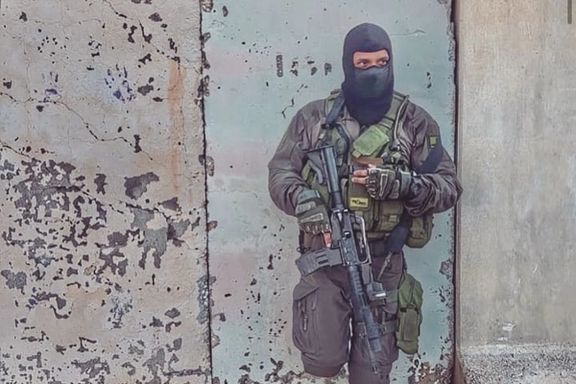
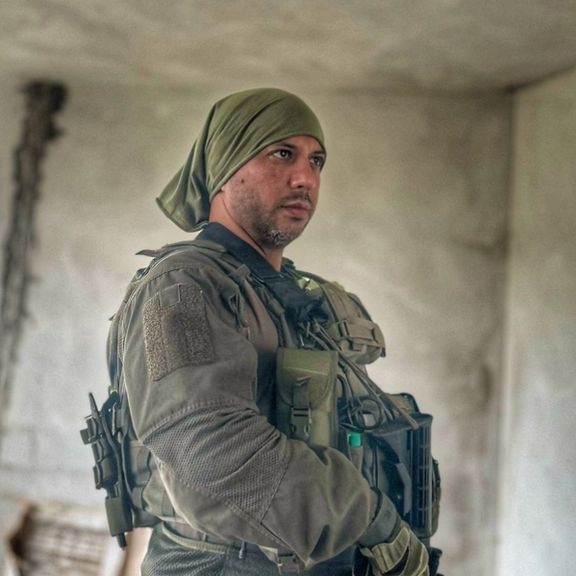
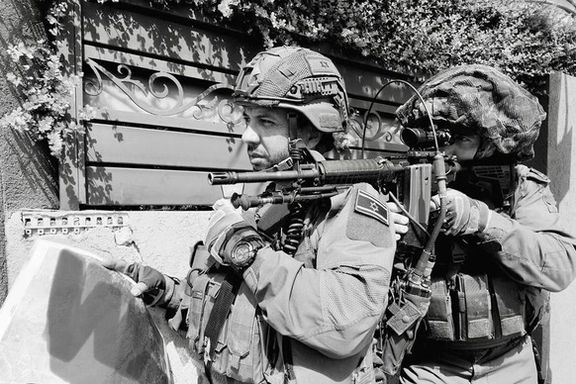
Itai Reuveni member of IDF's elite Paratrooper Brigade
As hundreds of missiles rained across Israel's skies, 40-year-old Itai Reuveni, an Israeli of Iranian descent, sought refuge in a bomb shelter with his family as his nation was attacked by the very country which was once his parents’ homeland.
A strange concept but a reality for the IDF reservist combat soldier belonging to the elite Paratroopers Brigade, who jumped into action on October 7, along with his unit stationed up north against the threat of Hezbollah.
He heard ‘endless booms’ as Tehran reportedly fired more than 200 missiles in a wave of launches in retaliation for the killing of Hamas and Hezbollah’s leaders.
The IRGC announced it had struck "the heart of Israel" in retaliation for the killings of Hamas leader Ismail Haniyeh, Hezbollah leader Hassan Nasrallah, and IRGC's top regional commander Abbas Nilforoushan. "If Israel responds to the Islamic Republic's operation, it will face devastating attacks," the statement said.
While Iran launched missiles, a terrorist attack unfolded in Tel Aviv, with at least eight people killed by gunfire. It is not known at this time if those attacks were coordinated, though the timing does appear to be suspicious.
One person, a Palestinian, has been killed in Iran’s strike against Israel, according to local reports.
Israeli Military Spokesperson said Tuesday this attack was serious and will have consequences. According to CNN, National Security Advisor Jake Sullivan also described the attack as “ineffective”, referring to it as a “significant escalation” by Iran.
Despite the ongoing animosity between Iran and Israel, Itai feels deeply connected to his Iranian roots and culture while he sees himself as a proud Israeli ready to defend his nation -- even against his parent’s country of birth.
In an interview with Iran International, Itai said it’s important to make a clear distinction between the people of Iran and its government.
His father left Iran as a young child in the 1950s, a few short years after the establishment of the State of Israel. His mother, Diana, on the other hand, had a much different journey to Israel. Having fled Iran during the 1979 Islamic Revolution, she had to rebuild her life from scratch as a 27-year-old chemist with no command of Hebrew.
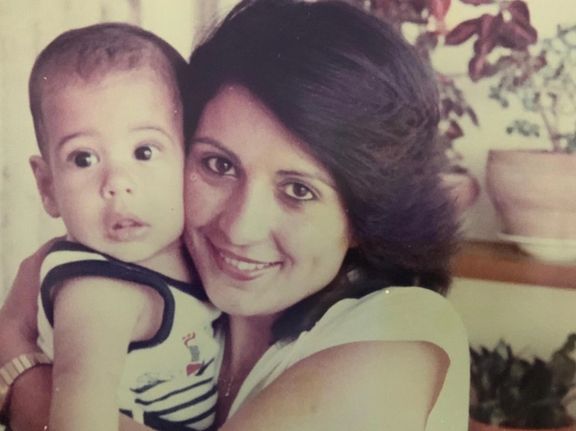
Itai Reuveni pictured as a baby with his mother Diana.
The establishment of the Islamic Republic had changed her life in a flash.
Diana’s parents stayed in Iran where her father, Itai’s grandfather, was arrested and jailed because his daughter and eventually other children escaped to Israel. It wasn’t until Itai was a teenager that he met his maternal grandparents in Israel.
Photo of Itai's mother Diana receiving an award from the late Shah for her academic achievements.
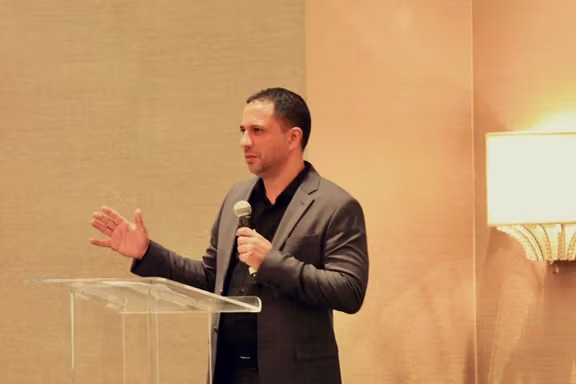
Itai, who studied Iranian studies and Political Science, specializes in civil society, terrorism and the Middle East – working at nonprofit ‘NGO Monitor’ when the country is not in a time of war.
Having served in the North, fighting Hezbollah, and being of Iranian origin, he offers an inside look and unique perspective into what it’s like for Israelis and what could unfold next after the Islamic Republic's strike
How everything changed after Nasrallah
Since Oct 7, Israeli Prime Minister Benjamin Netanyahu has been trying to maneuver a multi-front war, the Iran threat and pressures from the United States and Europe demanding a ceasefire – to put an end to the war against Hamas, said Itai over a zoom interview with Iran International.
But he said everything changed last week when Israel launched a targeted strike, killing Hezbollah leader Hassan Nasrallah.
Itai viewed this as a turning point, marking the collapse of Iran’s proxy deterrence. What Iran had reportedly invested billions in over decades was largely dismantled from top to bottom.
“I think that's a historic point. It's exactly like October 7th was a very negative historic point. But what happened in the past week is going to change the interactions in the Middle East.”
The destruction of one of Iran’s biggest proxies, he believes, changes the balance of power in the region, destroys Iran’s deterrence strategy and leaves the Iranian government vulnerable.
Prior to that, Israel’s use of pagers and walk-talkie loaded with explosives left Hezbollah operatives reeling. That’s when Itai knew the Israeli government’s policy and war tactic was changing.
“I think they're in shock. They don't understand how we destroyed their greatest asset in their international politics.”
Itai said Israel finally reached a breaking point, declaring, “enough is enough.” He sensed that Israelis felt trapped in a cycle of violence where diplomacy had no impact, and border skirmishes and missile strikes offered no resolution, leaving people on both sides stuck in a constant state of conflict.
The attacks are an effort to prevent Hezbollah from continuing to fire rockets at northern Israel, which it has been doing since the war against Hamas. Israel's airstrikes are continuing to widen, and their military started a ground invasion on Monday.
“We are removing the gloves, and we don't care what others will say. And I think it showed. We eliminated one of the biggest command structures of the biggest terror organizations in the world. We celebrated it, the Lebanese celebrated, the Syrians, the Iranians. All the people that are affected by this, by the behavior and the activities of Hezbollah,” he said.
Taking out the leader of Hezbollah, Itai said, showed a dramatic shift in Isarel’s policy to take matters into their own hands and send a clear message to its boss: the Ayatollahs in Iran.
It also sent a clear message to the United States that Israel was no longer yielding to pressure for a ceasefire and was prepared to chart its own course.
Going after someone high-level like Nasrallah also means the fear surrounding him diminished in the eyes of the public.
Itai said Nasrallah was often seen as the “big bad wolf,” and that eliminating him helped to dispel the myth around him being untouchable and in turn injected positive energy into Israeli society. Something he said Israel hasn’t felt since Oct 7.
“With all the sadness of the hostages, with all the sadness that we are still at war. And we have 200,000 people that left their homes in the north and in the south. Still, it was a boost of energy. And I think not only for us, for many other people in the region,” he added.
The Middle East, Itai said, looks to Israel for support to help dismantle the Islamic Republic, which many Arab countries also see as an extensional threat.
“Other countries look on us and understand that if we will not stop this momentum of murderous terror organizations that is raping and mutilating people, they will be next. Everyone looks upon us.”
The United States and Israel said they were working together to ensure Iran faces a harsh comeuppance for its attack on the Jewish state with some 200 ballistic missiles on Tuesday, in an unprecedented salvo the US helped fend off.
“Iran made a big mistake tonight, and it will pay for it,” Israeli Prime Minister Benjamin Netanyahu said in a Hebrew language video statement, saying that its missile attack on the Jewish state had failed.
"The regime in Iran does not understand our determination to defend ourselves and our resolve to retaliate against our enemies ... They will understand. We will stand by the principle we have set: Whoever attacks us, we will attack them."
Earlier in the day, air raid sirens sounded across the length and breadth of Israel shortly after the US announced it had informed Israel of indications that Iran was prepared to launch the attack imminently
Israel briefly closed its air space has missile defense systems lit up the night skies over Tel Aviv and Jerusalem but some other unverified images from social media appeared to show projectiles slamming into the ground in Israel.
The United States said it was working with Israel on meting out a response.
"We will consult with the Israelis on next steps in terms of the response", US National Security Adviser Jake Sullivan said, saying that US naval destroyers helped counter the incoming fire.
"We have made clear that there will be consequences, severe consequences for this attack, and we will work with Israel to make that the case," adding that the attack was "defeated and ineffective".
The Israeli military put the number of incoming Iranian missiles at around 200.
Local news reports indicated a Palestinian in the Jericho area of the Israeli-occupied West Bank was killed after the Israel military said it had no immediate indications of any injuries or deaths.
US Vice President and Democratic Presidential hopeful warned Iran or its armed allies against attacking US forces in the region.
"I will always ensure Israel has the ability to defend itself against Iran and Iran-backed terrorist militias," Harris told reporters. "We will never hesitate to take whatever action is necessary to defend US forces and interests against Iran and Iran backed terrorists".
"Legal, rational, and legitimate"
Iran described the assault as a legitimate response to Israeli attacks on its citizens and interests.
"Iran’s legal, rational, and legitimate response to the terrorist acts of the Zionist regime—which involved targeting Iranian nationals and interests and infringing upon the national sovereignty of the Islamic Republic of Iran—has been duly carried out," Iran's mission to the United Nations said in a post on X.
"Should the Zionist regime dare to respond or commit further acts of malevolence, a subsequent and crushing response will ensue. Regional states and the Zionists’ supporters are advised to part ways with the regime."
In the run-up to the attack, US Central Command, the military grouping responsible for the Middle East, announced that three more aircraft squadrons including F-15, F-16, and A-10 war planes were arriving in the region and that one has already arrived.
Oil prices jumped nearly $6 dollars from session lows to top $72 a barrel before settling in later trading, in a sign of trepidation about the key oil transit way through the Strait of Hormuz straddling Iran.
Israel launched what it called a limited ground incursion into Lebanon on Monday which it said aims to dislodge Hezbollah from border villages firing rockets at Northern Israeli communities.
Israel has for two weeks been landing increasingly devastating blows against Iran-backed Hezbollah in Lebanon, killing its leader Hassan Nasrallah in aerial bombardment on Beirut on Friday.
The attacks have killed up to a 1,000 people including many civilians but also much of Hezbollah's senior leadership and rank and file fighters.
A top Hamas leader Ismail Haniyeh was killed in an explosion Tehran in July in an assassination widely blamed on Israel.
Iran in April launched hundreds of drones and missiles at Israel in its first direct attack on Israeli territory in retaliation for an Israeli air strike on an Iranian diplomatic compound in Damascus.
The United States, Western and Arab powers helped Israel fend off that attack.
Iran and its armed allies throughout the region have been confronting Israel since Palestinian Hamas militants attacked Israel on October 7.
At least six people including a local Revolutionary Guards commander were killed and several others were injured in a series of attacks on Tuesday in Iran’s Sistan-Baluchestan province.
The deadly incident in the restive southeastern region was the latest in a string of attacks on security forces widely blamed on armed Sunni militants.
Unknown assailants killed an IRGC commander in the city of Bent named by state media as Parviz Kadkhodaei in an armed attack on Tuesday. The attack also claimed the lives of Yousef Shirani, head of the city council, and two conscript soldiers.
In a separate incident, two officers were killed when armed men opened fire on a police vehicle in Khash County.
Meanwhile, Haalvsh, a group monitoring rights violations in the region, reported that armed men targeted a military vehicle on the Jakigur highway in Rasak County. Shortly after, the insurgent Sunni Baluch group Jaish al-Adl claimed responsibility for the attack.
Recent attacks in Sistan and Baluchestan have intensified.
On Monday, Reza Shojaei, commander of the Sistan-Baluchestan Border Guard, announced that Mehdi Balouchi, a member of the Jakigur Border Guard unit, was killed in a clash with unidentified armed individuals, while two others were injured. The attack occurred during the transport of "food rations and support for border guards" near Pashamak village in Rasak County, according to a local news report.
On Sunday, domestic news agencies reported sporadic clashes across the province, with unknown gunmen involved in multiple shootings.
Jaish al-Adl, a group labeled a "terrorist organization" by Iran, Pakistan, and the United States, claimed responsibility for all the attacks.
The Islamic Republic News Agency (IRNA) reported the death of Amir Mohammad Amiri, an Iranian border guard in the Makki Hirmand area, in a clash with armed individuals. In another attack, Ramin Velayati, a member of the Special Forces Command in Khash County, was killed by gunmen. Gunmen also opened fire on a police station in Iranshahr, injuring at least one police officer.
The escalation follows heightened tensions in mid-January when the Revolutionary Guards launched a missile strike on Jaish al-Adl positions within Pakistan.
The incident strained relations between Iran and Pakistan, leading to retaliatory actions by Islamabad within Iranian borders. However, both nations have since declared that tensions have been resolved.
Jews in Iran are being pressured by the authorities to publicly mourn the death of Hezbollah leader Hassan Nasrallah, known for his antisemitic ideology.
Nasrallah, head of Iran's largest proxy, made multiple statements against Jews and Israelis over the years, most famously declaring that "If we searched the entire world for a person more cowardly, despicable, weak and feeble in psyche, mind, ideology and religion, we would not find anyone like the Jew. Notice, I do not say the Israeli.”
The Lebanese Shia militant leader also said in 2002 that "If they [the Jews] all gather in Israel, it will save us the trouble of going after them worldwide."
Rabbi Pini Dunner, from the Beverly Hills Synagogue which has a huge Iranian community, told Iran International that “Iran's Jewish community lives in fear of persecution if they don't align themselves with the regime's warped views."
The community, the Middle East's largest outside Israel with around 5-8,000 remaining, was compelled to issue a statement criticizing Israel and America for the killing of the Hezbollah leader.
"What choice do they have? It tells you everything you need to know about how unsafe and insecure the Jewish community feels in Iran," he added.
Tehran-born Beni Sabti, who now lives in Israel, first located the pro-Nasrallah notices on Telegram from the leadership of the Jewish communities in Iran. The Jewish community of Isfahan wrote that it “congratulates and condoles the martyrdom of Sheikh Hassan Nasrallah, the Secretary General of Hezbollah in Lebanon, who was martyred in the brutal operation of the Zionist regime.”
An announcement by the Jewish community in Iran, expressing sorrow for Nasrallah's death and condemning Israel.
Sabti, a research fellow at Israel's National Institute of Security Studies, said that the Tehran Jewish community also published a similar announcement as the community in Isfahan.
The term dhimmi has been applied to Iranian Jews and Jews living in Muslim-majority nations in the Arab world to capture their servile position where they are legally required to obey Islamist supremacy.
The statement from the Isfahan Jewish community called for “severe retribution” against the actions by Israel against Hezbollah in Lebanon in the last two weeks, including the assassination of the long-time leader.
Iran's Jews numbered around 80,000 until the 1979 creation of the Islamic Republic.
The Iranian-American journalist, Karmel Melamed, an expert on Persian Jews, told Iran International "the majority of them fled Iran and now live in America or Israel”.
Melamed said ”It shouldn't surprise anyone that the mullah regime in Iran has paraded out Iran's Jews and other religious minorities from the country to supposedly mourn the death of the terrorist Nasrallah because this has been their long standing propaganda tradition to do so for the last 45 years.”
He explained that “For nearly five decades the Ayatollahs have either paid off certain Jewish leaders in Iran or used duress against Jews and other religious minorities in Iran in order to have them participate in their sham public events that promote the regime's sick radical Islamic ideology or advance their false persona in the international news media."
While Iran legally recognizes the three Abrahamic faiths, Jews, like other minority groups in the Shia state, have systematically been oppressed. “In reality, this Islamic regime in Iran has treated Jews and other non-Muslims as third class citizens with limited to no rights and created an environment of extreme hostility, imprisonment or confiscation of their properties, to the point where the vast majority of non-Muslims in Iran have fled Iran since 1979," Melamed added.
Alireza Nader, an Iranian-American expert on minorities in Iran, told Iran International that the Jews of Iran are "a small and vulnerable group ... forced to show sympathy for the regime and its allies. Otherwise they could be in great danger.”
New data from the Central Bank of Iran reveals that the average price per square meter of housing in Tehran hit 885 million rials (around $1,500) last month, leaving over half of renters with little hope of ever buying a home due to low income levels.
New data from the Central Bank of Iran reveals that the average price per square meter of housing in Tehran hit 885 million rials (around $1,500), leaving over half of renters with little hope of ever buying a home due to low-income levels.
According to the Central Bank’s estimates, housing prices have increased nearly elevenfold since the start of US sanctions in 2018 and have tripled in local currency over the past three years, during the presidency of Ebrahim Raisi. During the same period the rial fell 50% against the US dollar.
Although the figures provided by the Central Bank indicate a significant rise in housing prices, a loan expert at a private Iranian bank told Iran International that the actual increase in housing prices is much higher than what the Central Bank claims.
Chichek M, identified here by a pseudonym for security reasons, further explained that due to the obligation to offer loans, particularly mortgage loans, at interest rates below inflation, banks in the country have been incurring losses.
According to the latest official reports, Iran's seven largest banks collectively have accumulated losses of 4,640 trillion rials (about $7.7 billion).
Chichek added that while the country’s inflation rate is around 45%, the interest rate for bank loans is set at approximately 23%.
The Central Bank's statistics on housing prices also contradict figures from other governmental institutions. For instance, the Central Bank claims that the average price per square meter of housing in Tehran increased by 16.8% year-on-year in August, whereas the Statistical Center of Iran reports this figure to be 43%.
A significant portion of the soaring house prices in Iran is attributed to the devaluation of the rial against foreign currencies, particularly the US dollar. However, the Central Bank's detailed data reveals that even accounting for currency fluctuations, housing prices have nearly doubled in dollar terms.
The exchange rate of the US dollar has jumped from 40,000 rials in early 2018 to around 600,000 rials, marking a 600% increase. However, during the same period, housing prices have surged by 1,000%, based on Iranian rial.
One reason for the faster rise in housing inflation compared to the rial’s depreciation against the dollar is the government's failure to build new housing. Another factor is the rush of people’s rial-based assets into the housing market as a way to preserve their value.
For example, President Ebrahim Raisi promised to build one million housing units annually, but Mohammadreza Rezaei Kochi, the head of the Parliament’s Construction Committee, says this plan has only achieved 2% progress: “Over the past three years, only a small portion of the previous government’s unfinished projects have been completed and handed over to the public”.
Meanwhile, the ISNA news agency reported on September 22, citing new Central Bank data, that 51% of Tehran's population cannot afford to buy a home priced at 885 trillion rials per square meter.
The report adds that 51% of Tehranian households are renters, who, in addition to facing 45% inflation in rental costs, would have to wait 48 years to purchase a home.
ISNA notes that housing has become a major crisis for everyone in recent years. It describes homeownership as a dream for many Iranians, one that they may never realize in their lifetime.
After days of speculation, Israel’s military confirmed on Tuesday that it has begun “limited, localized and targeted raids against Hezbollah terror targets in the border area of southern Lebanon”.
The announcement said the raids were based on precise intelligence against Hezbollah "terrorist targets and infrastructure" in southern Lebanon as the conflict between the two sides reaches the closest it has come to war since 2006.
“These targets are located in villages close to the border and pose an immediate threat to Israeli communities in northern Israel,” the statement said, carried out by the elite 98th division, deployed two weeks ago from Gaza.
Since October 7 when Iran-backed Hamas invaded Israel, sparking the Gaza war, Iran’s biggest proxy, Hezbollah, has engaged in almost daily bombardments of Israel’s north in allegiance with Hamas.
It has seen 63,000 Israelis displaced and over 100,000 Lebanese. Since operations stepped up two weeks ago when Israel targeted what is believed to be 1,500 Hezbollah operatives in pager and walkie-talkie explosions, hundreds of thousands more Lebanese have fled southern Lebanon and Hezbollah-controlled areas of Beirut.
A man walks near damaged buildings, in the aftermath of Israeli strikes on Beirut's southern suburbs, Lebanon October 1, 2024.
Air strikes have blitzed Hezbollah, including assassinating its leader, Hassan Nasrallah, last week. Its top commanders have also been eliminated.
The Israeli military also released footage of the preparations for the ground operation named Northern Arrows.
Meanwhile, as the successor to Nasrallah remains to be announced, then group’s deputy, Naim Qassem, warned that the group would continue its campaign in the first televised address following Nasrallah’s killing.
“Hezbollah will go on with its goals and its battle,” he said, saying that in spite of the annihilation of the top ranks of the group’s commanders, they would be easily replaced.
“Our system of command and control as well as the mujahideen [fighters] will continue to follow up and implement the alternative plans accurately. All are ready in the battlefield.”
Addressing the pager operation which left the group humiliated on the world stage after Israel infiltrated the group's communications network, he said: “We have sacrificed a lot since the pager operations, the martyrdom of the commanders and the martyrdom of the leader (Nasrallah).
"If this happens anywhere else with any organization across the world, it will collapse, but we did not. We are going on despite the pains and the sacrifices. We are going on because we have the hope and we trust Allah almighty to be victorious. We are the people of jihad.”
US defense secretary, Lloyd Austin, gave the green light to his Israeli counterpart, Yoav Gallant, for the limited incursion.
According to a Pentagon readout of the call between the two officials, they “agreed on the necessity of dismantling attack infrastructure along the border to ensure that Lebanese [Hezbollah] cannot conduct October 7-style attacks on Israel’s northern communities”.
While the US and UK were helping citizens to leave Beirut amid the escalation, the situation in Israel remained unchanged. A US official, speaking off the record to Iran International, said: “Israel has a great ability to deter terrorist threats with the likes of the Iron Dome so the situation here is much more stable.”
A Nasrallah poster in Tehran after his killing by Israel. September 27, 2024
Andrew Fox, an ex-officer in the British forces, said on X that the Israeli incursion was not a simple operation. “It’s a huge area to try and clear - and impossible to hold, and nothing to stop Hezbollah reinfiltrating after the IDF withdraw,” he said.
“I’ll be amazed if this IDF ground op in Lebanon is more than a relatively limited incursion to clear known sites. Similar to creating a buffer zone. I cannot see any sense in a full scale invasion.”
The operation is focusing on the border area which was meant to be protected by UNIFIL’s peacekeepers in the 2006 UN Resolution 1701. On a clearly marked line, the border between the two countries was meant to be cleared of terror groups and the groups forced to disarm. Neither has happened.
In a statement, UNIFIL said: "Yesterday, the IDF notified UNIFIL of their intention to undertake limited ground incursions into Lebanon. Despite this dangerous development, peacekeepers remain in position.
"Any crossing into Lebanon is in violation of Lebanese sovereignty and territorial integrity, and a violation of resolution 1701. We urge all actors to step back from such escalatory acts, which will only lead to more violence and more bloodshed. We strongly urge the parties to recommit to Security Council resolutions and 1701 (2006) as the only viable solution to bring back stability in this region."
Reuters reported that "the Lebanese forces withdrew five kilometers north of the border”.
A senior political figure opposed to Hezbollah in Lebanon, speaking to Iran International of anonymity, said: "Hezbollah acted alone as a non-state actor and cannot expect the state to defend them when a retaliation takes place. As the Lebanese Army was unable to disarm Hezbollah, it cannot be dragged into a war to defend it either."
"Lebanese sovereign territory is under attack, and Hezbollah is part of a regional armed networked controlled by the Iranian regime. Lebanon alone cannot defend itself against internal and external actors and strengthen its sovereign institutions without the support of the international community represented in the United Nations and Arab League."
On Tuesday morning, sirens were sounded in central Israel as Hezbollah targeted deeper into the country with multiple ballistic missiles. The Israeli military said the projectiles were intercepted but there have been reports at the time of publication of at least one man suffering shrapnel injuries, according to Magen David Adom, Israel's rescue service.
Israeli military announced there had been a direct hit on Israel's highway 6 near Kfar Qasim.
Hezbollah also claimed it fired Fadi-4 missiles toward the intelligence agency Mossad's headquarters in Glilot, north of Tel Aviv, while Iran's Tasnim news agency said "the initial plan of the Zionists to advance by land into Lebanese territory has failed so far".
The British foreign secretary, David Lammy, reiterated calls for a diplomatic solution to the crisis which shows no signs of easing. "Speaking to [US] Secretary [of State Antony] Blinken this evening, we were clear on the need for a diplomatic solution in the Middle East."
"The UK is calling for an immediate ceasefire and the implementation of a political plan that allows displaced Israeli and Lebanese civilians to return to their homes,” he said.
The UN agency for Palestinian refugees, UNRWA, announced that a top Hamas commander, Fatah Sharif, killed by Israel in south Lebanon Monday, was one of its employees but had been suspended since allegations of his ties to the militant group emerged in March.
Israel has alleged that UNRWA has been infiltrated by the Iran-backed Palestinian militant group.