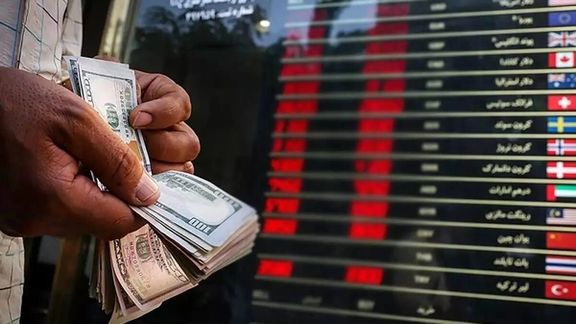
After Iran's Central Bank report on government banks providing large loans to their employees and affiliates, new reports have emerged about these loss-making financial institutions entering the local foreign currency market.
In Iran's heavily state-controlled economy, the government has long been the primary supplier of foreign currencies and controller of imports. Since 2012, when international sanctions began to sharply devalue the Iranian rial, the government has struggled to keep essential imports affordable. To manage this, it introduced multiple exchange rates, a system that has fueled widespread corruption. Influential insiders have taken advantage of government-provided privileges, such as export-import licenses, to profit from the disparities between official and market rates.
The official exchange rate is significantly lower than the free market rate for foreign currencies. The government aimed to control rising prices by subsidizing essential imports like basic food, animal feed, and medication, offering importers access to cheaper foreign currency in an effort to make these goods more affordable and prevent mass discontent
For instance, a portion of Iran's imports, such as medicine, is currently done using the government-subsidized rate of 285,000 rials per US dollar, while other imports, like food, are conducted through the "NIMA" system at 468,000 rials per dollar. Meanwhile, goods like household appliances or mobile phones are imported at the free market rate, which has soared to over 630,000 rials per dollar.
Iranian exporters are also obligated to either exchange their foreign currency earnings through the NIMA system or negotiate with importers to provide them with the required currency.
Recent reports from Iranian media reveal that Iranian banks are not only exporting goods directly but also selling the foreign currency earned from these exports to importers at a rate 10% higher than the NIMA rate. This allows the banks to profit from both exporting goods and selling the resulting foreign currency at a premium above the official NIMA rate.
Why is the government silent?
While the average inflation rate over the past few years has remained above 40%, and the Iranian rial has lost approximately 90% of its value since US sanctions were re-imposed on Iran in 2018, the government has mandated that banks provide loans to the public and companies at interest rates between 20% and 23%.
Moreover, from mid-2018 to mid-2024, the government’s debt to the country’s banking system skyrocketed by 430%, reaching 15.6 quadrillion rials—a sum equivalent to $23 billion at the free-market exchange rate and $55 billion at the official government rate.
The critical point here is that the government's debt to the banking system is in Iranian rials, meaning that with the annual decline in the value of the rial, banks are incurring massive financial losses.
For comparison, the free-market exchange rate for the US dollar has surged from 65,000 rials in mid-2018 to 630,000 rials today. As a result, the value of a large portion of the loans that Iran's banking system extended to the government and private sector at interest rates of 20% to 23% has been significantly eroded.
As a result, seven of Iran's largest banks are now struggling with accumulated losses totaling 4.6 quadrillion rials (approximately $7.3 billion at the free-market exchange rate). With the government's limited ability to cover these mounting losses, the banks face the risk of bankruptcy or are being pushed into activities normally prohibited for financial institutions, such as real estate management, property trading, and engaging in both domestic and foreign trade.
For instance, official statistics indicate that the value of banks' real estate holdings has now reached 2 quadrillion rials. Thanks to an 1100% increase in rial-denominated housing prices since mid-2018, a portion of the banks' losses has been offset.
Banks are using these unsound practices as another method to compensate for losses stemming from the declining value of the rial and the significantly lower interest rates compared to the inflation rate.
Recently, the Central Bank of Iran announced that in the last fiscal year, which began on March 20, the country's banks provided 1.2 quadrillion rials in loans to their employees or affiliated companies, which also benefits their managers. The affiliated companies use these cheap loans to plug their own financial losses.
Republican presidential nominee and former US President Donald Trump appeared to rule out seeking regime change in Iran, saying he wanted the country to succeed but it could not be permitted to have nuclear weapons.
“I would like to see Iran be very successful. The only thing is, they can't have a nuclear weapon,” Trump said in an interview with Iranian-American podcaster Patrick Bet-David on Thursday.
Asked if he would like to see Iran change its ruling system, Trump said: “We can't get totally involved in all that. We can't run ourselves, let's face it.”
During the interview Trump also highlighted that he pressured China to stop buying oil from Iran during his presidency by threatening to block its access to US markets, a move he said was effective. When asked if he would revive the strategy, Trump said, "Different strategies. It all depends."
Last month, Trump told reporters that Washington must come to an agreement with Iran, in a seeming departure from his hardline stance toward its main adversary in the Middle East.
Trump's withdrawal from the 2015 nuclear deal, known as the Joint Comprehensive Plan of Action (JCPOA), in 2018, marked the beginning of what he termed 'maximum pressure' sanctions on Tehran.
The policy was praised by the group Iranians for Trump, who say that a Trump presidency could be an effective approach to advancing freedom and democracy in Iran.
Trump has repeatedly expressed his preference for deals with Washington's opponents but his comments come as tensions in the Mideast have ramped up and his campaign said Iran has made threats on his life.
The United Nations' mission in Afghanistan has called for an investigation into reports that a large group of Afghan migrants was shot and killed while attempting to cross into Iran.
In a statement on Thursday, the UN Assistance Mission in Afghanistan (UNAMA) expressed "deep concern over disturbing reports of an incident on 14 to 15 October in Sistan province, Sarbaz district, Kala Gan border area of Iran, with allegations that a large group of Afghan migrants were opened fire on, resulting in deaths and injuries."
"(UNAMA) reminds all parties that the rights of migrants, refugees, and asylum seekers are safeguarded under international law.”
Afghan media outlets citing witnesses said more than 200 Afghan migrants who entered Iran illegally were attacked on Iranian territory and that dozens had been killed and injured.
Taliban chief spokesperson Zabihullah Mujahid announced the dispatch of a high-ranking delegation to investigate the incident. The delegation includes the deputy interior minister for security and representatives from the ministries of defense and intelligence.
The exact details of the incident remain disputed.
Iran-based human rights group Haalvsh reported on Tuesday that Afghan migrants were fired upon by Iranian border forces on Sunday near the Pakistan border, while Baluch Campaign, another rights group, said the migrants encountered a land mine while attempting to cross the area.
Iranian authorities have denied these reports. Iran's Special Representative for Afghanistan, Hassan Kazemi Qomi, stated on Wednesday via X: "Following comprehensive inquiries through reliable sources, it has been confirmed that the allegations surrounding the deaths of dozens of illegal immigrants at the Saravan border are baseless."
Amid the furore, Afghanistan's former attorney general, Mohammad Farid Hamidi, condemned the incident, describing it as a crime against humanity.
“These refugees, in search of safety and refuge from life-threatening dangers, braved perilous seas, mountains and deserts,” tweeted on Wednesday.
Hamidi also criticized Afghanistan's Taliban rulers, saying they are unwilling to protect Afghan citizens abroad.
"The irresponsible and illegitimate rulers in Afghanistan have disgraced the country and its citizens at the international level," Hamidi wrote in a post on X, saying the Taliban "neither have the ability nor the capacity to defend the rights of Afghan citizens outside the country."
These developments come as Iran's Parliament introduces a controversial plan to reduce the foreign national population by 10 percent annually, which would impact the approximately 10 million Afghan migrants currently living in Iran.
The proposed law seeks to limit foreign nationals and their families to no more than three percent of the population in any city, village, or province within three months of enforcement. To support this initiative, Iran is deploying border closures and surveillance, including artificial intelligence monitoring.
In addition, Iran has ramped up its deportation efforts, with plans to expel at least two million undocumented migrants by March 2025, according to Ahmad Reza Radan, commander of the country's law enforcement forces.
Israeli forces killed top Hamas leader Yahya Sinwar in Gaza on Thursday, Israeli Prime Minister Benjamin Netanyahu said, in a major blow to the Iran-aligned group and a possible boon to flagging peace efforts.
"Today we have settled the score. Today evil has been dealt a blow but our task has still not been completed," Netanyahu said in a video statement.
"To the dear hostage families, I say: this is an important moment in the war. We will continue full force until all your loved ones, our loved ones, are home," he added.
The Israeli military released drone footage it said showed the last moments of militant boss, caked in dust in a bombed-out house apparently severely wounded and attempting to throw a projectile at the camera.
Unverified graphic footage circulating on social media appeared to show a corpse roughly resembling Sinwar in a military tactical vest and headscarf with distinctive crooked teeth.
Israeli authorities said DNA and dental records analysis gleaned from the site and matched to records from Sinwar's over 20 years in Israeli prisons proved his identity.
Hamas has yet to confirm his death.
President Joe Biden said US intelligence had aided Israel to locate senior Hamas leaders, calling it a "good day".
Israel has had every right to eliminate the leadership and military structure of Hamas. Hamas is no longer capable of carrying out another October 7," Biden said in a statement.
"There is now the opportunity for a 'day after' in Gaza without Hamas in power, and for a political settlement that provides a better future for Israelis and Palestinians alike," he added.
Sinwar was the architect of the October 7, 2023 attacks which killed around 1,100 Israelis - most of them civilians - and ensnared scores of hostages in a shock to Israeli security which has brought the region close to all-out war.
Iran's other armed allies in the region including Hezbollah in Lebanon and the Houthis in Yemen joined the fight against Israel and the Islamic Republic itself has twice launched missile fusillades against the Jewish State.
The latest, on Oct.1, killed no Israelis and was repelled with US and Western aid. Israel has promised unspecified retaliation.
Sinwar succeeded Ismail Haniyeh - who was killed in a likely Israeli bombing of his guesthouse in Tehran in August - as the head of the group's political bureau, making him its highest ranking leader and de facto chief.
Iran's Supreme Leader this month blessed that attack as a justified act of resistance and emphasized the Islamic Republic's support for armed allies in the region like Hamas which have been confronting Israel for over a year.
US officials cited by domestic media outlets have pointed to hardline positions adopted by Sinwar as well as by Israeli Prime Minister Benjamin Netanyahu as obstacles to a negotiated ceasefire and hostage release in Gaza.
More than 42,000 Palestinians have been killed in the Israel's offensive so far according to Gaza's health authorities, including 28 people in an Israeli strike on a shelter in the northern Gaza Strip on Thursday.
Iran connection
Sinwar played a pivotal role in building Hamas’s strategic alliance with Iran, according to Israeli and Western military analysts and officials.
The bloody crackdown by Iran's ally Syria starting in 2011 on militias and dissidents linked to the Muslim Brotherhood - the ideological movement from which Hamas hails - dented relation with Tehran which Sinwar helped repair.
Sinwar traveled to Iran on notable visit in 2012 in which he was photographed as part of a Hamas delegation in an audience with Khamenei and after which Hamas-Iran ties improved.
In footage released following Haniyeh's assassination, Khamenei's office depicted the slain leader introducing Sinwar as a veteran of Israel's prisons.
Iran’s assistance, frequently cited by Sinwar, was instrumental in building Hamas’s military strength.
In a speech the same year, Sinwar confirmed that Qassem Soleimani, the late senior Iranian paramilitary general, had reached out to Hamas's leadership and offered all means at Iran's disposal to aid their cause.
The October 7 attack was a culmination of Hamas’ evolution under Sinwar’s guidance from an organization viewed by Israel as preoccupied with administering Gaza to a fearsome attacker dedicated to altering the security balance in the region.
Those enhanced capabilities enabled by its alliance with Iran were on display as Hamas fighters launched a complex attack by land, air and sea while overrunning military installations with the aid of drones.
The commander of Iran’s Revolutionary Guards issued another warning to Israel on Thursday against its plans to retaliate for a missile barrage launched by Tehran earlier this month.
In a televised speech on Thursday, Hossein Salami warned: “We tell you [Israel] that if you commit any aggression against any point, we will painfully attack the same point of yours."
He dismissed the deployment of the US-provided THAAD missile defense systemthis week, sent in preparation for any possible Iranian retaliation in the tit-for-tat aggression.
The US also deployed 100 troops in preparation for the escalation, President Joe Biden standing by the country's regional ally.
“Do not trust the THAAD,” Salami added, adding, “You cannot commit genocide and remain safe", referring to Israel's ongoing war against Iran-backed Hamas in Gaza.
Israel has vowed to eliminate Hamas following the October 7 attack, in which over 1,000 Israeli civilians were killed. In the aftermath, Hamas claims that around 42,000 Palestinians have been killed, while Israel asserts that at least 16,000 of those casualties were Hamas operatives.
While Israel’s air defenses intercepted most of the missiles, several struck targets including military and civilian sites, causing minor damage.
A US Terminal High Altitude Area Defense (THAAD)
Rasoul Sanaei Rad, the political deputy of the Supreme Leader Ali Khamenei's office, downplayed the US efforts to support Israel. On Thursday, he referred to the THAAD deployment as “a show and propaganda to boost the morale of the Israelis, who are in a state of panic.”
The Israeli government has vowed to respond to Iran’s missile strike, continuing its military operations in neighboring Lebanon and Gaza, where it has been targeting the leadership of Iran's proxies, Hezbollah and Hamas.
Syrian state media reported on Thursday that Israeli jets targeted the port city of Latakia in the early morning, while US forces carried out multiple strikes against military infrastructure belonging to Iran's Yemeni proxy, the Houthis.
Iran's FM Abbas Araghchi meets Egyptian President Abdel Fattah al-Sisi on October 17, 2024.
Iran's Foreign Minister Abbas Araqchi’s visit to Egypt on Wednesday, part of a Middle Eastern tour, marking the first high-level Iranian diplomatic visit to Cairo in almost 12 years. The most recent visit to Egypt took place in January 2013, when then-Foreign Minister Ali Akbar Salehi visited Cairo during an African tour.
He met with Egyptian President Abdel Fattah al-Sisi in Cairo on Thursday. Sisi reiterated Egypt’s call to prevent the conflict from expanding, stressing the need to avoid escalation, as reported by the Egyptian presidency.
FM Abbas Araghchi meets his Egyptian counterpart on October 17, 2024
Araqchi’s visit follows stops in Jordan, Saudi Arabia, Qatar, Iraq, and Lebanon. He also met with his Egyptian counterpart, Badr Abdelatty, on Thursday.
While relations between Egypt and Iran have been strained for decades, the two nations have increased high-level diplomatic engagement since last year’s Gaza crisis. Egypt, which sits on Gaza's border, is one of the mediators between Hamas and Israel, along with the US and Qatar.
Russia's deputy foreign minister warned Israel that it would be "a catastrophic development" to strike Iran's nuclear facilities, wading in on the conflict between the two archenemies.
Deputy Foreign Minister Sergei Ryabkov issued the warning on Thursday, according to state news agency TASS, risking bringing Russia further into the escalating conflict between Israel and Iran and its regional proxies.
Following Iran's ballistic missile attack on October 1, speculation is mounting that Israel could target Iran's nuclear, oil, or military facilities, as it has long threatened, although the US has warned that they will not support a strike on nuclear facilities.
Showing the ever deepening ties between Moscow and Tehran, Ryabkov said Russia has "repeatedly warned and continue to warn ... against even hypothetically considering the possibility of a strike on [Iranian] nuclear facilities and nuclear infrastructure".
On Wednesday, the Associated Press reported that the Biden administration believes it has secured assurances from Israel not to target Iranian nuclear or oil facilities.
A day earlier, The Washington Post reported that Israeli Prime Minister Benjamin Netanyahu had informed the Biden administration of his willingness to target military sites in Iran rather than nuclear or oil facilities, according to official sources.
Last week, Russian President Vladimir Putin highlighted a "very close" alignment of views with Iranian President Masoud Pezeshkian, as tensions in the Middle East continue to escalate, raising fears of a wider regional conflict.
Iran has provided Russia with drones for its war on Ukraine, resulting in further sanctions for Tehran and the two have increasingly carried out military exercises together. Iran is also building a drone factory in Russia with its close ally.
Iran and Russia, heavily sanctioned by the West, find themselves increasingly isolated on the global stage. Russia's invasion of Ukraine has made it the most sanctioned nation in the world, surpassing even Iran.
Amid these sanctions, Iran is deepening long-term agreements with strategic partners like China and Russia, in alignment with Supreme Leader Khamenei’s "Looking East" policy.