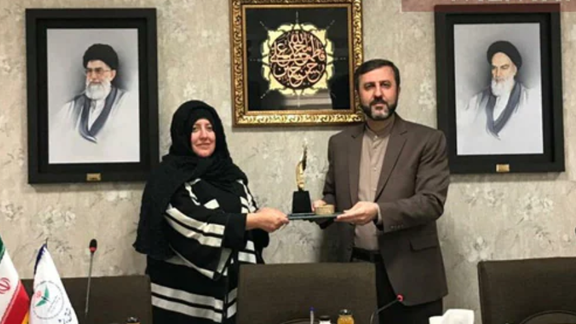
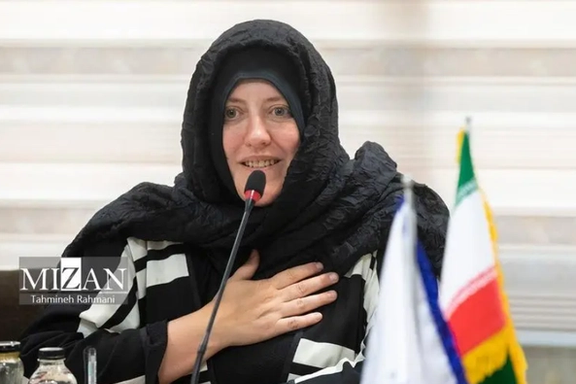
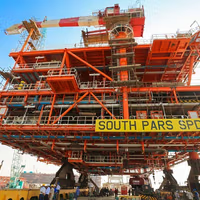
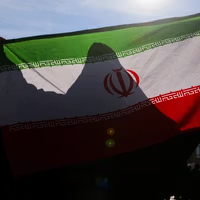
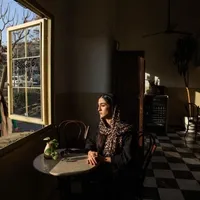
Charlotte Kates accepts the Iranian human right award.
Canada designated Samidoun, a pro-Palestinian group responsible for leading "death to Canada" chants and burning the Canadian flag during an anti-Israel protest in Vancouver earlier this month, as a terrorist entity on Tuesday.
Canada's move was made alongside the US Treasury Department's decision to list the group as a specially designated global terrorist entity.
Samidoun, which means "the steadfast ones" in Arabic, had been registered as a non-profit in Canada since March 2021.
"Violent extremism, acts of terrorism or terrorist financing have no place in Canadian society or abroad," Canada's Public Safety Minister Dominic LeBlanc said in a statement.
"The listing of Samidoun as a terrorist entity under the Criminal Code sends a strong message that Canada will not tolerate this type of activity, and will do everything in its power to counter the ongoing threat to Canada’s national security and all people in Canada.”
The US and Canada allege that Samidoun has links with another terrorist-designated group, the Popular Front for the Liberation of Palestine (PFLP).
Samidoun describe themselves on their official website as being advocates for the release of Palestinian prisoners. The organization did not immediately respond to an Iran International request for comment.
According to Public Safety Canada (PSC) many of those prisoners have ties to assassinations and attacks against Israel.
The PSC says Samidoun has been operating since 2011 and has 20 chapters around the world, including Iran, which Canada designated as a state supporter of terrorism.
Elham Abedini is listed as the coordinator of Samidoun's Iran chapter on Samidoun's official website.
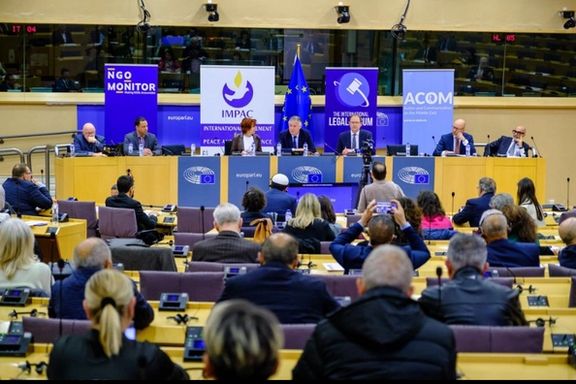
NGO Monitor, a research institute that has been investigating and raising concern over Samidoun to governments around the world since 2018, says the group has an informal connection to the Islamic Republic of Iran through a shared ideology and Iran's pursuit of soft power.
NGO Monitor presents information about Samidoun in the European Union Parliament (March 2023)
The non-profit's communications director Itai Reuveni told Iran International that Iran uses groups like Samidoun to exert its ideology and influence in the West without revealing themselves as the source.
"This fits to the Iranian practice to only use proxies. Samidoun is part of the proxies. Not just Hezbollah and Hamas, but also through soft power proxies " says Reuveni.
The anti-west, anti-Israel and pro-Islamic Republic narrative fits in with Iran's narrative that it wants to export through groups like Samidoun, who have direct access to the West, Reuveni added.
In July, a top US intelligence official revealed that the Iranian government provided financial support for the pro-Palestinian demonstrations rocking US campuses. An Iran International exclusive also found evidence that Iran was behind campus protests rocking McGill university in Canada.
Matthew Levitt, the director of the Reinhard Program on Counterterrorism and Intelligence at The Washington Institute for Near East Policy, said Samidoun was "explicitly active in some of the most vile pro-violence behavior at campus protests. "
Levitt, the author of Hezbollah: The Global Footprint of Lebanon's Party of God, says Iran has definite ties to the PLFP, for which Samidoun was acting as "sham charity" front, according to a US treasury statement on Wednesday.
“Organizations like Samidoun masquerade as charitable actors that claim to provide humanitarian support to those in need, yet in reality divert funds for much-needed assistance to support terrorist groups,” said US treasury official Bradley T. Smith in the statement.
Samidoun and Iran
Samidoun's director, Charlotte Kates, accepted an official "human rights award" in Iran on August 4th, an accolade that was also bestowed on the secretary-general of militant group Palestinian Islamic Jihad (PIJ).
Kates also appeared on Iran State TV, where she praised Hamas’ Oct. 7 attack on Israel.
“I spoke about the brave, heroic October 7 operation and the legitimacy of the resistance,” Kates said, dedicating the award to the “martyrs and prisoners of Palestine.”
In a March 2024 Samidoun-hosted webinar, Kates praised Hamas as “the people that are on the frontlines, defending Palestine and fighting for its liberation".
Kates is also under a hate speech investigation in Canada for praising the attack.
Samidoun's website covered Kates's meeting with Kazem Gharibabadi, Iran's Secretary-General of the High Council for Human Rights at the awards ceremony in Tehran. Kates also took part in a joint live interview with Gharibabadi.
Charlotte Kates of Samidoun appearing in Iran.
The existence of Samidoun's Tehran chapter and their participation in Iranian state events could not happen without the Iran government's approval, says NGO Monitor's Reuveni.
Palestinian Islamic Jihad, the PFLP, and the Popular Resistance Committees have themselves cited a relationship with Iran including military support.
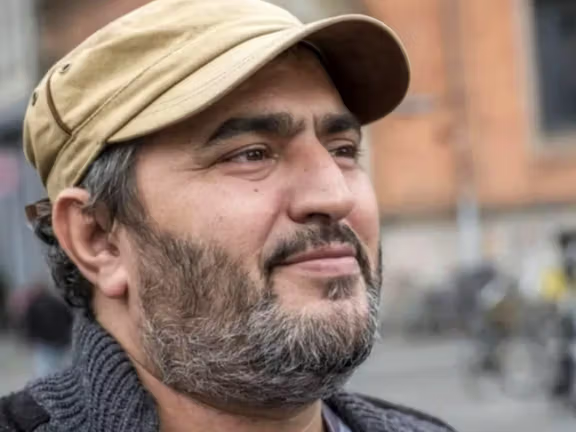
Kates's husband, Khaled Barakat, also a director of Samidoun, was identified by the US treasury statement as allegedly backing the fundraising and recruitment efforts to support the PFLP's "terrorist activity against Israel". Israeli security service Shin Bet alleges that Barakat is an active senior member of the PFLP.
The PFLP operates in Gaza and the West Bank and participated in attacking Israeli civilians on Oct. 7, the treasury department added.
Khaled Barakat in a photo that appears on the Samidoun website.
Some Iran watchers like Jason Brodsky say that the PFLP's direct links to Iran are evidence enough linking Samidoun to the Islamic Republic.
Brodsky, policy director of United Against Nuclear Iran (UANI), says Kates' official visits to Iran, appearance on state TV and meeting with high-level officials like Iran's Judiciary Chief Gholamhossein Mohseni Ejei points to an official link with the Islamic Republic.
In 2011 by the United States Department of State and the European Union sanctioned Ejei for his role in suppressing the 2009 Iranian presidential election protests.
"My concern is that the Islamic Republic likes to cultivate these individuals who have access to the West," Brodsky said.
"She is engaged in messaging that is very much in line with the Islamic Republic's ideological outlook," added Brodsky.
According to NGO monitor, Samidoun does not publish financial information, and is only registered in Vancouver, British Columbia.
However, Samidoun is a fiscally sponsored project of the Alliance for Global Justice (AFJG), an Arizona-based organization. The AFJG also is a fiscal sponsor for left-wing initiatives including the Palestinian Campaign for the Academic and Cultural Boycott of Israel (PACBI).
In May 2019, PayPal, DonorBox, and Plaid shut down online donations to Samidoun due to its alleged links to the PFLP.
Samidoun has also been listed as a terrorist entity in Israel and banned in Germany and the Netherlands. The Dutch parliament voted to designate Samidoun a terrorist organization this week.
Israeli security services have arrested a Russian-Israeli citizen for being part of an Iran-backed assassination plot targeting a senior scientist for $100,000, the second in just three days.
It is the third such arrest in a matter of weeks. Vladimir Varehovskim 35, from Petah Tikva in central Israel, is alleged to have agreed to carry out the assassination and now faces a court hearing on Wednesday, October 16.
In a joint operation, Shin Bet and Israel Police uncovered "an Iranian intelligence network working to recruit and activate citizens in Israel," according to a police statement.
“Some of the tasks performed were documented by Vladimir and payment was received for their performance,” a statement from Israel Police said. “The contact between him and the Iranian officials took place in the English language and as part of it he was asked to purchase a dedicated phone.”
After having done a series of smaller operations for Iran such as gathering information about an Israeli entity, hanging banners and spraying graffiti, “Vladimir later agreed to carry out a mission to eliminate an Israeli scientist for the sum of $100,000”, Israel Police said.
Ronen Solomon, an Israeli intelligence and defense expert, told Iran International: “The Iranians are learning from Western intelligence methods which had been taken from Israeli operations in order to target Israeli officials. Iran is also learning from the Russians.”
He said recruitment is being done by a cyber program, the latest suspect being recruited by Facebook. Recent recruits have also been recruited through Telegram.
“The Iranians see Russians as the weak link in Israeli society,” he said, hundreds of thousands having used Israel’s right of return laws for Jews since the fall of the Soviet Union.
“This is the second case in a row, so it could be the same handler in Iran,” he added.
Many of the roughly 1.5 million Russians in Israel are atheist and do not integrate as well into Israeli society as others, preferring to live in areas with large numbers of fellow Russian speakers.
Since the war with Ukraine making travel for Russians increasingly hard, Israel absorbed many more seeking a second passport.
It follows the arrest on Monday of Vladislav Victorson, 30, on charges of orchestrating an assassination plot on behalf of Iran. The Russian, living in the Tel Aviv suburb of Ramat Gan, had been in contact through social networks with a person named "Mari Hossi”, speaking in Hebrew.
Victorson was also accused of agreeing to assassinate an Israeli citizen and throw a grenade at his home, the statement from Israel Police saying he had worked to obtain weapons, including a sniper rifle, pistols and grenades.
He was also accused of having carried out tasks including burying money and burning vehicles in Yarkon Park in Tel Aviv. In addition, he was asked to sabotage communication infrastructure and ATMs as well as set fire to forests.
He is alleged to have recruited two other citizens, including his partner, Anna Bernstein, just 18 years old, who took part in several tasks in the operation.
Israel Police said he was also accused of locating street gangs in order to recruit them to perform additional tasks and photograph demonstrators during protests.
Asher Ben Artzi, the former head of Israel's Interpol, warned: "The Iranian intelligence is quite sophisticated. They are very active."
A closed community, he said Israel's Russians are vulnerable to recruitment. "We can assume that as many of them have a tough life here, they could be more angry at the state of Israel. If you offer such people a lot of money, they don't resist such a temptation," he told Iran International.
"The bottom line is that Iranian intelligence is very dangerous for us," he added as cases of this kind become ever more frequent.
Iran-backed plots recruiting date back more than a decade and have seen Iran hiring a wide spectrum of society, including an orthodox Jew from the religious suburb of Jerusalem, Beit Shemesh, arrested in July. In 2022, a network of Israeli women was uncovered as having been recruited by Iran.
Last month, Israel revealed they foiled an Iranian plot to assassinate top leaders including Prime Minister Benjamin Netanyahu, the head of Shin Bet and the country’s defence minister.
Moti Maman, a 73-year-old Israeli businessman from the city of Ashkelon, was accused of twice smuggling himself into Iran via Turkey to meet with intelligence officials directing the plots from Tehran.
Kayhan daily says Iran must close the Strait of Hormuz in the Persian Gulf to European vessels in retaliation for the European Union’s sanctions on Iran Air, the country’s flagship carrier.
“Europe chose the path of confrontation instead of interaction with Iran by starting a new round of sanctions under the false pretext that Iran has sent missiles to Russia. Now Europe must wait to pay the cost of its decision,” Kayhan arguedon Wednesday inan article titled “Europe Shut the Sky to Iranian Flights, Block the Sea to European Ships."
“Iran definitely has more capabilities to put pressure on Europe today in the gambit that they started,” the ultra-hardline daily whose managing editor, Hossein Shariatmadari, is an appointee of Supreme Leader Ali Khamenei, wrote, arguing that preventing European vessels from reaching their destinations in the Persian Gulf will be more costly to Europe than the ban on Iranian flights.
Iran Air, the only Iranian airline operating flights to European Union countries, suspended all its services to Europedue to new sanctions imposed by the European Union that targeted Iran Air, Mahan Air which is partly owned by a Revolutionary Guards (IRGC) linked company, and Saha Airlines, a civil operator owned by the Islamic Republic of Iran Air Force.
The Persian Gulf and the Strait of Hormuz.
The United States and its Western allies accuse Iran of using its civilian flights to send weapons including missiles to Russia for its war in Ukraine. The Islamic Republic denies any missile transfer to Russia.
There have always been allegations that the Islamic Republic uses its civilian fleet for military transfers.
Iran International acquired the audio file of an interview with former foreign minister Mohammad-Javad Zarif in April 2021. In the interview that was never published in Iran, Zarif criticized Qasem Soleimani, the slain commander of the extra-territorial arm of the Revolutionary Guards (IRGC), the Qods Force, of using Iran Air flights for shipments, presumably fighters and weapons, to Syria rather than the allegedly IRGC-linked Mahan Air which he said was less safe.
Mahan Air was designated by the US Treasury in 2011 for "providing financial, material and technological support” to the IRGC. These were followed by bans by several European countries including Denmark and Germany in the following years until the airline lost all its flights to European destinations by Spain joining the embargo in 2020.
Iranian officials and hardliners have periodically called for the closure of Hormuz as retaliation for various Western actions. Around 21 percent of the world's crude oil passes through the straits, heavily patrolled by both Iran and Western navies. This means that a closure of Hormuz will also stop all of Iran's oil shipments and a significant portion of China's oil inports. From January to September, China imported 4.2 mb/d of crude via the Strait of Hormuz, accounting for 43% of its seaborne crude.
Iranians have taken to social media since the announcement of the Iran Air sanctions and the country’s suspension of its flights to European destinations to voice their frustration.
Iran Air sanctions mean that no Iranian can fly directly to destinations in the Western Hemisphere without using a connecting flight from other regional airports such as those in Turkey, the United Arab Emirates, or Qatar.
Some netizens contend that the suspension of direct flights to Europe will highly affect expatriate Iranians including students and their families, including the elderly and the sick who will find it very difficult to find their way through non-European airports to board connecting flights.
The International Energy Agency (IEA) said on Tuesday that the global oil market is set for a surplus and that it was ready to act in the event of a supply disruption, suggesting an Iran outage may have little impact.
“Heightened oil supply security concerns are set against a backdrop of a global market that – as we have been highlighting for some time – looks adequately supplied," the IEA said in a monthly report on Tuesday.
"For now, supply keeps flowing, and in the absence of a major disruption, the market is faced with a sizable surplus in the new year,” the Paris-based watchdog added.
An October 1 missile attack by key OPEC-member Iran on Israel sent oil prices soaring as investors fretted over a potential supply disruption from an Israeli counterattack on Iran's oil facilities.
Most of those gains have evaporated however, as buoyant global supply and lackluster demand in China sapped price momentum while no retaliation has yet materialized.
The IEA, which manages developed countries' emergency oil stocks, said government oil storage stood at over 1.2 billion barrels and spare capacity in OPEC+, which comprises the Organization of the Petroleum Exporting Countries and allies such as Russia, were at all time highs.
"As supply developments unfold, the IEA stands ready to act if necessary," the agency said.
Oil sites off the table
Prime Minister Benjamin Netanyahu assured US President Joe Biden in a phone call last week that Israel will refrain from attacking Iran's nuclear or energy facilities, US newspapers reported citing officials.
Oil prices tumbled nearly 5% toward a two-week low on Tuesday, driven by the U.S. media reports which eased fears of a supply disruption.
In response to the escalating conflict following its October attack on Israel, Tehran reportedly moved its tankers away from Kharg Island, one of its main oil export terminals in the Persian Gulf – a precautionary measure taken to shield the tankers from potential Israeli retaliatory strikes.
Iran had around 40 million barrels of floating oil storage in early October, enough to continue exports to China for one month.
While it is unclear whether Kharg Island is among Israel's potential targets, recent data obtained by Iran International shows that Iran's oil loadings have plummeted by nearly 70% in early October, indicating significant disruptions in its oil export capabilities.
As a major oil exporter and OPEC member, Iran’s oil exports make up 65% of its government budget and 8% of its GDP – though it recently fell short of realizinga quarter of its projected oil revenues.
Despite its escalatory attack on Israel in October, Tehran has since signaled an apparent desire to avoid an all-out war while also asserting its readiness for it if necessary.
On the back of new sanctions, Iran has denied supplying ballistic missiles to Russia as domestic media blames Moscow for exacerbating Tehran's challenges while offering no support in return.
"Iran is bearing the cost due to Russia's actions, while Moscow, prioritizing its national interests and its dependency on the UAE, aligns with them on the issue of Iran's three islands," Rouydad24 wrote on Tuesday.
On Monday, the European Union imposed a fresh round of sanctions on Iran, specifically targeting Iran Air and several other entities, citing Tehran's involvement in supplying missiles and drones to Russia. The measures target individuals and organizations facilitating the transfer of military technology.
Rouydad24 also noted that if Iran is truly not complicit, Russia could assist in proving this to the international community, yet it remains silent. "Iran has borne a significant burden as a result of the Russia-Ukraine war despite deriving no benefit from the conflict. The recent reimposition of sanctions on Iran Air, which were painstakingly lifted during the JCPOA, directly impacts the Iranian people," it added.
On Sunday, Iranian Foreign Minister Abbas Araghchi posted on X that during a meeting in New York with Josep Borrell and Enrique Mora, he had reiterated Iran's denial of providing ballistic missiles to Russia.
"I clearly said, and reiterate once again: we've not provided ballistic missiles to Russia. If Europe needs a case to appease Israel's blackmail, better find another story," he wrote.
His remarks followed a report from The Wall Street Journal, in which EU reporter Laurence Norman claimed that during a meeting in New York with EU foreign policy chief Josep Borrell, Araghchi acknowledged that Iran had sent short-range missiles with a range of 250 kilometers to Russia.
Norman wrote, “Senior EU official says Araghchi acknowledged in NY that Iran had sent missiles to Russia of less than 250km range. He claimed they were not 'ballistic' missiles.”
The European Union's latest decision follows earlier warnings from March 2024, when the European Council stated that any transfer of ballistic missiles by Iran to Russia would lead to further sanctions.
In September, following the United States' announcement of sanctions against Iran Air for allegedly delivering ballistic missiles to Russia, the United Kingdom, Germany, and France quickly followed suit, imposing their own sanctions on the airline.
In response, even conservative media outlets acknowledged the situation, attributing the blame to Russia for the resulting consequences. In a commentary titled "New Sanctions for the Sake of Russia," the conservative Nameh News website remarked, "Iran is paying a high cost for Russia's war against Ukraine. Iran has not been gaining anything from Russia's war against Ukraine."
The article directly blamed the missile sales to Russia as the cause of fresh sanctions, including those reimposed on Iran Air, which had been lifted following the 2015 nuclear agreement. Nameh News also stressed that the sanctions directly affect the Iranian people, underscoring the broader consequences of Iran's involvement in Russia's conflict.
Araghchi criticized the move, stating, "Western countries still do not understand that sanctions are a failed tool and have not proven their effectiveness in practice."
Iran Air had been operating direct flights to several major European cities, including Frankfurt, Hamburg, Paris, and London, before the sanctions.
Iran has faced widespread criticism for its deepening military ties for Russia, particularly for supplying drones and missiles, which has also triggered global sanctions.
Amid rising tensions with Israel, Iran has stated it sees no reason to continue indirect talks with the US at this time, citing the escalating Middle East crisis as a major obstacle to renewed negotiations.
Iranian Foreign Minister Abbas Araghchi made the statement during a visit to Oman, which had previously facilitated indirect talks with the US.
"We do not see a basis for these talks until the current crisis is resolved. Afterward, we will decide whether to resume negotiations and in what form they should continue," Araghchi said.
Iran’s latest declaration comes as the state and country brace for an anticipated counter-retaliation from Israel following a missile barrage earlier this month.
Tehran launched over 180 ballistic missiles at Israel, in response to an Israeli air strike in the southern suburbs of Beirut that killed Hezbollah leader Hassan Nasrallah and Brig-Gen Abbas Nilforoushan, the operations commander of the Islamic Revolutionary Guards’ (IRGC) overseas arm, the Quds Force. The Israel Defense Forces (IDF) says the majority of missiles were "intercepted by Israel and a defensive coalition led by the United States".
Despite that escalation, Tehran has since – including the Iranian Foreign Minister's visit to Oman – appeared to signal its effort to avoid an all-out war with Israel.
“We are not seeking war, although we are fully prepared for it. We believe that diplomacy must work to prevent a major crisis in the region,” Araghchi said.
It remains uncertain whether Kharg Island, Iran’s primary oil export terminal in the Persian Gulf, is among Israel's potential targets. However, recent data obtained by Iran International indicates that Iran's oil loadings have plummeted by nearly 70% in early October.
Reports suggest that after Iran’s large-scale missile attack on Israel on October 1st, Tehran immediately withdrew its tankers from the Kharg Island to prevent them from being targeted by Israeli retaliatory strikes. Since then, Iran's oil loadings have significantly dropped.
The Pentagon announced on Sunday that the US is deploying the advanced Terminal High Altitude Area Defense (THAAD) missile defense system to Israel, accompanied by approximately 100 American troops to operate it.
This marks the first deployment of US forces to Israel since the Hamas-led attacks on October 7, 2023. The move comes amid escalating tensions, following Iran's launch of around 200 missiles at Israel on October 1, as the situation in the Middle East continues to deteriorate.