A billboard in Jerusalem that reads "the end of Ayatollah's regime in Iran".
Distance posed no challenge for the Israeli military, which demonstrated its ability to enter Iran and act at will, all while showing restraint, a leading urban warfare expert told Iran International.
John Spencer, who spent 25 years as an infantry solider and officer in the US Army, and served as advisors to senior US army leaders, said Israel’s October 26 retaliation was both restrained yet powerful, and deliberately didn't reveal all of its capabilities.
“It was a very solid and impactful show of force that Israel can reach the Islamic regime in Iran, can penetrate all their air defenses to include the S-300 and can target and show restraint when it wants,” said Spencer.
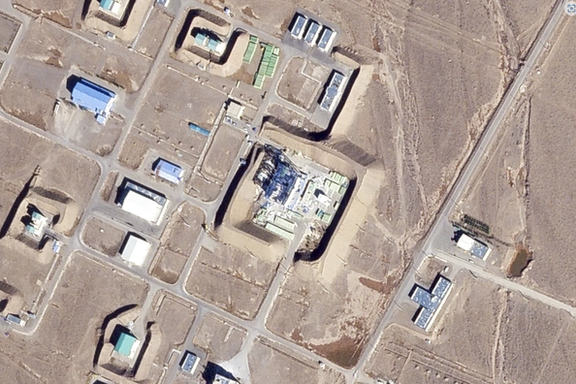
Satellite images showed likely damage sustained to a base run by the Islamic Revolutionary Guard Corps (IRGC) that builds ballistic missiles and launches rockets as part of its own space program. Iran launched a military satellite in space from Shahroud Space Center in 2020.
Satellite photo from Planet Labs PBC appears to show a damaged building at the Revolutionary Guards's Shahroud Space Centre in Semnan province in Iran.
Tehran has largely remained silent other than acknowledging Israeli attacks taking place in Fars, Ilam, Khuzestan and Tehran provinces, stressing that damages were limited.
Images from satellite firm Planet Labs also showed that in the four-hour attack overnight Saturday, a military base in Parchin near Tehran, where nuclear tests were allegedly conducted in the past, was damaged.
Parchin was marked by Iran as military, not nuclear. It was also one of the sites which had been banned from inspections by the UN’s nuclear team.
Spencer said Israel also damaged S300s which are used to protect vital targets, including Iran’s Supreme Leader Ayatollah Ali Khamanei.
“Israel can hit anything it wants in Iran that it chooses to,” said Spencer.
Israel military chief said on Tuesday that if Iran attacks, they will hit back with capabilities that we did not even use last time.
“If Iran makes the mistake of launching another missile barrage at Israel, we will once again know how to reach Iran, with capabilities that we did not even use this time, and strike very, very hard at both their capabilities and locations that we set aside for now," said Israeli Chief of the General Staff Herzi Halevi.
He said Israel also reserved capabilities that it chose not to demonstrate, but the question is why?
Why Israel held back capabilities
Spencer said while nothing is black and white, Israel’s power lies in its allies, namely the United States, that wanted to avoid a full-scale war.
Guarantees were made by the Americans in exchange, said Spencer, like the US recently issued new sanctions against Iran's oil sector, including the so-called oil ghost fleet, which carries oil products sanctioned by the US.
Israel also took neighboring Arab countries into its decision-making factor that urged the US and Israel to avoid Iranian oil and gas sites for fear of reprisal.
With the US elections on November 5, there were a lot of considerations to be made, he said.
Donald Trump’s former national security advisor Ambassador John Bolton posted to X on Tuesday that there was pressure from the Biden-Harris administration and the impending US elections that forced Israel to retaliate against Iran in what Bolton described as a limited way.
“The Tehran regime has gotten away with too much for too long. After November 5, Israel should strike Iran’s nuclear-weapons program,” Bolton wrote.
There are growing calls inside Israel’s government to do more with Iran. While deterrence was established, an Israeli government source told Iran International, that the weekend strikes did not go far enough to avenge a Hezbollah drone strike last week on the seaside residence of Prime Minister Netanyahu. Iran denied any involvement in that attack, but Israel pointed the finger at the Islamic Republic, which it views as Hezbollah’s boss.
Israel’s Channel 13 news, said the security cabinet discussed the topic for "long hours," reporting that the weekend's strikes were not intended to avenge the attack on the PM's home, launched by Iran's largest militia, Hezbollah, in Lebanon. It said, "another response is expected".
Even some people inside Iran, from the pro-Israel camp, posted to social media that they were disappointed in Israel’s targets were hoping for strikes on Iran’s political leadership.
Some Iranians had invested hope in Israel to help overthrow the Islamic Republic rule especially after Prime Minister Benjamin Netanyahu’s speech delivered to the Iranian people where he made a direct appeal to them.
“You deserve better,” said Netanyahu in a pre-recorded speech last month.
Brigadier General (res.) Amir Avivi told Iran International prior to Israel's counterstrike, that Israel will perform one of many strikes in the Islamic Republic.
Avivi, who is a close friend of Netanyahu and is consulted for his military expertise, said that Israel’s first strike in Iran is beginning and not a means to an end.
What will Iran do?
When asked if Iran would counterstrike, Spencer said if you take the Islamic Republic leadership at their word, then yes.
Pezeshkian sent a letter to the UN Secretary General, saying Iran “reserves its inherent right to legal and legitimate response to these criminal attacks at the appropriate time”.
Abbas Araghchi, Iran’s foreign minister, said on Tuesday that Iran will respond to Israel. "Responding to Israel’s attack is our right, but the Islamic Republic will decide on this response itself, and we won’t allow anyone to drag us into emotional reactions."
Araghchi also noted that Tehran knows which countries allowed Israel to use their airspace to attack Iran, but the US is the main culprit.
Speaking at the United Nations Monday, Iran’s UN envoy told the Security Council, that it reserved the right to strike back. Iran also accused the US of being complicit in Israel’s airstrikes and said it would bear the consequences.
The US envoy, issued a warning to Iran, saying that any further aggressive actions against Israel or US personnel in the region would result in severe consequences.
“Stop pouring gasoline on the fire of the regional conflict,” the American envoy said, addressing the Islamic Republic.
Urban warfare expert John Spencer stated that Israel’s recent action serves as a deterrent, signaling to Iran that Israel could respond even more forcefully if Iran chooses to retaliate, given that it refrained from targeting additional sites. He also noted Iran’s often unpredictable behavior, making it difficult to forecast the Islamic Republic’s response.
However, Spencer cautioned against underestimating Iran’s capabilities. He warned that with the unpredictability of war and Iran’s actions, any Iranian retaliation targeting Israeli civilians could quickly escalate the conflict.
Iran still has thousands of cruise and ballistic missiles, for example.
“Iran still has the capability to conduct long range strikes against Israel. If it ratcheted up targeting civilian areas it would be really problematic. Nobody wants to see that.”
This round of Israeli strikes, though effective in destroying military targets while showing restraint, achieved important goals for Israel but the next move Iran makes will determine what unfolds in the near future.
Lebanon’s Hezbollah named Naim Qassem as its new Secretary General on Tuesday, following the death of former leader Hassan Nasrallah in an Israeli airstrike in Beirut last month.
Qassem, who has served as Hezbollah’s deputy leader since 1991, was elected by the group’s Shura Council. At 71, Qassem is regarded as a foundational member of Hezbollah, with long-standing ties to Iran.
Unconfirmed reports indicate that Qassem was flown from Beirut to Tehran on October 5 aboard a plane belonging to Abbas Araghchi, the Iranian Foreign Minister, following the Israeli assassination of Hezbollah chief Hassan Nasrallah in Beirut. Iranian officials have not confirmed the reports, but if Qassem is based in Iran, Hezbollah’s leadership in Lebanon would then be managed remotely.
Israeli Defense Minister Yoav Gallant hinted at Qassem’s vulnerability, posting on X shortly after his appointment that “Temporary appointment. Not for long.” In Hebrew, he adds: “The countdown has begun.”
In its official Arabic account on X, the Israeli government said: "His tenure in this position may be the shortest in the history of this terrorist organization if he follows in the footsteps of his predecessors Hassan Nasrallah and Hashem Safieddine."
It added that "there is no solution in Lebanon except to dismantle this organization as a military force."
Iranian leaders publicly congratulated Qassem on his appointment. President Masoud Pezeshkian praised his “defense of Lebanon’s sovereignty and ideals of the resistance front,” while Iranian Parliament Speaker Mohammad Baqer Ghalibaf lauded Qassem’s role in supporting Hezbollah’s cause in Lebanon and the region.
Qassem appeared on camera on October 8 from an undisclosed location, days after Nasrallah’s death and amid reports that Hashem Safieddine, another potential Hezbollah leader, was targeted by Israel.
In his statement, Qassem referred to the Israel conflict as a “war about who cries first,” pledging Hezbollah’s continued resistance despite what he called “painful blows from Israel.”
Iranian ties and ideological alignment
Qassem’s ties to Iran have been central to his role in Hezbollah. An advocate of the Guardianship of the Jurist doctrine, he regards Iran as the backbone of Hezbollah’s resistance efforts in Lebanon.
He has emphasized that Hezbollah’s presence in the resistance movement depends on Iran’s strategic support amid international pressure.
Naim Qassem meeting Iran's Supreme Leader Ali Khamenei - August 2024
Born in southern Lebanon’s Kfar Fila in 1953, Qassem has held various roles within Hezbollah and the broader resistance movement. He co-founded the Union of Muslim Students in Lebanon in the 1970s and later joined the Amal Movement, before shifting to Hezbollah after Iran’s 1979 Islamic Revolution. Qassem has also published more than 12 books on religious and political topics, including Hezbollah: The Story from Within, detailing Hezbollah’s ideological foundations.
He has also authored books on Iran's Supreme Leader Ali Khamenei and his predecessor Rouhollah Khomeini, who founded the Islamic Republic.
Education ties and sanctions
Qassem previously led Lebanon’s Islamic Religious Education Association and served as an advisor to Lebanon’s Al-Mustafa schools, which promote Shiite Islamic ideology and receive support from Iran’s Al-Mustafa International University. The US Treasury Department sanctioned Al-Mustafa International University in 2020, alleging its involvement in intelligence operations for the Islamic Revolutionary Guard Corps and recruitment for Iran’s Quds Force.
In 2018, the United States and its allies in the Terrorist Financing Targeting Center, including Saudi Arabia, Bahrain, and the UAE, sanctioned Qassem and froze his assets, accusing Hezbollah of destabilizing the region.
Israel's top military officer on Tuesday threatened a stronger retaliation should Iran launch further missile strikes, shortly after Iran's foreign minister hinted at a studied response to Israel's Saturday airstrikes.
Israel's airstrikes on Iranian military sites early Saturday damaged the country’s missile production capabilities in three sites and air defenses in at least two facilities, according to the analysis of satellite imagery.
However, Chief of Staff of the Israel Defense Forces (IDF) says the country used only "some of its capabilities" in the airstrikes launched in reaction to Tehran's Oct. 1 missile barrage, vowing to launch an even harsher attack in case of an Iranian response.
"If Iran makes the mistake and launches another barrage of missiles at Israel, we will once again know how to reach Iran, reach even with capabilities that we did not use this time, and hit very, very hard both the capabilities and places that we left aside this time," Herzi Halevi told the aircrews at the Ramon Air Base in southern Israel who took part in the strike on Iran.
Halevi emphasized that Israel held back certain capabilities in recent strikes, leaving key targets untouched. “We did this for a very simple reason — because we may be required to do it again. We didn’t finish this event; we are right in the middle of it."
His remarks came a few hours after Iran's Foreign Minister Abbas Araghchi said Tehran reserves the right to respond to the Israeli airstrikes but will not show an emotional reaction.
"Responding to Israel’s blatant aggression appropriately is our legal right, but the Islamic Republic will decide on this response itself, and we won’t allow anyone to drag us into emotional reactions," he said. Still, Araghchi stressed that Israel will pay a heavy price for the attack.
Israel, however, does not seem to be only target of Iran's threats following the Israeli air raids. Some Iranian hardliners are now warning that US interests could be targeted by Islamic Republic forces, asserting that Iran should view "interests, resources, and military personnel" as legitimate targets.
The United States has in recent days repeatedly warned Tehran against responding to the Israeli airstrikes, so that the tit-for-tat exchanges of fire would stop.
"Our message for Iran remains clear: Should it choose to undertake further aggressive actions against Israel or US personnel in the region, there will be severe consequences. We will not hesitate to act in self-defense," the US Ambassador to the United Nations tweeted Tuesday. "But let there be no confusion: The US does not want to see further escalation. We believe this should be the end of the direct exchange of fire between Israel and Iran."
Earlier on Monday, State Department Spokesman Matthew Miller said the Biden administration believes Iran should not respond to the Israeli airstrikes in any way.
"Israel had the right to respond to Iran's Oct. 1 attack. We believe Israel's response on Friday night should be the end of that matter, as the nature of their response was proportionate. We believe Iran should not respond in any way. If Iran does respond, the US will continue to defend Israel," Miller said.
Now the ball is in the court of Iran's Supreme Leader Ali Khamenei. He has delegated decision-making to the Supreme National Security Council, but all SNSC members are his appointees. Thus, the ultimate decision on whether to attack Israel still rests with Khamenei, though he seeks to sidestep direct accountability for potential consequences.
Iran plans a 200 percent increase in military spending in an upcoming budget, a spokesperson said on Tuesday, and will aim to boost revenue through higher taxes despite a big deficit and a moribund currency besetting the economy.
"The military budget has increased by almost 200 percent. We hope this meets our security needs and those of the country’s military,” President Masoud Pezeshkian's spokesperson Fatemeh Mohajerani said of the proposed budget on Tuesday.
The Iranian rial hovered near all-time lows around the time of the announcement. It had plumbed lower depths after archenemy Israel on Saturday launched its biggest ever attack on the Islamic Republic, prompting calls by officials to beef up defenses.
A new report from Iran’s Parliamentary Research Center reveals that at least 20 percent of the government’s oil revenue is lost in efforts to bypass US sanctions, confirming previous reports by Iran International on the scale of revenue losses in oil exports.
The Parliament Research Center’s report highlights that in the first four months of the current Iranian fiscal year, 23 percent of the government's planned 4-month budget went unrealized. Despite the government’s extensive, unscheduled borrowing from the National Development Fund (NDF), it is projected to still face a budget deficit of approximately 880 trillion rials (equivalent to $3 billion at this year's official exchange rate of 285,000 rials per dollar) by the end of the year.
Next year starting March 21, the proposed budget will reach $105 billion, calculated on 550,000 rials per one dollar. The deficit will be around 30%, bridged by a variety of ways, including borrowing from banks, issuing bonds and diverting oil revenues from the share of the sovereign national fund, as well as up to 40% higher taxes.
According to estimates from the Parliament Research Center, despite these measures the projected budget deficit for the upcoming year may reach approximately $5.8 billion.
Realization of 4-month budget in various sectors during current fiscal year
Components of Next Year’s Budget Bill
In the 2025-2026 budget, 33 percent will rely on tax revenues, 18 percent on the sale of bonds and government assets, and 45 percent on oil and gas revenues as well as borrowing from the National Development Fund (NDF). Borrowing from the banks is not even mentioned in the draft bill as part of the deficit, but rather as revenue. This borrowing leads to printing money, since the banks are directly and indirectly state owned and have no money of their own to lend to the government.
The share of key revenue components in next year’s budget bill and their growth compared to the current budget law
The proposed 39 percent tax increase in next year’s budget bill comes at a time when the country is facing over 40 percent inflation, while the government plans to raise public employee salaries by only 20 percent, with similar increases set for labor wages.
On the other hand, the projected 85 percent increase in customs revenue will significantly raise the prices of imported goods, worsening the overall living conditions for the public.
The government also intends to increase bond issuance by 96 percent to cover 11.7 percent of the budget, or more than 10%, effectively borrowing further from the banking system, which will lead to higher liquidity and inflation.
Additionally, the government plans to obtain a substantial portion of the National Development Fund’s 48 percent share of oil export revenue in the form of loans. So far, the government has borrowed $100 billion from this fund—initially established as a nest egg for future generations—and is currently unable to repay this debt.
Oil Revenue Details
Budget revenue from domestic sales of oil and gas products in next year’s budget bill is projected to reach $16.5 billion, a 14 percent increase over this year. The government plans to raise gasoline prices next year, though the exact increase is not specified in the budget bill or in the report from the Parliament Research Center.
The last time the government imposed a significant gasoline price hike in 2019, widespread public protests erupted, followed by a severe crackdown by security and military forces, resulting in the deaths of 1,500 civilians.
The government also aims to export 16 billion cubic meters of gas next year, valued at $5.2 billion. The Parliament Research Center states that, due to a severe gas shortage, only 75 percent of this target is likely to be realized.
Additionally, for the coming year, the government forecasts total daily oil and gas condensate exports to reach 1.85 million barrels, which will be allocated among the government, the armed forces and their special projects, the National Development Fund, and the National Iranian Oil Company (NIOC).
Tanker tracking companies put the Iranian oil export volume in 9 months of 2024 at about 1.5 mb/d.
Sector’s share in Iran’s oil and gas export
A notable figure in the distribution of oil export shares is that of the armed forces, which has quadrupled compared to the initial version of this year’s budget law. However, the report from the Parliament Research Center reveals that the government, without public announcement, has significantly increased the armed forces' share in the initial budget law of current year. Consequently, next year, the armed forces’ share of oil exports will increase by only 24 percent compared to this year.
A critical point in the Parliament Research Center's report is that the government has set the price of oil at $63 per barrel for next year's budget, but Research Center says it is unlikely to sell for more than $60. Given the current oil price of around $70 per barrel in international markets, it seems more than 20 percent of the government’s oil export revenue will be lost due to sanctions evasion and discounts to Chinese customers.
The report does not address the realization of oil revenues for the armed forces. However, Iran International recently reviewed three oil trading documents from "Thunder Sahara Company," affiliated with Iran's armed forces, showing that half of the export oil value managed by this shell company is lost in the process of circumventing sanctions.
The Parliament Research Center also states that the oil export shares allocated to the government, NDF, and NIOC amount to a total 1.25 mb/d. However, actual exports are likely to reach no more than 1.1 mb/d.
After Israeli strikes across Iran at the weekend, opposition figures are calling for further action against Iran, saying they did not go far enough.
On Sunday night, members of parliament raised the idea of a further attack, saying that the weekend’s retaliation for this month’s ballistic missile barrage by Tehran failed to avenge the drone attack that targeted long-time Prime Minister Benjamin Netanyahu’s home in Caesarea earlier this month.
A government source told Iran International, “There is a feeling that the attacks this weekend weren’t enough to also avenge the attack on the Prime Minister’s home.”
While the parliament does not have the power to decide on military strategy, reserved for the war cabinet, it has become a political opportunity for Netanyahu’s rivals such as former Prime Minister Yair Lapid, to portray him as weak while the country battles Iran’s proxies across the country’s borders.
“It’s a political, not a strategic discussion,” the source added, stressing that it was not necessarily reflective of the military leaders’ policy.
Israel's Channel 13 said the security cabinet discussed the topic for "long hours," reporting that the weekend's strikes were not intended to avenge the attack on the PM's home, launched by Iran's largest militia, Hezbollah, in Lebanon. It said "another response is expected".
Since the Iran-backed Hamas attack on Israel last year, the country’s opposition parties have called for Netanyahu to resign, with protests across the country blaming him for the war and the failure to find a resolution to release the 101 hostages still held in Gaza.
On Sunday, following the hours-long attacks on Iran, centrist Lapid, the head of the Yesh Atid party, congratulated the Air Force but said it was not hard enough, with the targets tempered by intervention by the US, which has played a critical role in preventing an all-out war between the two nations.
In spite of the damage the strikes have done to Iran’s air defenses, Lapid wrote on X: “The decision not to attack strategic and economic targets in Iran was wrong. We could and should charge Iran a much heavier price.”
The head of centre-right party Yisrael Beitenu, Avigdor Lieberman, said the Jewish state must expect a harsh response for the weekend's operation, and in turn, act with strength to deter Israel’s archenemy.
“They [Iran] will continue their efforts to obtain nuclear weapons and they will continue to transfer the funds from the sale of oil and gas to Hezbollah, the Houthis, the Shiite militias and various proxies,” he wrote on X.
“Unfortunately, it seems that instead of collecting a real price, the Israeli government is once again content with showmanship and public relations. Buying silence instead of a clear decision. The time has come to act in a way that will reflect our strength and not just talk about it.”
Germany has recalled its ambassador to Iran over the execution of Jamshid Sharmahd, a German citizen and US resident, and summoned the Iranian chargé d'affaires as global condemnation grows over the killing.
German Foreign Minister Annalena Baerbock recalled the ambassador after he formally voiced Germany's condemnation to the Iranian foreign minister, the German foreign office said in a post on X.
Iran executed the 68-year-old dissident who was a software developer and California resident on Monday. He was abducted by Iranian agents during a visit to the United Arab Emirates in 2020 and forcibly taken to Iran. In February 2023, the Iranian judiciary sentenced him to death on charges of endangering national security.
Germany's ambassador in Tehran issued a démarche to Iran's foreign minister, strongly protesting the execution of Jamshid Sharmahd, according to an X post. The message added that Foreign Minister Baerbock has since recalled the ambassador to Berlin for consultations.
Sharmahd was convicted of heading a pro-monarchist group named Tondar accused of a deadly bombing incident that occurred in 2008 at a religious center in Shiraz, killing 14 and injuring 215 more. The accusation, repeatedly denied by Sharmahd, was never substantiated by documented evidence. He was denied a fair trial and due process, as most other political prisoners, especially dual nationals.
The execution has ignited a global wave of condemnation from a broad spectrum of people, including Iranian dissidents, foreign officials, and the victim's family.
Along with a video of herself looking at the camera in silence, his daughter Gazelle Sharmahd, criticized the US and German governments for their inaction during the past four years. “Are you seriously still going to ignore our family and leave even my father’s presumed corpse defenseless in terrorist hands?”
European Union Foreign Policy Chief Josep Borrell condemned his killing in the strongest possible terms, saying that the EU is considering measures in response.
Abram Paley, the US deputy special envoy for Iran, called the execution abhorrent and condemned the country's rising rate of executions.
"Sharmahd should never have been imprisoned in the first place," Paley wrote on X. "His kidnapping and rendition, as well as sham trial and reports of torture, were reprehensible. We...stand with the international community in holding the regime accountable for its horrific abuses."
German lawmaker Friedrich Merz called his trial a mockery of international standards of legal proceedings, saying, “The Iranian regime has once again shown its inhumane character.”
"Jamshid Sharmahd was executed because there are still people in Iran and around the world who believe that an establishment responsible for 'crimes against humanity' can be transformed by simply changing a president or parliament," Nobel Peace Prize laureate Shirin Ebadi said.
Iran’s exiled prince Reza Pahlavi condemned the Islamic Republic for the execution and criticized the US and German governments for their lack of support to free Sharmahd..
“The oppressive Islamic Republic regime, led by the despicable Ali Khamenei, has further stained its hands with the blood of Jamshid Sharmahd...[who] was denied basic human rights and a fair trial. Despite holding dual citizenship with Germany and permanent residency in the US, he received inadequate support from these governments. Their failure to leverage their influence to secure his release or at least his life is a stain on their conscience.”
Renowned activist Masih Alinejad, who was herself the subject of alleged foiled abduction and assassination attempts, shared a cartoon published by a state-run newspaper that depicts Sharmahd and late dissident journalist Ruhollah Zam in fishing nets accompanied by a threatening caption, “Next: Masih Alinejad.” Zam, who had left Iran and was living in France was kidnapped by Iran’s secret services in Iraq and taken to Iran. After interrogations and possibly torture he was hanged in December 2020.
“The Islamic Republic understands no language of peace or diplomacy. Their language is that of hostage-taking, execution, assassination, and murder,” Alinejad wrote.
Canada-based Iranian activist Hamed Esmaeilion described the execution, which came shortly after an Israeli attack inside Iran, as an attempt to deflect attention from its domestic and international failures, a sentiment that was echoed by a large number of Iranians around the world.
“Jamshid Sharmahd was yet another hostage executed at the hands of the Islamic Republic. This regime of murder and manslaughter compensates for its failures and inability to address major domestic and international challenges by suppressing the Iranian people. The regime takes revenge on the people for its defeats.”
Iran conducted the most executions of any country in the world after China last year, Amnesty said in a report in May, adding that nearly 75% of all executions worldwide in 2023 outside China were in Iran. The recent wave of executions brings the total number of hangings in Iran this year to more than 567, including 20 women, according to rights groups.