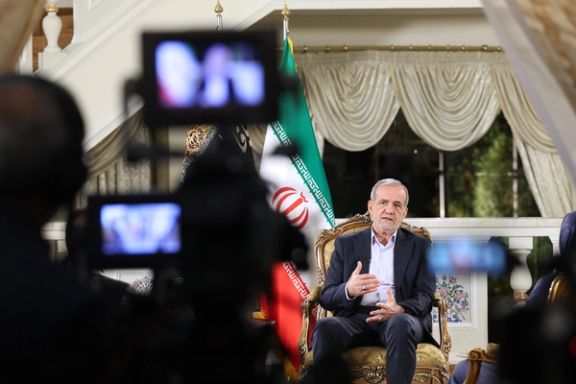
Iranian President Masoud Pezeshkian during an interview with state TV on December 3, 2024
An Iranian state TV interview with President Masoud Pezeshkian has sparked debate for its sharp line of questioning and well-worn remarks by a new leader facing deep economic and foreign policy challenges.
Reformist-leaning media in Iran criticized Elmira Sharifi-Moghaddam, a female anchor for state TV channel IRINN, for posing challenging questions to President Pezeshkian about the state of the economy.
Commentators seen as reformists argued that her questions were unfair, overlooking long-standing issues Pezeshkian faces, such as sanctions and a deeply inefficient economic system.
However, the questions raised during the interview were far less probing than those typically posed by European or American TV anchors. The interview's style appeared intentionally crafted to align with state TV's political leanings, closely tied to the ultraconservative Paydari party, whose members are known to influence the broadcaster's newsand current affairs policies.
A former Tehran mayor, Gholamhossein Karbaschi, who owns and runs the centrist daily Ham Mihan, criticized the President's decision to participate in a live one-hour interview on state television.
In an article for Iran, the state-owned newspaper, Karbaschi argued that Pezeshkian should have refused the format dictated by state television, instead asserting control over when and how he addressed the nation
"He should have changed the state TV's game and chosen when and for how long to speak to the public," Karbaschi suggested, adding that Pezeshkian could have delivered "just two sentences to convince the people."
Karbaschi argued that the interview was intended to undermine the president rather than facilitate meaningful communication with the public.
"What we saw on TV was an honest president speaking transparently while facing unfairly challenging questions," he wrote.
The former mayor also accused the anchor of frequently interrupting Pezeshkian and raising provocative topics, such as a potential gasoline price hike, to derail his explanations of the administration’s performance.
Karbaschi further claimed that the president was given limited time to express his views on the controversial hijab law.
•
•
Domestic media appeared to express frustration upon realizing that the interview with Pezeshkian, his second since taking office on August 1, differed from those with previous presidents – when anchors typically refrained from challenging their guests and even assisted in portraying their performance in a favorable light. This was especially true in interviews with former President Ebrahim Raisi, much of the media noted.
Conservative columnist Abdoljavad Mousavi commented that "Pezeshkian spoke in the same manner about everything, making it difficult to assess his weaknesses and strengths," but argued that the president spoke with candor and honesty.
In contrast, Amir Hossein Jafari, a columnist for the pro-reform outlet Rouydad24, argued that Pezeshkian's remarks on various issues "hardly convinced the public."
Jafari highlighted key topics addressed in the interview, such as gasoline price hikes, internet censorship, and pressures stemming from the new compulsory hijab law.
"Apart from hijab, the president did not say much about other matters," he noted.
The word "disparity" dominated Pezeshkian's interview, reflecting gaps between the government’s financial resources and expenditures, production and consumption levels, and public expectations versus what the government can realistically deliver.
Throughout the conversation, Pezeshkian emphasized the lack of funding as a core issue. He acknowledged several economic challenges, many of which have escalated into crises, but maintained that there is little the government can do to address these disparities.
Pezeshkian offered no tangible solutions for short- or medium-term problems, instead suggesting measures that would only have been effective had they been implemented years ago.
He frequently remarked, especially regarding cultural issues, "Things should have been addressed when people were in primary school. It’s too late and too difficult to fix them now."
After the interview, Pezeshkian invited feedback on his X account. Many Iranians criticized his approach, calling him too timid.
"You should talk like a hammer!" one social media user urged.
Others expressed discontent over Pezeshkian’s perceived failure to uphold campaign promises, such as improving the economy, lifting internet censorship, and easing pressures on women over the hijab.
As one observer noted, "He has realized that things are not as easy as he thought when he made those promises during his campaign."
The Islamic Republic of Iran Broadcasting (IRIB), Iran's sole radio and television provider, faces international sanctions for human rights violations. Who controls IRIB, and how relevant is it in Iran today?
Q: Who oversees IRIB’s operations and leadership?
Established after the 1979 Islamic Revolution, IRIB is the sole entity authorized to broadcast radio and television signals in Iran.
Under Iran’s Constitution, IRIB operates under the control of the supreme leader, who holds the authority to appoint and dismiss its head. The supreme leader's influence extends through his appointed representative within the organization.
The IRIB Supervisory Council, formed under Article 175 of the Constitution, includes representatives from the president and Parliament, each selecting two members. The chief justice, appointed by the supreme leader, selects two of the council's six members, further consolidating the supreme leader’s oversight.
Q: What are the sources of IRIB’s budget?
Unlike public service broadcasters in some other countries, such as the BBC, which is primarily funded through license fees and advertising, IRIB receives its budget from the government, supplemented by advertising revenue.
For the Iranian calendar year ending March 20, 2025, Parliament allocated 240 trillion rials (approximately $400 million) to IRIB. Despite an estimated $35 billion budget deficit, IRIB’s funding has consistently increased over the years, often surpassing inflation. This year’s allocation is three times higher than the previous year’s.
In addition to its main budget, IRIB receives separate funding for “cultural” activities and earns substantial revenue from advertising, amounting to trillions of rials annually.
IRIB is a vast organization employing between 30,000 and 50,000 people, significantly more than the BBC, which has around 21,000 employees.
Q: To which political factions are IRIB heads affiliated?
The IRIB is currently led by ultra-hardliners closely linked to the Paydari (Steadfastness) Party and the Revolutionary Guards (IRGC), both of which hold significant influence in Iran’s political system.
In 1987, shortly after becoming supreme leader, Ali Khamenei reinstated Mohammad Hashemi-Rafsanjani as the head of IRIB. Hashemi-Rafsanjani had been appointed by Khamenei’s predecessor, Ruhollah Khomeini, the founder of the Islamic Republic. He is also the brother of Akbar Hashemi-Rafsanjani, a prominent moderate conservative politician who played a key role in ensuring Khamenei succeeded Khomeini as supreme leader.
Hashemi-Rafsanjani’s tenure at IRIB ended in 1993. Since then, Khamenei has exclusively appointed leaders from the Principlist political camp, a coalition of conservative and ultra-hardline groups that dominate Iran’s right-wing politics.
Principlists have traditionally formed alliances against reformist politicians in elections. However, in the past decade, these alliances have narrowed, with many moderate conservatives—such as former President Hassan Rouhani and former Speaker of Parliament Ali Larijani, who headed IRIB from 1994 to 2004—distancing themselves from hardliners and ultra-hardliners.
Q: Who is the current head of IRIB?
Supreme Leader Ali Khamenei appointed Peyman Jebelli, a former head of IRIB’s foreign services, as the organization’s chief in 2021. Jebelli is politically aligned with Saeed Jalili, an ultra-hardline politician and former secretary of the Supreme National Security Council, who ran in the snap presidential elections of July 2021.
Jebelli appointed Vahid Jalili, Saeed Jalili’s brother, as his cultural deputy. In this role, Vahid Jalili wields significant influence over IRIB’s policy direction. He is also a member of the ultra-hardline Paydari (Steadfastness) Party, further consolidating the faction’s control over the state broadcaster.
Q: What foreign-language services does IRIB offer?
Press TV, launched in July 2007, is IRIB’s primary international channel, broadcasting in English.
In addition to Press TV, IRIB operates several channels targeting foreign audiences in multiple languages. These include Arabic-language channels such as Al-Alam, Al-Kawthar TV, and Al-Alam Syria; a Spanish-language channel, Hispan TV; and Hausa TV, which is aimed at West African audiences.
The IRIB also runs the Sahar Universal Network (SUN), launched in 1997, which broadcasts in languages including Dari, Azeri, Kurdish, Urdu, and Balkan languages such as Bosnian and Albanian.
The Jam-e Jam Network, which targeted Iranian expatriates and shared its name with the California-based opposition channel Jaam-e Jam that began broadcasting in 2015, ceased operations in 2023.
Q: Why has IRIB faced international sanctions?
IRIB has been sanctioned by multiple countries and organizations, including the United States and the European Union, for its role in censorship and human rights violations.
These sanctions cite IRIB’s broadcasting of forced confessions and its close ties to Iran’s security apparatus, which have been used to suppress dissent.
The current head of IRIB, Peyman Jebelli, is also under Western sanctions, including those by the US, for facilitating the suppression of free speech and using the media to support state violence.
Press TV, IRIB’s English-language outlet, has been sanctioned by the US and European entities for similar reasons.
Q: What is IRIB’s viewership?
IRIB’s viewership has significantly declined over the past two decades as many Iranians have turned to satellite TV channels, including banned Persian-language news and entertainment channels based abroad, instead of the national broadcaster.
IRIB officials claim that the organization retains a viewership of 72 percent. However, a survey by the Iranian Students Polling Agency (ISPA), a government-affiliated polling body, reported a substantial drop, with only 12.5 percent of respondents identifying IRIB as their primary source of news, down from 51 percent in 2017. The same survey found that just 11.5 percent watch IRIB’s entertainment programs.
In recent years, IRIB’s monopoly has also been challenged by the rise of online entertainment platforms such as Filimo, which are gaining popularity among Iranian audiences.
Syrian President Bashar al-Assad's forces and Iran-backed militias are deploying to push back Islamist-led fighters from the edge of the city of Hama, Syrian army sources told Reuters, as a shock rebel advance continues southward.
It comes as Russian airstrikes hit civilian areas overnight in a bid to push back fighters gaining ground just kilometers away from the city.
Hama’s fall would put major pressure on President Bashar al-Assad after the capture last week of Aleppo, Syria’s second city.
As rebels in the country continue to advance, the speed of their assault has concerned Assad's allies, with Iran sending Iraqi and Afghan militias to support the long-serving President.
The Syrian government, which has deployed troops around the frontlines of Hama and begun a conscription drive amid the unrest, were supported by Iran-backed Afghan and Iraqi militia. Amid the shortage of troops, checkpoints in Damascus and eastern Deir al-Zor have been put in place to sign up young men to join the army, residents told Reuters.
Tehran is unnerved by the rebel offensive in Syria, as the country serves as a crucial smuggling route for weapons shipments to Hezbollah, Iran's primary military proxy in the region.
Islamic Revolutionary Guards Forces (IRGC) also have outposts there. According to Arabic journal Al Majalla, Iran has 55 military bases in Syria and 515 other military points.
The Israeli military has said it is just 13 bases but says Iran has "appropriated Syrian defense assets". The Atlantic Council also cites camps which are essential to the IRGC such as Damascus International Airport, al-Tayfour Airport, Azraa Base, Sayeda Zeinab Base, al-Kaswa Camp, Zabadani Camp, and al-Qusayr Camp.
Both Russia and Iran have supported the Assad ruling family for decades and between 2015-20 were vital in helping Damascus claw back most of the country from rebel control after they captured swathes of Syria since 2011.
It comes as Russia has been focused on its war on Ukraine and Iran in its proxy war on Israel, which has been surrounded by Iran-backed allies from Iraq, Syria, Yemen, Gaza, Lebanon and the West Bank.
Syria is a key location for both Russia and Iran. Assad is a key link in Iran’s network of Shia militias around the region while for Russia, the naval port of Tartous and Hmeimin air base near Latakia are strategic bases.
After years of fraught relations, Iran and Saudi Arabia are considering joint projects in agriculture and natural resources, an Iranian minister said.
At the United Nations Convention to Combat Desertification (COP16) in Riyadh, Iran’s Minister of Agriculture, Gholamreza Nouri, outlined progress made during bilateral talks.
"We laid the groundwork for developing infrastructure in natural resources, the environment, and agriculture between Iran and Saudi Arabia," Nouri said.
His remarks mark a significant development in the rapprochement fostered by the 2023 China-brokered agreement between the two nations.
Saudi Arabia cut diplomatic ties with Iran in 2016 after its embassy in Tehran was stormed during a dispute over Riyadh's execution of a Shiite Muslim cleric.
Tensions escalated further with subsequent conflicts, including missile and drone attacks on Saudi oil facilities and tankers in the Persian Gulf, attributed to Iran-backed Houthi forces, amidst a nearly decade-long war.
Saudi-Iranian relations have improved following the Beijing Agreement, with both countries exploring areas of mutual interest. Yet, trade between the two remains limited. Iranian officials have expressed an ambition to boost bilateral trade to $1 billion annually, a stark contrast to the negligible trade volumes recorded in recent years.
Flights resume amid warming relations
In a further sign of thawing ties, Iran Air resumed flights between Mashhad and Dammam after a nine-year hiatus.
"A deputy from Iran’s embassy, the representative of Iran Air, and representatives from Saudi Arabia’s General Authority of Civil Aviation welcomed arriving passengers in Dammam and stressed the need to facilitate the movement of people between the two countries," ISNA said.
While economic and environmental collaboration are key goals, the rekindling of relations is also part of a broader geopolitical calculus, Saudi and its Persian Gulf neighbor, the United Arab Emirates, working on backdoor diplomacy to reduce the military actions of Iran in the region and curtail its allies across the area.
Last week, Bloomberg reported that Crown Prince Mohammad bin Salman, the de facto Saudi ruler, made an offer of increased trade to Iranian officials in recent weeks in the hope of ratcheting down tension with the West.
Iran and Saudi Arabia re-establishing ties with Chinese mediation in March 2023.
Despite progress, challenges remain since the rekindled ties between the two countries, including the ongoing Yemeni Houthis' blockade of the Red Sea region since the war in Gaza.
David Ottaway from the Wilson Centre wrote in March that at an emergency summit of the 57-member Organization of Islamic Cooperation and Arab League held in Riyadh on November 12 last year, Saudi Arabia managed to quash Iranian efforts to mobilize military support for Hamas in its war with Israel.
The meeting also managed to stall pressure on the six Arab states that now have diplomatic ties with the Jewish state—Egypt, Jordan, the United Arab Emirates, Bahrain, Sudan, and Morocco—to cut them. After the Gaza war, talks to normalize relations between Saudi and Israel which progressed into the public domain, have also been stalled, a move which will please Tehran.
Iran's former President Ebrahim Raisi and bin Salman (MBS) met during the summit to discuss various possible areas for cooperation, including Saudi investment in Iran’s sanctions-hobbled economy.
It was here that bin Salman allegedly warned Raisi that Iran "would have to rein in the activities of its regional Arab allies and proxies as the quid pro quo for any Saudi financial or economic aid", Ottaway said.
Syria’s second largest city Aleppo fell to rebel forces within a mere 48 hours of their launching a shock offensive. Now they push forward on the road to Damascus.
The hardline Islamist-led forces are unlikely beneficiaries of fallout from neighboring conflicts in which key Syrian allies Iran and Russia are sapped and distracted while uneasy neighbor Turkey presses its advantage.
Syrian president Bashar al-Assad, accused of war crimes by many Syrians and rights groups, fended off an armed challenge to his rule following Arab Spring democracy protests in 2011 with help from Iran-backed Hezbollah fighters and Russian air power.
But much has changed. The war in Ukraine has preoccupied Russia, Hezbollah limped to a ceasefire with Israel and Iran finds itself on the backfoot in a multifront confrontation with Israel in which it has lost the initiative.
“Over the last year, Hezbollah's forces inside Syria got weaker,” said Ibrahim Al-Assil, a Syrian analyst at the Middle East Institute in Washington, D.C.
Al-Assil said he was detained by the Syrian secret police in 2011 while taking part in a peaceful protest against Assad in Damascus. He said he was interrogated and tortured for four days at a Syrian military Airport.
“Now even Russia is overwhelmed and busy with the war in Ukraine,” said Al-Assil who founded the Syrian Nonviolence Movement but now predicts deadly upheaval. “The battle is not going to be easy. It's going to be bloody. It's going to be brutal."
The Israeli military has launched dozens of strikes on alleged Iran weapons facilities, smuggling routes and warehouses, curbing the ability of Iran and its allies to help.
The Israeli military announced on Tuesday in a new release that their Air Force conducted a strike in Damascus targeting Hezbollah’s representative to the Syrian military, Salman Nemer Jamaa.
Israel said Jamaa was a Hezbollah operative who was a key figure in enabling weapons smuggling to Lebanon from Syria, in a sign the Jewish state would still pound its Lebanese adversary despite the calm next door.
How far can Iran go to support Assad?
Whether Iran in its cash-strapped and weakened state can afford to come to Assad's rescue remains a key question.
“Is Syria the hill the Iranian regime is willing to die on? I don't think so,” said Hazem Alghabra, who grew up mostly in Syria was a former advisor to the US State Department on Near Eastern Affairs.
The Iranian establishment may understand its weakened position, and Hezbollah forces could be demoralized and underequipped after a punishing 14-month wrestle with the Mideast's top military power.
“The Iranian regime is not going to make big decisions while they're being chased literally by Israel and the United States. The Iranian regime moves when there's an opportunity, a weakness," Alghabra said. "They operate a bit like a virus, whenever they see a weakened immune system, they move in it."
Who are the rebel forces?
Two of the main rebel forces, Hayat Tahrir al-Sham (HTS) and the Syrian National Army (SNA), are both backed by Ankara.
HTS, known as the Organization for the Liberation of the Levant, is a former Al Qaeda affiliate that pledges to build a state based on Islamic principles.
They are made up Islamist insurgents with Jihadi ideology and former Free Syrian Army factions. They managed to take control of key places in Syria such defense factories in Aleppo, a thermal power station and an air base, according to monitors and eyewitnesses.
All met with little resistance, Greg Brew, an Iran analyst with the Eurasia Group told Iran International.
“Assad's forces have essentially melted away,” said Brew. “Turkey is largely in the driver's seat when it comes to extracting real concessions and real advantage from the situation."
Ankara, while supporting anti-government rebels, may not want Assad to fall, however.
Turkish President Recep Tayyip Erdogan may be using the Islamist insurgents to push a reluctant Assad to acquiesce to a Turkish sphere of influence in Northern Syria, allowing the millions of Syrian refugees in Turkey to return.
Weakened Syrian control over the area may aid Turkey's goal of undermining Kurdish foes further to the East who could also soon find the US military umbrella under which they have operated for years yanked away by an isolationist President Trump.
“Turkey is in a position to extract the greatest gains, the greatest advantage from this sequence of events, even if it hasn't been dictating the events, it does look likely to benefit,” said Brew.
On Tuesday, US airstrikes hit the Eastern Syria in the city of Deir Ezzor. The day before, US backed anti-Assad forces took several villages there from Iran and Iran-backed Assad forces.
While regional power politics may mean Israel and Turkey do not seek Assad's outright ouster, Syrian people trapped in the conflict are at the mercy of the country's clashing internal foes.
Syrian's suffered under the human rights abuses of their president but are likely wary of the Islamist insurgents who have pushed out his forces in recent days.
"People now are focusing on survival," said Al-Assil.
Iran is witnessing a record surge in divorces, with couples citing economic hardship as the primary cause, interviews with Iran International reveal.
Their accounts align with new data showing that Iran has reached its highest-ever divorce-to-marriage ratio.
Iran’s Open Data Center, which provides public access to government-generated data, reports that from March 20, 2023, to March 20, 2024, there were 2.4 marriages for every divorce recorded.
While there were just 481,000 marriages in that timeframe, reportedly the lowest in 27 years – divorces soared up to 202,000, marking the third-highest divorce count on record.
In the 1980s, the national divorce-to-marriage ratio was under 9 per 100 marriages. Since then, it has quadrupled, now approaching 40 divorces for every 100 marriages.
In light of the Iranian government’s crackdowns on individuals speaking to foreign media, some names have been abbreviated or last names omitted.
Professor K., a sociologist, told Iran International how financial instability has driven unprecedented pressure on marriages in Iran.
“When couples can’t afford rent or constantly fear eviction, the sense of security needed to nurture a relationship vanishes,” he said. “Young families feel trapped between rising inflation and unemployment. It’s tearing them apart.”
Trapped in Tehran's rising cost of living
The challenges faced by young couples are evident in the nation’s capital, where Narges and Ali say they once dreamed of buying a small apartment after their wedding.
Today the 29-year-olds have been married for three years and say they have noticed that with each year, rising prices push that dream further out of reach.
A divorce court in Iran
Ali told Iran International that they kept hoping the next year would bring some relief to their household finances.
"But after a while, it felt like living in limbo," he said.
In March, a report from state-controlled media indicated that nearly one in three Iranians is living below the poverty line, largely due to the high inflation experienced over the past five years.
Like many Iranian families, the financial challenges confronting Narges and Ali, have seeped into their personal lives.
“We were just existing,” Narges said. “He worked day and night, and so did I, but each time we saved a little, the rent would go up again. One day, I looked at him, and we both knew—we were just surviving. There was nothing left between us.”
Some studies suggest that by the year 2051, around 26 million of the country's population, or one-quarter of the population, will be elderly.
Despite several massive budget allocations to a regeneration scheme, fewer babies are born each year.
Iran’s government has set an ambitious target to raise the fertility rate to 2.5 by 2028, but critics say the state has not been able to boost the living standards, with more than 35% considered to be living under the absolute poverty line according to official statistics and many more living in increasing hardship despite having multiple jobs.
An examination of rental prices in the capital and the ongoing housing crisis highlights why many families have downsized, relocated to less desirable areas, or are living indefinitely with their parents, as is the case with Leila and her fiancé.
Like Narges and Ali, Leila and her partner say securing a place to live together remains a distant dream for them.
In Tehran, the monthly rent for a one-bedroom apartment in central districts has surged to over 250 million rials (approximately $400), whereas the average household income is around 150 million rials (about $220).
With a master’s degree in accounting, 27-year-old Leila told Iran International that her job prospects are limited, and her savings minimal.
“We’re both working, but after covering expenses, there’s hardly anything left to save,” she says.
Her mother, Farideh, shared, “When I was her age, I was already married, and we had our own place. Now the struggle is just to live, forget about a wedding or children.”
According to the latest data, Alborz province, located just north of Tehran, recorded a rate of 61 divorces for every 100 marriages. Other provinces in the region, including Mazandaran to the north, Tehran itself, Gilan to the northwest, Semnan to the east, and Markazi to the southwest, are also experiencing similar trends.
Economic strain delays marriage in traditional regions
In regions where traditional marriage norms remain strong, divorce rates are lower.
The latest statistics suggest that Chaharmahal and Bakhtiari recorded 30 divorces per 100 marriages and South Khorasan 27 – both closer to the national average.
Meanwhile, Sistan and Baluchestan recorded the lowest rate, with just 10 divorces per 100 marriages.
People walk in Grand Bazaar, in Tehran, Iran, September 8, 2024.
But, the economic strain in these regions appears to impact overall low marriage rates.
Despite its resource wealth, Sistan and Baluchestan face significant challenges, including underdevelopment and poverty. Reportedly the poorest province of Iran, it has a population of 4 million, which includes about 700,000 Afghan nationals.
Over the past years, the region has experienced many crises, including shortage of fuel, bread, and drinking water, as well as drought, widespread unemployment and increasing poverty.
Hossein, a shop owner in the provincial capital Zahedan, explained that poverty among the youth is fueling disillusionment.
“Young men used to marry in their early 20s. Now, they wait until they can support a family – but that day seems further and further away,” he told Iran International.
Mehri, a 32-year-old teacher and mother of two from Semnan, says she struggles daily with her family’s financial burdens.
Her husband, once an engineer, was laid off, and she says they are now forced to survive and live on her modest teaching salary.
“There’s no peace in our home anymore,” she told Iran International.
Sociologists, including Professor K., caution that the continued trend of low marriage rates could lead to broader social challenges, including increased isolation.
“Marriage has always been a cornerstone of stability in our culture,” said Professor K. “As more families fracture under economic pressures, we risk losing the community bonds that marriage has traditionally helped to strengthen.”
With economic pressures showing no signs of abating, experts say the disintegration of traditional marriage patterns over the last decades will lead to long-term challenges for Iran's social fabric.