Iranian Nobel laureate released temporarily for medical care
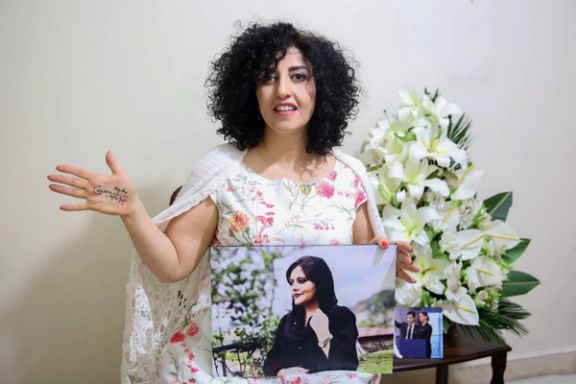
Nobel Peace Prize laureate Narges Mohammadi has been granted leave for three weeks to receive medical care, her lawyer said.
Nobel Peace Prize laureate Narges Mohammadi has been granted leave for three weeks to receive medical care, her lawyer said.
"The reason for this decision is her physical condition following a tumor removal and bone graft surgery that took place 21 days ago," he wrote on X.
Mohammadi, 52, has spent much of the past 20 years in and out of prison. She is currently serving a 13-year sentence in Tehran's Evin prison.
Earlier in October, Mohammadi’s family accused Iran's security and judicial authorities of repeatedly blocking her transfer to a hospital for an angiography procedure, according to a statement they released.
Mohammadi has been arrested, tried, and sentenced to prison multiple times because of her human rights work.
She was awarded the Nobel peace prize in 2023 for her three-decade campaign for women's rights in Iran.
The head of the Norwegian Nobel Committee, which awards the prize, said he was "deeply worried about her enduring illness and pain".
"We call upon the Iranian authorities to permanently end her imprisonment and ensure that she will get adequate medical treatment for her illnesses," Joergen Watne Frydnes said in a statement.

Iranian President Masoud Pezeshkian has stated that his government cannot implement a new hijab law passed by the hardline parliament, warning that its enforcement would lead to widespread discontent in Iranian society.
“There are too many questions about the execution [of the hijab law] for me who must implement it… Will society accept this? … We must not do something that will cause discontent among others [for offering services to unveiled women],” Pezeshkian said in his second televised interview with state television since taking office.
According to political analysts, Pezeshkian is facing immense pressure from his supporters to resist pressure from ultra-hardline factions urging him to sign the finalized law.
“An unjust law will not be enforced, and if it is, it will create discontent,” Pezeshkian said in the interview, later adding that he was consulting with other authorities to seek a resolution to the current impasse.
He also suggested that ultra-hardliners had tried to cause a challenge to his newly formed government by demanding the enforcement of the hijab law as soon as he took office.
In response to the interview, conservative politician and journalist Mohammad Mohajeri posted on X, saying “Pezeshkian announced in the televised interview, correctly, that the hijab law is not implementable and will bear no outcome other than discontent in the society.”
“This law will not only not encourage anyone to wear the hijab but will also create new challenges with an unpredictable outcome in the difficult current circumstances. The solution is to be reasonable,” Mohajeri added.
During his presidential campaign, Pezeshkian pledged to end hijab patrols and violence against women for dress code violations. Now, his supporters and some reformist-aligned media are openly calling on him to honor that commitment.
Sazandegi newspaper printed an image of Pezeshkian’s tweet during the campaign on its front page on Monday with the headline “A Promise Should Be Fulfilled” across the top in prominently large letters.
At the time, several high-profile politicians backed Pezeshkian’s promise by declaring that they guaranteed that Pezeshkian would not keep his promises – including current Vice President for strategic affairs Javad Zarif.
Mandatory hijab regulations were first introduced in 1981, following the 1979 Islamic Revolution, and formally enforced in 1983.
The details of the new hijab law, unveiled by domestic media on Saturday, including stricter measures and the potential rise of vigilantism, have deeply unsettled many Iranians.
In response to a solicitation for audience opinions, many citizens told Iran International this week that they fear the new law will be used as a tool for state-driven financial exploitation.
They expressed concerns that, rather than relying on the morality police, the government might enforce hijab rules through cash fines, prison sentences, and measures like denying women access to social rights and services.
The ultra-hardliner Kayhan newspaper, unexpectedly, on Monday criticized the new hijab law from a different perspective and accused reformists of using the controversies over it to “oppose the hijab as a principle”.
Kayhan contended that there was no need for a new hijab law and argued that insistence on new methods of enforcement instead of the so-called morality police patrols has resulted in a “several-fold increase in the foul and destructive spectacle of unveiling.”
In the recent interview, Pezeshkian also insisted that the enforcement of the hijab law will affect not only the women who have chosen to be unveiled but also others because it threatens to penalize restaurants and drivers of ride-hailing services for not refusing service or reporting them to authorities.
"They want to penalize Snapp drivers for unveiling their passengers. This causes discontent. What does [the unveiling of the passenger] have to do with him?" he asked.
Impasse over hijab law amid government infighting
The ultra-hardline-dominated Guardian Council gave its final approval to the hijab law in mid-September.
Typically, the president officially communicates such legislation to all government agencies within a few days for implementation.
The law has been in limbo, however, since then due to Pezeshkian's refusal to take the required step. Pezeshkian is not the first president to refuse to take responsibility for legislation they opposed. In a few instances in the past, former Presidents Mahmoud Ahmadinejad and Hassan Rouhani took the path of shifting the responsibility to the speaker.
If Pezeshkian continues to refuse to communicate the law, the onus to give the hijab law official status will be on Parliament Speaker Mohammad-Bagher Ghalibaf.
Pezeshkian and Ghalibaf's fraught relationship has recently worsened, over another government bill aimed at preventing Vice President Zarif's exclusion from the government over his son's American citizenship.
Last week, Ghalibaf signaled a shift by aligning with ultra-hardline factions, declaring Zarif's appointment illegal and asserting the hijab law would become official by 13 December, though he did not clarify who would authorize its communication.
Since Pezeshkian’s appointment, the enforcement of the state’s existing hijab regulations has continued and intensified. Several high-profile cases underscore the authorities' ongoing focus on forcibly regulating women’s public behavior.
The ongoing standoff arises amid continued societal backlash against the enforcement of the hijab, compounded by years of dissent and protests.

Iran sentenced 14 political prisoners to death in November and executed at least 135 convicts, the second-highest monthly total in 2024, rights groups say, condemning capital punishment as means to quell dissent.
The executions included 127 men, 4 women, and a juvenile, with 11 Afghan nationals among those put to death, US-based rights group Human Rights Activists News Agency (HRANA) reported on Monday. Additionally, 37 individuals were sentenced to death, including 68 for drug-related offenses.
Fourteen fresh death sentences in political cases last month also indicated the ruling theocracy was determined to make a strong example of participants in the Woman, Life, Freedom protests which began in 2022.
166 people were executed in October in the deadliest month of 2024 so far, rights groups say.
Of those executed in November, one man was executed after surviving a previous execution in April.
On November 13, Iran put Ahmad Alizadeh to death in a prison outside Tehran for the second time on a murder charge. According to Oslo-based Iran Human Rights, Alizadeh, who was charged with murder, had previously been hanged for 28 seconds but was resuscitated at the plaintiffs' request.
Earlier in the month, Iran executed the first member of its Jewish minority in 30 years, Arvin Ghahremani, for the alleged murder of another man following a monetary dispute.
Woman Life Freedom activists sentenced to death
Six political prisoners were sentenced to death by Tehran’s Revolutionary Court in a joint case on charges of "armed rebellion" for allegedly belonging to "anti-regime groups," HRANA reported Monday.
The defendants — Akbar Daneshvar Kar, Mohammad Taghavi Sang-Dehi, Babak Alipour, Pouya Ghobadi Bistoni, Vahid Bani-Amerian, and Abolhassan Montazer — were sentenced to death.
In the same case, two other prisoners — Ali and Mojtaba Taghavi Sang-Dehi — were sentenced to prison, bringing the total prison term for all eight defendants to 54 years, along with 20 years of exile.
In northeastern Iran, prisoner Mohammad Mehdi-S was sentenced to death for allegedly fatally stabbing Basij member Rasoul Doost-Mohammadi during the 2022 protests in the city of Mashhad, HRANA said.
Mehdi-S, whose full name has not been disclosed, denied the charges. The court also sentenced him to 74 lashes, payment of blood money and two-and-a-half years in prison for possessing explosives.
Iran’s 2022 protests, sparked by the death of Mahsa Amini in police custody in September 2022, led to the detention of thousands.
In a high profile case in mid-November this year, Tehran’s Criminal Court sentenced six individuals connected to the 2022 protests in the Ekbatan neighborhood to death.
The defendants — Milad Armoon, Alireza Kafaei, Amir Mohammad Khosheghbal, Navid Najaran, Hossein Nemati, and Alireza Barmarzpournak — were accused of allegedly participating in the killing of Basij member Arman Ali Verdi during the Women Life Freedom uprising.
Similarly, political prisoner Mehrab Abdollahzadeh has been sentenced to death by the Revolutionary Court in Urmia, Hengaw reported on Friday.
The rights group said the sentence stems from allegations linking Abdollahzadeh to the killing of another Basij member during the 2022 Woman, Life, Freedom protests and added that he was tortured during his detention.
Women's rights activist Varisheh Moradi was also sentenced to death by Tehran's Revolutionary Court on charges of "armed rebellion." The court cited her alleged affiliation with the Free Life Party of Kurdistan (PJAK) as the basis for the sentence.
Rights groups have condemned the judicial process in these cases, citing a lack of due process, confessions coerced through torture and the targeting of political prisoners and protesters.
November's high number of executions and death penalties underscores the ongoing repercussions of the 2022 Woman, Life, Freedom protests and authorities' efforts to silence dissent through capital punishment.
This surge in executions is part of a broader trend. Last year, Iran executed at least 853 individuals, marking the highest number in eight years according to Amnesty International.

Iranian citizens warn the country’s new hijab law will tighten restrictions on personal freedoms while also serving as a tool for state-driven financial exploitation.
In response to Iran International’s inquiry about how the new "Hijab and Chastity" bill will affect daily life in Iran, hundreds of voice messages from within the country reveal widespread frustration. Many of the respondents connected the legislation to broader grievances about the government’s misplaced priorities.
The 'Hijab and Chastity' bill has been approved by both Parliament and the Guardian Council and is now awaiting formal enactment by key officials, including the President. Meanwhile, enforcement of existing hijab regulations has intensified, with high-profile cases highlighting the state’s continued focus on regulating women’s public behavior.
To protect respondents from potential retaliation by Iranian authorities, their names have been withheld.
Many respondents accused the Islamic Republic of using the new law to deflect attention from its domestic failures. They also condemned the state’s financial and military support for allies like Syrian President Bashar al-Assad and groups labeled as terrorist organizations, including Hezbollah and Hamas, saying that prioritizing these entities has long neglected the urgent and enduring needs of Iranian citizens.
The new hijab law imposes fines for repeated violations. Women receiving two text message warnings may face fines up to $213 (150 million rials). Fines escalate to $2,347 (1.65 billion rials) for severe breaches. Those who fail to pay may be barred from accessing administrative, financial, and social services.
One individual alleged the government exploits women through these hijab fines to fund its proxy forces, telling Iran International: "You fired the missiles, Hezbollah used up the ammunition, Hamas’s entire weapons system was destroyed, and its warehouses were wiped out. Now, you’ve put all of it on the tab of Iran’s women and girls. This is not a hijab law—this is outright theft from the people, plain and simple, in broad daylight, and through women."
State officials have long maintained that the current hijab law, as well as the new one, is essential for upholding Islamic values and preserving societal morality. Mandatory hijab regulations were first enforced following the 1979 Islamic Revolution, with formal implementation beginning in 1983.
Another individual connected the law to frustrations over Iran’s domestic and foreign policies, describing it as a distraction from the government’s failures. They asserted, "The Islamic Republic has lost Syria and Lebanon, has nothing else left, and has been humiliated in the global community. Now, it wants to take out its frustration on the people of Iran. The disgraceful hijab bill was passed by representatives who are not representatives of the people. Half of the society did not vote for them, and they represent the corrupt system of the Islamic Republic. This bill has been written based on the governments and laws of extremist regimes like the Taliban and ISIS. They claim to be separate from them, but they are the same—part of those cursed and condemned extremists."
In several voice messages, Iranians described the financial penalties as a cynical attempt to extract revenue from citizens. They argued that the fines are simply a means for a financially struggling government to generate income.
"The real issue here is money. They are only interested in extorting people by any means possible. Just look at these past few years—they have tried to extract money from people in every way imaginable…Now, they have realized that the women and girls of Iran are standing firm and will not surrender, they thought to pass some ridiculous laws to at least make some profit out of this," one individuals said.
With average monthly salaries in Iran ranging between $170 and $200, respondents also criticized the fines as unrealistic and infeasible.
"Look at the situation of the Iranian people today—thanks to the system they have created, how many of them even have that amount in their accounts? How do they expect people to pay such fines? Even those who might have this money will not give it to them," one respondent said.
Another Iranian pointed out the challenges of imposing fines in a context where economic hardships prevent many from affording basic necessities, arguing: "These actions regarding hijab are not laws. This is coercion. They realized they could not enforce it with the morality police, violence, and all the other measures. Now they have resorted to imposing fines. They have involved themselves in such matters while ignoring more critical issues. By God, they should care about the people's food and medicine.Yesterday, I went to the pharmacy, and I swear there was hardly any medicine available... People are crushed under the weight of this unbearable cost of living."
For many respondents, the new hijab law seemed to reflect the state’s continued emphasis on social control over addressing urgent issues such as inflation, medicine shortages, and declining living standards.
According to the law, vehicles involved in hijab violations can be impounded for up to a week. For individuals who rely on their vehicles for their livelihood, this has devastating consequences.
"The hijab and chastity law is just one of the things that has severely affected me. For a week now, they have impounded my car in the parking lot. They have taken away my livelihood. I am a driver who can no longer afford my expenses," one citizen said.
The law encourages and allows citizens to report hijab violations through a police-managed platform, raising concerns for some Iranians about its broader societal impact.
Some Iranians also argued that the law’s divisive and oppressive nature is yet another tool by the state to suppress dissent.
“The people will not tolerate oppression, nor will they betray one another. Why would they? These authorities think freedom is just about hijab, but they fail to understand that the freedom we demand is also about ending inflation and making life affordable,” said one respondent.
Despite the law's provisions, many citizens told Iran International that they will resist its enforcement.
One individual emphasized the need for collective action: "We, the people, must oppose this disgraceful bill in any way we can—through hashtags, phone calls, strikes, protests—whatever means we have."
Others warned that the government’s focus on such laws could backfire: "Even the Islamic Republic knows that with this bill, and just one week of its implementation, it has dug its own grave. Enough is enough."
Many Iranians argued the government is increasingly disconnected from its people's priorities, while it is increasingly reliant on coercion to maintain control. Some also suggested that the enforcement of the law could potentially become a catalyst for further dissent.
The law is scheduled to be referred to President Masoud Pezeshkian on December 13, who will have five days to sign and implement it.

The details of Iran's new hijab law, unveiled by media in Tehran on Saturday, including stricter measures and the potential rise of vigilantism, have deeply unsettled many Iranians.
The full text of the legislation, recently disclosed to the public, has unveiled previously hidden provisions, including requirements to establish "popular" groups tasked with issuing verbal and written warnings to individuals who fail to comply with the new law.
In recent days, some social media users and anti-immigrant activists have launched campaigns opposing the exemption in the new law that allows "foreign nationals with official residence documents" to bypass the Iranian citizenship requirement for joining these "popular" groups.
Iranian officials always refer to millions of Afghan immigrants who live in Iran as “foreign nationals”.
Under the Iranian government's interpretation of Islamic practice, "popular" groups or religious individuals are authorized to intervene in public spaces and urge citizens to comply with hijab regulations.
Anti-Afghan immigration activists argue that the exemption made in the hijab law will allow Afghan immigrants with ties to the Revolutionary Guards (IRGC) to form vigilante groups to harass women for hijab.
Such concerns are exacerbated by the history of the IRGC’s recruitment of Shia Afghans to fight alongside Iranian forces in Syria during the Syrian civil war.
Diaspora activist Elham Omidvari criticized the emphasis on permitting “foreign nationals” to issue hijab warnings to Iranians in a tweet on Sunday. She argued that the hijab law should be opposed in its entirety, as it fundamentally violates the basic human rights of Iranian women.
Lawmakers deliberately included a clause to allow “foreign nationals” to warn women for hijab to "divert people’s attention from the other tragedies" stipulated in the hijab laws, another diaspora activist Hatef Motahhary argued in a tweet.
“As if now the women’s problem is whether it is an Afghan or a Basij militia member who will warn them for hijab!” he wrote.
The new law has criminalized “encouragement” to defiance of hijab rules, as well as “derision and insults” to women for wearing it.
Such offenses will be punishable by cash fines, refusal of an exit permit to leave the country, a ban of six months to two years on social media activity, a prison sentence of two to six years, or 74 lashes.
Tens of viewers have responded to Iran International TV’s inquiry about how they expect the hijab law to affect their lives. Many of them have said Iranians will continue civil disobedience and refuse to abide by the hijab law despite the cash fines, prison sentences, and deprivation from services that the government should provide to them.
The Guardian Council approved the hijab law in mid-September. Typically, such legislation would be officially communicated to all government agencies by the president within a few days for implementation. However, President Masoud Pezeshkian has neither taken this step nor made any public comments on the matter.
If Pezeshkian fails to communicate the law, the onus will be on Parliament Speaker Mohammad-Bagher Ghalibaf who said a few days ago that the process of the public announcement and enforcement of the highly controversial legislation was delayed for “security reasons related to the anniversary of the 2022 [protests]”.
The protests that lasted several months and spread across the country were sparked by the death of 22-year-old Mahsa Amini in the custody of morality police in September 2022.
Pezeshkian’s supporters insist that he should refuse to communicate the hijab law because he made a promise to Iranians not to let women be harassed for hijab.
“Mr. President, the hijab law is a banana peel for your government—one that could cause its downfall,” Amir Tanha, a prominent social media activist with a large following on X, tweeted on Saturday. “By endorsing it, you will only pit yourself and your government against the very people who voted for you. Let the Parliament take responsibility for communicating this flawed law,” he added.

Iranian dissident rapper Toomaj Salehi, who was previously sentenced to death, has been released after serving one year in prison, Iran's Judiciary announced on Sunday.
"The convicted individual, Toomaj Salehi, who had been sentenced to one year in prison for the crime of propaganda against the Islamic Republic, was released from prison on December 1, 2024, after serving his sentence," a statement released by the Judiciary's news agency Mizan said.
Toomaj, a metalworker from Isfahan in central Iran, emerged as a prominent figure in Iran's 2022 uprising, using his rap lyrics to condemn repression, injustice, and poverty.
During the height of the Woman, Life, Freedom protests on October 30, 2022, the intelligence ministry in Isfahan province violently arrested him again for his artistic activities in favor of the anti-government movement. While in custody, he was tortured severely and forced to make televised "confessions".
Toomaj was sentenced to 75 months in prison last July after the Iranian Supreme Court overturned the decision of a lower court sentencing the rapper to a death. More than a year after being arrested, he was released on bail in November 2023. Several days after his release, he published a video message alleging torture and mistreatment at the hands of intelligence agents. Almost immediately, he was re-arrested.
In April 2024, Salehi was sentenced to death by a revolutionary court in Isfahan on charges of "spreading corruption on Earth." Iran’s Supreme Court overturned the death sentence in June.
Toomaj's release came a few weeks after Iranian dissident journalist Kianoosh Sanjari committed suicide after warning he would take his own life unless several prisoners, including Salehi, were released.
Shortly after Sanjari's death, fellow activist Hossein Ronaghi began a hunger strike by sewing his lips shut. He vowed to continue his sit-in protests in this symbolic act until the late journalist and close friend’s demands to free political prisoners, including Toomaj, were met. From behind bars, Toomaj urged Ronaghi to end his hunger strike, pleading with him not to risk his life.