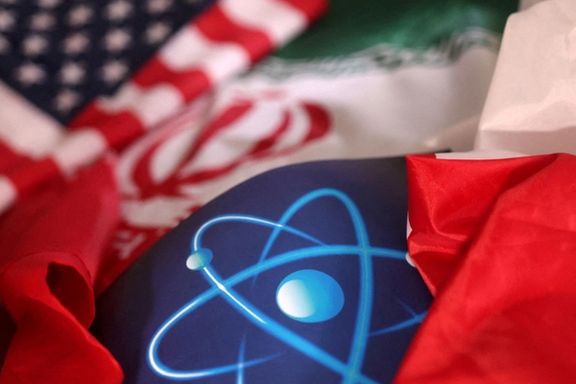
As debates in Iran continue over the possibility of negotiations with the United States, divisions have emerged. While some advocate for talks, others remain skeptical about their potential benefits or even feasibility.
Iran's embattled Vice President for Strategic Affairs and former foreign minister, Mohammad Javad Zarif, authored an article in Foreign Affairs titled "How Iran Sees the Path to Peace," stating, "The Islamic Republic is open to negotiations – including with America."
Zarif added: "Instead of increasing pressure on Iran, the West should pursue positive-sum solutions. The nuclear deal provides a unique example, and the West should look to revive it. But to do so, it must take concrete and practical actions—including political, legislative, and mutually beneficial investment measures—to make sure Iran can benefit economically from the agreement, as was promised. Should Trump decide to take such steps, then Iran is willing to have a dialogue that would benefit both Tehran and Washington."
While Zarif talked about "reviving" the 2015 nuclear deal, the United States clearly wants a totally new deal covering matters beyond the nuclear issue, including Iran's regional ambitions and its missile program which happens to be a source of concern for Iran's neighbors and European states.
Despite Zarif's overture, hardliner analyst Foad Izadi who is characterized by the Iranian state television as an expert on the United States, told conservative Nameh News website in Tehran: "We cannot say with a one hundred percent assurance whether negotiating with the United States is good or bad for Iran as we do not have access to confidential information."
Expressing distrust of the United States, Izadi accused the US, along with Turkey, of involvement in the Syrian insurgents' surprise attack on government forces allied with Iran. As evidence for his claim, he cited Secretary of State Antony Blinken, who remarked that "the United States was not surprised" by the attack on Aleppo, despite Hay’at Tahrir al-Sham (HTS), the main insurgent group, being designated as a terrorist organization by the US.
Izadi further alleged, "If the Americans did not design the attack, they were at least aware of it—and they are undoubtedly pleased with what is happening in Syria." He added, "The United States' plan is to settle scores with the Islamic Republic within the next four years, as beyond that, it will be unable to act due to Iran's membership in the Shanghai Cooperation Organization and BRICS agreements."
He further charged that Iranian supporters of negotiations with the United States are not aware that the other sides use negotiations only “to buy time, to confuse Iranian officials and to wage a psychological war on Iranians."
•
•
Iran should negotiate with the United States only when the officials can say with a high degree of certainty that the country is going to be better off after the talks, Izadi said.
Former head of the Iranian parliament's National Security and Foreign Relations Committee, Heshmatollah Falahatpisheh, told the Khabar Online website in Tehran that China and Russia favor Trump's "maximum pressure" policy against Iran. He added that Russia is also wary of any potential agreement between Iran and Europe. However, he noted that Europe’s primary goal in its negotiations with Tehran is to address its own concerns.
Falahatpisheh emphasized that the United States remains the primary actor in negotiations with Iran. He argued that Iran's best course of action is to persuade Europe not to allow itself to be leveraged by the US to trigger the 2015 nuclear deal’s snapback mechanism against Iran.
He concluded, "Trump will never engage in negotiations that do not advance the interests of the United States."
An Iranian commander who led the battle to retake Aleppo from Syria’s opposition forces in 2017 has returned, Iran’s state media said, as President Bashar al-Assad faces renewed threats from armed groups bent on toppling his government.
Javad Ghaffari, a senior figure in Iran’s Revolutionary Guard Corps (IRGC) was reported to have arrived in Damascus on Sunday, Iran's state-run Al-Alam news website reported, hours after Iran’s foreign minister said Iranian forces could be deployed to Syria if requested by Assad.
Ghaffari was sanctioned by the United States in September 2024 for his role in “targeting critics of the Iranian regime abroad” as head of the IRGC Intelligence Organization’s Special Operations Division.
Previously, Ghaffari spent a several years in Syria leading forces, including Hezbollah fighters and the Afghan Fatemiyoun militia in campaigns to reclaim key central and Eastern cities Palmyra, Deir ez-Zor, and Al-Bukamal from opposition groups.
He was dubbed Butcher of Aleppo by his foes following the bloody battle over Syria’s second largest city, where thousands were killed and injured.
Despite his military successes, Ghaffari had to leave Syria in 2021, according to Times of Israel, after his actions — including attacking American forces and deploying Iranian weapons to unauthorized locations — were deemed by Damascus to have contravened Syrian sovereignty. The report was not independently confirmed.
His re-emergence underscores Iran’s enduring influence in Syria and Assad’s precarious situation following the recent advances of his adversaries.
Armed groups led by Hayat Tahrir al-Sham launched a significant offensive last week, violating a four-year-old truce and seizing substantial portions of Aleppo and its suburbs, as well as areas around the northwestern city of Idlib.
The Syrian army has responded by retreating from key positions in Aleppo to regroup in northern Hama. Reinforcements and equipment are arriving in the area, with preparations for a large-scale counteroffensive underway to reclaim lost territories.
Ghaffari’s presence signals both a renewed Iranian commitment to Assad’s survival and the high stakes of the ongoing conflict.
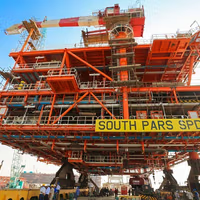
Iran and allied Iraqi militias have earned at least a billion dollars in a scheme to launder fuel oil from the Islamic Republic as originating from its Arab neighbor, Reuters reported, providing a key economic lifeline amid US-led sanctions.
The profits come from sales abroad to mostly Asian markets as well as diversion to Iraqi asphalt plants at government-subsidized prices, the news agency reported citing sources and Western intelligence reports.
They estimated that the proceeds from the illicit trade ranged from $1 billion to over $3 billion annually.
Energy-rich Iran faces obstacles to getting its crude oil and fuel to the global market and has for years used complex routes and shadow fleets to disguise its flows and skirt mostly Western sanctions.
Iraq's leadership is composed mostly of Iran's co-religionists from the preponderant Shia community, and the ascendant political parties are supported by Iraqi armed groups funded and armed by Tehran.
One of those militias, Asaib Ahl al-Haq, is a key backer of Iraqi Prime Minister Mohammed Shia al-Sudani and according to the Reuters report is central to the smuggling operation.
Some of the asphalt plants the report said were involved are under the control of the group and another militia Kataib Hezbollah, which is more directly backed by Iran's Islamic Revolutionary Guard Corps.
Iran’s foreign minister announced Tehran’s willingness to consider deploying forces to Syria if requested by President Bashar al-Assad’s government, marking a potential major escalation to the conflict.
“The Islamic Republic neither commands resistance groups in Arab countries nor maintains organizational ties with them but supports their cause and, if needed, provides assistance.” Abbas Araghchi was quoted as saying by the Al-Araby Al-Jadeed website on Tuesday.
The remarks come as Syria's stalemated civil war was suddenly jolted last week as rebels led by hardline Islamists launched an offensive which captured Aleppo, the second biggest city, in a setback to a key regional ally of the Islamic Republic.
Araghchi revealed his intention to visit Russia for discussions on Syria, emphasizing the need to calm the conflict and present initiatives for a long-term resolution.
“We have made extensive preparations to calm the situation in Syria and create opportunities for presenting initiatives and establishing a permanent solution,” he added.
Araghchi also addressed Syria’s demands for a Turkish withdrawal as a prerequisite for renewed ties between Damascus and Ankara, calling it a logical condition.
He further criticized Turkey’s support for armed groups opposing Assad, warning that the expansion of activities by terrorist groups—a term Araghchi attributed to certain opposition factions—poses a greater threat to regional neighbors than to Iran.
“We are always seeking consultation and dialogue with Turkey regarding our differences,” he said.
Esmaeil Baghaei, spokesperson for Iran’s Ministry of Foreign Affairs, said Tuesday that the foreign minister conveyed the country's policy opposing what he described as terrorism during recent visits to Syria and Turkey.
“Terrorism is a contagious disease that does not stop in one place. If countries do not cooperate in combating this problem, all nations will undoubtedly be affected,” he said at an economic conference in Mashhad.
Rebel fighters talk together as one of them stands on a military vehicle holding a weapon in the town of Tel Rifaat, Syria December 2, 2024.
Fighting intensifies in Syria
Meanwhile, northeast Syria has seen renewed combat as US-backed Kurdish forces clashed with Assad’s troops.
Airstrikes targeted Iranian-backed militias in the Deir al-Zor region, with Syrian and security sources attributing the attacks to the US-led coalition.
The coalition has not commented, and there was no independent confirmation of the strikes.
The conflict poses a significant challenge for Assad, whose forces are grappling with rebel advances near Aleppo and Hama.
Syrian state media reported intensified Russian and Syrian airstrikes in response, while rescue workers reported civilian casualties from hospital bombings in Aleppo and Idlib.
These developments complicate an already volatile regional landscape, with conflicts in Gaza and Lebanon still rumbling despite a fresh ceasefire aimed at ending the war between Hezbollah and Israel.
Analysts warn that escalation in Syria could spill over into neighboring countries, deepening instability across the Middle East.
As Iran positions itself as a key player in Syria’s future, Araghchi’s remarks highlight Tehran’s dual strategy: supporting Assad militarily while pursuing diplomatic engagement with Turkey and Russia.
Iran has no current intention to engage in dialogue with Washington, citing a lack of appropriate grounds for such discussions, Iranian Foreign Minister Abbas Araghchi told The New Arab on Monday.
"We are waiting to see how the new administration formulates its policies, and then we will determine our course of action," he added in comments released on Tuesday.
On Iran's negotiations with Europe over the nuclear issue, Araghchi, a key architect of the 2015 nuclear agreement, noted that Tehran has "many reasons to be pessimistic."
On Friday, German, British, and French political directors met with Iran's representative, Kazem Gharibabadi, in Geneva to discuss Tehran’s nuclear program and sanctions, bilateral issues, and the regional situation, according to a post by the German Foreign Office on X. The statement noted that the parties agreed to continue diplomatic dialogue soon, but no tangible progress was announced.
Gharibabadi similarly reaffirmed Iran's general commitment to dialogue and engagement, though his comments indicated little progress beyond agreeing to continue discussions.
Notably, the US State Department had previously announced that the United States would not participate in the talks between Iran and the three European powers.
“We have made it clear that Iran must provide full cooperation with the IAEA without further delay. And we’ll continue to closely coordinate with the Governments of France, Germany, and the United Kingdom,” spokesperson Matthew Miller said last week.
Tehran currently holds enough enriched uranium to produce four nuclear bombs, according to estimates by the IAEA. Although uranium enriched to 60% purity is not yet suitable as fissile material, Iran could refine it to weapons-grade levels within 2-3 weeks. This status, known as a nuclear-threshold position, implies that Iran could quickly transition to a nuclear-armed state if it has the technical capability to assemble a functional weapon.
Meanwhile, the United States is gearing up to reintroduce strict measures against Iran under President-elect Donald Trump. According to The Wall Street Journal, the incoming administration plans to reinstate the “maximum pressure” campaign, designed to limit Iran’s economic resources used to support armed groups and other hostile activities.
Last week, Mike Waltz, Trump’s incoming national security adviser, said, “The change you’re going to see is more focus on Iran.” During Trump’s previous term, his administration imposed sweeping sanctions on Iran’s oil sector to hinder its nuclear program and diminish its regional influence.
Iran’s president warned on Monday that the state is short of foreign currency and without parliamentary allocation of dollars for imports, gasoline prices would rise amid the country's economic crisis.
In a televised address, Masoud Pezeshkian admitted that in spite of promises that prices would not rise and that there would be no foreign exchange allocated for gasoline imports, it was a necessary means to manage in the worst recession since the founding of the Islamic Republic in 1979.
"When the allocation of foreign exchange is not compensated, gasoline prices will inevitably rise," he said.
He highlighted the financial strain posed by gasoline imports, citing a potential budget deficit that would harm low-income groups through inflation, referring to a shortage of foreign currency earnings that limit the government's ability to finance imports.
In the past six years, since the United States re-introduced oil export sanctions, the government has been forced to print more money that has pushed annual inflation to above 40%.
“When we allocate dollars to import gasoline, it leads to a budget deficit, resulting in inflation that harms low-income groups. By doing this, we exert pressure on them,” he added.
A gas station in Iran
On Tuesday, Mohammad Bagher Ghalibaf, Speaker of the Parliament, countered by asserting that pricing petroleum products is the government’s responsibility.
“Let the government do its job, and we will not interfere,” he added.
The debate occurs while there are broader concerns over Iran's "energy imbalance," a term Pezeshkian used to describe the country's shortages in gas, electricity, and water.
During the interview on Monday, he stressed that unsustainable energy consumption, coupled with heavy subsidies amounting to $130-$150 billion annually, burdens the economy.
“This equates to 900 million rials [$1,300] per capita,” he said, emphasizing the incompatibility of current energy needs with production capacity.
Iran's Economy Minister Abdolnasser Hemmati
Economy Minister Abdolnaser Hemmati also echoed concerns about shortages on Tuesday, pointing to rampant gasoline smuggling and the financial toll of imports.
Speaking at an insurance conference, Hemmati said: "Whenever we discuss this, people say we intend to increase gasoline prices. No logic accepts this massive gasoline smuggling while we are forced to import gasoline ourselves.
"As long as I am the Minister of Economy..., I will do my utmost to combat these rent-seeking practices. It is time for reforms. We must address the imbalances once and for all."
The potential for a gasoline price hike has sparked discussions ahead of next year’s budget approval, with parliament members divided. Some warned that such a move could provoke political unrest, reminiscent of the November 2019 protests following steep price increases during Hassan Rouhani's presidency.
Pezeshkian has consistently highlighted energy shortages, particularly around gasoline. His remarks that $5 billion is spent annually on imports contrast with figures from Tasnim News Agency, affiliated with the IRGC, which said last year’s total was $2 billion.