Iran accuses Israel of destabilizing Syria, urges UN to intercede
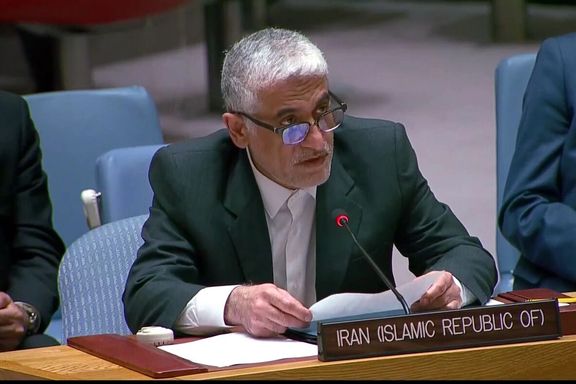
Iran's ambassador to the United Nations on Wednesday urged the Security Council to hold Israel accountable for what he described as its destabilization of Syria.

Iran's ambassador to the United Nations on Wednesday urged the Security Council to hold Israel accountable for what he described as its destabilization of Syria.
Addressing a Security Council meeting on the situation of Syria, Amir-Saeid Iravani called Israel "the greatest threat to the present and future of Syria.”
“Israel continues to violate Syria’s sovereignty and territorial integrity, and the Security Council must take decisive action to stop and hold Israel accountable for its destabilizing actions," he said.
Since the beginning of Syria's civil war in 2011, Israel has carried out hundreds of strikes in Syria to quash Iran’s influence and interrupt supply routes to Hezbollah in Lebanon, its most powerful armed ally in the region.
In December, the Bashar al-Assad government - a key pillar of Iran’s influence in the region - fell despite 13 years of Iranian military support.
Iravani said Iran's presence in Syria "has been legal, in accordance with international law and at the request of the Syrian government at the time."
Iran's military withdrawal, he added, was "carried out responsibly, taking into account the potential impacts on the Syrian people."
Iranian forces have largely quit Syria following Assad's fall, the Wall Street Journal reported on Tuesday, citing US, European, and Arab officials.
Members of Iran’s Quds Force have now relocated to Iran and pro-Assad militia groups have disbanded, the report added, citing a senior US official.
According to Western and Arab officials cited, most forces in eastern Syria—including Iranian Revolutionary Guards officers and Afghan, Iraqi, Lebanese and Syrian fighters—retreated to al-Qaim, a border town on the Iraqi side.
Some Iranian personnel based in Damascus flew to Tehran, while Hezbollah fighters in western Syria fled overland to Lebanon, they added.

The sudden departure of Bashar al-Assad from Damascus to Moscow exposed deep divisions between Iran’s government and its people. While state loyalists viewed the event as disastrous, many ordinary Iranians rejoiced in it with renewed hope.
Criticism of Iran’s massive investments and military intervention in Syria is mounting, deepening the Islamic Republic's legitimacy crisis. Supreme Leader Ali Khamenei and the institution of Velayat-e Faqih are at the center of public discontent and protests over these policies.
The Islamic Republic's vulnerability has been highlighted by several setbacks since mid-September, including the weakening of Hezbollah and Hamas, and the degradation of Iran’s air defenses and ballistic missile production capabilities by Israeli strikes. The delayed retaliation to the Israel's attack (October 2024) has angered some hardliners.
For years, Khamenei’s supporters have seen Assad as a linchpin in their vision of a Shiite crescent stretching from Iran through Iraq and Syria to Lebanon. Assad’s Syria served as a buffer against Sunni extremism and a conduit for Iran’s influence via armed groups like Hezbollah. Losing it represents not just a geopolitical setback for Tehran, but the potential unraveling of the Axis of Resistance that Iran painstakingly cultivated over the past decade.
Disillusionment of loyalists
Many of Khamenei’s followers, who had invested ideological fervor in this alliance, are grappling with deep disappointment and a crisis of faith in their leadership.
One striking example came from Bisimchi Media, an outlet close to the intelligence unit of the Islamic Revolutionary Guard Corps (IRGC), which accused Khamenei of passivity in responding to Israel’s attacks. This was perhaps the first critical assessment of the leader’s actions. Although the criticism was swiftly retracted and the media outlet’s editorial board issued an apology, it revealed growing dissatisfaction among the states hardline supporters.
Following that unprecedented event, Tasnim News, a far more prominent IRGC outlet issued a warning against deviations and lapses of loyalty to Khamenei, emphasising the need to adjust with his pace and direction. That the warning went beyond an internal discipline and found its way into the public showed that tensions were becoming harder to contain even within the state’s closest ranks.
Prominent figures like Hadi Zarea, a member of the Quds Force in Syria, have publicly criticized Iran’s strategy, accusing IRGC leadership of exaggerating successes and creating additional challenges for the country. These critiques highlight an expanding rift among loyalists and further embolden the opposition.
Leader's rallying cries
To counter this, voices close to the supreme leader’s office have tried to inject optimism and raise spirits, echoing Khamenei’s advice to show resilience in defeat and humility in victory. Still, the despair is palpable among those who had believed the Iran-led Axis of Resistance was invincible.

Assad’s rule was presented as proof of Shiite resilience. Its collapse not only diminished Iran's territorial reach but forced its advocates to face the harsh reality that their strategic calculations may have been overly optimistic.
Moreover, the potential emergence of a semi-democratic or Sunni-led government in Syria could significantly alter the regional power balance, isolating Iran and its allies further. This scenario raises concerns about a resurgence of Sunni extremism, which could destabilize Iran internally.
Shift in domestic balance of power
Khamenei needs his loyal followers to quell unrest and prolong his rule. But many in those ranks are now grappling with disillusionment. Some are questioning Iran's foreign policy and call for introspection and reassessment. It remains to be seen if and how Khamenei would rally his base and address their growing concerns in the face of a rapidly changing regional landscape.
The fall of Assad has profound psychological implications for Iranian society. Millions of Iranians seeking structural change in Iran now perceive the state as weaker and less capable of imposing fear and repression. This perception erodes the government’s authority and helps dissidents to bolster resistance and collective identity. Activism may gain momentum as people grow more confident in challenging the state’s propaganda and misinformation.
Hope on one side, passivity and fragmentation on the other, could signal potential for more powerful uprisings and dynamic social movements that challenge the unjust, inept rulers of Iran.
While Iran is not yet a failed state, it exhibits characteristics of a failing state, including economic mismanagement, judicial misconduct, infrastructure decay, and inadequate social services. The weakening of the Axis of Resistance and continued foreign policy defeats have undermined public support for the government, eroding its ability to maintain control. As the rulers' authority deteriorates, citizens are more likely to act radically, further destabilizing the state.

Mehran Abtahi was a 37-years-old newlywed studying to become an environmental engineer at a Canadian university when his life was tragically taken from him.
Mehran is one of 176 people killed when the Iran’s Islamic Revolutionary Guard Corps (IRGC) shot down Ukraine International Airlines PS752 over the skies of Tehran with two surface-to-air missiles on January 8, 2020.
On Monday evening, Mehran’s younger brother Arman, and other families of PS752 victims gathered in Vancouver and across Canada to mark the somber anniversary.
“The pain of that moment has not lessened. It's a wound that remains open,” Arman told Iran International.

Iran initially denied responsibility, but admitted to shooting down the airliner three days later after mounting evidence made Tehran's culpability clear. Iranian authorities continue to maintain that the incident resulted from human error.
The victims' families remain unconvinced, however, with many believing the attack was aimed at the West.

176 photos and ornaments with the victims' faces adorned on a white Christmas tree at the Vancouver event commemorating the lives lost.
Most of those killed were Canadians, permanent residents of Canada and people with ties to the country who were visiting family in Iran during the Christmas break.

Seeking justice and accountability
Amid heaving sobs, one mother who lost her daughter said, "it still feels like one long day that just won’t end," inconsolable.
Arman, like many of the families, is trying to cope with grief while seeking justice not only for their families but for all Iranians facing oppression, he said.
Canada, Sweden, Ukraine and the United Kingdom have taken Iran to the International Court of Justice (ICJ) over the downing of the airliner. The four countries announced the move in 2023 shortly after the deadline passed for Iran to submit arbitration under the Montreal Convention.
“It’s long a journey but this is one step closer to justice,” Arman said.
During the candlelight vigil, Arman told Iran International that seeking accountability is a part of preventing future similar tragedies.
“When we delay justice, it gives the atrocities to the criminals to do what they do. We should urge the international community to hold them accountable to prevent such tragic events from happening again,” Arman said.
Many of the families of the victims said that since the tragedy the Iranian government has been targeting them and trying to silence them.
On Oct 30, 2023 Manzar Zarabi, an Iranian resident who lost two children, a daughter-in-law, and her five-year-old granddaughter Sofie was detained by Iran’s security forces for several days before being released.

Canadian Iranian human rights activist Hamed Esmaeilion — whose wife and daughter were killed on the flight — said his mother was banned from leaving Iran for at least six months last year in response to his activism.
While Arman hasn't been directly impacted by official intimidation on Canadian soil, he said his family in Iran has, but declined to elaborate citing their safety.
"It's very hard," Arman said. "They are alone and I'm here,"


Iran's Supreme Leader Ali Khamenei on Wednesday told the Iraqi prime minister that Tehran-backed militias should be strengthened and the United States must be ejected.
Khamenei said the presence of American forces in Iraq is illegal and against the interests of the Iraqi people and government.
"Evidence and indications point to the Americans' efforts to solidify and expand their presence in Iraq, which must be firmly resisted as an act of occupation," he said in a meeting with Iraqi Prime Minister Mohammed Shia Al Sudani in Tehran.
Iran-backed armed groups in Iraq have been launching attacks against American forces and their allies in the region over the past decade.
The Islamic Resistance in Iraq (IRI), a coalition of Tehran-backed militants, said in a statement last year they would continue their attacks until the Americans are “expelled from the country, forced to submit and are defeated."
The IRI is not the only group of Iran-aligned Shia groups in Iraq.
The Popular Mobilization Units (PMU), known as the Hashd al-Shaabi in Arabic, is another umbrella group of primarily Shia armed factions in Iraq that receive support from Iran. Unlike the IRI, the PMU is a formal part of the Iraqi armed forces and reports directly to the Prime Minister.
In his meeting with Al-Sudani, Khamenei referred to the PMU as one of the key elements of power in Iraq, saying " the Hashd al-Shaabi must be preserved and further strengthened with utmost dedication."
Khamenei's remarks came three days after Islamic Revolutionary Guards Corps (IRGC) Quds Force Commander Esmail Qaani arrived in Baghdad to meet with leaders of the Shia factions including the Hashd al-Shaabi, Emirati outlet Erem News reported citing an Iranian source.
Ghaani was set to discuss Washington's pressure on the Iraqi government to dissolve the PMU or integrate it into the Iraqi armed forces, the report added.
The Hashd al-Shaabi was established in 2014 following a religious decree to combat Islamic State, which at the time had taken control of four Iraqi governorates and threatened Baghdad.
Supported by the IRGC, the groups wield considerable power over Iraq’s governance, military and energy infrastructure.
Despite their original mandate to combat ISIS, many of the militias have since expanded their activities, frequently targeting US forces and installations in Iraq with rockets and drones and exacerbating tensions between Tehran and Washington.

Families of the victims of Flight PS752 say they plan to release an investigative film about the downing of the passenger jet five years ago, as part of their ongoing effort to hold Tehran accountable for the tragedy.
In an interview with Iran International, Iranian-Canadian Javad Soleimani, who lost his wife Elnaz Nabiyi in the shoot-down, explained that the film would incorporate the families' own 2021 fact-finding report and address key developments since.
The Islamic Revolutionary Guard Corps’ (IRGC) Aerospace Force shot down the Ukrainian airliner shortly after takeoff from Tehran, using two surface-to-air missiles on January 8, 2020.
Iranian authorities initially denied responsibility, only admitting to it three days later when confronted with intelligence and photographic evidence. Tehran has since continued to assert that the incident was the result of "human error."
Among those killed were 55 Canadian citizens and 30 permanent residents, as well as nationals from Iran, Ukraine, Sweden, Afghanistan, and the United Kingdom.
Soleimani and other families have since urged Canada and the affected countries to ensure Tehran faces justice. Expressing his frustration with Canada's response so far, Soleimani said, “Canada should have done a lot, and faster… it has been very hard on the families.”
“The most important issue bothering the families is that we still don’t know what happened that night. The Islamic Republic has not cooperated,” Soleimani said.
Soleimani argued that there is a lack of transparency and the withholding of critical information, including findings from the flight's black boxes. He told Iran International that countries in the international coordination group—Canada, Sweden, the UK, and Ukraine—have access to this information but have not shared it with the families.
There are currently three international judicial pathways underway over the downing, with Canada, Ukraine, Sweden, and the UK pursuing two.
In their case before the International Court of Justice, the four countries argue that Iran negligently and intentionally allowed Flight PS752 to be shot down, covered up the incident, mishandled the investigation, and harassed victims' families.
Ukraine, in its statement on the anniversary, said the countries would take steps to hold Tehran accountable before the International Civil Aviation Organization (ICAO) – the UN aviation body – in the coming months.
Separately, the families have taken their fight to the International Criminal Court (ICC). The Association of Families of Flight PS752 Victims has submitted a legal request to the ICC prosecutor’s office, seeking to expand the ongoing investigation into alleged war crimes in Ukraine to include the Iranian missile strike that brought down Flight PS752.
Soleimani says the Canadian government did not back the families in this path. "The least Canada could have done is write a support letter, but they have not done that," he said.
The investigative film, titled “January 8, Frozen” is a way for the tragedy to be “visualized” and written into the history books in a significant way, Soleimani said. He also says the victims' families have united behind the film to raise awareness and highlight their ongoing efforts.
While Canada met one of the families’ major demands by listing the IRGC as a terrorist entity in 2024, Soleimani says there are many demands yet to be fully addressed.
He criticized the governments and the RCMP’s continued reluctance to open a criminal case, saying that, alongside Ukraine’s own criminal case, the two countries could have achieved much more.
When asked whether he believes the prorogation of Canada’s parliament after Prime Minister Justin Trudeau’s resignation would impact the pursuit of justice, he said he was worried.
"Hopefully, it will not have an impact on the case before the ICJ,” he said, adding that “Whoever comes into power, we need more attention on PS752.”
Scheduled for release by the end of summer 2025, the film currently features several mothers of victims and will include contributions from more of the victims' families.
"If we don’t have the truth, there cannot be closure for any of the families. Justice can only happen, when there is also truth,” Soleimani said.

Ali Khamenei rebuked proponents of renewed talks with the United States under President Donald Trump, warning of intractable American hostility.
Ali Khamenei said on Wednesday Iran’s refusal to engage with the US, despite maintaining ties with Europe, showed Washington's broader diplomatic failure.
"The United States has failed in Iran and is now seeking to compensate for this defeat," he said in a meeting with a group of his supporters from the city of Qom.
The comments come around two weeks before Donald Trump’s inauguration and the likely return of his so-called maximum pressure sanctions policy on Iran.
Trump has said Iran cannot be allowed to gain nuclear weapons but has also suggest Washington is not seeking to topple the Islamic Republic by force.
Some Iranian officials and political figures, including aides to President Masoud Pezeshkian, have called for talks with Trump to mitigate punishing US-led sanctions.
Referring to Iran before the establishment of the Islamic Republic, Khamenei said, "America had effectively taken control of this country, but we wrested it away. Their grudge against our nation and revolution is profound."
In contrast to government officials and many others advocating for negotiations, Hossein Shariatmadari, Khamenei’s representative at Kayhan newspaper, denounced such proposals in an editorial, saying advocates for US negotiations are either "asleep, drunk or insane."
But in an apparent endorsement of Pezeshkian - an embattled relative moderate - Khamenei commended his stance against the United States and Israel, while urging officialdom to focus solely on the Islamic Republic’s interests in their policymaking.
Iran’s Foreign Minister Abbas Araghchi told China’s CCTV in an interview published earlier in January that Tehran is ready for constructive and prompt nuclear negotiations.
Khamenei stressed the importance of supporting Iran-backed groups across the region, despite heavy blows they have received at Israel's hands, saying, “resistance remains alive and must grow stronger by the day.”
"The enemy's soft war aims to distort reality and separate it from public understanding," he said, warning against the influence of hostile propaganda on the public mood, which has soured after a year of economic and foreign policy setbacks.
"While you grow stronger, they claim you are weakening."
French President Emmanuel Macron this week warned Tehran's nuclear program is nearing the point of no return.
Iran says its uranium enrichment program is for peaceful purposes but has accelerated activity since Trump withdrew from the 2015 nuclear deal - officially known as the Joint Comprehensive Plan of Action (JCPOA) - during his first term and reimposed sanctions on Tehran.
"The Islamic Republic is fully prepared for all parties to return to the 2015 agreement and fulfill their mutual commitments," Pezeshkian said on Tuesday.
Last month, European powers France, Germany, and Britain warned that Iran’s actions had further eroded the agreement, noting that Tehran’s stockpile of highly enriched uranium has no credible civilian justification.