30,000 Iranian GPs unwilling to work over low fees, official says
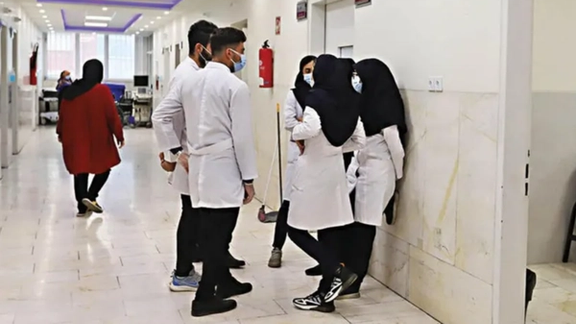
Around 30,000 general practitioners in Iran are unwilling to practice due to low doctor's fees, according to Mohammad Raiszadeh, head of the Medical Council.

Around 30,000 general practitioners in Iran are unwilling to practice due to low doctor's fees, according to Mohammad Raiszadeh, head of the Medical Council.
"The problem we are facing is that general practitioners are not interested in pursuing specialization or working in the medical field. This issue cannot be resolved with such extremely low fees," Raiszadeh, who leads the non-governmental licensing and regulatory body for the medical profession, said Thursday.
The same official noted in November that, compared to the salaries of civil servants and the wages of workers, doctors' incomes have experienced minimal growth in recent years. Moreover, due to a persistent inflation rate exceeding 40%, nominal incomes have lost much of their purchasing power since 2019.
The Iranian government strictly regulates medical fees and annually announces chargeable rates for private general practitioners, specialists, and dentists.
In early April, for instance, doctor's fees for general practitioners and specialists were set at 1.26 million rials ($20) and 1.89 million rials ($30), respectively, for the next twelve months. The medical community argues that these tariffs for medical services do not align with inflation and has strongly objected to them.

The Islamic Republic of Iran and Taliban-run Afghanistan - two pariah powers squeezed by the United States and weary from confronting it – have made unlikely common cause.

Iran’s Islamic Revolutionary Guard Corps (IRGC) has unveiled its latest loitering munition drone, the Rezvan, during the ongoing military drills codenamed Great Prophet 19.
The drone, with a range of 20 kilometers and an operating time of 20 minutes, is designed for rapid deployment and targeted attacks, particularly in complex terrain, according to the IRGC.
"Our drones carried out several rounds of firing and drone operations, and in our scenario, we successfully destroyed hypothetical enemies and terrorists attacking Iranian bases," said Mohammad Pakpour, the commander of the IRGC Ground Forces, on the sidelines of the exercise in the Azgeleh region in the western Kermanshah province.
The suicide drone is fired from a cylindrical launcher and transmits live video to the operator, allowing for precise target selection and engagement, IRGC media Tasnim reported.
Also on Thursday, the Iranian Army announced that it will incorporate 1,000 new drones into its combat forces in the coming days. These drones were designed and manufactured jointly by the Iranian Army and the Ministry of Defense.
Commander of the the Army's Ground Force Brigadier General Kioumars Heidari said that the new military equipment joining the Army has capabilities like maneuverability, precision, and smartness, but he did not elaborate on details.
Iran has been conducting multiple military exercises in the past few weeks, including air defense drills near nuclear sites like Natanz and a 110,000-strong Basij mobilization in Tehran.
IRGC commander-in-chief Hossein Salami said Thursday that the ongoing military exercises aim to make the enemies refine their assessments of Iran’s defense capabilities and demonstrate that the country’s deterrence is unaffected by external events, a tacit reference to the fall of Tehran’s longtime ally Bashar al-Assad in Syria.
"The goal of the exercises is to adjust and refine the enemy's calculations regarding Iran's defense power so that they do not make decisions based on incorrect calculations," Salami said. "Foreign developments do not affect our deterrence."
He discussed what he characterized as enemy attempts to depict Iran's defense capabilities as diminished, particularly in the wake of developments in Syria. "The enemy has invested heavily in psychological and media operations, especially after recent events in Syria, to foster the perception that the defensive and deterrent power of the Islamic Republic of Iran has weakened and that Iran has lost its regional deterrent assets," he said.
The Great Prophet 19 exercise is the latest in a series of drills conducted by Iran's military to showcase its capabilities and project a message of strength in the region, following consecutive defeats for its allies since September.

Italian Prime Minister Giorgia Meloni said Thursday that she had no information if US tech billionaire Elon Musk was involved in the release of Italian journalist Cecilia Sala from detention in Iran.
Meloni also addressed the case of Alireza Abedini, an Iranian-Swiss detainee in Italy, noting that the matter remains under active review by the Ministry of Justice. She explained that the evaluation involves both technical and political aspects, conducted in accordance with the treaty between Italy and the United States.
"This matter requires continued discussion with our American friends," Meloni said. "I would have liked to discuss it with President Biden, who had to cancel his trip, and to whom we extend our solidarity."
Abedini, accused of transferring drone technology to Iran, was arrested at Milan Airport on a US warrant. According to Washington, the technology was used in a February attack near the Jordan-Syria border that killed three American soldiers. Iran denies the allegation.
His arrest has been linked to the detention of Italian journalist Cecilia Sala, who was apprehended in Tehran last month while on a standard journalistic visa. Sala was released on Wednesday following diplomatic efforts.

Gunmen killed a border guard on Thursday in Mirjaveh County, located in Iran's restive southeastern province of Sistan-Baluchestan, state-run media reported.
The province, which borders Afghanistan and Pakistan, has been a hotspot for sporadic deadly clashes involving militant groups, armed drug traffickers, and Iranian security forces.
Among the groups active in the region is Jaish al-Adl, known for ambushes, bombings, and other violent operations that have claimed the lives of civilians and security personnel.
Jaish al-Adl advocates for an independent Baluchestan, encompassing Baluch populations on both sides of the Iran-Pakistan border, and has carried out numerous attacks in southeastern Iran.
Sistan-Baluchestan is one of Iran’s least developed regions, with strained relations between its predominantly Sunni Muslim population and the country’s Shiite-led establishment.

Azerbaijan's President Ilham Aliyev criticized Iran for a slew of alleged affronts, in a sign of mounting tension between the neighbors, including a jibe by a preacher accusing Baku of conspiring with Israel.
“The cleric from the city of Ardabil has repeatedly used insulting expressions against Azerbaijan, the Azerbaijani people and me,” Aliyev said during a press briefing on Tuesday.
Referring to Seyyed Hassan Ameli, the Friday Prayer Leader of Ardabil, Aliyev questioned Iran's leadership, asking, “What is his reaction, does he support this or not, and who will apologize to Azerbaijan? Will they apologize or not?”
The controversy stems from a recent event broadcast on IRIB News, where a local eulogist insulted both Aliyev and Turkish President Recep Tayyip Erdoğan, alleging that Aliyev had engaged in a "multi-billion dollar gamble with the Israelis", with whom Baku has good relations.
In December, Azerbaijan’s ministry of foreign affairs summoned Iran’s chargé d’affaires in Baku to formally protest the incident.

A day after Aliyev's remarks, Ali Akbar Ahmadian, Secretary of Iran’s Supreme National Security Council, arrived in Baku for what Iranian media described as "security diplomacy aimed at strengthening political-security relations with South Caucasus countries."
Ahmadian is expected to meet with President Aliyev and Azerbaijani officials before continuing to Yerevan for discussions with Armenian Prime Minister Nikol Pashinyan.
Long-standing disputes and security concerns
Aliyev's criticism extended to broader grievances, including Iran's facilitation of fuel transfers to Nagorno-Karabakh via Armenia, which Azerbaijan considers a violation of its sovereignty.
“We began to see that fuel trucks from Iran were regularly making trips to Karabakh from Armenia,” Aliyev said. After private efforts to stop the shipments failed, Azerbaijan made the issue public, exposing what Aliyev described as sloppy forgeries involving fake Armenian license plates on Iranian vehicles.
The Azerbaijani leader also criticized Iranian military exercises near their shared border, which he viewed as an attempt at intimidation. “If any military training is held on our border, we did the same on this side. We showed that we are not afraid of anyone,” he said.
Embassy attack and accountability
Aliyev revisited the January 2023 attack on Azerbaijan’s embassy in Tehran, labeling it an organized terrorist act. He pointed to a delayed police response and the immediate declaration of the assailant as mentally ill as evidence of a cover-up.
“We were officially promised...that the person would be sentenced to death,” Aliyev said. “But they deceived us again. The case was sent back to court for investigation. We know that death sentences in Iran are pronounced for less serious crimes and are immediately executed.”
Aliyev dismissed Iran’s expression of regret over the Ardebil cleric’s remarks as insufficient, demanding tangible consequences.
“We believe that the provincial mullah should be punished, at the very least dismissed from his post and made to apologize to Azerbaijan,” he said.
Aliyev’s remarks and Ahmadian’s visit to Baku highlight the complexity of Azerbaijan-Iran relations. While Ahmadian’s trip suggests Tehran’s interest in mitigating tensions, the outcomes of his discussions in Baku and Yerevan may shape the future trajectory of the strained ties.