France summons Iran's ambassador over 'hostages' held in Tehran
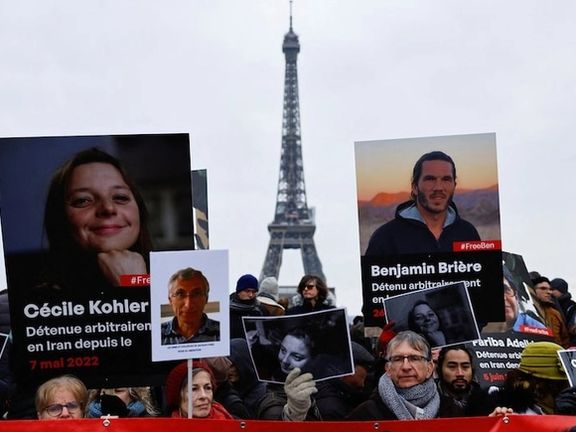
The French Foreign Ministry says it has summoned the Iranian ambassador over the issue of French nationals who were "hostages of the state of the Islamic republic of Iran."

The French Foreign Ministry says it has summoned the Iranian ambassador over the issue of French nationals who were "hostages of the state of the Islamic republic of Iran."
"Their situation is unbearable, with undignified detention conditions that, for some, constitute torture under international law," the ministry said, adding that French nationals are advised not to travel to Iran.
The Iranian ambassador was summoned three days after the French foreign minister said Iran's future ties and sanctions relief depend on the release of three French citizens detained in the country, with some held in conditions resembling torture.
"The situation of our compatriots held hostage in Iran is simply unacceptable; they have been unjustly detained for several years, in undignified conditions that, for some, fall within the definition of torture under international law," French Foreign Minister Jean-Noel Barrot said Tuesday.
Rights groups say three French citizens—Cécile Kohler, Jacques Paris, and Louis Arnaud—have been arbitrarily imprisoned without due process, with Kohler and Paris held for over two years.
Arnaud, a banking consultant, was sentenced to five years in prison by an Iranian court in November 2023.
Kohler, a teacher of contemporary French literature, was arbitrarily detained along with her partner Paris during a trip to Iran on charges of “espionage.”
Both Paris and Kohler were subject to inhumane detention conditions including forced false confessions on state TV.

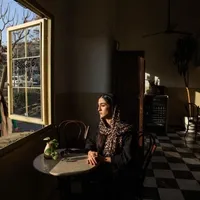
Tehran's art scene is moving underground with exhibitions and performances that defy pervasive censorship, turning home venues into sanctuaries for creative self-expression.
I attended one such event last week, a play I learned about through a friend. It was staged in a unit at a mixed-use building, half commercial, half residential. Not an earth-shattering show to be frank, but a unique experience worth sharing, especially the petty-crime feel of it.
This is how it happened.
The friend who told me about the play gave me the director’s number. I messaged him on Telegram. He asked for a reference and I named my friend. He sent me a bank account number to pay for my ticket: 200,000 tomans ($2.50 on the day of publication). Minutes after the transfer, I received a confirmation message and a slick brochure in PDF format, complete with cast, crew and the venue address.
I asked if I could tell others about it. “Only if they’re trustworthy,” he replied.
Underground performances in Iran rely solely on word of mouth. Public advertising is no option because an unauthorized show is not supposed to take place in the first place. Any work of art that seeks the public light—a film, a song, a book, or a play—has to be reviewed and approved by the censors at the aptly-named Ministry of Culture and Islamic Guidance.
But in the past few years, most notably since the widespread protests of 2022, more and more people refuse to submit their work to the ministry. They rather take it underground and take the financial hit than honor official red lines mandating the hijab and barring physical contact between men and women.
Resistance
"Many of us in theater work two jobs to sustain this resistance,” the director told me before the show on the condition that I protect his identity.
“The government likely knows about our performances, but as long as they’re small-scale and mired in hardship, they turn a blind eye.”
But they couldn’t turn a blind eye on Parastoo Ahmadi and her groundbreaking online concert with no hijab in a public space. The performance briefly landed her in jail.
“Her performance epitomized this movement,” the director said. “It shattered almost every taboo that’s been created by our fanatic rulers in the past four decades.”

Concerts in Iran require permits. Women are forbidden from singing in public. And of course they have to cover all but their faces and hands. Parastoo performed in an old caravanserai with no hijab, filmed it and released it on YouTube. She did indeed cross all red lines—and will most likely pay for it.
Very few are that bold, of course. But they are “doing their bit in the struggle,” as the director put it.
On the day of the performance, I habitually arrived 15 minutes early. It was a building like any other in central Tehran. I buzzed the third buzzer as instructed and was let in. There was no elevator. Walking up the stairs, I heard from a unit what sounded like the playful giggle of a toddler.
On the third floor, I found a woman seated at a desk by the door. I gave her my name and ticket information. The setting resembled an arts school, perhaps one offering classes in creative writing. I was asked to wait on the roof terrace to avoid crowds forming in the hallway.
On the rooftop, six or seven others were already waiting. A small area had been enclosed with plastic sheeting, and a heater stood near a table and chairs. We huddled around the heater for warmth until we were called back inside and, to our surprise, were guided to the fourth floor instead of the third.
Doing their bit
An average-size apartment had been turned into a space for performances. A wall was removed and most others were painted black. It was a modest stage, six by eight meters perhaps. Two rows of benches faced the stage, enough for 15-20 people.
The first act had two actors, a man and a woman. The woman wore a t-shirt and no hijab. I was thrilled and nervous. Everybody was, I think. Like children in a Halloween event. For the first time in my life, I watched a man hug a woman on stage. That most ordinary of contacts left us gasping. I almost teared up pitying us for all that the Islamic Republic has taken away from us.
I’d rather not say much about the performance not to risk revealing the identities of those involved.
After the performance, I spoke with the director. “Why such a small audience?” I asked. “We can't host large audiences or perform back-to-back shows,” he explained. “After a few performances, we need breaks of several days or weeks to keep everything secure and unnoticed.”
Another reason for the small audience, he said, was the lack of advertising. “Not many hear about events like ours. Most are friends and friends of friends. Many rather not risk it, fearing police raids and arrest.”
I asked if that was a real possibility and if he was scared. “I am mostly concerned for my team," he said briefly, perhaps knowing that the subject would make him anxious.
Despite the risks and the financial losses of not having a mass audience, more and more artists ignore the Guidance Ministry and its censors. Films produced with no permit appear at festivals abroad; unlicensed music and theater performances are flourishing; and books published without license can be seen on the shelves of the odd bookstore “doing its bit” - as the director had put it.
Last but not least in doing their bit is the audiences: fed-up Iranians turning away from works of art that bear the government’s seal of approval.
It’s hard to tell if these scattered, unadvertized acts of resistance will join and grow into a social movement beyond Tehran’s art scene.
But even if they don’t, they will create—they already have—a new collective space for free expression, a new front in the war of attrition against those who would silence them.

Iran hit out at formal complaints by Ukraine, Canada, Britain and Sweden to a top aviation body and the International Court of Justice over Tehran's 2020 downing of Ukraine International Airlines flight PS752 which killed 176 people.
Seyed Ali Mousavi, the Iranian foreign ministry’s director-general of legal affairs described the move as "hasty and unjustified".
The shooting down of the plane in 2020 by the Islamic Revolutionary Guard Corps (IRGC), he added, was "not intentional or deliberate."
The four countries' legal action over the tragedy with the International Civil Aviation Organization (ICAO) and the world's top court is not new, but government statements on their quest timed with the five-year anniversary of the attack stoked Iranian ire.
Urging Iran to accept full responsibility for its actions, the four countries demanded reparations for the harm caused.

Israeli Prime Minister Benjamin Netanyahu said on Friday that Yemen's armed Houthi movement is advancing Iran's regional agenda and will face continued military action for their attacks on Israel.
“The Houthis are an extension of Iran, and they serve the terrorist goals of the Iranian axis in the Middle East,” Netanyahu said.
The Israeli prime minister said Iran-backed militants “pose a danger to Israel and the entire region, including harming global freedom of navigation.”
His remarks follow airstrikes on Houthi-controlled ports and infrastructure in Yemen on Friday. The Israeli military said that the strikes targeted the Hizaz power station, as well as the Hodeida and Ras Isa ports.
Netanyahu added that Israel will continue “with determination and force against any entity that threatens Israel – wherever and whenever necessary.”
Pro-Houthi Yemeni media reports described nearly 30 airstrikes across Sanaa and Hodeidah.
Iran's foreign ministry condemned Friday's attacks on Houthi positions in Yemen, which it said were carried out by Israel, the US, and Britain, calling the strikes unacceptable.
At least one person was killed and nine others injured in the attacks, according to the Houthi-affiliated Al-Masirah TV.

A Swiss citizen Iran says died by suicide in prison was a 64-year-old tourist, a Swiss foreign ministry spokesman told Iran International, adding that Switzerland is seeking more details on his arrest and death from Tehran.
The foreign ministry added on Friday that the individual had been living in South Africa for the past 20 years and was traveling in Iran as a tourist.
The email response from the ministry said that the Swiss embassy in Iran was earlier denied access to the prisoner and now wants Tehran to provide full information about his arrest and death.
"Since Switzerland was informed of the arrest, the Swiss Embassy in Tehran has been in daily contact with the Iranian authorities to obtain more information about the circumstances of the arrest and to gain access to the detained Swiss citizen," the foreign ministry said.
"However, due to the accusations (espionage – national security), the requested consular access was not granted," it added. "Switzerland is demanding that the Iranian authorities provide detailed information."
The Swiss citizen who allegedly committed suicide in Semnan Prison on Thursday had been arrested while collecting soil samples in Iran’s central desert during an Israeli airstrike, media affiliated with Islamic Revolutionary Guard Corps reported.
Meanwhile, local media quoted unnamed Iranian official as saying that person was conducting espionage when he was arrested. The name of the Swiss citizen and the circumstances of his arrest and death remain unclear.
“This individual used prior intelligence training to take their own life during a specific opportunity,” Mashregh News, a publication affiliated with the Islamic Revolutionary Guard Corps (IRGC), reported late Thursday, citing an unnamed security official.
"Switzerland is demanding that the Iranian authorities provide detailed information on the reasons for his arrest and a full investigation into the circumstances of his death," the Swiss foreign ministry said.
The individual, detained by the IRGC Intelligence Organization, was accused of gathering information in a sensitive area during Israel's October air attack. The media report specifically said that this occurred during the Shahroud attack, which targeted an IRGC missile facility. Satellite imagery from Planet Labs later revealed significant damage to the site, known for building ballistic missiles and launching rockets as part of Iran’s space program.
After their arrest, the person was transferred to Semnan Prison, where they allegedly revealed information about their network and communication links, according to the outlet.
A local judiciary official confirmed the death on Thursday, saying that the Swiss national, facing espionage charges, had committed suicide in their cell.
Switzerland has also confirmed the death. "The FDFA confirms the death of a Swiss citizen in Iran," spokesperson Pierre-Alain Eltschinger told Iran International. "The Swiss Embassy in Tehran is in contact with the local authorities to clarify the circumstances of the death in an Iranian prison," he added.
According to Mizan, Iran's judiciary news website, the detainee asked their cellmate on Thursday morning to purchase food from the prison canteen. While alone in the suite, the detainee reportedly took their own life. "Prison officials immediately intervened to save the individual, but their efforts were unsuccessful," Mohammad Sadegh Akbari, a local judiciary official, was quoted as saying. “Suicide has been definitively confirmed.”
Iran has arrested dozens of dual nationals and foreigners in recent years, often on charges of espionage or security-related offenses. Some of these detainees have been released in exchange for deals involving Iranians held in foreign prisons.

Iran has more missiles than it can store, the Revolutionary Guards commander said, dismissing what he called enemy propaganda about the weakening of Iran's armed forces following consecutive attacks by Israel on Iran and its allies.
Providing no details about what he meant by the term, Hossein Salami stressed that Iran faces no shortages of missiles, drones or naval vessels, calling them key elements of the country’s deterrence strategy.
He also announced that the country will unveil new underground missile and drone cities, highlighting them as symbols of military strength and self-reliance, independent of foreign territories like Syria.
Iranian military commanders have been announcing the procurement of new offensive weapons since their proxies and allies in the region suffered consecutive defeats last year.
Tehran was pushed out of Syria in December after the ouster of its ally Bashar al-Assad from power at the hands of opposition insurgents.
Salami added that Iran does not rely on Syria for its deterrent power, stating, "Syria fell, but we did not rely on military advantages from Syria to an extent that would impact our deterrence."
"Our deterrence is not based on operations from any other land. It is fully rooted in Iranian soil, will, decisions, and actions," he added.
However, since establishing its military presence in Syria in 2011, Tehran has frequently emphasized Syria’s importance to its Axis of Resistance, referring to it as its strategic depth.
Earlier in the week, other IRGC generals announced the procurement of new drones. Iran has also been conducting multiple military exercises in the past few weeks, including air defense drills near nuclear sites like Natanz and a 110,000-strong Basij mobilization in Tehran.
This comes as two senior IRGC commanders said this week that financial constraints and the loss of Syria, a key regional ally, have left the Islamic Republic unable to retaliate against Israel's October airstrikes.
The loss marks one of the most significant setbacks for Iran’s so-called Axis of Resistance in 15 months of conflict with Israel. Tehran, which frames the Axis as legitimate resistance against Israel, has been cautious to avoid full-scale conflict with its better-armed foe.