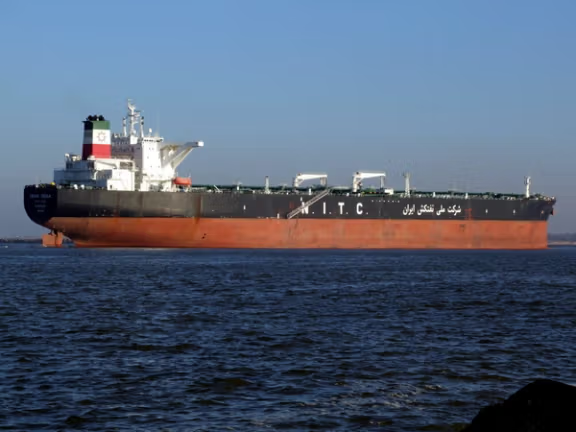
Iran has begun shipping oil stored in China with Beijing's approval, sources told The Wall Street Journal, about two weeks after Iran International reported Tehran's determination to sell off the supplies ahead of harsher sanctions expected under Donald Trump.
The 25 million barrels of oil were gradually shipped to China prior to May 2019 as a precaution when President Donald Trump imposed sanctions on Iran’s oil exports but granted China temporary waivers.
However, in May 2019, when the Trump administration revoked these waivers, the oil was left unsold and stranded in leased storage tanks at the ports of Dalian and Zhoushan.
On December 23, Iran International first reported on the IRGC’s mission to remove these oil reserves from Chinese Dalian port. In a subsequent report, Iran International cited a source as saying that Iran was trying to withdraw other oil reserves from Zhoushan Port, China.
Following these reports, Reuters sources on January 8 confirmed the existence of such a large volume of blocked Iranian oil reserves in China, adding that Iran must pay $450 million in storage fees to Chinese oil storage facilities to release it.
The Wall Street Journal latest report on January 11 has shed new light on Iran’s efforts to retrieve its stored oil from China, warning that the IRGC has taken charge of unloading and claiming this oil. There are concerns that the proceeds from its sale may be transferred to the Islamic Republic's regional proxy forces.
The report adds that two tankers, the Madestar and CH Billion, were recently dispatched to Dalian port to load part of the Iranian oil. The Madestar, left Dalian earlier this month carrying 2 million barrels of oil, while the other, the CH Billion, is reportedly still docked in Dalian with a cargo of 700,000 barrels.
To circumvent sanctions and sell its oil, Iran has relied on intricate shipping networks. For a Chinese buyer to purchase the stored Iranian oil, the shipment would first need to leave China and re-enter, with its documentation altered to disguise it as non-Iranian oil.
•
•
According to The Wall Street Journal, the current value of Iran’s stranded oil in China exceeds $2 billion. However, Tehran owes approximately $1 billion in fees for the leased storage tanks at the two Chinese ports, twice as much as reported earlier by Reuters.
The newspaper, citing informed sources, wrote that concerns have grown over the withdrawal of the oil from Chinese ports and Tehran’s efforts to sell them under the IRGC's direction. According to the report, Iran has allocated the revenue from this operation to the IRGC, which funds and arms affiliated groups across the Middle East.
In this context, the Associated Press reported on Sunday, January 12, that Hezbollah has started paying compensation to war-affected residents of southern Lebanon. In the past Iran has financed reconstruction costs and assistance to the Shiite population in Lebanon.
Sources in the report indicated that so far, certain families have received payments ranging from $194 to $14,000. Hezbollah has also mobilized 145 reconstruction teams comprising over 1,250 engineers and hundreds of analysts and accountants.
The World Bank estimated in a report in November — before the ceasefire later that month — that losses to Lebanon’s infrastructure amount to some $3.4 billion.
Under the budget law, Iran’s presidential administration has allocated 650,000 barrels of oil per day to the IRGC for the next Iranian fiscal year, starting March 21, to export directly and the revenue from these exports is designated for “strengthening the defensive capabilities of the Islamic Republic.”
Sixty-eight political prisoners across multiple Iranian prisons have sounded the alarm over the imminent execution of three fellow inmates, highlighting the escalating number of executions in the country.
In a letter issued on Saturday, the signatories condemned the death sentences of Pakhshan Azizi, Behrouz Ehsani, and Mehdi Hassani, currently held in Evin Prison, urging society to take urgent action to prevent their execution.
“While the ruling political system in Iran continues its crisis-inducing domestic and foreign policies, it seeks solutions through intensified repression in social, political, and cultural spheres,” read the letter.
The political prisoners emphasized that the Iranian government is escalating executions as a tool of control, particularly targeting political dissidents amid growing protest movements.
The letter called the death penalty "state-sponsored premeditated murder" and demanded its total abolition. It also highlighted the stark reality that over 1,000 executions have taken place in Iran in 2024 alone, with the country now responsible for nearly 75% of all global executions this year.
"This is not just a statistic but a method of silencing the oppressed," the prisoners wrote.
Amir Raisian, a defense attorney, confirmed on Wednesday that the death sentence of Pakhshan Azizi had been upheld by Iran's Supreme Court despite what he called numerous procedural flaws in the case. Azizi's brother, Aso Azizi, added that her case had been forwarded to the execution unit.
(Right to left) Pakhshan Azizi, Behrouz Ehsani Eslamloo, and Mehdi Hassani
The Supreme Court also upheld the death sentences of Behrouz Ehsani and Mehdi Hassani on the same day, according to reports from HRANA, a human rights monitoring group.
Fear of growing protest movements
The letter’s signatories warned that the increasing use of executions is part of a broader strategy to stifle dissent.
"The regime, worried about the emergence of new protest movements, is attempting to maintain an atmosphere of fear and terror in society," they wrote.
In response to the sharp rise in executions, protests have erupted both domestically and internationally, with global human rights organizations calling for immediate action.
The issue has become more urgent amid the ongoing hunger strikes by prisoners in the "No to Executions Tuesdays" campaign, which entered its 50th week on January 7. Initially launched in February 2024, the campaign has spread to 30 prisons across Iran, demanding a halt to executions.
On January 6, HRANA reported that 54 prisoners across the country now face execution on political or security-related charges, a significant rise from 33 in February 2024. This increase underscores the growing crackdown on dissent, with at least 21 new individuals added to the list of political prisoners facing death sentences in the past year.
A call for action from inside Evin
Sepideh Gholian, a political prisoner held in Evin Prison’s women’s ward, also reacted strongly to the Supreme Court’s confirmation of Azizi’s death sentence. In a letter obtained by Iran International, Gholian called on people to form a "chain of life to combat the regime's culture of death."
She described the atmosphere as war-like, saying that prisoners are living in constant fear of execution.
"Behind these tall walls and barbed wires, we are women who whisper the names of those sentenced to death every day," Gholian wrote. "The death sentence of Pakhshan Azizi, a woman who once protected war-stricken children, has been confirmed."
Azizi, a Kurdish social worker, was arrested in Tehran on August 4, 2023. After enduring nearly five months of solitary confinement and torture, she was transferred to Evin Prison’s women’s ward in December. In July, Azizi was sentenced to death by Judge Iman Afshari of Branch 26 of the Tehran Revolutionary Court for charges of "rebellion" (Baghi). The Supreme Court upheld her sentence on January 8, and her case is now in the hands of the execution unit, her family confirmed.
Azizi's case has drawn widespread attention to the Islamic Republic’s practice of using the death penalty to suppress political activism and dissent. International human rights groups continue to demand her release and the abolition of capital punishment in Iran.
Iran's government on Saturday expressed its preparedness to help the authorities in the United States contain the ongoing fires in California.
“As the Iranian Red Crescent Society has announced, we are ready to dispatch rapid response teams to assist in combating the fires in California," said Fatemeh Mohajerani, the spokeswoman for the Pezeshkian administration.
"Human beings cannot remain indifferent to the destruction of homes and natural resources of other nations, whether caused by war or the wrath of nature. We sympathize with you, the people of California, who have been separated from your homes and safe living environments, have lost your homes and possessions to the fires, and have endured this devastating wildfire caused by severe climate change," she said.
The Islamic Republic is offering help to the US while it is facing a severe economic and energy crisis back home and has shut down schools and public offices this weekend due to energy shortages.
It has also been widely criticized for its repeated failure to contain forest fires, which devastate wildlife habitats almost every summer.
Last summer, the huge fires in Khaeez protected area in southern Iran exposed significant shortcomings in the nation's crisis management system.
Environmental activists have long advocated for more effective firefighting strategies, especially in terrains characterized by mountainous regions, dry vegetation, and strong winds, as these measures could help prevent such disasters.
Linking California fires to Middle East wars
Iran's hardline media have described the Los Angeles fires as an act of divine anger and a punishment for the United States' support of Israel in the Gaza conflict.
Mohajerani also alluded to a potential connection between the California fires and the Middle East conflicts, saying, "We recall the sorrow of thousands of displaced people who have suffered due to the selfishness and war-mongering of others."
Since Tuesday, six simultaneous blazes have swept through Los Angeles County neighborhoods, claiming at least 11 lives and damaging or destroying 10,000 structures. The toll is expected to rise as firefighters conduct house-to-house searches.
Turkey’s Foreign Minister Hakan Fidan says Ankara seeks to strengthen ties with its eastern neighbor and expects Tehran to support its fight against the Kurdistan Workers’ Party (PKK).
“There are some who think differently about PKK in Iran. But it is not a secret that we call on all the countries – the US, Russia, etc. – not only Iran, not to support PKK or at least not to remain indifferent,” Fidan said Friday during a press conference in Istanbul.
He made the remarks in response to a question about IRGC Quds Force Chief Esmail Qaani's alleged meeting with the PKK-linked YPG leaders.
Fidan also suggested that Iran might reconsider its regional policies and adopt a new strategy in the Middle East following developments in the region, including the fall of Tehran’s ally Bashar al-Assad in Syria.
Ankara is known as the main supporter of the Syrian rebels led by Ahmed al-Sharaa, also known by his nom de guerre Abu Mohammad al-Julani, who toppled Assad's government in Damascus.
Fidan said the new Syrian administration should be given a chance to address the presence of Kurdish militants in the Arab country, reiterating that the Turkish military would act if it did not.
Since the fall of Assad on December 8, 2024, Ankara has repeatedly said the Kurdish YPG militia must disband, lay down its weapons, and have its foreign fighters leave Syria.
Turkey has listed the YPG, which spearheads the US-backed Syrian Democratic Forces (SDF), as a terrorist organization linked to militants waging a decades-old insurgency against the Turkish state.
However, Washington considers them a key ally battling Daesh (ISIS) terrorists.
Iran's hardline media described the Los Angeles fire as an act of divine anger and a punishment for the United States' support of Israel in the Gaza conflict.
The Kayhan newspaper, funded by Supreme Leader Ali Khamenei, wrote on its front-page headline Saturday that by supporting Israel in Gaza, the US had "created apocalyptic scenes," and now "the cries of the oppressed children of Gaza and the Palestinian mothers have caught up with America, imposing a similar situation on the state of California and the city of Los Angeles."
The Jam-e Jam newspaper also ran a similar story on its front page with the headline "Fire-Angeles."
The newspaper referred to Donald Trump's comment that the Middle East would turn into hell if Israeli hostages were not freed before his inauguration and described the Los Angeles fire as "America's hell."
A representative of Iran's Supreme Leader Ali Khamenei also called the California fires "God's revenge against the leaders of America" over what he called their complicity in Israel's war in Gaza.
"A city the size of Gaza has burned, while all its inhabitants were American capitalists. This fire was God’s revenge against the American leaders," said Rasoul Falahati, a representative of Khamenei in Gilan province in northern Iran.
On Tuesday, US President-elect Donald Trump warned during a press conference at his Mar-a-Lago estate in Florida that "all hell will break out in the Middle East" if Hamas does not release the hostages by Inauguration Day, repeating the statement several times.
The Arabic-language Al-Alam Network, owned by the state media corporation Islamic Republic of Iran Broadcasting (IRIB), shared images showing the destruction caused by the Los Angeles fires and compared them to the devastation in Gaza.
Other Iranian media also used terms like "Los Angeles in hell" and "the infernal city," criticizing what they described as "very weak" crisis management in the US.
The Fars News Agency reported that "the infernal fire of Los Angeles is days away from being contained."
"Grim footage out of California is reminiscent of ravaged homes, schools, and hospitals in Gaza," Zarif wrote. "It's only human to sympathize with Californians who've lost everything to the wrath of nature—particularly as many there have stood with Gazans who lost everything to the savagery of Israel."
Meanwhile, government offices and schools across Iran were shut down on Saturday due to a natural gas shortage, extending the ongoing energy crisis that began at the start of winter with widespread gas and electricity shortages.
Since Tuesday, six simultaneous blazes have swept through Los Angeles County neighborhoods, claiming at least 11 lives and damaging or destroying 10,000 structures. The toll is expected to rise as firefighters conduct house-to-house searches.
The largest wildfire ravaging parts of Los Angeles this week changed direction on Saturday, prompting additional evacuation orders and presenting a fresh challenge to exhausted firefighters.
A member of the US House of Representatives has called for enhancement of Washington's defense capabilities in response to Tehran's unveiling of a new loitering munition drone.
"Iran’s Rezvan loitering munition and its growing drone capabilities underscores the need for the US to bolster its own defense capabilities," said Congressman Pat Fallon in a post on his X account on Saturday.
"Innovative anti-drone defenses and countermeasures are essential to our military's readiness," he added.
His comments came two days after Iran’s Islamic Revolutionary Guard Corps (IRGC) unveiled its latest loitering munition drone, the Rezvan, during military drills codenamed Great Prophet 19.
The drone, with a range of 20 kilometers and an operating time of 20 minutes, is designed for rapid deployment and targeted attacks, particularly in complex terrain, according to the IRGC.
The suicide drone is fired from a cylindrical launcher and transmits live video to the operator, allowing for precise target selection and engagement, IRGC media Tasnim reported.
The Great Prophet 19 exercise was the latest in a series of drills conducted by Iran's military to showcase its capabilities and project a message of strength in the region, following consecutive defeats for its allies since September.