Israel, Hamas reach long-awaited ceasefire deal to end Gaza war
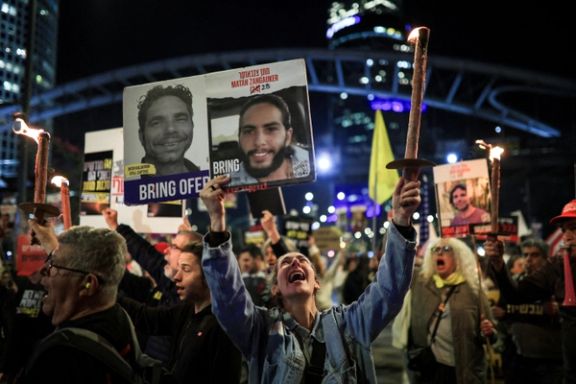
Supporters of Israeli hostages kidnapped during the deadly October 7, 2023, attack by Hamas block a road as they demand a deal during a protest amid ongoing negotiations for a cease-fire in Gaza, in Tel Aviv, Israel, on Jan. 13, 2025.
Israel and Hamas have reached a ceasefire deal to end the Gaza war, US President Joe Biden announced on Wednesday, over 15 months after the October 7 attack by Iran-backed militants triggered the bloody conflict.
The Israel-Hamas deal outlines six-week initial ceasefire phase that includes gradual withdrawal of Israeli forces from central Gaza and return of displaced Palestinians to north Gaza, Reuters reported citing an official briefed on the agreement.
US President Joe Biden hailed the deal in a White House speech, flanked by Vice President Kamala Harris and Secretary of State Anthony Blinken.
The grueling war began when Gaza-based Palestinian militants' attacked Israel on October 7, 2023, killing 1,200 soldiers and civilians and abducting 250 foreign and Israeli hostages.
Israel's incursion into the enclave killed tens of thousands of people, many of them civilians, and morphed into a region-wide confrontation between Iran-backed armed groups and Israel, which receives weapons and funding from the United States.
Iran finds itself on the backfoot as the confrontation winds down, with Israeli blows pounding Hezbollah into a ceasefire Lebanon, weakening Iran's ally Bashar al-Assad in the face of a rebel advance which toppled him, degrading Iran-backed Palestinian militants in Gaza and hitting Iranian military targets directly in October.
Only the Iran-aligned Houthis in Yemen appeared to fight on largely unscathed.
The agreement comes after months of negotiations facilitated by Egyptian and Qatari mediators, with support from the United States and was reached just before the January 20 inauguration of US President-elect Donald Trump.
Trump's Middle East envoy Steve Witkoff took part in the latest diplomacy and was present in a news conference in Doha convened on Wednesday by foreign minister Sheikh Mohammed bin Abdulrahman Al Thani, a main interlocutor between the warring sides.
The President-elect had repeatedly vowed that "all hell will break out" in the Middle East if Hamas did not agree to release the hostages by January 20.
But Biden appeared keen not to attribute the diplomatic breakthrough to his successor, responding to a shouted question by a journalist on who deserves credit for the deal, Biden or Trump: "Is that a joke?"
•
•
Phased hostage release
According to the deal, Hamas will release 33 Israeli hostages in a first phase, including all women including soldiers and civilians, children and men over 50.
Israel, in turn, will release 30 Palestinian detainees for every civilian hostage and 50 Palestinian detainees for every Israeli female soldier Hamas releases. Israel will also release all Palestinian women and children under 19 detained since October 7, 2023, by the end of phase one.
The total number of Palestinians released will depend on the hostages released and could range between 990 and 1,650 Palestinian detainees, including men, women, and children.
Hamas will release hostages over a six-week period, with three hostages released every week, and the remainder before the end of the period, Reuters reported citing the official briefed
The release of hostages will begin with the living, followed by the remains of those who have died. Qatar, Egypt, and the US will guarantee the implementation of the agreement, Reuters reported.
Israeli forces entered Gaza following an October 7, 2023, attack by Hamas-led militants who breached security barriers and infiltrated Israeli communities, killing 1,200 soldiers and civilians while taking over 250 hostages, both foreign and Israeli.
Israel's military actions in Gaza have resulted in over 46,000 deaths, according to Gaza health ministry data, leaving the coastal strip in ruins, with hundreds of thousands of survivors enduring harsh winter conditions in tents and temporary shelters.
While many analysts agree that Iran finds itself in a weakened position, a conservative commentator inside Iran claims that the unstable situation might shift in Tehran's favour.
Former politician Abolfazl Hassanbeigi, who is permitted to express his views in Iran's domestic media, also cautioned the country's officials that Iran is likely to face two challenging years ahead.
In the interview with the conservative Nameh News site, Hassanbeigi suggested that with proper management, the situation could improve -- ultimately bringing the region in line with Iran’s interests.
In its analysis, Nameh News noted that recent developments in the region have led many to believe that Tehran's influence has been weakened.
The diminishing influence of Hamas and Hezbollah, coupled with the fall of Assad in Syria, and the rise of Joseph Aoun—viewed as a candidate favored by both the US and Saudi Arabia—as Lebanon's president, has led many analysts to conclude that the dominance of Iranian-backed forces in the region might be drawing to a close.
Several Iranian observers, including imprisoned government critic Mostafa Tajzadeh, have argued that the fall of Assad, along with Israeli strikes on Hezbollah and Hamas, signals the collapse of what Iran refers to as the "axis of resistance," a term Tehran uses to describe its network of allies and proxies in the region. These observers view this as a strategic defeat for the Islamic Republic, attributing Iran’s growing isolation and economic difficulties to Supreme Leader Khamenei’s commitment to the "axis."
Meanwhile, Iran's ambassador to Lebanon, Mojtaba Amani, said last week that the election of Aoun, who has not been Hezbollah's candidate, does not represent a defeat for Iran.
Nameh News dismissed the idea of the "axis of resistance" ending as a delusional, suggesting that over time, the prevailing perception might shift towards viewing the region as increasingly aligned with the US.
However, the outlet also noted that some analysts believe the "axis" has experienced similar fluctuations in the past but has ultimately been revitalized, continuing to influence regional developments.
The website also pointed out that "none of the two views reflect the whole truth. In fact, both of them reflect what the analysts like to happen. West Asia has always been giving birth to new developments that disrupted previous equilibriums. However, the main question is that where will Iran be standing and what role Tehran is likely to play in the region."
Hassanbeigi told Nameh News that Iran's regional strength depends on resolving its internal disputes, asserting that the country is powerful enough to deter opposition if united.
He criticized radicals in Iran's political landscape, particularly in the parliament, for undermining the presidential administration through psychological warfare and efforts to tarnish its image.
"The radicals think of themselves as a new political force and that they can do anything they want even if their behavior harms the country's national interests," Hassanbeigi argued.
Addressing tensions with the US, Hassanbeigi remarked that despite Netanyahu's efforts, Washington does not appear to view a war with Iran as being in its best interest.
He acknowledged the challenges ahead, stating, "We face a couple of difficult years, but if we navigate this period effectively, the regional dynamics will shift."
He claimed that American policies often create adversaries wherever they intervene, as their excessive demands alienate others in the region.
Iran’s navy unveiled its first signals intelligence (SIGINT) vessel, Zagros, on Wednesday, said to be designed for electronic surveillance and cyber intelligence operations.
"The Zagros will serve as the watchful eye of Iran's navy in the depths of the seas and oceans," Navy Commander Shahram Irani said during the unveiling ceremony.
The launch coincides with extensive military exercises aimed at safeguarding the country's nuclear infrastructure, including key facilities in Natanz and Fordow.
The drills, involving both the Islamic Revolutionary Guard Corps (IRGC) and the Iranian army, are expected to continue until mid-March.
The head of the Atomic Energy Organization, Mohammad Eslami, announced on Wednesday that two additional exercises will be conducted in the coming days, focusing on passive defense to demonstrate maximum operational readiness.
The unveiling of the Zagros comes amid intensified and ongoing international scrutiny of Iran's nuclear program.
Tehran maintains its nuclear activities are solely for peaceful purposes, a claim increasingly challenged due to its elevated uranium enrichment levels.
The International Atomic Energy Agency (IAEA) has confirmed that Iran holds uranium enriched to 60%, approaching weapons-grade levels.
Tensions between Iran and the United States have escalated in recent years, especially after the US withdrew from the 2015 nuclear deal during Donald Trump's presidency and reimposed sanctions. Relations were further strained by the killing of General Qassem Soleimani in 2020, as well as Tehran's support for regional proxy groups, and alleged attacks on commercial shipping in the Persian Gulf.
Iran’s investment in the Zagros and other military technologies underscores its focus on strengthening surveillance and defensive capabilities in response to regional and international challenges.
Admiral Shahram Irani asserted that the ship is domestically constructed and will play a key role in securing maritime domains, including the Indian and Pacific Oceans.
"The Iranian navy has successfully addressed the nation’s defensive demands through local expertise and advanced intelligence capabilities," Admiral Irani said.
US President-elect Donald Trump needs to show he will keep his word before Iran will consider talks with his administration, Iranian President Masoud Pezeshkian told reporters on Wednesday.
"If Trump proves he follows through on his words, we will engage in talks with him," President Pezeshkian said during a cabinet meeting.
His comment followed the foreign minister's statement on state television the previous day, saying that Tehran would not engage in talks with the US unless Washington first rejoined the 2015 nuclear deal, the Joint Comprehensive Plan of Action (JCPOA).
“We will not negotiate with the United States until it returns to the JCPOA. We will also continue consultations with China and Russia, considering them two key members of the JCPOA,” Foreign Minister Abbas Araghchi stated.
This is not the first occasion on which the Islamic Republic has insisted on evidence of US intentions prior to entering into negotiations.
Since the Trump administration withdrew from the JCPOA in 2018 and imposed severe economic sanctions, Tehran has repeatedly called for the easing of these sanctions as a sign of Washington's goodwill.
Iranian and international media, along with analysts, however, anticipate Trump to intensify sanction enforcement to compel Tehran into make concessions.
NBC is scheduled to air an interview with President Pezeshkian on Wednesday, where, according to his aide, he will convey Tehran’s willingness to engage in talks with the Trump administration.
This apparent divergence in messaging has drawn attention and criticism inside Iran.
In a short version of the interview NBC released on Tuesday, Pezeshkian also denied that the Islamic Republic had any plans to assassinate Donald Trump for the 2020 killing of Qassem Soleimani, a pivotal figure who led Tehran's military operations across the Middle East.
Efforts by the Biden administration to restore the 2015 nuclear deal included extensive indirect talks with Tehran in 2021–2022, which stalled after Russia's invasion of Ukraine. Russia, a key JCPOA signatory, played a significant role in those negotiations.
Iran's government is under increasing pressure from a worsening economic crisis and regional military setbacks in the Middle East over the past year.
Inside Iran, Trump’s return to the White House has led many officials, analysts, and state media to advocate for preemptive talks with the incoming administration to prevent further strain in relations with the US.
Araghchi's comments elicited strong criticism from Hamid Abutalebi, a political advisor to former President Hassan Rouhani. In a post on X, Abutalebi charged the Pezeshkian administration with inconsistency and a lack of clarity in its foreign policy approach.
“It seems that the esteemed government is engaging in ‘political self-deception,’” Abutalebi wrote. “On one hand, the President sends a message signaling a willingness to negotiate, while on the other, his Foreign Minister, in tonight's interview, takes a stance against the President's position, effectively neutralizing it.”
Iranian Foreign Minister Araghchi says Tehran is ready to engage in negotiations with Europe regarding Ukraine. However, he emphasized that dialogue must be reciprocal.
"If Europe is upset about Russia using Iranian weapons, it should also be held accountable for its military cooperation with Israel," he said on state TV.
Iran-backed operatives attempted to lure an Israeli businessman to the United Arab Emirates, Israel's National Security Council said on Tuesday, weeks after an Israeli rabbi was killed there.
According to the NSC statement issued in Hebrew, the operatives introduced themselves as journalists from the Persian edition of Al Arabiya -- the Saudi-owned media network with a presence in Dubai.
The Iranian agents, the statement read, reached out to the Israeli businessman via Telegram, inviting him for an interview on the topic of Iran for the news channel.
The team then attempted to plant malicious software on the Israeli man's device through links, "designed to grant them access to his mobile phone without his knowledge."
The businessman, suspicious about the messages, reported the account to security services leading to an investigation.
"The characteristics of the conversation and the invitation to conduct an 'interview' on the subject of the Iranian regime indicate that indeed Iranian terror elements are behind the approach. In fact, this was an attempt to lure the Israeli to Dubai with the intent to harm him," the NSC statement said.
This incident comes less than two months since Chabad emissary Zvi Kogan was murdered in the UAE, who Israel says was murdered in "antisemitic act of terror."
Kogan’s body was found near the Omani border.
Three Uzbek citizens have since been arrested in connection with the case, with UAE authorities saying they will take "take the necessary measures to uncover the details, circumstances, and motives of the incident."
In 2020, Jamshid Sharmahd was kidnapped by Iranian operatives from Dubai and forcibly taken to Iran via Oman. He was sentenced to death and executed in what Amnesty called a "grossly unfair trial" in 2023. Iran accused him of being the leader of a pro-monarchist terrorist group. Sharmahd and his family denied the claim. Amnesty International said he faced a grossly unfair trial based on forced “confessions", held in solitary confinement since 2020.
In 2013, Iranian intelligence agents are believed to have kidnapped British-Iranian businessman Abbas Yazdi from the car park of his Dubai company.
Israel saw a record surge last year in Iran-backed plots, rising by 400% in the wake of the Gaza war.
“During the year, 13 serious espionage affairs by Israelis were exposed and thwarted for the Iranian intelligence agencies, and serious indictments were filed against 27 Israelis,” a statement from Israel’s security agency Shin Bet said.