A ceasefire deal announced this week between Israel and Hamas signals a defeat for the Palestinian militant group's main backer Iran, a former hostage in Tehran who also influenced the ceasefire negotiations told Iran International.
Nizar Zakka, head of Hostage Aid Worldwide, was abducted in 2015 by the Islamic Revolutionary Guard Corps (IRGC) after attending a conference in Tehran.
The US-Lebanese dual national was locked up four years in Iran’s notorious Evin prison, spending 18 months in solitary confinement, despite being officially invited to the country by a Vice President at the time.
Zakka was released June 2019 in exchange for Negar Qods Kani, an Iranian prisoner in the United States.
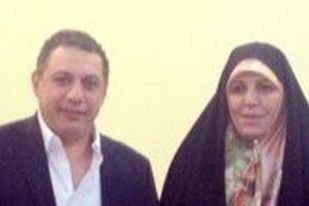
Nizar Zakka with Shahindokht Molavardi, who was Vice President for Women and Family Affairs .
“The whole concept of hostage taking has been created and developed by the Islamic Republic of Iran. They (Iran) have built their foreign policy based on hostage taking,” said Zakka on this week’s episode of Eye for Iran podcast.
Hamas and Iran - which arms, funds and trains the Palestinian militant group - had high hopes for the October 7, 2023 attack on Israel which killed 1,200 soldiers and civilians and saw the abduction of 250 foreign and Israeli hostages.
Both framed the deadliest day in Israel's history as the beginning of the end of their hated enemy. But after Israel's fearsome incursion into Gaza devastated the enclave, killing nearly 45 thousand Palestinians, and air strikes pounded Iran and its allies for 15 months, Zakka says Iran is unlikely to view hostage-taking so favorably.
“It's a big lesson that (hostage diplomacy) will not work,” said Zakka.
One of Hamas senior leaders Khalil al-Hayya characterized the ceasefire deal as success for the group, defining it as a "historic moment."
"Our people have thwarted the declared and hidden goals of the occupation. Today we prove that the occupation will never defeat our people and their resistance,” al-Hayya said in a televised speech from Qatar.
Zakka said in fact Iran and its proxy lost their ability to negotiate with people's lives the moment a ceasefire was reached.
It is no coincidence that hostages are at the center of the conflict between Hamas and Israel, Zakka said, as Hamas is carrying on a tradition from the inception of the Islamic Republic after revolutionaries in 1979 seized the US embassy and dozens of US hostages in Tehran in 1979.
The Islamic Republic has for nearly five decades sought to trade foreign detainees with governments in exchange for prisoners or economic and political concessions.
The failure of Iran’s militant proxies and the agreement that on principle has been reached between both sides demonstrates that Tehran’s foreign policy tactic doesn’t have the sway it used to, according to Zakka.
Iran sees it otherwise. The IRGC referred to the ceasefire as a victory for Gaza and the Palestinian people.
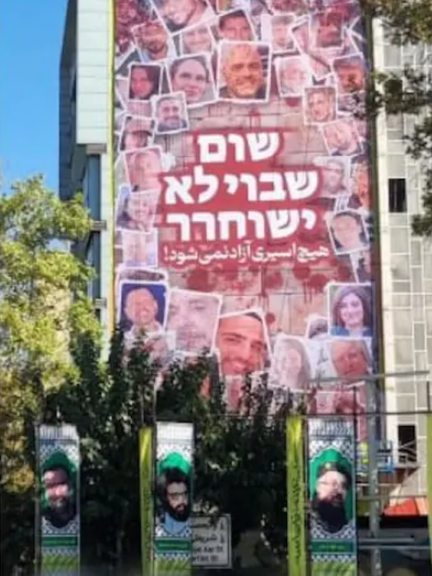
A blood-splattered mural depicting Israeli hostages in Gaza was unveiled in Tehran last year with the message: “No hostage will be released,” written in Farsi and Hebrew. Now, it appears, they will.
Mural in Tehran depicting Israeli hostages in Gaza.
If the Israeli cabinet and government formally approve the ceasefire, the first six-week phase will take effect on January 19.
The deal reached Wednesday would see the release of 33 hostages over the next six weeks in exchange for hundreds of Palestinians imprisoned in Israel. The Jewish state would pull back in parts of Gaza allowing the return of displaced Palestinians along with humanitarian aid.
Ceasefire role
“I am so happy. I love it. I did a lot. I worked a lot. Yesterday on Israeli TV Channel 12, they said that the ceasefire was made because of my advocacy and my work," said Zakka.
Zakka was in direct contact with President-elect Donald Trump, encouraging him to take a firm stance to bring back all the hostages, not just Americans among them.
Trump, Zakka said, listened.
“I asked President Trump to pressure Bibi Netanyahu,” said Zakka, "We explained to President Trump that if he would accept to make a deal for only four Americans and leave the rest behind, that would be like signing the death certificate for all the other hostages in Gaza. I told Trump that Bibi Netanyahu will kill everybody."
The conversations between Zakka and Trump took place over WhatsApp and email, he said.
Zakka said the bombing of Gaza also puts the lives of Israeli hostages in jeopardy too. When he was imprisoned in Iran, he said he used to pray for the Americans to bomb the IRGC facilities but with the devastation in Gaza, he realized that would put innocent lives at risk too.
"I feel so much for these people because they are bombed by Israel, their own country, and then taken hostage by Hamas, using them as a human shield."
Ending hostage diplomacy
The American-Lebanese technology expert and former businessman has made it his life's mission to make sure Iran does not engage in future hostage-taking and helping save the lives of other hostages.
Speaking on Eye for Iran, Zakka was in Damascus searching the underground cells for Austin Tice, a US journalist who disappeared during ousted President Bashar al-Assad’s rule.
He is now considered missing, and Hostage Aid Worldwide believes he is being held against his will in a safehouse. Zakka declined to elaborate to protect the investigation.
Zakka is also lobbying the United Nations (UN) to strengthen the International Convention Against the Taking of Hostages to include punishments for violators and for the UN manage talks with countries that engage in hostage diplomacy.
When Iran detained Italian reporter Cecilia Sala last month, for example, Italy negotiated directly for her release.
“We cannot let the Iranian regime negotiate with each country separately, take hostages, and get away with it," Zakka said. "We need to stand together as an international community against hostage-taking.”
A CIA employee accused of leaking classified information regarding Israel's October plans to attack Iran pleaded guilty on Friday to charges of willfully retaining and sharing national defense information, according to the US Department of Justice.
Asif William Rahman, who had been employed at the US intelligence agency since 2016, confessed to illegally downloading, printing, and distributing classified materials on multiple occasions, including several incidents in 2024.
The FBI apprehended Rahman in Cambodia in November, later transferring him to federal court in Guam to face charges.
The leaked information pertains to intelligence from US satellites detailing preparations for an Israeli air assault on Iran, aimed at retaliation for an October 1 missile attack on Israel.
Two US intelligence documents dated October 15 and 16, originally restricted to the "Five Eyes" intelligence-sharing alliance (Australia, Canada, New Zealand, the United Kingdom, and the United States), appeared on the pro-Iran Telegram channel Middle East Spectator as Israel geared up to respond to the barrage of 181 ballistic missiles.
The platform’s X account lists its location as the Islamic Republic of Iran.
In a public statement, Middle East Spectator denied any direct connection to the original source of the leaks, saying, “we assume [it to be] a whistleblower within the US State Department.”
A US flag that had previously been painted on the ground in the courtyard of the Iranian president's office to be trampled by visitors, has now been removed.
The flag was painted there during the Raisi administration but was erased a few weeks ago under Masoud Pezeshkian's term, Ensaf News reported on Friday.
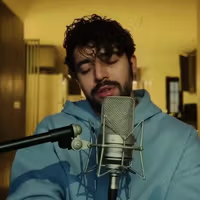
A Iranian dissident rapper arrived in Berlin on Friday after being temporarily released on medical furlough from a prison in Tehran, where he was previously sentenced to death.
" Woman, Life, Freedom forever," Saman Yasin wrote in a post on X, sharing a video of his arrival in Berlin airport, without providing further details of how he had left Iran.
Yasin was arrested in October 2022 amid Iran's Woman, Life, Freedom nationwide protest movement sparked by the death of a young woman, Mahsa Amini, in morality police custody.
Yasin was initially sentenced to death on charges including "enmity against God, assembly and collusion to act against national security."
However, his death sentence was overturned by the Supreme Court in April last year. He was later sentenced to serve five years in prison in exile in Kerman province in southeastern Iran.
In July 2023, a source close to Yasin's family told Iran International that Saman was tortured and subjected to forced confessions during interrogations.
In October of last year, Saman Yasin was temporarily released from Tehran's Ghezel Hesar Prison on medical furlough after posting a bail of 40 billion rials (just over $50,000), according to his lawyer.
"My client, Saman Yasin, has been released on medical leave today after spending approximately 26 months in prison," his lawyer said. "This decision was made following a medical commission’s recommendation and with judicial approval, after securing bail."
Many Iranian dissidents have sought refuge in Europe following the protests, including acclaimed filmmaker Mohammad Rasoulof. Rasoulof left Iran on foot, crossing the rugged mountainous border into Iraq to escape an eight-year prison sentence imposed for his film about the 2022 uprising.
Yasin, along with dissident rapper Toomaj Salehi—who was also sentenced to death but later released on bail—and Behrad Ali Konari, were among several rappers detained in connection with the uprising.
State-appointed Iranian clerics expressed conflicting views in their Friday sermons about negotiations with the United States, just days before President-elect Donald Trump is set to take office.
Clerics delivering the political speeches on the weekly Islamic holy day are appointed by Supreme Leader Ali Khamenei and reflect prevailing sentiment within the theocracy.
Tehran's interim Friday Prayer imam, Kazem Sedighi, spoke out against talks with Washington, dismissing the idea that Iran needs to reduce sanctions to address its current economic crisis.
Sedighi's remarks were in line with Iranian hardliners who continue to criticize the proponents of reconciliation with the West.
"To think that if the United States reconciles with us, our livelihood will prosper and our needs will be met goes against reason, experience, and the Holy Quran. God has not permitted a faithful community to live under the banner of disbelief," Sedighi said.
"Those who speak of reconciliation with the United States and trample on past experiences and the blood of martyrs should know that our people have sacrificed their blood and youth," he added.
Since Iran's regional military setbacks last year and the steep fall in the value of its currency, many officials and politicians loyal to the Islamic Republic have called for negotiations with the US, citing the need to transcend an economic crisis that has impoverished tens of millions of Iranians.
The Friday imam of Karaj, a city near Tehran, also criticized those who believe the promises of the "Enemy"—a term used by Iranian officials for the United States—but conceded that talks benefiting Iran could be permitted.
"Negotiations that safeguard national interests are acceptable as long as those interests are not compromised," Mohammad Mehdi Hamedani said, adding, "However, based on past experiences, if negotiations occur under conditions that fail to protect national interests, they will result in yet another outright loss."
Both clerics urged the public not to trust the US, arguing for the need to raise awareness about what they described as the duplicity of major powers and their empty promises. They urged the public not to trust non-state information and what they described as "propaganda by enemies."
Iranian officials have grown increasingly concerned about what they perceive as widespread ideological apathy among the Iranian population and a declining trust in the Islamic Republic, particularly following the 2022 nationwide anti-state protests.
Despite decades of strict media control and internet restrictions, Iranians continue to watch Persian-language satellite television channels broadcast from abroad and use circumvention tools to access uncensored information online.
The spokesman for the Islamic Revolutionary Guards downplayed concerns in Tehran about incoming US President Donald Trump, who imposed heavy sanctions on Iran during his previous term.
"Some people express concern and attempt to alarm us over Trump’s return," Ramezan Sharif said on Friday. "We have faced and overcome every American president, all united in their hostility toward the Revolution. We endured Trump’s four-year term, and he, more than most, understands the strength of Iran."
During his first term, Trump enacted a series of measures to weaken Iran’s economy and diminish its regional influence, particularly targeting its nuclear program. He withdrew the United States from the 2015 nuclear deal with Tehran. His policy became known as "maximum pressure."
Earlier in December, Trump's newly appointed Middle East advisor, Massad Boulos, announced that the incoming administration plans to revive its maximum pressure strategy against Iran, signaling a clear intent to reinforce the country’s isolation.
The media have also highlighted this, with Bloomberg reporting on Thursday that advisers to Trump are devising a comprehensive sanctions strategy to ramp up pressure on Iran, citing sources familiar with the matter.
On Monday, The Economist described Iran as "vulnerable to a Trumpian all-out economic assault," while The Spectator warned, "Trump’s presidency could spell the end of Iran’s regime."