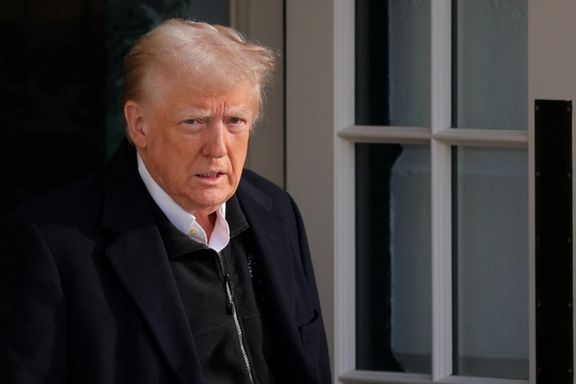
US President Donald Trump's latest remarks on Iran, which downplayed the likelihood of military conflict and suggested possible dialogue, have prompted some Tehran insiders to favor direct talks and a potential agreement with his administration.
“This time Trump is completely different from before. There were [people like] John Bolton and [Mike] Pompeo before and he had radicals [around him],” Ahmad Bakhshayesh-Ardestani, a member of the Parliament’s National Security and Foreign Policy Committee told the Iranian Labour News Agency (ILNA) Tuesday.
Last week, President Trump expressed hope that a deal on Iran's nuclear program would eliminate the need for the US to support an Israeli attack on Iran.
"It would really be nice if that could be worked out without having to go that further step ... Iran hopefully will make a deal, and if they don't make a deal, I guess that's okay too," Trump said.
Last week, Trump terminated Secret Service protection for former national security advisor John Bolton, former secretary of state Mike Pompeo, and former special envoy for Iran Brian Hook, despite alleged threats from Iran against their lives. This decision has drawn criticism from some Republicans.
Bakhshayesh-Ardestani also argued that Trump’s approach and way of thinking about conflicts in the world have changed because he wants to tell the world that he has the power to go to war but wants to solve the problems without resorting to force.
He also argued that Trump has adopted a new approach to the Islamic Republic because he has realized that Iran does not seek a nuclear bomb. “Trump’s focus is on Iran for not having nuclear weapons. Iran considers nuclear weapons to be religiously forbidden,” he said, adding that this means an agreement between the two sides is possible.
He was apparently referring to an alleged fatwa by Supreme Leader Ali kHamenei many years ago. However, analysts argue that the so-called fatwa is merely an advisory opinion rather than a binding legal decree. They argue it was intended to mislead the international community about the true intentions of a nuclear program that Tehran insists is peaceful.
In late December, Bakhshayesh-Ardestani had said that an Israeli strike against Iran's nuclear facilities would effectively allow the Islamic Republic to move toward developing nuclear weapons.
Speaking to the moderate conservative Entekhab news website in Tehran on Monday, a former Iranian diplomat at the UN, Kourosh Ahmadi, described “the tone and content of the words that Trump has spoken about Iran after taking office” as “more diplomatic than hostile.”
“Firstly, he has only talked about negotiation and agreement [with Iran], and secondly, his tone is mostly calm and there is no threatening rhetoric,” he said.
Ahmadi suggested that Trump's stance has increased the likelihood that he plans to "officially propose negotiations as the first step in relations with Iran, rather than focusing on threats or pressure."
The former diplomat also advised Iranian authorities to view Trump’s statements as an indication of his openness to negotiating with Tehran before exploring other options.
President Masoud Pezeshkian and officials of his administration including Foreign Minister Abbas Araghchi say Tehran is open to and prepared for talks with the Trump administration, but it is unclear to what extent they are willing to be flexible. Trump also has not officially reveal his next steps toward Tehran.
Other Iranian officials, including Pezeshkian’s Special Envoy in Maritime Economy, Ali Abdolalizadeh, have in recent weeks indicated that the “governance” has concluded that there must be direct talks between the US and Iran.
In the parlance of the Islamic Republic, terms like "governance" or "system" are frequently used to refer to Supreme Leader Ali Khamenei. In 2018, Khamenei stated that the Islamic Republic would never engage in negotiations with the US, specifically not with the Trump administration.
In mid-January, a senior figure in Khamenei’s office claimed that the Supreme Leader’s anti-American remarks in a speech were not meant to rule out negotiationsif the positions of the two sides of a dispute align.
Iran's political establishment continues to send mixed signals on its openness to talks with Washington, as the deputy speaker of parliament said Wednesday that Tehran supports negotiations, while a leading hardline newspaper doubled-down on its opposition.
Hamidreza Hajibabaei, the senior lawmaker and former minister in Mahmoud Ahmadinejad’s administration, told the media that Tehran has no “enmity or war with America.”
“We are open to negotiations, but they must be fair,” he added.
Iranian officials repeatedly stress the need for fair negotiations, indicating that any demands must fall within the scope of what they are willing to accept.
During talks between the two sides a decade ago, Tehran strongly rejected the inclusion of non-nuclear issues, including its ballistic missile program and regional activities.
Prior to Hajibabaei's remarks, Supreme Leader Ali Khamenei, who holds the highest authority in the Islamic Republic, cautioned top government officials to remain vigilant during any negotiations.
Several state-controlled media outlets and commentators interpreted this as a subtle signal of Khamenei’s approval for talks with the Trump administration.
In contrast, the ultra-hardliner Kayhan newspaper, with close ties to Khamenei’s office, sharply criticized the US for pressing maximalist demands on the Islamic Republic. According to Kayhan, these demands included imposing limits on its missile program, reducing its nuclear activities to what it described as a symbolic level, and prohibiting its interventions in the region.
Despite a rising number of Iranian officials and commentators, who are permitted to speak to the media, advocating for negotiations, Kayhan maintained that Tehran does not see an urgent need to negotiate the lifting of sanctions.
The country’s economic crisis, which has been ongoing for some time, has deepened in recent months, with the national currency losing more than half of its value and Iran facing severe shortages.
"The discussion of negotiations with the US, which will certainly lead nowhere, causes powerful governments that have formed the opposing front against the US to doubt Iran's seriousness in economic and multilateral cooperation," Kayhan's analysis concluded, potentially hinting at a partnership deal Tehran recently formalized with Moscow. "As a result, they may refrain from entering major partnerships with the Islamic Republic. Therefore, negotiating with the US is a lose-lose game for us and a win-win for the US."
Iran's president says the Islamic Republic has not received any messages from US President Donald Trump yet.
Asked by reporters about receiving a message from Trump, President Masoud Pezeshkian said, "No, we have not received any messages yet."
Foreign Minister Abbas Araghchi also told reporters that there has been no communication with Trump. "No specific message has been sent or received."
Speaking after a cabinet meeting in Tehran, he talked of the erosion of trust after past agreements were broken.
"We had previously reached an agreement, but they broke the agreement, and now the basis is distrust," he said.
Iran engaged in 18 months of indirect negotiations with the Biden administration between 2021 and 2022 to restore the United States’ participation in the JCPOA after Trump unilaterally exited the agreement in 2018, imposing harsh sanctions on Iran. However, the Vienna talks ended without a deal, particularly after Russia’s 2022 invasion of Ukraine. The conflict raised questions about whether Tehran genuinely sought an agreement or aimed to ease sanctions.
Deputy Foreign Minister for Political Affairs, Majid Takht-Ravanchi, said on Monday that Tehran is consulting on President Donald Trump's policies toward Iran and has developed strategies and plans to address them.
Takht-Ravanchi said that Iran will not engage in negotiations on issues beyond its nuclear program, potentially referencing US demands for Tehran to end its involvement in regional affairs.
Iran's Supreme Leader, Ali Khamenei, on Tuesday called on Iranian officials to remain vigilant about their adversaries when engaging in negotiations and to approach agreements with caution. His cryptic remarks have been interpreted by some as a subtle endorsement of talks with the United States.
"Behind the smiles of diplomacy, there are always hidden and malicious enmities and resentments. We must open our eyes and be careful with whom we are dealing, trading, and talking," Khamenei said at a gathering of top military and political figures.
Ali Khamenei has served as the supreme authority of the Islamic Republic for the majority of its nearly 46-year history, wielding ultimate decision-making power.
Iranian media and political commentators have criticized Foreign Minister Abbas Araghchi’s official visit to Kabul on Sunday, arguing that Tehran has not yet formally recognized the Taliban government.
In a Monday article, reformist publication Etemad Online questioned the rationale behind the visit, arguing that while neighboring countries are a priority in foreign policy, visiting a nation whose government Tehran has not recognized raises significant concerns. The article noted that the trip took place “despite warnings from experts.”
The caretaker of Iran's embassy in Kabul, Alireza Bigdeli, declined to confirm whether Araghchi’s visit signified recognition of the Taliban regime. “Recognition [of a government’s legitimacy] is a process grounded in international law with its own specific criteria,” he said, asserting the distinction between diplomatic engagement and formal recognition.
On Saturday, the conservative newspaper Jomhouri Eslami had urged Araghchi to cancel the trip, citing unresolved issues such as disputes over water rights between Tehran and Kabul, border violations by the Taliban, the influx of illegal immigrants into Iran, and Taliban support for terrorist groups.
The newspaper warned that attempting to address these issues during the visit was “only an illusion” and predicted the visit would yield no tangible benefits.
In a harshly worded commentary published Monday, Jomhouri Eslami criticized the visit, calling the Taliban an “insurgent, violent, and backward group.” The article also questioned whether the Taliban merited attention from the Iranian Foreign Minister and accused proponents of the visit of either misunderstanding the region or prioritizing personal agendas over Iran’s national interests.
Ali Bigdeli, a senior foreign policy expert, also expressed skepticism in an interview with the Fararu news website. He argued that Araghchi didn't have to travel to Kabul to address Iran’s water rights regarding the Helmand River or recent tensions with Afghanistan. Bigdeli suggested that Iran could have invited a high-ranking Afghan delegation to Tehran instead.
Notably, the leader of the Taliban, Mullah Hibatullah Akhundzada, did not meet with the Iranian foreign minister during his one-day visit.
Araghchi stated that Afghan officials had pledged to honor their obligations regarding Iran’s share of the Helmand River water, framing it as both “human and religious duties.”
While some media outlets were critical, others offered a more positive assessment of the visit.
Khabar Online, a platform affiliated with former Parliament Speaker Ali Larijani, highlighted potential economic and political benefits. The outlet also discussed the opportunity to resolve longstanding water disputes, which, if left unaddressed, could trigger mass migration from Iran’s southeastern province of Sistan and Baluchestan.
“Experts in international relations believe that the Ministry of Foreign Affairs, recognizing Afghanistan’s geopolitical significance, is prioritizing trade and security to align Afghan authorities’ political behavior with Iran’s national interests,” the outlet's report noted.
During his visit, Araghchi expressed Tehran's eagerness to boost imports from Afghanistan in order to establish a more balanced trade relationship. Currently, Afghanistan imports oil, gas, food products, construction materials, agricultural machinery, and petrochemical goods from Iran.
According to Afghanistan’s Ministry of Industries and Trade, bilateral trade grew by 84% in 2024, reaching $3.197 billion.
The European Union’s High Representative for Foreign Affairs said Iran poses an ongoing threat to international peace as the bloc called for a halt to executions and urged Tehran to align with international human rights standards.
Kaja Kallas said the council in its meeting on Monday "discussed Iran’s continuing threats to international peace". European member states, she added, emphasized that Tehran's "practice of detaining foreign nationals for political leverage must end."
"We also will have a deeper discussion on Iran and European Union-Iran policy, in the very near future," she added.
The Council of the European Union in a meeting on Monday called on Iran to halt executions and align its policies with international human rights standards, emphasizing the rights of women, girls, and minority groups.
“The EU will also urge Iran to release all arbitrarily detained individuals, including foreign and dual nationals, to bring detention conditions into line with international standards and to provide due process to all detainees,” the Council said in a statement.
The Council also demanded Tehran's full cooperation with UN mechanisms, including the Independent Fact-Finding Mission and the UN Special Rapporteur on Iran.
Earlier on Monday, French Foreign Minister Jean-Noel Barrot said that his country would propose the European Union issue sanctions against Iranian officials responsible for the detention of French citizens in Iran.
Last week, the European Parliament adopted a motion for a resolution condemning Iran’s detention of European Union citizens, labelling the practice as “hostage diplomacy.”
The resolution called for the immediate and safe release of all EU citizens held in the country, including the three French nationals—Grondeau, Kohler, and Paris—as well as Swedish-Iranian death-row prisoner Ahmadreza Djalali.
Iran's Supreme Leader Ali Khamenei urged Iranian officialdom to know their enemy when negotiating and to make deals accordingly, in cryptic remarks some commentators viewed as a tacit endorsement of talks with the United States.
"Behind the smiles of diplomacy, there are always hidden and malicious enmities and resentments. We must open our eyes and be careful with whom we are dealing, trading, and talking," Khamenei said at a gathering of top military and political figures.
Sitting beside President Masoud Pezeshkian, who has publicly expressed openness to US talks, Khamenei continued: “When a person knows his opponent, he may make a deal, but he knows what to do. We must know and understand."
Although Khamenei did not explicitly address relations with the US, his call for vigilance was construed by many, particularly Reformist media in Tehran, as a tacit green light to talks with Washington.
These outlets emphasized what they called a noticeable shift in his tone, which appeared more open to the possibility of a potential deal, signaling a subtle but significant softening in his rhetoric.
Khamenei is known for speaking in circuitous and obscure terms when addressing the competing power factions within the governing system he leads.
He rarely takes clear political or diplomatic stances, often opting to remain behind a shield of deniability. Over a decade ago, he also cautioned Iran's negotiators during nuclear talks, positioning himself more as a bystander than a decision-maker.
A scene from a meeting of Supreme Leader Ali Khamenei with Iran's senior officials and envoys from Muslim countries on January 28, 2025
The ultimate decision maker of the Islamic Republic for most of its nearly 50-year history, Khamenei's rule is backed by a feared domestic security apparatus has fended off an assassination attempt, popular uprisings, armed insurgencies and terrorist attacks.
“The Supreme Leader's statements today clearly demonstrate that diplomacy must be conducted with a thorough understanding of the other side and their animosities," Mohammad-Hossein Ranjbaran, an advisor to the foreign minister, wrote on X.
"This is a clear message for everyone to move forward on this difficult path with solidarity and consensus.”
Reformist commentator Mohammad-Ali Ahangaran said: “The Supreme Leader, if he intended to reject the possibility of negotiations, should have done so in today’s speech."
“However, the wise Leader of the Revolution, through today’s warnings and clarifications, showed that he has a different plan — a plan that has, for some time, deprived a group of ultra-revolutionaries... of peace and rest,” he added.
'Financial elites'
Khamenei also pointed to what he called the duplicity of US diplomacy, citing alleged examples of American support for violence against civilians.
"When US Congress members applaud the butcher responsible for the massacre of thousands of children, or when they award a medal to the captain of the American warship that shot down an Iranian passenger plane with 300 civilians aboard, these acts reveal their malicious and hidden enmity behind their diplomatic smiles," Khamenei added.
He was referring to the war in Gaza and Iran Air Flight 655, a scheduled passenger flight from Tehran to Dubai via Bandar Abbas that was shot down in 1988 by two surface-to-air missiles fired by USS Vincennes, a United States Navy warship.
Khamenei also accused the United States of being beholden to powerful financial elites, echoing recent domestic criticisms of the new administration of Donald Trump as being too close to prominent billionaires.
"The US government stands as the pinnacle of arrogant and colonial powers, heavily influenced by the world's top financial elites,” he said.
Khamenei framed modern imperialism as a continuation of past colonialism.
"The history of colonialism shows three stages: the plunder of natural resources, the destruction of authentic cultures, and the seizure of national and religious identities. Today, the powerful and malevolent global systems are imposing all three stages of colonialism on nations," he said.
"Every day, major financial cartels devise new ways to reshape the identity and interests of nations and expand their colonial dominance," Khamenei noted.
Praise for Hezbollah, Gaza
Khamenei lauded what Iran calls resistance movements in the Middle East, saying that Hezbollah in Lebanon continues to stand strong despite the loss of prominent leaders, including Hassan Nasrallah who was killed by Israel in September.
"This (Nasrallah’s death) is no joke. How many individuals of Seyyed Hassan Nasrallah’s stature exist in the world? After his loss, while friends and foes assumed Hezbollah’s end was near, the organization proved otherwise. In some cases, it stood stronger and more motivated against the Zionist regime," he said.
Iran is widely perceived to have had its strategic stature in the region deeply weakened by Israeli military blows in the 15-month conflict that has gripped the Mideast since Iran-backed Hamas attacked Israel on Oct. 7, 2023.
"Gaza, a small and limited region, has brought the heavily armed Zionist regime, fully backed by the US, to its knees. Gaza defeating the Zionist regime is no small feat.”
The meeting on Tuesday also featured remarks from President Pezeshkian, who stressed the importance of unity and justice in the face of global challenges, drawing on allegories from the life of Prophet Muhammad, whose revelation anniversary was the event's centerpiece.
"The prophets’ mission was to establish justice and eliminate divisions and conflicts," Pezeshkian said. "The Prophet Muhammad’s first act after migrating to Medina was to create brotherhood among feuding tribes. Today, more than ever, Iran, Islamic societies and all nations need to embrace this perspective."