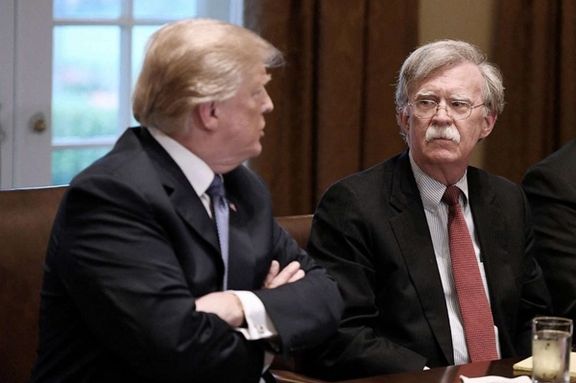
US President Donald Trump's policy on Iran is a muddle lacking any coherent strategy, his former national security advisor John Bolton told Iran International’s Eye for Iran podcast, speaking after Trump pulled his security detail despite an alleged death threat from Tehran.
“This is just typical Trump confusion,” Bolton said. “He doesn't he doesn't have a philosophy. He doesn't do grand strategy. He doesn't pursue policy in the way most people understand those terms. It's a lot of conflicting things that exist simultaneously in his mind.”
On the same day Trump reinstated the so-called maximum pressure campaign of his first term to cut Iran’s oil exports to zero, Trump expressed willingness on Tuesday to negotiate for a "verifiable agreement" to prevent Iran from acquiring nuclear weapons.
During the signing of the sanctions directive, Trump even said he was reluctant to enforce tough measures on Iran.
“This is one that I’m torn about,” he told reporters. “Everybody wants me to sign it. I’ll do that. It’s very tough on Iran.”
Some Iran analysts have viewed Trump’s conflicting statements as part of signature deal making style aimed at keeping adversaries off balance.
“Trump shifts between veiled threats, economic pressure, and conciliation with Iran’s regime. It keeps Tehran on its toes and is part of his style of coercive diplomacy,” wrote Jason Brodsky, the policy director for United Against Nuclear Iran (UANI) on X.
Iran's mixed messaging to Trump
But Bolton believes Trump would do anything to appear a master negotiator.
“I think there's a risk with Trump that he'd negotiate anything with anybody,” said Bolton, "The idea that he believes he's the best dealmaker in the world - he wrote a book called The Art of the Deal - is something that should trouble us because he doesn't really understand fully what's at stake here."
Iran’s leadership has seemingly responded to Trump's overtures with mixed messages.
Iran’s Foreign Minister Abbas Aragchi said on Wednesday that Trump’s demand for a halt on its nuclear ambitions is within reach.
But after Trump floated nuclear talks, Supreme Leader and Ayatollah Ali Khamenei responded with deep skepticism on Friday, saying negotiations with Washington “are not intelligent, wise or honorable."
Iran has still not explained its past secret nuclear activities. A recent report by the New York Times citing unnamed US Intelligence alleges that a secret team of Iran's scientists are exploring faster ways to develop an atomic weapon.
The race to potentially get a nuclear bomb is closer than ever as the country has been ramping up production of fissile material in recent years.
According to an International Atomic Energy Agency (IAEA) report from Dec. 6, Iran’s monthly production of uranium enriched to 60 percent. At that rate, Tehran would likely be able to produce the amount of enriched uranium needed for a bomb in less than a week.
The Zeal for the Deal
Serving as Trump’s national security adviser during his first term has given Bolton a window not only into the president's style but the intimate details of Iran's nuclear progress.
Iran cannot be trusted, argued Bolton, pointing to Tehran and North Korea’s alleged cooperation on the nuclear front.
“We know North Korea has cooperated with Tehran on things like the nuclear reactor in Syria that was destroyed by the Israelis in 2007," said Bolton.
"There's been cooperation in the ballistic missile work because they're both using the same Cold War era Soviet Scud missile technology. The risk that there's that there's cooperation that we have not uncovered, I think is something we need to be concerned about.”
While Bolton question's Trump's appetite for a deal, he also feels that Trump would not be fooled by the Iranian establishment's so-called charm offensive.
Iran's Vice President for Strategic Affairs, Javad Zarif, has again sought to promote a softer image of the Islamic Republic while advocating a path to diplomacy.
In a recent interview with NBC news, President Masoud Pezeshkian said he was willing to negotiate with the European Union and United States, while denying allegations that Iran had sought to kill Trump.
“Iran has never attempted to nor does it plan to assassinate anyone,” Pezeshkian told NBC, just months after the US Department of Justice charged an Afghan national they say was tasked by Iran to kill Trump with an alleged murder-for-hire plot.
The Islamic Republic's outreach is risky and aims only at relief from US-led sanctions, in Bolton's view.
"I think that's one reason they want to try to get another nuclear agreement in place so that they can get off the sanctions that violate the agreement and proceed to nuclear weapons. The idea, obviously, is to have the best of both worlds," said Bolton.
Trump was not deceived by the Iranians during his first term as president, added Bolton, who says he hopes Trump will again not be swayed by Iranian assurances.
German authorities have told Gazelle Sharmahd that the body of her father, Jamshid Sharmahd, has been returned to Germany after his death in an Iranian prison while awaiting execution, she told Iran International.
An autopsy was still required to confirm his identity, she said.
"Once that happens, we can say with certainty that it is my father," she said, adding that the next step would be legal action against Iranian authorities in Germany.
On October 28 last year, Iran's judiciary website Mizan announced that Sharmahd was executed. However, a week later on Nov 5, the judiciary spokesperson Asghar Jahangir said that Sharmahd died of a stroke before his scheduled execution.
Sharmahd was abducted by Iranian agents during a visit to the United Arab Emirates in 2020 and forcibly taken to Iran. In February 2023, the Iranian judiciary sentenced him to death on charges of endangering national security.
Sharmahd was convicted of heading a pro-monarchist group named Tondar accused of a deadly bombing incident that occurred in 2008 at a religious center in Shiraz, killing 14 and injuring 215 more. The accusation, which Sharmahd repeatedly denied, was never substantiated by documented evidence.
Link to Iranian prince's MSC invitation
In her interview with Iran International on Friday, Gazelle Sharmahd linked the return of her father's body to Berlin’s broader dealings with Tehran, pointing to Germany’s role in barring exiled Iranian prince Reza Pahlavi from a Munich Security Conference.
"It is very clear that these two events that happened yesterday are completely connected. Germany has essentially become a servant of the Islamic Republic," she said.
"Orders come from Tehran, and in one day, they say, ‘Yes, we will return your hostage, but we will return him as a corpse.’ On the same day, another order comes, saying, ‘Yes, you can bring him to Germany, but no one is allowed to speak about it.’ And then Reza Pahlavi is removed from the Munich Security Conference," she said.
She accused Berlin of complying with Iran’s demands to suppress opposition voices. "These actions are different methods used to silence the voice of the Iranian people," she said, adding that Germany is helping Iran silence its critics.
In a press conference that few saw coming, US president Donald Trump stood alongside Israeli Prime Minister Benjamin Netanyahu to announce a jaw-dropping plan to take over and rebuild Gaza.
As Trump spoke, Netanyahu’s eyes darted back and forth between Trump and the gathered press, perhaps looking out for the potential fallout.
In a region where diplomacy often plays out at full volume, Trump’s announcement shattered the sonic barrier, leaving both allies and adversaries scrambling to adjust.
The Disrupter
The announcement was just the latest chapter in Trump's long history of disruption.
The man who started his 2016 presidential campaign polling near 1% in the Republican primaries soon bulldozed through the political establishment, knocking out seasoned contenders like Jeb Bush and Ted Cruz.
His unexpected victory over Hillary Clinton that year defied political logic. Even after losing the 2020 election, Trump managed to disrupted the system again, emerging in 2024 as a force that reshaped American politics yet again.
The Real Estate Mogul
Trump’s vision for rebuilding Gaza brings to mind his early triumphs as a real estate mogul, most famously in the Wollman Rink saga.
For six years, New York City bureaucrats had floundered in their attempts to restore the iconic Central Park ice skating rink, wasting millions of dollars.
On May 31, 1986, Trump declared in an interview with The New York Times, “I don’t want my name attached to losers. So far the Wollman Rink has been one of the great losers. I’ll make it a winner.”
He did take over the project shortly after, completing ahead of schedule and under budget. The rink became a thriving tourist attraction and a successful business, much loved by the city's residents.
To this day, Trump’s association with Wollman Rink remains visible — check the rink’s website, and boom, there's Trump’s unmistakable logo.
Much like Wollman Rink, Gaza is seen by many as a project doomed to failure, weighed down by decades of entrenched problems. But it’s precisely the kind of challenge that energizes Trump.
If nothing else, Trump’s announcement alone has already made people rethink what’s possible.
The Dealmaker
Trump’s proposal sparked reactions among Palestinian including those in the United State.
While some in Gaza, driven by their dire circumstances, may like the idea of relocation to other countries, many view the suggestion as an affront to their rights and aspirations
Tump's plan for Gaza has also pitted him against an ensemble of Middle Eastern strongmen: Egypt’s Abdel Fattah el-Sisi, Saudi Arabia’s Mohammed bin Salman, Jordan’s King Abdullah, Netanyahu himself, and Turkey’s Recep Tayyip Erdoğan.
But Trump’s most strategic target is none of the above. It’s the Ayatollah in Iran. The Gaza plan seeks to isolate the Islamic Republic and break the cycle of dysfunction that has plagued the region for decades.
Trump understands that sometimes ideas matter more than execution. By planting this idea in people’s heads, he’s already forced conversations that many considered impossible.
Whether or not the US ever commits to take over and Gaza, the ripple effects of his announcement are undeniable. Suddenly, everyone is talking about Gaza in a way they weren’t before.
The Ayatollah
While Trump’s plan is disruptive, it coincides with another seismic shift: the slow unraveling of the long-held dream of Iran's supreme leader Ali Khamenei: to push America out of the Middle East.
The Islamic Republic’s overreach in its quest for regional dominance has alienated many of its neighbors, at times pushing Arabs and Israelis closer together.
Instead of driving America out, Khamenei now finds itself in the midst of a conversation about a hypothetical take over of Gaza by the United States.
Trump, ever the disruptor, thrives in the chaos he creates. Whether it’s a New York ice rink or the Gaza Strip, he knows how to break through the noise — and make everyone listen.
US House Speaker Mike Johnson on Friday praised US President Donald Trump’s approach to Iran for ramping up pressure on Tehran and its regional allies, as a US senator called for additional sanctions on China over its role in Iran’s missile program.
Speaking alongside Israeli Prime Minister Benjamin Netanyahu, Johnson said Trump and Netanyahu both understand that “peace is secured through strength, not appeasement”.
“This week, (Trump) announced a plan to exert maximum pressure on Iran and its proxies who terrorize the Israeli people and the world,” Johnson said.
Trump on Tuesday signed a directive restoring the so-called maximum pressure policy on Iran of his first term and warned of "catastrophic" consequences if Tehran does not make a deal on its nuclear program.
Following the directive, on Thursday, the United States announced sanctions on networks involved in shipping Iranian oil to China.
The coordinated actions by the Treasury Department and the State Department span multiple countries, including China, India and the United Arab Emirates and involve several vessels linked to Iran's exports.
The new sanctions aim to disrupt Iran’s use of foreign-based brokers and front companies to bypass restrictions and sustain its oil exports, the treasury said.
The Treasury's move focuses on state firm Sepehr Energy, previously designated by the Office of Foreign Assets Control in late 2023 for its alleged ties to Iran’s Ministry of Defense and Armed Forces Logistics.
US Senator Pete Ricketts called for further action, urging the administration to impose costs on China, which he said plays a key role in Iran’s missile program.
"Reimposing maximum pressure on the Iranian regime requires imposing costs on Communist China,” the Republican Senator from Nebraska said in a post on X Friday.
“We encourage the administration to identify and sanction any entities involved in transferring missile propellants to Iran, including any Chinese companies sourcing the propellants and any Chinese ports that allow sanctioned Iranian ships to dock,” Ricketts added.
The German Institute for Global and Area Studies (GIGA) canceled a Berlin event featuring Iranian-American analyst Trita Parsi, citing security concerns after public backlash over his participation.
"Protests against the program have forced us to postpone, as we feel unable to guarantee the security of the event and panel members," GIGA said in a statement.
Parsi is accused by some dissidents and opponents of the Islamic Republic of furthering Tehran's policy narratives in the West.
An Iran International investigation in 2023 linked him and other oft cited analysts as being a part of a grouping formed by the Iranian government with the aim of advancing its perspectives on nuclear talks in the run-up to an international deal in 2015.
GIGA had planned to host the event on Feb. 17 where Parsi was to discuss a recent report on the prospects of multilateralism from the Quincy Institute, where Parsi is the executive vice president.
Following the announcement of Parsi as a speaker, a petition launched on Monday demanding that GIGA rescind his invitation gathered over 4,800 signatures within four days before the event was canceled.
Political activists and opponents of the Islamic Republic had also taken to social media to protest Parsi’s participation, accusing him of lobbying for Tehran and calling for institutions to prevent figures associated with the Iranian government from attending research conferences.
Some protesters had warned they would stage demonstrations outside the event venue if it was not canceled.
"We share the concerns of many protesters about the authoritarian government in Iran and its regional role, but neither the role of Iran or any other specific country was the topic of this event," GIGA added it its statement.
No new date has been announced for the rescheduled event.
This is not the first time Parsi has taken part in GIGA’s events. In 2024, he spoke at two online discussions hosted by the institute, where he addressed topics such as the future of Iran’s allied forces in the Middle East and the Israel-Hamas war.
Swedish broadcaster TV4 recently reported that Parsi’s brother, Rouzbeh Parsi, head of the Middle East program at Sweden’s Foreign Policy Institute, was linked to a network within Iran’s foreign ministry that sought to influence Western policies.
In 2023, a joint investigative report by Iran International and Semafor uncovered thousands of emails from Iranian diplomats, exposing a network of academics and think tank analysts cultivated by Iran's Foreign Ministry to advance Tehran's soft power agenda.
This network, known as the Iran Experts Initiative (IEI), was reportedly directed by the Foreign Ministry in shaping public commentary and media appearances. Members of the IEI held influential positions in Western think tanks and policy institutions, playing a pivotal role in promoting Iran's viewpoints on the global stage.
Dissident Iranian journalist and rights activist Masih Alinejad has been invited to the Munich Security Conference, according to a guest list seen by Iran International.
Alinejad received the invitation in mid-January this year.
She also attended the conference last year, where she met with several European politicians and activists, urged the designation of Iran's Revolutionary Guard (IRGC) as a terrorist organization in Europe and highlighted human rights abuses in Iran.
Iranian exiled prince Reza Pahlavi has also been invited to the conference. Earlier, the Munich Security Conference (MSC) told Iran International that Reza Pahlavi's invitation has been maintained, after the exiled prince accused Germany of interfering to block his participation.
Pahlavi took to X to confirm that the MSC had told him his invitation remains in place.
"This conference, like all public engagements, was always about my compatriots and having their voices heard on the world stage. So I will go with a message from the Iranian people: our fight is not just to free Iran, but the world, from the terror and blackmail of the Islamic Republic," Pahlavi wrote.