After the Chinese government banned sanctioned oil tankers from entering Shandong port—China’s largest terminal for Iranian oil—China’s imports of Iranian crude fell by more than half in January.
Findings by Iran International show that while Iran’s oil sales to China dropped sharply last month, the decline in export revenues began months earlier, coinciding with US sanctions on dozens of tankers carrying Iranian crude.
The Biden administration imposed sanctions on dozens of tankers carrying Iranian oil after Iran’s missile attack on Israel in early October last year. While this initially led to a relative decline in Iranian oil offloading at Chinese ports, the real blow came in early January when China, fearing potential US sanctions under Donald Trump's administration, prohibited sanctioned oil tankers from entering Shandong port.
Iran’s only oil customers are small, independent Chinese refineries, known as "teapots," most of which are based in Shandong, where 90% of Iranian oil cargoes is discharged.
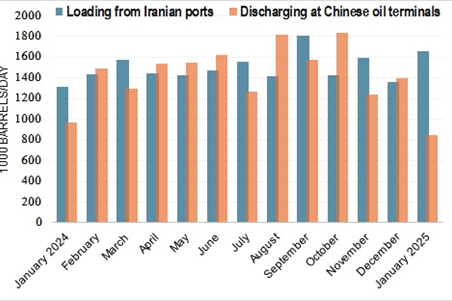
Data from Kpler shows that Iran’s oil deliveries to China fell below 850,000 barrels per day in January, compared to over 1.8 million barrels per day in October last year.
Homayoun Falakshahi, a senior analysis at Kpler told Iran International that Iran’s floating oil reserves have also tripled to 35 million barrels during this period. This explains the discrepancy between Iran’s claims of steady shipments and falling deliveries to China.
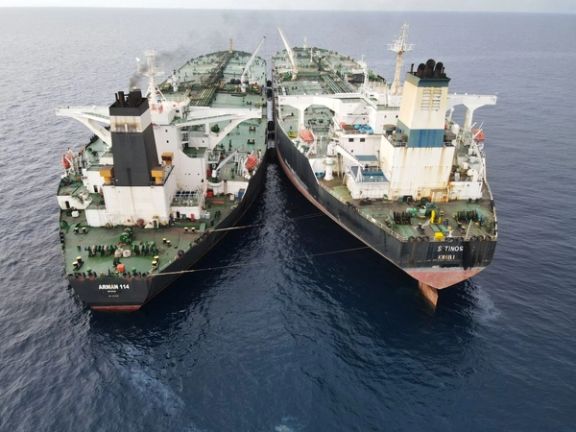
Most tankers are anchored in the waters off Singapore and Malaysia, while the Islamic Republic is seeking non-sanctioned vessels to transport the shipments to Shandong port.
Oil export revenues collapse, far exceeding decline in sales
Although Iran’s oil deliveries volume to China saw a relative drop in late 2024 and experienced a steep plunge in January, Iranian customs data indicates that the sharp decline in the country’s oil revenues began as early as October last year.
From March to September 2024, customs and government officials regularly reported monthly oil revenue figures. However, they had remained silent in since October until Iran’s Abdolnasser Hemmati, the minister of economic affairs recently referenced oil export revenues briefly in a about the country’s foreign trade.
The latest data published by Iran’s Customs Administration indicated that the country had exported $23 billion worth of oil in the first six months of the current Iranian fiscal year (March 21 to September 21). No further official figures were released until Hemmati, citing customs data, announced that Iran’s oil export revenue had reached $30 billion over the past ten months.
In simple terms, Iran’s monthly oil export revenue has plunged from $3.83 billion in the first half of the fiscal year (March-September), to just $1.75 billion over the past four months.
It remains unclear why Iran’s oil revenues have plummeted far more than the drop in crude sales volume to China. However, it appears that latest sanctions by the Biden administration on dozens of tankers in October 2024 have significantly increased the cost of transporting Iranian oil to China, leading to a severe revenue decline.
Moreover, Iran’s oil exports to Syria have also halted in recent months following the collapse of Bashar al-Assad’s government. However, with a daily export volume of only around 60,000 barrels, this alone cannot explain the halving of Iran’s oil revenues over the past four months.
Since October last year, the Iranian rial has also suffered a sharp devaluation, with the US dollar surging from around 600,000 rials to 900,000 rials in the free market—highlighting a major challenge for the Iranian government in meeting the country’s foreign currency needs.
Russia’s Challenge for Iran
In the final days of the Biden administration, Washington sanctioned over 180 oil tankers carrying Russian crude oil. According to Reuters, this move has caused the cost of chartering non-sanctioned tankers for transporting Russian oil to China to increase 3.5-fold. As a result, some previously non-sanctioned vessels that were involved in smuggling Iranian oil have shifted toward Russia, making it even more difficult for Iran to find non-sanctioned tankers to transport its oil to Chinese ports.
In this regard, TankerTrackers reported on February 13 that a very large crude carrier (VLCC), previously engaged in smuggling Iranian oil, is now en route to China with 1.9 million barrels of Russian crude.
Similarly, Kpler has confirmed that several large tankers that previously operated for Iran are now serving Russia.
Meanwhile, Russia’s floating oil storage has surpassed 88 million barrels, and it appears that the country’s logistical challenges won’t be resolved anytime soon.
Negotiating with the Islamic Republic gives Tehran's rulers legitimacy and betrays the people of Iran, exiled journalist and activist Masih Alinejad said on Friday.
"Supporting the Islamic Republic in any form, through negotiations or financial relief, betrays the Iranian people and strengthens a dictatorship that will never reform," she said in a post on X.
"Western policymakers must learn from past mistakes," she added in a shark rebuke to the idea of talks mooted by US President Donald Trump.
"The 2015 nuclear deal (JCPOA) failed because it provided a financial lifeline of billions of dollars to the regime, which it spent on its military and security forces rather than improving the lives of ordinary Iranians," she added.
Trump pulled out of that international deal in 2018 and imposed his so-called "maximum pressure" campaign of sanctions, which he renewed this month.
Still, Trump said he much preferred a deal over Iran's disputed nuclear program over any military action.
Alinejad, who is based in the United States, is a prominent voice advocating for women's rights and the overthrow of Iran's nearly 50-year-old theocracy. Iran's Islamic Revolutionary Guard Corps has plotted to kill her in exile, US law enforcement alleges.
She is in Germany for the Munich Security Conference, the premier annual forum for discussion of international security policy among top leaders.
For the third consecutive year, the organizers have excluded Iranian government representatives.
"I am pleased that Javad Zarif and Abbas Araghchi have been excluded from this conference despite all their efforts," she told Iran International in an interview on the sidelines of the conference.
"This is a positive step, but it is not enough. The West must take more fundamental steps to expel and isolate this terrorist government from all global arenas, which is certainly not an easy task," she added.
In a video post on X the previous night, referring to Iran’s exiled crown prince Reza Pahlavi's exclusion from the event, Alinejad said, "The exclusion of one of the opponents of the Islamic Republic from the Munich Security Conference is unacceptable."
US President Donald Trump aims to decimate Iranian oil sales to further weaken its Mideast adversary's economy, Treasury Secretary Scott Bessent said on Friday.
"We are committed to bringing the Iranians to going back to 100,000 barrels per day of exports, as when Trump left office," Bessent told Fox News in an interview.
"Their economy is quite fragile right now. They have massive inflation, they have the gigantic budget deficit ... if we get them back to the Trump 1.0 levels. I believe that they will be in severe economic distress."
Iran exports around 1.5 million barrels per day (bpd), with China by far the biggest buyer. The so-called "maximum pressure" campaign of US sanctions on Iran starting in 2018 during Trump's first term brought exports to as low as 200,000 bpd.
Trump this month reinstated the so-called "maximum pressure" campaign on Iran from his first term, with the stated aim of driving its oil sales to zero.
Beset said the proceeds from oil sales fund Iran's "terrorist activities around the world" and described purchases by China and India as unacceptable.
The US dollar reached a new high against Iran’s currency this week and the current annual inflation rate has hovered at around 40% since 2019 according to official figures, with prices for food and other essentials rising sharply.
A series of stepped-up US sanctions beginning in October on Russian and Iranian tankers, companies and entities facilitating their oil trade is increasingly hampering oil exports which are the main source of revenue for both countries.
One of two Iranian cargo vessels carrying a chemical from China which is used in missile fuel production has anchored outside the Iranian port of Bandar Abbas, CNN reported Thursday, signaling a potential resurgence of Iran’s missile production capabilities.
The shipment of 1,000 tons of sodium perchlorate was transported from China aboard the Golbon, which departed from Taicang port on January 21. The second vessel, the Jairan, has yet to depart, according to ship tracking data and intelligence sources cited by CNN.
Iran’s missile production infrastructure was severely damaged by Israeli strikes on Oct. 26 2024, which some experts believed would set back its solid propellant production by a year. However, the arrival of this shipment suggests that Iran could be resuming production sooner than anticipated.
Sodium perchlorate is a key precursor for ammonium perchlorate, an essential component in solid rocket propellant used in mid-range ballistic missiles.
Western intelligence sources cited by CNN estimate that the shipment could enable Iran to produce enough solid propellant for up to 260 Kheibar Shekan or 200 Haj Qasem missiles—both capable of reaching targets up to approximately 1,450 kilometers away.
Range of different Iranian missiles
The delivery was purchased for the Self-Sufficiency Jihad Organization (SSJO), a division of the Islamic Revolutionary Guard Corps (IRGC) responsible for missile development, according to CNN’s intelligence sources.
The Golbon and Jairan are operated by the US-sanctioned Islamic Republic of Iran Shipping Lines (IRISL), which Washington and London accuse of facilitating military-related transfers for Tehran.
Iran, lacking an effective air force, has heavily relied on developing short- and medium-range missiles, including a variety of ballistic delivery systems.
The United States and its European allies have long pushed for limits on Tehran's missile program, citing concerns that some missiles could eventually carry nuclear warheads.
Last year, Iran launched ballistic missile attacks on Israel twice, prompting the US and allied air defenses to intercept and shoot down most of the projectiles.
The Financial Times first reported on the shipment in January, citing Western security officials who estimated that the 1,000 tons of sodium perchlorate could yield 960 tons of ammonium perchlorate, producing approximately 1,300 tons of solid propellant—enough to power hundreds of mid-range missiles.
This shipment comes as Iran faces growing regional challenges, including the fall of its ally Bashar al-Assad in Syria and Hezbollah’s setbacks in Lebanon.
US lawmakers are urging European allies to reinstate strict United Nations sanctions on Iran, citing Tehran’s continued violations of the 2015 nuclear deal.
A bipartisan resolution, introduced in both the Senate and the House, calls on the United Kingdom, France, and Germany to trigger the “snapback” mechanism that would restore comprehensive sanctions on Iran through the UN Security Council.
The Senate version of the legislation is being led by Sen. Pete Ricketts (R-Neb.), the number two Republican on the Senate Foreign Relations Committee, with 11 cosponsors.
"Iran is the leading state sponsor of terrorism, and their actions have led to the murder of American servicemembers," Ricketts said. "Iran’s possession of a nuclear weapon would threaten our security and the security of our allies. Snapback sanctions are key to ensuring that President Trump’s maximum pressure campaign is successful."
In the House of Representatives, Reps. Claudia Tenney (R-NY) and Josh Gottheimer (D-NJ) have introduced companion legislation, urging European nations to act before key provisions of the Iran deal expire in October 2025.
"These snapback sanctions would include export controls, travel bans, asset freezes, and other restrictions on those involved in Iranian nuclear and missile activities," a press release shared on Tenney's website read.
The 2015 agreement, formally known as the Joint Comprehensive Plan of Action (JCPOA), had lifted UN, US, and EU sanctions on Iran in exchange for commitments to limit its nuclear program. The Trump administration withdrew the US from the deal in 2018, implementing a "maximum pressure" sanctions effort. In response, Iran later restricted access for international inspectors and resumed uranium enrichment beyond permitted levels.
The US lawmakers' call comes amid reports from the International Atomic Energy Agency (IAEA) that Iran is enriching uranium to 60% purity, just below the 90% threshold for weapons-grade material. IAEA Director Rafael Grossi warned that there is no civilian use for uranium enriched to such a level, raising concerns over Tehran's nuclear intentions.
With the October 2025 deadline looming, US lawmakers are pressing their European counterparts to act swiftly and decisively, warning that failure to reimpose sanctions could further embolden Iran’s nuclear ambitions.
Iranian airlines Mahan Air and Iran Air, the country’s flagship carrier, will not be allowed to fly to Beirut, Lebanese TV network LBCI reported, citing Lebanon’s aviation authorities.
The decision follows allegations by Israel's military that Iran’s IRGC Quds Force uses civilian flights to smuggle money to Hezbollah via Beirut airport.
“The Iranian Quds Force and the terrorist group Hezbollah have been exploiting Beirut International Airport international flights over the past few weeks in an attempt to smuggle funds allocated to arm Hezbollah with the aim of carrying out attacks against the State of Israel,” Israel's military spokesman in Arabic, Avichay Adraee, wrote on X.
The cancellation of flights from Iran to Lebanon was on Thursday confirmed by Saeed Chalondari, CEO of Tehran's Imam Khomeini Airport, who said permission had not been granted for Beirut flights.
Shortly after the cancellations, images surfaces on social media purporting to show Hezbollah supporters in Lebanon blocking the road to Beirut Airport in protest against the refusal to allow Mahan Air to land.
On Monday, Lebanese media reported that incoming flights from Iraq to Beirut are being subject to inspection to prevent the transfer of money to Iran-backed militant group Hezbollah.
Since the ceasefire began in November, both Israel and Lebanon have accused the other of dozens of breaches. Israel has accused Hezbollah of rearming after weeks of bombardment from Israel, targeting key infrastructure and the group’s top leadership.
Lebanon accuses Israel of territorial breaches and ongoing military action which has seen dozens of Lebanese killed amid the ceasefire.
Two weeks ago, Israel accused Iran of sending tens of millions of dollars to Hezbollah through clandestine cash deliveries, lodging formal complaints with the US-led committee overseeing the ceasefire, according to a report in The Wall Street Journal.
Iranian envoys have been flying into Beirut from Tehran with suitcases stuffed with US dollars to finance Hezbollah’s operations. Additionally, Israel has reported that Turkish nationals have been used as couriers to transport funds from Istanbul to Beirut, the report said.