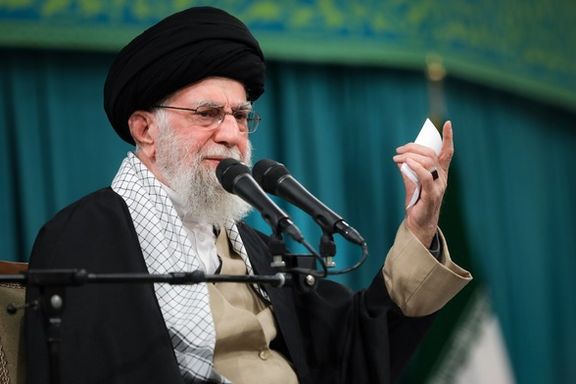
Iran's Supreme Leader Ali Khamenei, 27 October, 2024
The Islamic Republic will not engage in negotiations with "bullying" powers, Supreme Leader Ali Khamenei said in a speech on Saturday, a day after US President Donald Trump sent him a letter requesting nuclear talks.
Khamenei's official website quoted him as saying, "The insistence of some bullying governments on negotiations is not aimed at resolving issues but rather at asserting dominance and imposing their own demands. The Islamic Republic of Iran will certainly not accept their expectations."
President Trump revealed on Friday that he had sent a letter to Khamenei, offering negotiations while warning of military consequences if talks failed. Speaking to Fox Business Network, Trump said, “There are two ways Iran can be handled: militarily or through a deal. I would prefer to make a deal.”
Many in Iran anticipated Khamenei’s response to President Donald Trump’s letter during his speech at a meeting with top government officials on Saturday afternoon. Although the full text of his speech has not yet been released, but apparently he did not directly address Trump's letter.
Khamenei routinely meets with senior government officials, including the president, every Ramadan. This time, however, the announcement came unusually late on Friday evening Tehran time. This followed Trump’s revelation that he had sent Khamenei a letter offering negotiations on Iran's nuclear program while warning that military intervention was the alternative.
Iran has not officially acknowledged receiving Trump’s letter. On Friday, Tehran’s UN mission in New York stated that Iran had “so far” not received any such correspondence.
Speculation over Russian mediation
Highlighting the mediatory role that Russia is playing between Iran and the US, some Iranian media and pundits have speculated that the letter may have been handed to the Iranian ambassador Kazem Jalali during his meeting with the Russian Deputy Foreign Minister Sergei Ryabkov around midday Tehran time on Friday. Tehran and Moscow both said the meeting was to discuss international efforts to resolve Iran's nuclear program and Tehran-Moscow cooperation.
Hardline media predict no response
Trump sent another letter to Khamenei in 2019, after unilaterally withdrawing from the 2015 nuclear deal. Khamenei refused to accept the letter, delivered by then-Japanese Prime Minister Shinzo Abe, and insisted that Trump was untrustworthy.
An editorial in the Revolutionary Guards (IRGC) linked Javan newspaper on Saturday dismissed Trump’s latest letter as “a segment of America’s propaganda puzzle”. Referring to Khamenei’s refusal to accept Trump’s 2019 letter, the editorial suggested that Iran would once again ignore Trump’s message. “Based on the Islamic Republic’s polices; one can predict Iran's response to the letter. There will be no reply, assuming the letter is allowed to be delivered,” the article stated.
The ultra-hardliner Kayhan newspaper similarly referenced the 2019 incident and Khamenei’s rejection of the idea of negotiations with the United States in a speech in February. In its editorial on Saturday, Kayhan argued that Trump’s primary goals was to improve his own image and shift blame for lack of diplomacy onto Iran.
Backchannel diplomacy
Iran and the United States typically communicate through backchannels or intermediaries, such as Oman, which has on several occasions facilitated meetings between officials of the two countries or relayed messages.
Former President Barack Obama reportedly sent multiple letters to Khamenei between 2009 and 2015, discussing topics such as diplomacy, the nuclear deal (JCPOA), and potential cooperation against ISIS. However, there are no reports that Khamenei ever responded in writing to any of these letters.
An Iranian army commander has said the country’s military remains fully prepared for any scenario as diplomatic uncertainty deepens between Iran and the US.
Brigadier General Nozar Nemati, deputy commander of Iran’s Army Ground Forces, said that Iran’s military remains on high alert. “The armed forces, especially the Army, are always ready to defend the ideals of the Islamic Republic and protect the country’s borders,” he told IRNA on Saturday.
His comments came just hours after US President Donald Trump revealed that he had sent a letter to Iran’s Supreme Leader Ali Khamenei, offering negotiations but warning of military consequences if talks fail over Iran's nuclear program.
"I hope you're going to negotiate because if we have to go in militarily, it's going to be a terrible thing for them," Trump told Fox Business Network in a segment of the interview broadcast on Friday. "There are two ways Iran can be handled: militarily or through a deal. I would prefer to make a deal".
Later on Friday, Trump told reporters at the Oval Office, “We are at the final moments with Iran,” adding that “something’s going to happen very soon.”
The letter was swiftly rejected by an official outlet of Iran’s Islamic Revolutionary Guard Corps (IRGC), dismissing it as a psychological operation. Iran’s UN mission in New York also stated it had received no such letter.
Iran’s Foreign Minister Abbas Araghchi, speaking on Friday, had accused Israel of trying to pull the US into a regional war. “It is Israel’s desire to involve other countries in war. It is Israel’s desire to draw America into war,” Araghchi told AFP, warning that US intervention would leave Washington “extremely vulnerable.”
Amid the growing tensions, Nemati reaffirmed Iran’s border security efforts, noting that the country has reinforced its defenses and remains in coordination with IRGC forces. “Our forces are stationed across all critical border areas, working in complete harmony to ensure security,” he said.
Iran has also continued large-scale military drills, including Zolfaghar 1403, which last month showcased its naval, air, and ground combat capabilities.
Trump’s remarks come as his administration escalates its economic pressure campaign on Iran. On Thursday, US Treasury Secretary Scott Bessent outlined a renewed “maximum pressure” strategy aimed at cutting Iran’s oil revenues and further devaluing its currency.
Just over a month into his second term, President Donald Trump has unsurprisingly revived his “maximum pressure” campaign against Iran, while leaving Washington’s relationship with Iraq on uncertain ground.
While the US has been pushing for resumption of oil exports from northern Iraq, talks to resume pumping crude through Turkey have collapsed for the second time in a week, official sources confirmed to Reuters.
The breakdown extends a two-year deadlock that has stalled crude flows from the semi-autonomous Kurdistan region to Turkey’s Ceyhan port.
It also complicates President Trump’s strategy of boosting Iraqi oil supply to keep global prices in check while simultaneously increasing pressure on Iran by cutting off its access to cheap crude.
"There is strong insistence from the US side on ensuring the success of the negotiations by any means," a US government official close to the talks told Reuters.
For Baghdad, however, the standoff is part of a larger dilemma. As Trump revives his "maximum pressure" campaign against Iran, Iraq finds itself squeezed between two powerful allies—Washington and Tehran.
Not only is Iraq under growing pressure to restart oil exports, but also to curb Iran’s access to its financial system and restrict militia activity—moves that, in Washington’s view, would make Iraq more independent from Tehran.
Yet, for Iraq to fully align with US demands is unrealistic, given the 2,500 US troops still stationed in the country and last year’s $430 million in US military and economic aid.
Washington exerts financial pressure on Iran via Iraq
Beyond oil, the US is also tightening its grip on Iraq’s financial system in an effort to sever Tehran’s economic lifelines.
Last week, at the US Treasury’s request, Iraq’s central bank blocked five more private banks from accessing US dollars, according to Reuters. The move is part of a broader campaign to limit Tehran’s access to hard currency.
Additionally, Trump’s administration is reviewing all existing sanctions waivers that allow Iran to benefit economically, including the waiver that permits Iraq to purchase Iranian electricity and gas. If revoked, Iraq would be forced to find alternative energy sources or risk blackouts.
Iraqi leaders, however, appear to be pushing back slightly.
In an interview with Al Hadath, Iraqi Foreign Minister Fouad Hussein acknowledged US pressure but rejected the idea that Baghdad would fully align with Trump’s anti-Iran strategy.
“The United States proposed measures to increase pressure on Iran, but Baghdad is committed to balancing its relationships with both Washington and Tehran,” he said.
For now, there are no signs that Trump will escalate pressure immediately, but his unpredictability leaves Baghdad weighing not just whether it can rein in Iran’s influence—but whether it wants to.
Qatar’s prime minister called for a diplomatic resolution between the United States and Iran over Tehran's nuclear program and argued against military action in an interview with American commentator Tucker Carlson on Friday.
Mohammed bin Abdulrahman Al Thani ruled out support for any military action against Iran even as US President Trump warned that Washington's standoff with Tehran on the issue was in its "final moments" on Friday after warning the country to make a deal or face military action.
“There is no way that Qatar would support any kind of military step in that region,” the senior Qatari royal said. “And we will not give up until we see a diplomatic solution between the US and Iran. This needs to reach an agreement.”
Qatar, a small gas-rich Arab emirate across the Persian Gulf from Iran, is a key go-between mediating many of the regions conflicts.
Doha and its Arab neighbors have been wary of previous US military actions in the region and are keen to avoid disruptions to the key shipping waterway for their vast energy resources.
The senior Qatari royal raised concerns over the lack of clear international oversight on Iran’s nuclear activities. “There is no clear standard for managing those nuclear facilities,” he said. “And those clear standards [are] ensuring that this is a nuclear power plant that will be used for peaceful use.”
Al Thani underscored Qatar’s continuous engagement with Iran on the issue. “We are speaking with the Iranians all the time that we need to work together. We need to work with the IAEA in order to ensure that those standards are followed.”
The prime minister also dismissed reports that Iran is on the verge of developing a nuclear weapon. “There are a lot of news and headlines we see that Iran is close to a nuclear weapon. This is nothing we have ever heard, we have ever seen, or experienced,” he said.
“Even our engagement with the leaders there, even with the Supreme Leader, he said very clearly that he has issued a fatwa or a declaration that Iran will never go for a nuclear bomb,” he added.
The ceasefire between Turkey and an outlawed Kurdish group could further empower Ankara to fill a regional power vacuum after Tehran and its allies were battered in warfare with Israel, foreign relations expert Henri Barkey told Eye for Iran.
“Iran is very alone at the moment” said Barkey, an adjunct senior fellow for Middle East studies at the Council on Foreign Relations in Washington DC.
The push for a resolution to a decades-old insurgency by the Kurdish Workers Party against the Turkish state comes as the Middle East's tectonic plates shift and global alliances are in flux as President Donald Trump cast upends US commitments.
"We have a completely changed strategic situation in the Middle East," said Barkey, "no one at the moment has any dominance in the Middle East and it's up for grabs."
"Iran, for the foreseeable will not be able to do what it used to do in the past," added Barkey.
After 15-months of direct combat and proxy warfare pitting Iran against Israel throughout the region, Tehran has come off worse.
It's main ally Hezbollah in Lebanon took a heavy toll from an Israeli ground invasion and air strikes. Most notably, Iran's oldest ally in Syria's Assad dynasty was toppled by Sunni Islamist rebels closer to Turkey, giving Ankara a new regional ward.
How Turkey benefits from peace with the PKK
The jailed leader of the PKK Abdullah Ocalan called on its members to lay down arms in an address from his island prison near Istanbul on Feb. 27.
That announcement was followed by a ceasefire days later which ended 40 years of armed struggle for a Kurdish homeland.
While President Recep Tayyip Erdogan's rapprochement is largely driven by domestic political considerations to create a new constitution enabling him to run for a third presidential term in 2028, Turkey stands to likely make gains in Northern Iraq, where many PKK fighters are stationed.
Turkey’s gains may be Iran’s losses.
“Both Turkey and Iran would like to influence Iraqi Kurds,” said Barkey.
The Turks and PKK making peace formally will help in those efforts to increase influence.
A protester waves a flag bearing a portrait of Abdullah Ocalan, the leader of the Kurdistan Workers Party jailed in Turkey since 1999.
The relationship between Turkey and Iran Barkey characterized as complex, but one in which there are at least cordial ties and a stable border. Both Islamic nations, however, are revisionist with ideals of grandeur.
Turkey's Minister of Foreign Affairs, Hakan Fidan, said in an interview with Al Jazeera Arabic last month that Iran's foreign policy of relying on militias led to more losses than gains.
Shifting tectonic plates
Recent diplomatic tensions between Tehran and Ankara represents a broader shift in the Middle East.
Add to the mix Turkey reportedly offering to send peacekeepers to Ukraine, contingent on the war ending with Russia – and Israel, striking southern Syria and attempting to increase ties with Syrian Kurds.
Israel says it part of a new policy to demilitarize southern Syria, but the new government led by the Hay'at Tahrir al-Sham (HTS) hardline Islamist group which is close to Turkey has denounced Israel.
“The Israelis also are risking by going too far into trying to punish the Syrians, forcing the Syrians, essentially to look for allies,” said Barkey onEye for Iran.
One ally that Damascus will not reach out to is Tehran, maintaining its anti-Islamic republic stance.
“That’s it,” said Barkey on there being zero chance that Iran could reestablish itself in Syria, while Ankara enjoys a close relationship with the new HTS leaders.
“The Syrians and HTS blame Iran for propping Assad in power all these years, that Assad would not have succeeded in staying in power this long, or even winning the civil war if it wasn't for Iranian support.”
Reports: The offer of Turkish peacekeepers in Ukraine
Turkey is not signaling support of Ukraine by offering up peacekeepers, said Barkey.
Rather it's a chance for Erdogan to appear relevant on the world stage. Iran, on the other, despite its relationship with Russia, is irrelevant.
“Before Iran was a very useful if not a direct instrument of the Russians but a useful actor on the international scene because it created so many problems for the United States and its allies,” said Barkey.
Barkey questioned Iran's ability to send ballistic missiles to Russia after significant blows by Israel to its stockpile.
Meanwhile, Russia has positioned itself as a mediator between Washington and Tehran over potential nuclear talks.
"No leader has done more for Russia than Trump, so Moscow could pressure Iran," Barkey told Eye for Iran.
"It is quite possible that the Russians will put some pressure on the Iranians, whether it's real or make believe," said Barkey.
The changing alliances, new world order and the stable unpredictability of Trump, may further destabilize the Islamic Republic while Turkey gains the upper hand in the region.
You can watch the full episode of Eye for Iran with Henri Barkey, an adjunct senior fellow for Middle East studies at the Council on Foreign Relations, on YouTube or you can listen on Spotify, Apple, Amazon, Castbox or any major podcast platform.
US President Donald Trump warned on Friday that the situation with Iran had reached a critical stage, adding that he preferred to reach a deal over Tehran's nuclear program.
“We can’t let them have a nuclear weapon,” Trump told reporters at the Oval Office. “We are at final moments with Iran. Something’s going to happen very soon."
There’ll be some interesting days ahead, that’s all I can tell you. You know, we’re down to final strokes with Iran,” he added.
He also blamed former US President Joe Biden’s policies for strengthening Tehran financially, saying that Iran was “stone cold broke” during his presidency but had since amassed “$300 billion” in oil revenues.
“Oil builds up fast. It’s a nice, nice living if you have a nice little well. And they do, they have a lot of nice little wells, right?” he said.
Trump again argued that the October 7 Hamas attack on Israel "would have never happened” under his leadership. He also said that Iran had been prepared to reach a deal with the US before the 2020 election but changed course after he lost.
“I think that I would have had a deal within one month after the rigged election of 2020,” he said. “They were all set to make a deal. And then when I lost, they saw this person who’s a stupid person, very stupid person. And they said, let’s not make a deal. And they were right. He took the sanctions off. They became rich under Biden.”
While he said he preferred a diplomatic resolution, he implied that other options remained on the table.
“Hopefully we can have a peace deal. But the other will solve the problem.”
Earlier, Trump said in an interview with Fox Business Network that he had sent a letter to Iran’s Supreme Leader Ali Khamenei offering talks toward a deal on its nuclear program but warned that the alternative was military intervention.
Tehran's UN mission in New York said no letter from Trump has been received.