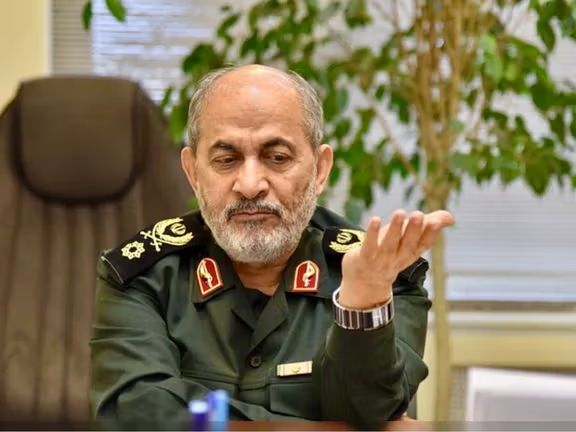
Former Revolutionary Guards Minister Mohsen Rafiqdoost
The recent admission by a former Revolutionary Guards minister about orchestrating the killing of dissidents on European soil in the 1980s and 1990s shed light on Tehran's ruthless suppression of opponents abroad.
In a video interview published by Didehban-e Iran, Mohsen Rafiqdoost, a founding member of the Islamic Revolutionary Guard Corps (IRGC) and its minister from 1980 to 1999, described his role in funding covert operations abroad. His statements indicated that Iran was directly involved in orchestrating political assassinations beyond its borders.
His office in a statement on Monday attributed the shock admissions to his mental debilitation after a brain surgery despite the release of a hitherto unpublished segment of another video interview in 2018 in which Refiqdoost had made similar claims.
Political implications and reactions
Iranian-Canadian political analyst Shahir Sahidsaless speculated in an X post on Tuesday that Rafiqdoost’s admission to multiple assassinations could not have been “accidental, inadvertent, or unplanned.” He suggested that these revelations are tied to Iran-US negotiations and potential sanctions relief. According to Sahidsaless, the IRGC, which holds significant economic power in Iran, benefits from ongoing sanctions and may be attempting to undermine diplomatic efforts by confirming Iran’s involvement in assassinations.
"Rafiqdoost's confessions are deliberately intended to block any possibility of negotiations [with the United States] and the lifting of sanctions," Sahidsaless wrote. He argued that assassinations in the West go beyond Iran's support for militant groups, a longstanding point of contention with Western governments. These admissions, he said, amount to an acknowledgment that the government has directly ordered and carried out killings abroad.
Thus far, European governments and the United States have not responded to these claims. Sahidsaless speculated that the lack of immediate reaction might be due to ongoing diplomatic considerations, including US efforts to engage with Tehran.
Possible diplomatic fallout
Sahidsaless warned that this controversy could lead to intensified international pressure on Iran, including the formal designation of the IRGC as a terrorist organization in Europe and strengthened European support for US-imposed sanctions. If negotiations fail and Iran persists in advancing its nuclear program, these admissions could provide further justification for punitive measures.
Ahmad Bakhshayesh, a conservative member of the Iranian Parliament’s National Security and Foreign Policy Committee, similarly referred to the importance of the timing and impact of Rafiqdoost’s controversial interview. “Foreign [powers] will take this as a true statement,” Bakhshayesh told the Iranian Labour News Agency on Monday.
While acknowledging that Rafiqdoost’s claims might contain some truth, he criticized the general for discussing classified matters at a time when Iran is under maximum pressure. “This is injustice to the country, especially in the current circumstances that we are under maximum pressure.”
Who were the victims?
According to Rafiqdoost, the victims included dissidents as well as high-profile figures such as Shapour Bakhtiar, Iran's last prime minister under the Shah, who was assassinated in Paris in 1991, and General Gholam-Ali Oveissi, the chief commander of the Imperial Iranian Armed Forces, who was killed in Paris in 1984.
“The Basque separatist group in Spain carried out these assassinations for us. We paid them, and they conducted the killings on our behalf,” he said.
Rafiqdoost’s admissions could be potentially used by the families of victims in European courts as evidence if they choose to sue the Islamic Republic as a sponsor of terrorism.
Hossein Mousavian, Iran’s former ambassador to Germany (1990–1997) and a senior nuclear negotiator, tweeted that he was :stunned, amazed and shocked" by the revelations, particularly regarding the killing of dissident artist Fereydun Farrokhzad in Munich in the 1990s. However, Mousavian himself has long faced allegations of involvement in Iran’s overseas assassination campaigns. Opposition groups have accused him of orchestrating over 20 assassinations in Europe, including the notorious Mykonos restaurant killings in Berlin in 1992, where four Kurdish leaders were murdered by Iranian agents.
Less than a week before the start of the new Iranian year, the government has yet to set new wages, which are adjusted annually for tens of millions of public and private sector workers.
The challenge is that last year’s high inflation would require tripling the current minimum monthly wage, which has fallen to the equivalent of $120. However, Iran’s deep economic crisis makes it nearly impossible for government-controlled enterprises to absorb such a sharp increase in labor costs. According to official estimates, a family of three needs at least $400 per month to cover basic necessities.
Even mid-level government employees, such as ministry press secretaries, earn only about $160 a month, a well-informed source in Tehran told Iran International. While this amount has greater purchasing power in Iran than in the US or Europe, it still represents a poverty-level income.
A meeting between government, business, and labor representatives is scheduled for March 11, but sources told local media that no decision is expected. With Nowruz beginning on March 20 and food prices soaring, many Iranians are struggling to afford holiday shopping.
An economic analyst in Tehran told Iran International that retail markets are stagnant as people cannot afford New Year shopping. Basic food prices have risen 30 to 100 percent since early January, driven by the Iranian currency losing half its value against the US dollar in recent months. This depreciation directly impacts the cost of food imports as well as machinery, fertilizers, and other agricultural necessities.
Meanwhile, the Trump administration is tightening economic sanctions, threatening to further reduce Iran’s oil exports—the backbone of its centrally controlled economy. Washington is demanding that Tehran abandon its nuclear program, but Supreme Leader Ali Khamenei has so far rejected negotiations on President Donald Trump’s terms.
By comparison, minimum wages in neighboring Iraq are twice as high as in Iran, while in Turkey, the minimum wage is nearly seven times greater, reaching $8,000 per year. With the current exchange rate, the average salary in Iran does not exceed $1,500 annually.
This growing financial hardship has sparked concerns of social unrest, similar to the mass protests of 2019 and 2022. Warnings about the risk of an uprising are appearing on social media and even in state-controlled media, as poverty spreads to the lower middle class.
Before the 1979 revolution, Iran’s urban middle class enjoyed rising living standards, with increasing access to homeownership, cars, and foreign travel. Today, economic pressures are reversing those gains, fueling discontent across the country.
Sweden faces an escalating security threat from Iran, which has intensified its intelligence activities and use of criminal networks within the country, the Swedish Security Police (SAPO) warned on Tuesday.
In its annual threat assessment, SAPO highlighted Iran’s efforts to monitor and suppress opposition movements abroad, exploit vulnerabilities within the Iranian diaspora, and acquire sensitive technology to circumvent sanctions.
"Iran's primary objective is to secure and strengthen its regime, closely linked to protecting the country from perceived external threats and circumventing sanctions," SAPO's statement said.
"These priorities influence the security-threatening activities carried out by Iranian security and intelligence services against Sweden."
SAPO reported increased Iranian activities in Sweden over the past year, including efforts to pressure opposition figures and their families.
Iranian intelligence services have reportedly used criminal networks to conduct violent acts targeting Israeli interests and groups perceived as threats.
"The use of criminal actors is not new or unique to Iran but has occurred to a greater extent over the past year, with notably younger actors involved during 2024," SAPO added.
Sweden has also been a target for Iran’s attempts to acquire advanced technology and knowledge to bypass international sanctions. SAPO warned that Iran is actively seeking dual-use products, including those that could support its weapons programs.
"Iran is heavily focused on acquiring knowledge and products for the development of weapons of mass destruction or delivery systems," the report said. "This acquisition spans several industries. For instance, machinery intended for civilian use can also be employed in the development of such weapons."
The warning comes amid heightened tensions between Sweden and Iran. Last month, the Swedish government accused Tehran of using a Shiite Muslim mosque in Stockholm to spy on Sweden and the Iranian diaspora there.
"There is a tangible risk that the security situation can deteriorate further and that can occur in a way that is hard to predict," said Charlotte von Essen, head of the security police.
SAPO’s assessment underscores the growing threat posed by Iranian intelligence activities and foreign influence operations in Sweden, as authorities work to counter hybrid threats from hostile state actors which also include Russia and China.
Last year, the relationship between the two countries reached a diplomatic crisis forcing a prisoner swap of Swedish diplomat Johan Floderus and a second Swedish citizen, Saeed Azizi, for an Iranian convicted in Stockholm of committing war crimes over his part in 1988 mass executions in the Islamic Republic.
While Iran denies receiving a letter from President Donald Trump demanding nuclear talks, statements by Supreme Leader Ali Khamenei, the foreign ministry and Iran's UN ambassador Saeed Iravani appear to be responses to it.
The officials' statements suggest that the letter or message contained a mix of carrots and sticks. They also indicate that Iran may be open to Trump’s proposals, provided the talks remain strictly focused on the nuclear issue, as Iravani stated.
Iravani further suggested that Iran can take part in talks with America only to convince Washington that its nuclear program is peaceful.
At another level, media, commentators, and politicians seem perplexed by Trump’s approach. As political analyst Ali Bigdeli told the pro-reform daily Arman Melli, “Trump’s statements about Iran have confused everyone.” He added that “Trump disregards diplomatic protocols and seeks to stage a show of power.”
“He wants to overwhelm the other side, leaving them uncertain about how to respond,” Bigdeli said. Given this, he suggested that Iran might be better off using European mediators rather than engaging with Trump directly.
At the same time, in a commentary in the reformist daily Shargh, Iran's former ambassador to Riyadh Mohammad Hosseini has predicted that "the possibility of a military attack by the United States and Israel on Iran is serious and highly likely in the near future."
Hosseini outlined 10 reasons and indicators suggesting that an attack on Iran is imminent. These include the shared Israeli and US assessment of a shifting balance of power in the region, Iran’s declining ability to respond to threats, and officials in both countries recognizing the weakening ties between the Iranian people and their government.
Hosseini added that Israel and the United States recognize Iran has accelerated uranium enrichment to weaponization levels. He also noted that both countries are aware of Iran’s loss of strategic depth in the region and the likelihood that Russia could use Iran as a bargaining chip in negotiations over Ukraine.
Ali Hossein Ghazizadeh, London-based Iran International analyst, said that Trump understands Iranians will not agree to negotiations under pressure, yet he insists on talks solely to demonstrate that Iran is unwilling to engage.
Meanwhile, former diplomat Fereydoun Majlesi told local media that IAEA Chief Rafael Grossi is concerned about the possible weaponization of Tehran's nuclear program. Another concern for the West is nuclear proliferation in the region as a result of regional countries' rivalry with Iran.
He noted that the United Arab Emirates has already built a nuclear power plant, and Turkey and Saudi Arabia may also be encouraged to develop their own nuclear programs. Majlesi added that Grossi recognizes Iran's ability to effectively circumvent US economic sanctions, making it less likely to abandon enrichment. He quoted Grossi as saying that Iran’s nuclear program has gained new momentum since the US withdrew from the 2015 nuclear deal.
Former chairman of the Iranian parliament's foreign relations committee, Heshmatollah Falahatpisheh, told the conservative Nameh News website that Trump's threats against Iran are mere "bluffs" and that now is not the right time for Iran to negotiate with him.
State TV commentator Hassan Hanizadeh also dismissed Trump's "war or negotiation" rhetoric as "empty threats," arguing that Trump has no real intention of negotiating with Iran.
Meanwhile, Iran's former chief diplomat in London, Jalal Sadatian, told Nameh News that while Trump might soften his stance on Iran’s nuclear program, he is unlikely to change his broader approach to dealing with Iran.
A top former Revolutionary Guards commander has revealed that revenue from arms deals helped finance Iran's assassinations of political opponents overseas, in a shock admission which his office swiftly retracted as a sign of debilitation after brain surgery.
Mohsen Rafiqdoost, a former bodyguard of the Islamic Republic's founder Ayatollah Ruhollah Khomeini and an architect of the Islamic Revolutionary Guard Corps (IRGC), made the comments in a recently surfaced video interview.
A bank account in Frankfurt was used to channel money for covert operations abroad, Rafiqdoost said, including for the killing of a former Iranian military commander General Gholam-Ali Oveisi in Paris in 1984.
“We had an account under the name KM,” he said in the video published Monday by Abdollah Abdi, the editor of independent outlet Abdi Media. “The money in that account was used for actions outside the country that could not be done with ordinary funds.”
He also linked the account to proceeds from arms sales during the Iran-Iraq war, recalling how a weapons purchase in Spain left a surplus of $10,000. “That was the beginning of moving funds into that account,” he said.
Mohsen Rafiqdoust
Rafiqdoost’s statements follow remarks he made on Saturday to the Iranian site Didban Iran, where he said he oversaw multiple assassination operations targeting dissidents. He named several figures killed in Europe, including Shapour Bakhtiar, the last prime minister under the Shah, and Fereydoun Farrokhzad, a singer and outspoken critic of the Islamic Republic.
“The Basque separatist group in Spain carried out these assassinations for us. We paid them, and they conducted the killings on our behalf,” he said.
Rafiqdoost's office disavowed the interviews, chalking the reported comments up to mental deficiencies after surgery and media distortions.
"Mr. Rafiqdoost underwent brain surgery in past years, which resulted in extensive complications and may have affected his recollection of certain memories and names. Therefore, his statements are not legally or historically reliable," it said in a statement.
"Media judgments regarding his statements are inaccurate. Only the official narrative of the events in question can be considered valid."
Khomeini critic silenced
US-based former Iranian ambassador to Germany Hossein Mousavian expressed surprise at the remarks, saying in a post on X that he had believed for decades that Farrokhzad’s killing was the work of Iranian opposition groups.
“After 32 years, for the first time, I learned the facts of the case from Mr. Rafiqdoust’s interview,” added Mousavian, now at Princeton University, New Jersey.
Farrokhzad was murdered in 1992 in Bonn, Germany. At the time, Iranian officials denied involvement, while reports suggested a professional-style hit.
German police found Farrokhzad's body in the kitchen of his apartment. A switchblade had been driven into his right shoulder from behind, and a longer kitchen knife was lodged in his mouth.
Singer and outspoken critic of the Islamic Republic, Fereydoun Farrokhzad
In exile, Farrokhzad had become a fierce and outspoken critic of Iran's clerical rulers. He repeatedly mocked Khomeini, portraying him as an illiterate, superstitious figure with sexual fixations in his writings.
Farrokhzad’s murder is often considered part of the so-called Chain Murders in Iran—an series of assassinations that saw numerous dissident intellectuals and activists either disappear or be killed between 1986 and 1998.
The Islamic Republic’s Ministry of Intelligence later admitted responsibility for some of the killings.
Mousavian said the Iranian embassy had even facilitated talks for Farrokhzad’s possible return to Iran.
“My colleagues and I at the embassy worked diligently for several months with full capacity, sincerity, and conviction to obtain the approval of the relevant Iranian authorities for his return and security,” he wrote.
Human rights organizations have long accused Tehran of orchestrating assassinations abroad. In a report published in December, the Abdorrahman Boroumand Center detailed four decades of extrajudicial killings tied to the Islamic Republic.
The Iranian government has just three months to finally implement Article 64 of the constitution which mandates an increase in the number of parliamentary seats, forcing better representation for Iranians in underrepresented regions.
The directive requires the government to facilitate the addition of 40 new representatives from densely populated regions to the Islamic Consultative Assembly (Majlis or Majles).
The plan, approved by the parliament last month and ratified by the Guardian Council, aims to address significant demographic shifts that have occurred since the last adjustment to the parliament composition in 1999.
The changes have resulted in an unequal distribution of representation, with some sparsely populated districts having the same number of representatives as significantly larger ones.
Article 64 of the constitution stipulates that 20 representatives should be added to the parliament every 10 years. However, no adjustments have been made since 1999, despite four previous attempts to increase the number of seats, which were blocked by government opposition.
Unnamed experts cited by Fars news agency argue the current seat distribution is severely imbalanced, pointing to districts with 30,000 residents having equal representation to those with millions. For example, Alborz province, with 4.2 million residents, has only three representatives.
Supporters of the plan believe its implementation will strengthen the parliament and rectify social injustices caused by the current disparities in representation.