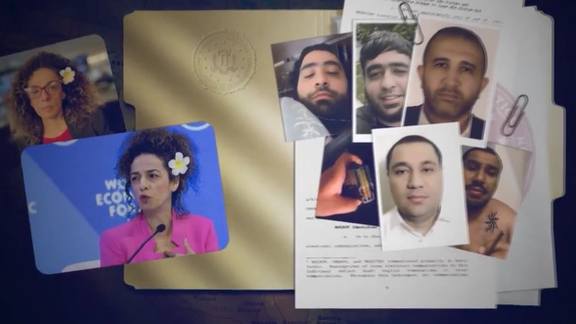
The mother of Khalid Mehdiyev, the gunman who tried to kill Iranian-American journalist Masih Alinejad, delivered emotional testimony in court Friday identifying her son's alleged co-conspirator Polad Omarov as the man who ordered the hit job.
Appearing visibly shaken in court, Ms. Mehdiyeva recounted a video phone call Omarov made to her and her husband sometime in 2022.
“My husband was praying. We had a caller, and I covered my head. We exchanged hellos," said Ms. Mehdiyeva, "He said, ‘My name is Polad. Where is your son? I sent him to do a job for me."
He allegedly told Ms. Mehdiyeva that her son had failed at the task he ordered him to do. Mehdiyev's attempt to murder Alinejad was unsuccessful. Because of the botched murder attempt, Omarov told Ms. Mehdiyeva her son put all of them in trouble.
Once Alinejad spotted Khalid, who was lurking around her home in Brooklyn, peering into her window and wandering around her, she reported him to the FBI. He had been stalking Alinejad's every move, even sleeping in his vehicle outside her home for at least two days.
Threats from the Russian Underworld
Just hours after Omarov's call, at 3 a.m., an unfamiliar American number appeared on Ms. Mehdiyeva's phone. It was Khalid. Unbeknownst to her and Omarov, Khalid was in jail.
Ms. Mehdiyeva's voice trembled as she looked her son's alleged co-conspirator in the eye.
“He (Omarov) is the one who devastated our lives,” said Ms. Mehdiyeva, speaking in Azeri through an interpreter.
The threats did not stop after that call.
Ms. Mehdiyeva testified that members of the Russian mafia group that her son belonged to —Vor Zakone, also known as "Thieves-in-Law"— continued to harass her.
Fearing for their safety, the family fled Baku for the countryside.
Eventually, with assistance from the FBI, they were brought to the United States.
Cross Examination
During cross-examination, the defense sought to challenge Ms. Mehdiyeva’s credibility.
The UN rights body has ruled the detention of a top Iranian rapper and activist arbitrary and contrary to international law in a response to a petition submitted by rights groups and international lawyers on his behalf.
Iranian authorities subjected Toomaj Salehi, who was imprisoned for more than 753 days, to judicial harassment for his music and activism, the Working Group on Arbitrary Detention wrote in an opinion issued on Thursday.
The group concluded that his prosecution stemmed from his political opinions and artistic expression, particularly his support for the nationwide Woman Life Freedom protests sparked by the death in custody of Mahsa Jina Amini in September 2022.
Salehi was sentenced to death for his songs in support of the protests after being charged with “corruption on earth” but the verdict was later overturned, and he was released on December 1, 2024.
“This is not just about Toomaj but it is about a nation’s struggle against fear. This opinion by the UNWGAD is an important step towards that goal,” said Salehi’s cousin, Arezou Eghbali Babadi in a press release on Friday.
Caoilfhionn Gallagher KC, international counsel for Salehi’s family, emphasized the significance of the ruling, saying that it underscored the need to protect him from further arbitrary detention.
Claudia Bennett of the Human Rights Foundation said the case illustrated Iran’s intolerance of criticism and warned that the international community would hold it accountable for human rights abuses.
Turkish security forces arrested five people accused of spying for Iranian intelligence in a coordinated operation across Istanbul, Antalya, and Mersin, the Istanbul Chief Public Prosecutor’s Office said on Friday.
The suspects, three Turkish citizens and two foreign nationals, had allegedly been involved in "military and political espionage," Turkey’s state-run Anadolu Agency reported citing the prosecutor.
The operation was carried out as part of an investigation by the prosecutor’s office and Turkey’s National Intelligence Organization (MIT).
The report added that the individuals had contacted members of Iran’s Revolutionary Guards (IRGC) intelligence, obtained information about military bases and important regions in Turkey and critical points abroad, and transferred it to Iranian intelligence.
Relations between Ankara and Tehran have grown frostier after Iran's oldest Arab ally the Assad dynasty was swept from Syria by rebels close to Turkey last year.
Turkish Foreign Minister Hakan Fidan this month hit out at Iran's reliance on regional militias as dangerous and called for a policy shift, stoking Iran's ire.
He also suggested that "if you are attempting to destabilize a third country, other nations may reciprocate by supporting groups within your own borders."
Arrest warrants for the suspects were issued, and they were apprehended in operations carried out in Istanbul, Antalya, and Mersin provinces, the agency reported.
In recent years, Turkey has experienced several incidents involving alleged espionage activities linked to Iran.
Last month, Israeli authorities sentenced a businessman to serve a 12 years in prison for spying for Iran and plotting to assassinate the country's leaders including the country’s PM and defense chief.
The man who was based in Turkey, but hailed from northern Israel, had entered Iran and met with agents who had instructed him to carry out operations in Israel.
In September 2022, Istanbul police arrested four Iranian citizens on suspicion of espionage, forgery of official documents, and human trafficking. The suspects were found in possession of numerous stolen passports, identification documents and espionage equipment.
In June 2022, Turkish authorities, in collaboration with Israeli intelligence agency Mossad, foiled an alleged Iranian plot to kidnap and assassinate Israeli tourists in Istanbul. The operation led to the detention of several Iranian and Turkish operatives Ankara accused of being linked to the IRGC.
The United States is undermining its diplomatic overtures to Iran by making threats, a senior Iranian cleric said on Friday, a week after US President Donald Trump's demanded Iran strike a nuclear deal or face military attack.
The remarks represent another strong official rejection by the theocracy of Trump's bid for a renewed nuclear deal.
"Today, you can clearly and explicitly see threats coming from US leaders. In practice, they issue threats, while in words and writing, they call for negotiations, two completely contradictory behaviors," Tehran's Friday Prayer Imam Mohammad-Hassan Abutorabi-Fard told worshippers during his weekly sermon.
Citing Iran's perceived resilience despite punishing military blows on Iran and its allies, Abutorabi-Fard said armed affiliates of Iran in the region remained strong.
"Today, Iraq, Palestine, Yemen, Lebanon, and the Hezbollah-led resistance axis stand as symbols of dignity in the face of infidels. This great achievement is the result of the Islamic Revolution, which has brought major victories for the Muslim community."
Khamenei has not publicly responded to the letter but has repeatedly voiced skepticism over US intentions, arguing that past experience shows Washington cannot be trusted. In his speech this week, he said Washington's calls for negotiations are a tactic to deceive global public opinion.
"The US President saying 'we are ready to negotiate with Iran' and calling for negotiations is meant to deceive global public opinion," Khamenei said. He also questioned the value of engaging with the US, recalling Trump's 2018 withdrawal from the 2015 nuclear deal.
"We sat down and negotiated for several years, and this very person took the completed, finalized, and signed agreement off the table and tore it up," Khamenei added.
Despite rejecting threats, Iran has left the door open for indirect diplomacy. Foreign Minister Abbas Araghchi on Thursday hinted at the possibility of engaging through Oman, though officials have maintained that Tehran will not negotiate under pressure.
"We reject talks under threats. Iran's dignity does not allow for submission," Araghchi said in an earlier statement.
US-Iran tensions have been steadily escalating. Trump signaled last week that the standoff has reached a crescendo, saying, "There are two ways Iran can be handled: militarily or through a deal. I would prefer to make a deal."
Khamenei said Iran would retaliate if attacked. "The United States is threatening militarization. This threat is irrational because war is not a one-sided blow; Iran is capable of retaliating and will certainly do so," he said.
As the standoff mounts, the UN's nuclear watchdog recently reported a sharp increase in Iran's stockpile of highly enriched uranium, though Tehran denies any intention of developing nuclear weapons. "If the Islamic Republic intended to build nuclear weapons, the United States would not be able to stop it," Khamenei added.
Foreign ministers from the G7 grouping of wealthy democracies criticized Iran for destabilizing the Middle East and urged it to resume negotiations over its nuclear program, according to a draft statement cited by Reuters.
The top diplomats were gathered in La Malbaie, Canada, to discuss a common strategy as the return of President Donald Trump has upended the relationship of de facto G7 leader the United States with its peers.
Their statement cited by Reuters said Iran was a principal driver of instability in the Middle East and urged Tehran to resolve the standoff over its disputed nuclear program through diplomacy.
The G7 nations include the United States, Britain, France, Canada, Germany, Italy and Japan. The final draft of the foreign ministers' statement awaits formal approval ahead of expected publication later on Friday.
Iran denies seeking a nuclear weapon, but the UN's nuclear watchdog last week pointed to a sharp rise in Tehran's stockpile of highly enriched uranium.
The United States and European Union said Iran's activities serve no credible civilian purpose and demanded it immediately desist.
Iran’s Supreme Leader on Wednesday said President Trump's past withdrawal from a nuclear deal renders diplomacy with him pointless now and vowed harsh retaliation to any attack by the United States or its allies.
Iran is intensifying its crackdown on women, minorities, and activists using drones, facial recognition, and tracking apps to monitor and suppress dissent, a new UN report reveals.
The UN's Independent International Fact-Finding Mission on the Islamic Republic of Iran revealed that Tehran has significantly expanded its efforts to control and restrict the rights of women and girls.
The report highlights how the government is leveraging technology to enforce strict hijab laws and criminalize activism, portraying these efforts as part of a broader strategy to stifle human rights advocacy.
“These repressive measures reflect the State’s ongoing persecutory conduct aimed at suppressing women and girls’ human rights and their right to equality,” the report published on Friday said.
Despite pre-election promises by President Masoud Pezeshkian to ease the enforcement of strict hijab laws, the government has increased its policing since last year. The Noor Plan has intensified surveillance and criminal prosecution of women who defy mandatory hijab rules, according to the report.
In April 2024, Iranian authorities deployed aerial drones in Tehran and southern Iran to monitor women's hijab compliance in public spaces. Additionally, facial recognition software was installed at the entrance of Amirkabir University in Tehran to track female students' adherence to hijab regulations.
A key element of the crackdown is the Nazer mobile application. Vetted individuals and police officers can use this app to report women suspected of hijab non-compliance in private vehicles, taxis, ambulances, and public transport. The app allows users to log the location, date, and time of incidents and submit vehicle license plate information. This triggers an automated message warning the vehicle's owner about the alleged violation and threatening impoundment for repeated offenses.
Sara Hossain, Chair of the Fact-Finding Mission, said, “For two years, Iran has refused to adequately acknowledge the demands for equality and justice that fueled the protests in 2022. The criminalization, surveillance, and continued repression of protesters, families of victims, and survivors, in particular women and girls, is deeply worrying.”
Women hold signs during a protest against the Islamic regime of Iran and following the death of Mahsa Amini, at the Angel of Independence monument in Mexico City, Mexico October 1, 2022.
Women human rights defenders and activists continue to face severe penalties, including fines, long prison sentences, and even the death penalty for peaceful activism. The report noted that at least 11 men and three women remain at risk of execution, amid concerns about torture, forced confessions, and unfair trials.
“The Government’s policies have denied victims in Iran the right to truth, justice, and reparations,” said Viviana Krsticevic, an expert member of the Mission. “Given the gravity of the violations in the country and the serious risk of recurring violence against those who express dissent or challenge the State and its policies, it is crucial for the Human Rights Council to continue supporting the victims in their search for redress and non-repetition.”
The report also noted how the Iranian government has expanded surveillance beyond its borders. Iranian activists and journalists abroad have been targeted through online harassment and threats.
Victims of torture and families of those killed in the protests have been intimidated to remain silent. Those who speak out, including human rights defenders, lawyers, and journalists, face threats and persecution. Many have been forced to flee the country.
Shaheen Sardar Ali, another expert member of the Mission, said, “It is imperative that comprehensive accountability measures also continue to be pursued outside the country.”
The Mission collected over 38,000 evidence items and interviewed 285 victims and witnesses. The report reaffirmed earlier findings of gross human rights violations and crimes against humanity, including rape, torture, and deaths falsely labeled as suicides.
Security forces showed "little or no distinction" between adult and child protesters, subjecting children to the same brutal treatment, including torture and unfair trials.
Ethnic and religious minorities, including Kurds, Baluchis, and LGBTQ+ individuals, were particularly targeted during the protests. The Mission also investigated the roles of Iran’s key state entities, including the Revolutionary Guard, police, morality police, and judiciary, finding these bodies responsible for widespread human rights violations.
The Mission compiled a confidential list of alleged perpetrators, which it will submit to the UN High Commissioner for Human Rights.
This report follows another released on Thursday by UN Special Rapporteur Mai Sato, which condemned Iran for executing over 900 people in 2024, the highest number since 2015. Sato said, "Iran remains the highest per capita user of the death penalty globally."
Sato also criticized Iran’s new hijab law, which imposes harsh penalties, including up to 15 years in prison for women deemed non-compliant. "This law marks an unprecedented expansion of state control over women’s bodies and personal choices," she said.
The Fact-Finding Mission will present its full report to the Human Rights Council in Geneva on Monday, March 18. The Mission urged the Council to appoint a new independent body to continue investigating human rights violations in Iran.
They questioned whether she had sought a U.S. green card prior to her arrival. She denied it, insisting she was only in the country due to threats in Azerbaijan.
“Do you remember telling your son on a recorded jail call that you would travel to Macedonia to enter the U.S.?” the defense asked.
“I don’t remember that,” she replied.
The defense further revealed that the U.S. government had provided financial support to the Mehdiyev family, including securing employment for her husband and eldest son.
Ms. Mehdiyeva had also worked as a nanny before quitting to attend the trial, leaving her in debt to her employer for $4,000 in prepaid wages. In total, the government provided the family with $31,120 in support.
Who are Vor Zakone?
The Russian criminal underworld developed in the gulags or the prisons of the Soviet Union and globalized in the post- Soviet world. The Vor Zakone evolved into a transnational organization with operations in 15 former Soviet republics and the countries of the former Eastern bloc.
Dr. Louise Isobel Shelley, an academic who specializes in terrorism, corruption, and transnational crime testified on behalf of the state as expert in court Friday. Shelley often consults with governments around the world about the Russian mafia.
Shelley said members of the Russian mafia carry out assassinations on behalf of state actors and are also involved in kidnappings, extortion, and money laundering.
Her testimony significant to the state which alleges the Iranian government-sponsored the murder-for-hire plot.
The plot to assassinate Alinejad was allegedly orchestrated as part of Iran’s campaign to silence one of its most vocal critics, according to Assistant U.S. Attorney Jacob Gutwillig.
As the trial continues, the chilling testimonies shed light on the dangerous intersection of organized crime and states, a web reportedly stretching from Tehran to Baku to the streets of New York City.