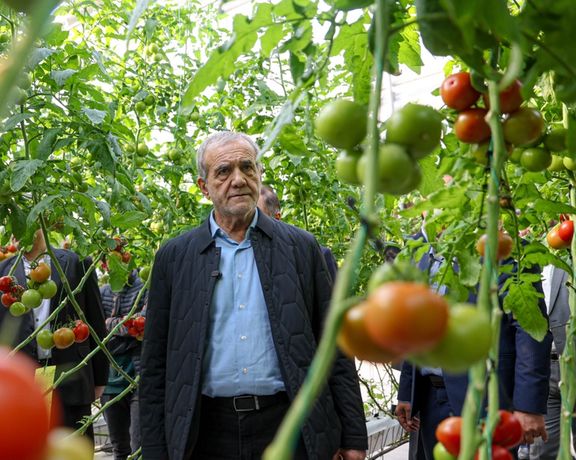
President Masoud Pezeshkian visiting a farm in March 2025.
During his June 2024 election campaign and his first six months in office, Iran's President Masoud Pezeshkian positioned himself as the "good cop" in the country's familiar good cop/bad cop dynamic between reformists and hardliners.
He embraced this role both domestically—advocating for civil rights, gender equality, and press freedom—and in foreign policy, where he emphasized maintaining good relations with all countries and resolving Iran’s nuclear dispute with the West as a path to economic recovery.
However, on February 7, Pezeshkian abruptly shifted from a pragmatic politician to a staunch hardliner with strong ideological overtones following a routine anti-US and anti-negotiation speech by Supreme Leader Ali Khamenei. Just weeks later, in an uncharacteristically heated tone, he went so far as to declare that he had no desire to engage with US President Donald Trump.
Whether Pezeshkian's "good cop" role was genuine or not, it may have served Khamenei’s interests at a time when he faced pressure to engage with the Trump administration. However, as Pezeshkian loses credibility among Reformists, hardliners remain hesitant to fully embrace him. His occasional expressions of regret—admitting shame over unfulfilled promises in domestic politics—have only deepened his political isolation.
The Supreme Leader has found a new "good cop" in Foreign Minister Abbas Araghchi, who was permitted to propose indirect negotiations with the United States in Muscat—despite Khamenei’s firm rejection of talks with Trump.
Recently, an Iranian commentator abroad half-jokingly categorized Iranian politicians into three groups based on their stance on nuclear negotiations with the United States. The first group consists of hardliners, led by ultraconservative Saeed Jalili, who oppose talks. The second includes moderates from centrist parties, such as former President Hassan Rouhani, who advocate for negotiations. The third group, he said, is led by President Pezeshkian—who, regardless of his stance, has no real influence over the nuclear issue.
Pezeshkian appears to lack clear solutions on other pressing issues as well. Addressing Iran’s soaring prices, he recently admitted, "I have no idea whom to blame for the uncontrolled rising prices." His remark drew sharp criticism on social media, where many reminded him that, as president, he is ultimately responsible for the government's handling of the crisis.
The Khabar Online website reported Friday that Pezeshkian has failed to deliver on four key promises, along with nearly all his other commitments. The report highlighted public dissatisfaction over continued social media censorship and his unresolved negotiations with hardliners on the strict compulsory hijab law. While enforcement has been temporarily suspended, the government has neither scrapped the bill nor convinced hardliners to stop harassing women and politicians.
The website also pointed to two major economic issues affecting Iranians' livelihoods that Pezeshkian has failed to address. He has been unable to persuade the Expediency Council to approve the FATF protocols, which could ease barriers to international trade and banking. More importantly, his promise to lift sanctions—seen as key to reviving the economy—remains unfulfilled. Now, he is not even willing to discuss the issue with the US, declaring, "Do whatever the hell you can do. I am not going to talk with you."
His critics—including ultraconservative Paydari Party members determined to unseat him, the so-called neocons aligned with Parliament Speaker Mohammad Bagher Ghalibaf, and hardline zealots who attack him at every turn for not enforcing strict Islamic hijab rules—are relentless in their pressure.
Pezeshkian’s vice president for legal affairs, Majid Ansari, blamed Paydari for the challenges the president is facing. "They have not shut down their campaigns and are still working to tarnish Pezeshkian's image," he told the media last week.
Pezeshkian is no longer the "good cop," yet no one sees him as the "bad cop" either. As one commentator put it on a Persian TV, perhaps he is no cop at all. Still, some Iranians believe in his good intentions. Despite his limited social backing, like the protagonist in the 1950s classic cartoon Deputy Dawg, he may have "a badge of tin," but he certainly has "a heart of gold."
The Islamic Republic’s crackdown over the years has gradually turned the ancient festival of lighting bonfires before Nowruz into a night of youth defying authorities.
Despite its evolving nature, the festival of Charshanbeh Suri remains a deeply rooted cultural event—one that continues to reflect both the resilience of tradition and the defiance of Iran’s youth.
Traditional Charshanbeh Suri celebrations
Charshanbeh Suri is celebrated on the eve of the last Wednesday before Nowrouz (Norouz), the Iranian New Year, which falls on the Spring Equinox (March 20 or 21). Chaharshanbeh means Wednesday and hence the name of the festival.
People normally light seven small brushwood bonfires in the streets or courtyards of their homes after sunset, jumping over them while chanting “May your red glow be mine and my pallor yours!”
Customs vary across the country but often include door-to-door spoon-banging in disguise for treats, fortune-telling, candle lighting, and traditional games. In smaller cities and rural areas, these traditions remain central to the festival, often accompanied by special dinners featuring local cuisine.
Iran's former queen, Farah Pahlavi, jumping over Chaharshanbeh Suri fire. Undated photo.
Suppression backfires
Following the Islamic Revolution of 1979, the religious establishment, which disdains ancient Iranian festivals as un-Islamic, imposed an unwritten ban on Charshanbeh Suri due to its association with fire, which they assumed to be a Zoroastrian tradition.
Islamic Revolutionary Committees -- incorporated into the police force a few years later -- soon began cracking down on youth celebrating with bonfires and firecrackers, particularly in major cities like Tehran. However, the more authorities attempted to suppress the festivities, the larger and more defiant the celebrations became.
Banning the sale of firecrackers led to the rise of homemade explosives, often resulting in casualties. Safe firecrackers and fireworks are no longer banned, but homemade variants to make greater noise still claims yearly casualties. In 2022, for instance, 19 died and 2,800 were injured during the celebrations. This year, according to Emergency Medical Services Organization, six have died and 50 have sustained serious limb injuries in the past few days, as celebrations began ahead of March 18, the eve of the festivities.
The police and the Basij militia of the Revolutionary Guards are mobilized annually to suppress gatherings involving large bonfires, loud music, and dancing. Clashes frequently occur, with youth taunting security forces through chants and fireworks.
Some neighborhoods, such as Ekbatan in western Tehran, have become hotspots for large-scale celebrations. The morning after often resembles a battle zone, with smoke from fireworks and homemade “bombs” lingering in the air.
In politically charged years—such as after the Green Movement protests of 2009 and the 2022 Woman, Life, Freedom protests—Charshanbeh Suri has taken on an overtly political tone, with participants chanting anti-government slogans in Tehran and other cities.
This year, Charshanbeh Suri coincides with Ramadan. On Saturday, Iran’s Acting Police Commander issued a categorical warning against “disregard for [Islamic] norms” during the festivities and the New Year holidays.
The name and origins of the festival
There is no evidence of fire-jumping traditions in pre-Islamic Persia. Zoroastrians, who hold fire sacred, would not defile it by jumping over it. However, they did light rooftop fires five days before the New Year to guide the spirits of the dead home for a reunion with their families.
Islamic-era historians have documented widespread celebrations among commoners and at royal courts over the centuries.
Most scholars agree that the celebration on the eve of the last Wednesday of the year is related to the Mesopotamian belief in the inauspiciousness of Wednesday, the fifth day of the seven-day week in the Babylonian calendar later adopted by the Jews who were held captive by them after the siege of Jerusalem in 597 BCE.
Former Iranian President Hassan Rouhani suggested that Supreme Leader’s opposition to negotiations with the United States could change depending on circumstances.
“There is no absolute opposition to negotiations,” Rouhani said in a meeting with former ministers and officials on Thursday.
“Did we not negotiate with the US on Iraq, Afghanistan, and the nuclear deal? Even back then, when I was secretary of the Supreme National Security Council, the leader himself wrote that negotiations should adhere to certain principles.”
His remarks contrast with Ali Khamenei’s previous statements, particularly following Donald Trump’s outreach to Tehran, in which he ruled out talks with Washington. The Supreme Leader had also maintained that if negotiations were to happen, they would not take place during Trump’s presidency.
Rouhani linked Iran’s economic difficulties to the US withdrawal from the Joint Comprehensive Plan of Action (JCPOA) in 2018, when Washington reimposed Tehran sanctions halted under the 2015 nuclear deal.
“Since then, Iran has lost $100 billion per year,” he said. By that measure, the total economic toll would amount to $650 billion during the six and a half years since the US pullout.
Iran’s foreign minister on Thursday also signaled Tehran's willingness to engage in indirect negotiations with the United States through Oman.
During an interview with the Iran newspaper, Araghchi, when asked about using indirect channels like those in Muscat, said, "Yes, it is not a strange method, and it has happened repeatedly throughout history."
"Therefore, indirect negotiation is feasible... What is important is that the will to negotiate and reach a fair and just agreement comes up in equal conditions, and the form of it does not matter."
This apparent change came shortly after Tehran acknowledged receiving a letter from President Donald Trump, which outlined the terms of a possible agreement on Iran’s nuclear program and, potentially, other issues, including Tehran’s regional proxies.
Shifting to domestic politics, Rouhani highlighted low voter turnout in the 2024 snap presidential election, where official figures put participation at 40%.
“The most important factor in national security is having a people,” he said, adding that many who voted in the second round did so “to avoid being stuck with someone else.”
This was widely interpreted as a reference to the runoff between Masoud Pezeshkian and Saeed Jalili. Official results have been met with skepticism, but even by the government’s own tally, the 2024 vote marked the lowest turnout in the history of the Islamic Republic.
Conservatives farther to the right even of Iran's Supreme Leader Ali Khamenei have become more assertive in their demands to implement a new restrictive hijab law which has been stalled for months.
During a speech on Saturday, Khamenei appeared to avoid responding to an ultra-hardline lawmaker who interrupted the session to ask Iran's ultimate authority on religion and policy why the hijab law had not come into force.
The situation turned awkward when Mohammad-Taghi Naghdali attempted to move closer after Khamenei said that he could not hear him and the veteran theocrat's security guards swiftly led him away to the back of the audience.
Enforcing the morality legislation - which imposes harsh penalties including heavy fines and prison sentences on women who violate strict hijab rules and on businesses that fail to comply - could be highly provocative in the current climate and risk sparking anti-government protests.
In an unprecedented move, lawmaker Mahmoud Nabavian, a member of the ultra-hardline Paydari Party, attempted to distance himself from those he labeled radicals following recent protests outside the Parliament by hardliner vigilantes.
Nabavian accused these radicals of deepening societal divisions and provoking those who oppose mandatory hijab.
“Calling for nationwide protests over [the imposition of hijab] aligns with the enemy’s plans to incite unrest in the country,” he wrote. More significantly, he suggested that these radicals are using social media to directly draw Khamenei into the issue.
Khamenei has conspicuously avoided addressing the hijab issue in his speeches in recent months, including during his December 17 address to an all-female audience.
However, in April 2023, he had taken a firm stance, declaring that disregarding hijab was “religiously and politically haram (forbidden).” In the same speech, he accused foreign intelligence agencies of encouraging Iranian women to defy the mandatory hijab.
A woman in Karaj, near Tehran, arguing with a hijab enforcer in 2024
Currently, most expressions of frustration from vigilante groups toward Khamenei are veiled and circulated on domestic social media platforms such as Eitaa, a popular forum among ultra-hardliners and their associates.
Earlier this week, a small group of female vigilantes staged a rally in the religious city of Qom outside the office of Ayatollah Abdollah Javadi-Amoli, a prominent grand ayatollah recently praised by Khamenei for his scholarly contributions to seminaries.
The rally’s speaker criticized grand ayatollahs for their silence regarding the delayed enforcement of the hijab law. Such direct criticism of senior clerics, particularly those aligned with state ideology, is rare and highly frowned upon.
A widely circulated social media post anonymously criticizing Khamenei for the Supreme National Security Council’s (SNSC) decision in September to shelve the controversial new hijab law has sparked controversy.
Some of Khamenei’s own loyalists have shared the post, interpreting it as an act of disrespect toward the Supreme Leader.
Although the SNSC is chaired by the president, its decisions require Khamenei’s endorsement to be implemented.
This faction played a key role in drafting the controversial hijab law and supports former nuclear negotiator Saeed Jalili, their preferred candidate in the June snap elections.
Despite their professed allegiance to Khamenei, ultra-hardliners strongly back Mohammad-Mehdi Mirbagheri, a mid-ranking cleric known for his extreme religious and political views, particularly on the hijab issue.
Small groups of vigilantes have staged protests after Friday prayers several times in recent months. A dozen women held a sit-in outside the Parliament, erecting makeshift shelters to demand the hijab law’s implementation.
Their protests intensified this week as hundreds were bused in from other cities to join the demonstrations outside Parliament. Unlike other political protests, security forces did not attempt to disperse the roughly 1,500 protesters gathered on Tuesday.
The growing assertiveness of vigilante groups has raised concerns even among conservatives.
Criticizing the “super-revolutionary Paydari associates” for their rigid stance on the hijab law, the conservative Tabnak news website warned on Wednesday that they “are striving to create new challenges for the administration and, perhaps, from an analytical and in-depth perspective, exert pressure on the governance.” In Iranian political discourse, the term “governance” is often used to indirectly refer to Khamenei and the policies he dictates to top officials.
The United States is undermining its diplomatic overtures to Iran by making threats, a senior Iranian cleric said on Friday, a week after US President Donald Trump's demanded Iran strike a nuclear deal or face military attack.
The remarks represent another strong official rejection by the theocracy of Trump's bid for a renewed nuclear deal.
"Today, you can clearly and explicitly see threats coming from US leaders. In practice, they issue threats, while in words and writing, they call for negotiations, two completely contradictory behaviors," Tehran's Friday Prayer Imam Mohammad-Hassan Abutorabi-Fard told worshippers during his weekly sermon.
Citing Iran's perceived resilience despite punishing military blows on Iran and its allies, Abutorabi-Fard said armed affiliates of Iran in the region remained strong.
"Today, Iraq, Palestine, Yemen, Lebanon, and the Hezbollah-led resistance axis stand as symbols of dignity in the face of infidels. This great achievement is the result of the Islamic Revolution, which has brought major victories for the Muslim community."
Khamenei has not publicly responded to the letter but has repeatedly voiced skepticism over US intentions, arguing that past experience shows Washington cannot be trusted. In his speech this week, he said Washington's calls for negotiations are a tactic to deceive global public opinion.
"The US President saying 'we are ready to negotiate with Iran' and calling for negotiations is meant to deceive global public opinion," Khamenei said. He also questioned the value of engaging with the US, recalling Trump's 2018 withdrawal from the 2015 nuclear deal.
"We sat down and negotiated for several years, and this very person took the completed, finalized, and signed agreement off the table and tore it up," Khamenei added.
Despite rejecting threats, Iran has left the door open for indirect diplomacy. Foreign Minister Abbas Araghchi on Thursday hinted at the possibility of engaging through Oman, though officials have maintained that Tehran will not negotiate under pressure.
"We reject talks under threats. Iran's dignity does not allow for submission," Araghchi said in an earlier statement.
US-Iran tensions have been steadily escalating. Trump signaled last week that the standoff has reached a crescendo, saying, "There are two ways Iran can be handled: militarily or through a deal. I would prefer to make a deal."
Khamenei said Iran would retaliate if attacked. "The United States is threatening militarization. This threat is irrational because war is not a one-sided blow; Iran is capable of retaliating and will certainly do so," he said.
As the standoff mounts, the UN's nuclear watchdog recently reported a sharp increase in Iran's stockpile of highly enriched uranium, though Tehran denies any intention of developing nuclear weapons. "If the Islamic Republic intended to build nuclear weapons, the United States would not be able to stop it," Khamenei added.
Iran is intensifying its crackdown on women, minorities, and activists using drones, facial recognition, and tracking apps to monitor and suppress dissent, a new UN report reveals.
The UN's Independent International Fact-Finding Mission on the Islamic Republic of Iran revealed that Tehran has significantly expanded its efforts to control and restrict the rights of women and girls.
The report highlights how the government is leveraging technology to enforce strict hijab laws and criminalize activism, portraying these efforts as part of a broader strategy to stifle human rights advocacy.
“These repressive measures reflect the State’s ongoing persecutory conduct aimed at suppressing women and girls’ human rights and their right to equality,” the report published on Friday said.
Despite pre-election promises by President Masoud Pezeshkian to ease the enforcement of strict hijab laws, the government has increased its policing since last year. The Noor Plan has intensified surveillance and criminal prosecution of women who defy mandatory hijab rules, according to the report.
In April 2024, Iranian authorities deployed aerial drones in Tehran and southern Iran to monitor women's hijab compliance in public spaces. Additionally, facial recognition software was installed at the entrance of Amirkabir University in Tehran to track female students' adherence to hijab regulations.
A key element of the crackdown is the Nazer mobile application. Vetted individuals and police officers can use this app to report women suspected of hijab non-compliance in private vehicles, taxis, ambulances, and public transport. The app allows users to log the location, date, and time of incidents and submit vehicle license plate information. This triggers an automated message warning the vehicle's owner about the alleged violation and threatening impoundment for repeated offenses.
Sara Hossain, Chair of the Fact-Finding Mission, said, “For two years, Iran has refused to adequately acknowledge the demands for equality and justice that fueled the protests in 2022. The criminalization, surveillance, and continued repression of protesters, families of victims, and survivors, in particular women and girls, is deeply worrying.”
Women hold signs during a protest against the Islamic regime of Iran and following the death of Mahsa Amini, at the Angel of Independence monument in Mexico City, Mexico October 1, 2022.
Women human rights defenders and activists continue to face severe penalties, including fines, long prison sentences, and even the death penalty for peaceful activism. The report noted that at least 11 men and three women remain at risk of execution, amid concerns about torture, forced confessions, and unfair trials.
“The Government’s policies have denied victims in Iran the right to truth, justice, and reparations,” said Viviana Krsticevic, an expert member of the Mission. “Given the gravity of the violations in the country and the serious risk of recurring violence against those who express dissent or challenge the State and its policies, it is crucial for the Human Rights Council to continue supporting the victims in their search for redress and non-repetition.”
The report also noted how the Iranian government has expanded surveillance beyond its borders. Iranian activists and journalists abroad have been targeted through online harassment and threats.
Victims of torture and families of those killed in the protests have been intimidated to remain silent. Those who speak out, including human rights defenders, lawyers, and journalists, face threats and persecution. Many have been forced to flee the country.
Shaheen Sardar Ali, another expert member of the Mission, said, “It is imperative that comprehensive accountability measures also continue to be pursued outside the country.”
The Mission collected over 38,000 evidence items and interviewed 285 victims and witnesses. The report reaffirmed earlier findings of gross human rights violations and crimes against humanity, including rape, torture, and deaths falsely labeled as suicides.
Security forces showed "little or no distinction" between adult and child protesters, subjecting children to the same brutal treatment, including torture and unfair trials.
Ethnic and religious minorities, including Kurds, Baluchis, and LGBTQ+ individuals, were particularly targeted during the protests. The Mission also investigated the roles of Iran’s key state entities, including the Revolutionary Guard, police, morality police, and judiciary, finding these bodies responsible for widespread human rights violations.
The Mission compiled a confidential list of alleged perpetrators, which it will submit to the UN High Commissioner for Human Rights.
This report follows another released on Thursday by UN Special Rapporteur Mai Sato, which condemned Iran for executing over 900 people in 2024, the highest number since 2015. Sato said, "Iran remains the highest per capita user of the death penalty globally."
Sato also criticized Iran’s new hijab law, which imposes harsh penalties, including up to 15 years in prison for women deemed non-compliant. "This law marks an unprecedented expansion of state control over women’s bodies and personal choices," she said.
The Fact-Finding Mission will present its full report to the Human Rights Council in Geneva on Monday, March 18. The Mission urged the Council to appoint a new independent body to continue investigating human rights violations in Iran.