Iran, IAEA discuss nuclear issues in Vienna meeting
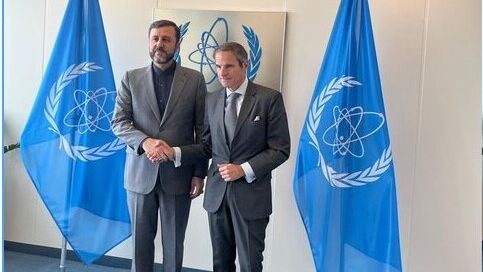
Iran’s Deputy Foreign Minister met with the director general of the International Atomic Energy Agency (IAEA) in Vienna on Monday to discuss Tehran's nuclear program.

Iran’s Deputy Foreign Minister met with the director general of the International Atomic Energy Agency (IAEA) in Vienna on Monday to discuss Tehran's nuclear program.
"I had a frank and constructive discussion with the director general of the International Atomic Energy Agency (IAEA)," Kazem Gharibabadi said in a post on X, of the meeting with Rafael Grossi.
He said the talks covered Iran-IAEA cooperation, the security of nuclear facilities and sanctions-related matter. While Iran remains committed to its safeguarding obligations, it must also ensure the protection of its national security, he said.
He added that resolving differences depends on an "independent, technical, impartial, and professional approach" by the agency. The relationship has been mired in disagreement in recent years, including Iran's banning one third of the UN's inspectors in 2023.
On Saturday, the United Nations' nuclear watchdog again warned that the Islamic Republic is very close to developing a nuclear weapon.
"Iran has an extremely ambitious and extensive nuclear program, under which it is enriching uranium to nearly weapons-grade levels," IAEA chief Grossi said. Last year he said Iran was "weeks not months" from a nuclear weapon.
On Sunday, amid a renewed policy of 'maximum pressure' under US President Donald Trump, US national security advisor Michael Waltz said the US wants Iran to abandon all aspects of its nuclear program, warning that all options are on the table should Tehran refuse.
"Iran cannot have a nuclear weapon. All options are on the table to ensure it does not have one," Waltz told ABC News.
Iran denies seeking a nuclear weapon but the UN's nuclear watchdog last week pointed to a sharp rise in Tehran's stockpile of highly enriched uranium.
The IAEA has argued in the past that there is no credible civilian use for uranium enriched to 60%, which is a short step from weapons-grade 90% enriched fissile material.

Tehran has denied that its foreign minister’s visit to Oman on Sunday was related to the US President’s letter to Iran's Supreme Leader. However, observers speculate that Tehran is seeking Muscat’s mediation.
President Donald Trump’s recent letter to Supreme Leader Ali Khamenei was delivered by former UAE Minister of State Anwar Gargash last week. Tehran, however, has not responded to the letter yet and seems unlikely to use the same diplomatic channel.
At a press briefing on Monday morning, Foreign Ministry Spokesman Esmaeil Baghaei dismissed a connection between Araghchi’s visit to Muscat and Trump’s letter and said the response to the letter “will be made through the appropriate channels after scrutiny is completed.” According to Baghaei, the contents of Trump’s letter will not be disclosed to the media.
Oman’s role in US-Iran diplomacy
In an interview with the government-run Iran newspaper after Khamenei’s public rejection of direct talks with Washington last week, Foreign Minister Abbas Araghchi signaled Tehran's willingness to engage in indirect negotiations through Oman.
For over two decades, Iran has relied on Oman as an intermediary for indirect communications with Washington, despite the existence of a formal diplomatic channel through Switzerland.
However, some observers link Araghchi's visit to Oman to US air strikes on Iran-aligned Houthis in Yemen. Referring to the US airstrikes on Saturday, conservative political analyst Asghar Zarei in Iran told Quds daily that the threat of further escalation has necessitated “consultations and the exchange of messages through Oman.”
But at the same time, citing Abu Dhabi’s close political and military cooperation with Israel and the West, Zarei further argued that Iran would not entrust the delivery of its response to Trump's letter to the UAE.
“Oman … has always shown its willingness to play an active role in regional issues, including the Syrian issue, and mediation between Iran and other powers,” the same daily quoted West Asia analyst Reza Sadrolhosseini as saying.
Some analysts also consider Baghdad and Doha as potential but much less likely alternatives for diplomatic exchanges between Tehran and Washington.
Iran's response to Trump
Trump sent another letter to Khamenei in 2019, after unilaterally withdrawing from the 2015 nuclear deal but Khamenei refused to accept the letter, delivered by then-Japanese Prime Minister Shinzo Abe, and insisted that Trump was untrustworthy.
The Iranian foreign minister’s meeting with his Omani counterpart, according to both sides, focused on bilateral relations and the latest regional and international developments. In a statement, Oman’s foreign ministry also emphasized the country's commitment to facilitating diplomatic solutions and easing regional tensions through dialogue and peaceful means.
Former President Barack Obama reportedly sent multiple letters to Khamenei between 2009 and 2015, discussing topics such as diplomacy, the nuclear deal (JCPOA), and potential cooperation against ISIS. There are no reports that Khamenei ever responded in writing to any of these letters. This time, however, as indicated by the foreign ministry's spokesman, a written response, possibly through Muscat, seems to be very likely.
Araghchi’s visit and the Yemeni situation
Some Iranian media and analysts have highlighted a possible connection between Trump’s most recent threats against Iran, the US airstrikes on Yemen, and Araghchi’s visit to Oman.
A commentary published on Monday by the reformist Ham-Mihan daily referred to Trump’s warning that supporting Houthis will not be tolerated and argued that by these airstrikes he aimed to demonstrate to Iran that there are only two options on the table: negotiation or military action, as in Yemen's case. Iran denies control over Houthis and has condemned the US strikes.
“The only thing that Iran does not need now is a new crisis,” the commentary said while suggesting that Iran should stay fully focused on the resolution of its nuclear program.

The Trump administration wants Iran to abandon all aspects of its nuclear program, the US national security advisor said on Sunday, warning that all options are on the table should Tehran refuse.
"Iran cannot have a nuclear weapon. All options are on the table to ensure it does not have one," Michael Waltz told ABC News on Sunday.
"And that’s all aspects of Iran's program. That’s the missiles, the weaponization, the enrichment. They can either hand it over and give it up in a way that is verifiable, or they can face a whole series of other consequences," he warned.
In 2015, Iran signed a nuclear deal with the United States and other world powers that imposed restrictions on its uranium enrichment capacity but effectively allowed it to maintain its nuclear program. It also did not directly address Tehran's ballistic missile program, focusing instead on nuclear-related issues.
While Iran is now signaling a willingness to accept similar restrictions on its nuclear program in exchange for sanctions relief, the Trump administration appears determined to put an end to Tehran's atomic ambitions.
The United Nations' nuclear watchdog warned on Saturday that the Islamic Republic is very close to developing a nuclear weapon.
"Iran has an extremely ambitious and extensive nuclear program, under which it is enriching uranium to nearly weapons-grade levels," Rafael Grossi, the director general of the International Atomic Energy Agency (IAEA) said.
Trump's national security advisor said on Sunday that "we cannot have a world with the ayatollahs with their finger on the nuclear button. And President Trump is determined (to prevent that), one way or another."
"Iran has been offered a way out of this to make sure that we don’t have a world that can be threatened by a radical regime," Waltz said, referring to Trump's direct letter to Iran's Supreme Leader.
Trump announced the overture at the same time he warned Iran to agree to a new nuclear deal or face military action.
While Supreme Leader Ali Khamenei has publicly ruled out talks, Iran’s foreign minister on Thursday signaled Tehran's willingness to engage in indirect negotiations with the United States through Oman.
On Sunday, Araghchi travelled to Muscat "to review bilateral and regional issues of mutual interest and concern."
"Our commitment is to diplomacy in defense of peace and stability, and I am always delighted to engage with my Omani counterpart in pursuit of these aims," he said, without explaining whether the issue of Omani mediation between Tehran and Washington had been discussed.
US may target Iranian assets in Red Sea
Araghchi's trip to Oman came hours after the US military started a series of large-scale airstrikes against Yemen's Houthis in what US officials described as a warning signal to their sponsors in Tehran.
US Defense Secretary Pete Hegseth said on Sunday the ongoing US airstrikes against Houthis serve as a warning to Iran to stop backing the group.
Washington would conduct "unrelenting" strikes against Yemen's Houthis until the Tehran-backed group ceases their military actions targeting US assets and global shipping, Hegseth told Fox News.
Secretary of State Marco Rubio also told CBS News that there was "no way" Yemen's Houthis would have the ability to attack global shipping without support from Iran.
In his Sunday interview with Fox News, Michael Waltz said the Trump administration "will hold not only the Houthis accountable, but we’re going to hold Iran, their backers, accountable as well.”
"And if that means they’re targeting ships that they have put in to – to help their Iranian trainers, IRGC and others, that intelligence, other things that they have put in to help the Houthis attack the global economy, those – those targets will be on the table too," he warned.
Iran allegedly operates reconnaissance ships in the Red Sea, including the commercial cargo ships Behshad and Saviz, which Washington says coordinate with the Houthis.
Despite scrutinizing their operations, neither the US nor Israeli militaries have targeted the ships.

The Islamic Republic is very close to developing a nuclear weapon, the United Nations' nuclear watchdog warned on Saturday, as the world awaits Tehran's response to Donald Trump's offer of either nuclear talks or the possibility of airstrikes on its atomic sites.
"Iran has an extremely ambitious and extensive nuclear program, under which it is enriching uranium to nearly weapons-grade levels," Rafael Grossi, the director general of the International Atomic Energy Agency (IAEA) said.
Speaking in an interview with Argentine online newspaper Infobae, Grossi said Iran’s nuclear situation is relatively contained right now.
However, he warned, "it remains very close to the nuclear threshold—meaning it could potentially acquire atomic weapons."
US President Donald Trump has sent a letter to Iran’s Supreme Leader Ali Khamenei offering talks toward a deal on its nuclear program, he told Fox Business Network on March 7, but warned that the alternative was a military intervention.
Khamenei on Wednesday said Trump's past withdrawal from a 2015 nuclear deal renders diplomacy with him pointless now and vowed harsh retaliation to any attack by the United States or its allies.
In his Saturday interview with Infobae, Grossi said Tehran has a history of violating its nuclear commitments.
"At times, Iran has failed to meet its international obligations, leading to serious tensions," the UN nuclear watchdog's chief said.
Iran denies seeking a nuclear weapon but the UN's nuclear watchdog last week pointed to a sharp rise in Tehran's stockpile of highly enriched uranium.
The IAEA has argued in the past that there is no credible civilian use for uranium enriched to 60%, which is a short step from weapons-grade 90% enriched fissile material.

The fast improving relationship between the United States under President Donald Trump and Russia may mean Moscow will seek more distance from Washington's Mideast nemesis Iran, Russian-born journalist and filmmaker Tanya Lukyanova said.
"It appears that Russia is no longer as interested in Iranian military assistance as the situation on the front lines in Ukraine is changing and as the geopolitical situation is also changing with the ceasefire proposed by the US and Ukraine," Lukyanova told the Eye for Iran podcast.
Trump rapidly called for a ceasefire and peace deal to resolve the war between Ukraine and Russia since taking office in January.
His administration has mooted ceding Russian-occupied territory in Ukraine and rules out Kyiv's accession to US-led military alliance NATO, delighting Moscow.
Ukraine and the United States this week agreed to a US proposal for a 30-day ceasefire - an initiative praised but not yet accepted by Russian President Vladimir Putin.
"The ceasefire negotiations hinge on Russia accepting that deal, but everything points towards - with Donald Trump coming to the White House - that this is the closest the US has ever come to having Russia as an ally," Lukyanova added.
Putin last week agreed to mediate nuclear talks between Washington and Tehran, according to Russian state media, scrambling an equation in which Iran and Russia had grown closer for years.
"Iran ties really improved rapidly since the beginning of the full scale invasion of Ukraine in February of 2022, when Iran became a major partner for Russia that had suddenly found itself isolated from the West," Lukyanova said.
"It found itself needing not only Iranian equipment and war technology, like its drones, weapons and missiles but also Iran became a key strategic player for Russia for evading sanctions."
Russia suggested to the United States last week that the two powers should hold talks focused on Iran's nuclear program, the Kremlin confirmed on Wednesday, in yet another sign of converging outlooks on global affairs by Washington and Moscow.
Iran's hollowed out standing in the Middle East may also provide an incentive for Moscow to recalibrate ties, Lukyanova added.
The battering Iran and its armed allies took in the region at the hands of Israel, especially with the loss of Tehran's oldest Arab ally the Assad dynasty to Islamist rebels, has diminished Iran's sway.
Soviet then Russian forces have been based along Syria's Mediterranean coast for decades - an arrangement now imperiled by the turmoil in the country.
"With that, Iran becomes less of an interesting partnership for Russia, which also is also trying to hold onto its standing in the Middle East, as we see now with their attempts to negotiate for the remain of their two military bases in Syria."

A top Iranian diplomat said on Friday that the Islamic Republic had agreed with China and Russia that any future talks over Iran's nuclear program must not stray into other issues.
The remarks appear to set a high bar for any new negotiations with United States, which has expressed deep misgivings with Iran's support of armed allies in the Middle East, missile program and domestic dissent.
China and Russia did not immediately confirm the alleged consensus.
"Any future talks must be nuclear talks only," Iran's deputy foreign minister Kazem Gharibabadi said in Beijing, where he was attending a trilateral meeting with Russian and Chinese counterparts.
"We made our position clear and China and Russia take the same position and have always maintained that non-nuclear issues won’t be part of the nuclear talks," he added. "This is the position of all three countries."
The three countries in an earlier joint statement emphasized the need to address the root causes of the nuclear standoff. They condemned unilateral sanctions as illegal and underscored Iran's right to the peaceful use of nuclear energy.
China's foreign ministry on Friday made no mention of the understanding on the scope of talks to which Gharibabadi referred.
"The situation of the Iranian nuclear issue is grim and has once again reached a critical crossroads," it said in a statement.
"China is willing to work with all parties to promote a fair, balanced and sustainable solution to the Iranian nuclear issue, safeguard the international nuclear non-proliferation mechanism, and promote international and regional peace and stability."
US President Donald Trump revealed on Friday that he had sent a letter to Iran's Supreme Leader Ali Khamenei offering negotiations but has warned of military action if talks failed, saying last week the standoff with Tehran was in its "final moments".
Iran's veteran theocrat rejected those overtures again this week, citing Trump's pullout from a 2015 international nuclear deal which involved Russia and China.
In his first term, Trump's administration had cited the deal's alleged leniency on Iran's military activities but the president has more recently repeatedly cited the nuclear program as the sole point of disagreement.
"I really want to see peace ... (but) they cannot have a nuclear weapon", Trump said last month. "It's very simple. I'm not putting restrictions. They cannot have one thing."
Trump, who has taken a hard line on Iran but broadly opposes foreign wars, made the remarks while reimposing harsh sanctions on the country, which were described in official documents as aiming to undermine Iran's broader military activities.