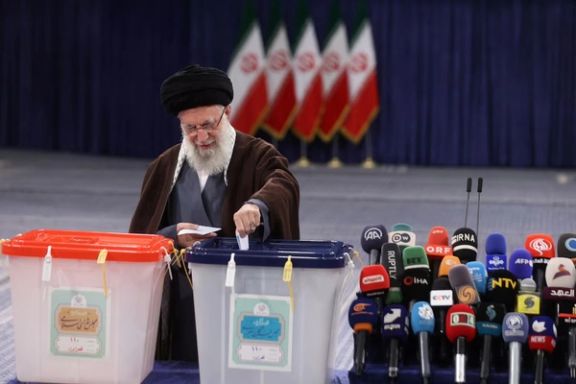
Iran's Supreme Leader Ali Khamenei casting his vote in an election (March 2024)
A prominent political commentator in Tehran has suggested that the best way for Supreme Leader Ali Khamenei to break the current deadlock is to hold a national referendum on the question of war or peace with the United States.
In two speeches delivered in the opening days of Nowruz, Supreme Leader Ali Khamenei appeared to indirectly respond to US President Donald Trump's letter proposing a new deal.
In his first address, a pre-recorded message aired on state television, Khamenei blamed the United States for instability in the region. In the second, delivered live, he denied commanding Iran’s regional proxy forces but warned Washington of a strong response to its military actions in the region.
Tehran has yet to issue an official response to Trump’s letter, as few details of its contents have been made public. In a New Year’s Eve interview with state TV, Foreign Minister Abbas Araghchi said the letter included “many threats and a few opportunities.” He added that Tehran is still evaluating the message. Meanwhile, US media reported that Trump gave the ayatollah two months to consider before replying.
Perhaps in an attempt to ease the pressure on Khamenei, Reformist commentator Ahmad Zeidabadi suggested in a tweet that the Islamic Republic should hold a referendum to determine the will of the people.
Given the widespread concerns expressed on social media and in call-ins to Persian-language TV channels based in Europe and the United States, it's clear that the economy—and its impact on daily life—is the top priority for most Iranians. It would not be difficult to predict the likely outcome of such a referendum.
Iranian political commentator, Ahmad Zeidabadi
In a post on X, Ahmad Zeidabadi wrote that Iran has two months to choose between war and an agreement with the United States. “Tehran must make a decision while its officials are unprepared for either option,” he said, adding, “They believe an agreement would bring humiliation, while a war could be devastating. Hence, the indecision.”
Zeidabadi warned that some are exploring a so-called third path—one that could ultimately lead to both humiliation and destruction. He noted that the current situation was foreseeable and, in fact, some politicians had predicted it, but their warnings went unheeded.
He also pointed out that while referenda are mentioned in Article 59 of Iran’s Constitution as tools to resolve difficult political, economic, social, and cultural issues, they have never been clearly defined or seriously pursued within the Islamic Republic’s framework.
Khamenei, however, has consistently rejected the idea of holding a referendum on any issue, dismissing proposals even from well-wishers like former presidents Hassan Rouhani and Mohammad Khatami on multiple occasions.
Yet, a referendum could offer him a way to resolve the current impasse—allowing him to shift the burden of any potential compromise with the United States onto the people. Still, many who commented on Zeidabadi’s post on X argued that no meaningful referendum is possible under current conditions. They noted that without a free press, functioning political parties, and open public debate, a genuine vote would be impossible. They also called for an end to the imprisonment of political activists, the unblocking of social media platforms, and guarantees for freedom of expression and assembly as prerequisites for any credible referendum.
Some analysts believe the mix of threats and defiance in Khamenei’s recent speeches suggests he is thinking aloud, searching for a way out of the current impasse. As he acknowledged in his first address, Iran’s main challenge is its struggling economy, severely weakened by US sanctions. While he is unwilling to appear submissive to his archenemy, America, the only viable path to economic relief may lie in accepting Trump’s conditions—an option that would be especially difficult for a leader known for his uncompromising stance.
Others pointed out that the government has consistently ignored public opinion in the past and holding a referendum now would be shifting responsibility onto the people for any potential compromise. Some expressed skepticism that even after a referendum, the Iranian government would truly respect the people’s will.
One commenter remarked that, as usual, Iranians would be left choosing between “bad and worse.” Still, some speculated that Zeidabadi may be hoping a referendum would give like-minded reformists an opportunity to participate more freely in the political process.
Iran's foreign minister revealed the contents of a letter from US President Trump to Supreme Leader Ali Khamenei during a call with his Iraqi counterpart, according to Iraq's foreign ministry.
Foreign Minister Abbas Araghchi “informed Mr. Fuad Hussein of the contents of a letter from US President Donald Trump addressed to the Iranian leadership, represented by the Supreme Leader Seyyed Ali Khamenei,” Iraq's foreign ministry said in a statement.
“He confirmed that the Iranian government will respond to the letter.”
Last week, an Emirati official brought a letter from Trump proposing nuclear talks with Tehran, which Supreme Leader Ali Khamenei rejected, saying such a proposal was deception from Washington amid crippling sanctions on Iran.
According to Iraq's foreign ministry, Hussein appreciated being briefed on the contents of President Trump’s letter and said he hoped that the exchange of messages would help open channels for dialogue between the two sides.
Iran's Foreign Minister Abbas Araghchi (left) and his Iraqi counterpart Fuad Hussein at Iraq’s Foreign Ministry’s headquarters in Baghdad, October 13, 2024
The two diplomats also discussed bilateral ties and agreed to continue communication, particularly during the sensitive phase ahead, the ministry added.
According to Axios, Trump’s letter to Khamenei included a two-month deadline for reaching a new nuclear agreement and warned of consequences if Iran expanded its nuclear program.
Iran's foreign ministry also released a readout of the call but made no mention of Trump’s letter. Instead, it focused on the escalation in Gaza and Lebanon following what it called brutal attacks by Israel, and the US military offensive in Yemen.
In part of the readout, the Iranian foreign ministry said Araghchi addressed US sanctions on Iran’s oil industry, saying the American claims and accusations aimed at pressuring Tehran were baseless.
The readout did not make any mention of Iraqi Oil Minister Hayan Abdel-Ghani who on Monday said Iranian oil tankers stopped by US forces in the Persian Gulf were using forged Iraqi documents, as Washington ramps up sanctions on Iran's oil exports as part of US President Donald Trump renewed "maximum pressure" campaign.
Sanctioning a Chinese refinery for buying Iranian oil is the first real sign of President Donald Trump’s “maximum pressure” on Tehran, the Wall Street Journal’s Editorial Board said on Sunday.
On March 20, the United States sanctioned Shandong Shouguang Luqing Petrochemical Co, which is known as a “teapot refinery” purchasing Iranian oil shipped by illicit methods to China in violation of US sanctions.
The WSJ said that after years of a lenient approach toward Tehran’s oil exports to China, the Trump administration finally took a step targeting the main source of Iran’s oil revenues. Chinese teapot refineries buy 90% of these exports and provide a lifeline for Tehran, which is financially strapped.
Officially, China buys almost no Iranian oil but its small refineries, not directly linked to government enterprises, unload tankers that wholly or partially carry Iranian cargoes.
“Unlike larger firms with links across the global economy, the teapots are less vulnerable to sanctions. But they tend to have links across the domestic Chinese economy. That’s what makes this move a warning to China,” the editorial said. It added that while Beijing might be willing to tolerate risk with its small refineries, it might not be ready to endanger US punitive measures against its bigger, state enterprises.
“If that’s trouble Mr. Xi could do without, he can make the business and political decision to drop Iran as a supplier. When Iran’s oil exports collapse, you’ll know the regime is feeling the heat. That’s when nuclear talks will have their best chance of success.”
President Trump last month announced the revival of his so-called maximum pressure policy toward the Islamic Republic, demanding talks to dismantle its nuclear program. Iran has responded by saying that it will not negotiate under Mr. Trump’s pressure, although it is facing serious financial pressures to a large extent brought on by US sanctions.
Steve Witkoff’s suggestion that he or another member of President Donald Trump’s team could potentially visit Iran for talks has received widespread coverage in Iranian online media.
At the end of an interview with Tucker Carlson on Friday, President Trump’s special envoy to the Middle East expressed hope that he or someone else from the administration might visit Tehran, as Carlson had suggested. Witkoff acknowledged the complexity of the Iran issue due to its nuclear dimension and the need for technical expertise. “I’m going to welcome that opportunity if I’m involved,” he stated.
So far, there has been no official Iranian reaction to Witkoff’s remarks. However, Nour News, a media outlet close to Iran's Supreme National Security Council, said in a tweet in English on Sunday that Witkoff’s tone “won’t clear up misunderstandings as no behavioral changes have occurred,” referring to US policies toward the Islamic Republic. Nour News added that the US is still pursuing talks while exerting pressure on Tehran. “If Washington wants a new nuclear verification process, it must first present real evidence of Iran's intent to obtain nukes!”
The lack of more commentary in online publications may be due to limited resources during the Nowruz holidays. Some public figures, however, have also commented on the interview via social media, where high engagement suggests significant public interest.
Throughout the lengthy interview, Witkoff reiterated that President Trump was open to negotiating a resolution with Iran, allowing the country to reintegrate into the global economy without the burden of sanctions. He emphasized Trump’s preference for diplomacy over military action and suggested that a verification program could be established to ensure Iran’s nuclear program remains peaceful.
Speaking on Fox News on Sunday, Witkoff reinforced the administration’s message to Iran, urging diplomatic engagement to resolve ongoing tensions. “And if we can't, the alternative is not a great alternative,” he warned, stressing that the U.S. would not allow Iran to develop nuclear weapons.
Diverging perspectives within the Trump administration
Witkoff’s remarks—particularly his focus on controlling Iran’s nuclear program through verification—contrast with statements from President Trump and other senior officials, who have called for the complete dismantling of Tehran’s nuclear program. White House National Security Advisor Michael Waltz reiterated on Sunday that the Trump administration seeks the full dismantlement of Iran’s nuclear program in a transparent manner that satisfies the international community.
Reactions from Iranian figures
“Dear friends in the Foreign Ministry, Witkoff has expressed interest in visiting Iran!” wrote Nosratolah Tajik, a relatively moderate politician and former diplomat, in a brief post on X on Saturday. He suggested that Tehran should invite Witkoff before formally responding to President Trump’s letter to Supreme Leader Ali Khamenei—both as a gesture of diplomatic goodwill and a display of political savvy, while also helping to deflect public criticism.
“It’s not just me saying this—former senior diplomats from the Foreign Ministry also advise against rejecting Witkoff’s expression of interest in visiting Iran,” wrote senior reformist journalist Mohammad Sahafi, referencing Tajik’s post.
An expatriate dissident, Akbar Ganji, echoed this sentiment, advocating for direct talks between Iran and the US, starting with a meeting between Iranian officials and Witkoff and eventually progressing to a summit between the Iranian and US presidents to finalize an agreement.
Former Reformist diplomat and political editor Abdolreza Raisi also backed the idea of hosting Witkoff in Iran. “How can we refuse to host him now that he’s expressed interest in visiting, especially to verify such claims and put the ball in their court?” he wrote in a post on X.
Skepticism from US analysts
Jason Brodsky, Policy Director at United Against Nuclear Iran (UANI), suggested in a post on X that certain Iranian officials and regime sympathizers may be attempting to exploit perceived divisions within the Trump administration. According to Brodsky, these figures are bypassing Secretary of State Marco Rubio and National Security Advisor Mike Waltz while engaging with officials they believe are more receptive to negotiations.
The Trump administration is seeking full dismantlement of Iranian nuclear program in a way that the entire world can see, White House National Security Advisor Michael Waltz told CBS News on Sunday.
“It is time for Iran to walk away completely from its desire to have a nuclear weapon. And they will not, and cannot be allowed to have a nuclear weapons program, that’s enrichment, weaponization, and its strategic missile program,” Waltz said.
“The President has all options on the table. But we want to be clear, this isn't some kind of, you know, kind of tit for tat that we had under the Obama administration, or Biden. This is the full program. Give it up, or there will be consequences,” he added.
His comments came in contrast to the much more conciliatory tone of Trump’s Middle East envoy, Steve Witkoff, who spoke of the US president's intention to resolve Iran's nuclear dispute diplomatically.
Earlier this month, Trump wrote a letter to Iran’s Supreme Leader Ali Khamenei in an attempt to explore a new nuclear agreement and prevent military escalation, Witkoff told Fox News on Sunday.
"We don't need to solve everything militarily," Witkoff said.
He emphasized that Iran cannot have a nuclear bomb, saying, “It cannot happen and it will not happen.”
"Our signal to Iran is let's sit down and see if we can, through dialogue, through diplomacy, get to the right place. If we can, we are prepared to do that. And if we can't, the alternative is not a great alternative."
On Friday, Witkoff told the Tucker Carlson show, “We should talk. We should clear up the misconceptions. We should create a verification program so that nobody worries about weaponization of your nuclear material."
He also said Trump believes the issue “has a real possibility of being solved diplomatically” and “acknowledged that he's open to an opportunity to clean it all up with Iran.”
His remarks raised questions about the Trump's administration's approach toward Iran, as Trump's Secretary of State, Marco Rubio, and National Security Advisor, Michael Waltz, have taken a much tougher stance, insisting over the past few weeks that Iran's nuclear program must be dismantled and that Iran will face military action unless it complies with US demands.
US President Donald Trump reached out to Iran’s Supreme Leader Ali Khamenei in an attempt to explore a new nuclear agreement and prevent military escalation, his special envoy said on Sunday.
"We don't need to solve everything militarily," Steve Witkoff told Fox News.
"Our signal to Iran is let's sit down and see if we can, through dialogue, through diplomacy, get to the right place. If we can, we are prepared to do that. And if we can't, the alternative is not a great alternative."
Witkoff emphasized that Iran cannot have a nuclear bomb, saying, “It cannot happen and it will not happen.”
On Friday, Witkoff said Iran used indirect channels to respond after the US president sent a letter to Supreme Leader Ali Khamenei earlier this month.
“I’m not at liberty to talk about the specifics,” Witkoff said in an interview released Friday on The Tucker Carlson Show, saying only it was through "back channels through multiple countries".
Last week, an Emirati official brought a letter from Trump proposing nuclear talks with Tehran, which Supreme Leader Ali Khamenei rejected, saying such a proposal was deception from Washington amid crippling sanctions on Iran.
Iran's foreign ministry said Tehran will respond privately to Trump's letter and will not make public its contents.
Witkoff's remarks come as a senior Iranian nuclear official on Sunday said that Iran will not yield to Western pressure regarding its nuclear program, warning that such pressure could have adverse effects on cooperation.
Behrouz Kamalvandi, spokesman for the Atomic Energy Organization of Iran (AEOI), emphasized Iran's determination to advance its nuclear industry and counter what he described as unjust accusations from Western powers.
In an interview on Sunday, Iran's Foreign Minister Abbas Araghchi said talks with the US are currently impossible unless significant changes occur as Washington awaits Tehran's response to its invitation for talks on a new nuclear deal.