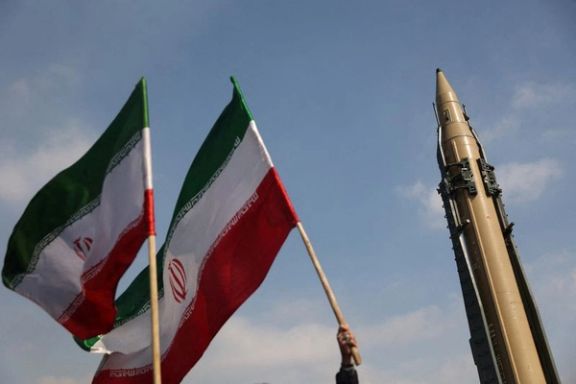
Iranians wave the national flag next to a missile at a rally protesting the United States ne
Under the shadow of US President Donald Trump’s threats to bomb Iran and after over a year of punishing blows at the hands of Israel, a bruised Islamic Republic remains defiant and seeks a comeback.
“Iran is not giving up,” Dr. Eric Mandel, founder of the Middle East Political Information Network (MEPIN) told Eye for Iran. “Iran's proxies—they may be down—Hezbollah, Hamas, the Houthis—but they’re not stopping.”
As the US positions aircraft in the Indian Ocean capable of striking Iran’s nuclear facilities, some Iranian officials have warned it will be forced to develop a nuclear weapon.
Iran has stepped up its production of fissile material in recent years, and the UN nuclear watchdog says it could accumulate enough enriched uranium for a nuclear weapon in less than a week.
Ali Larijani, a senior adviser to Supreme Leader Ayatollah Ali Khamenei, delivered this message on Monday. “If the US or Israel bomb Iran under the nuclear pretext, Iran will be compelled to move toward producing an atomic bomb,” he said.
Mandel, who regularly briefs members of Congress and national security officials, argued that supporting the Iranian people must become a central pillar of US foreign policy.
“America needs to start saying, we are pro-Iranian, pro-Iranian people, and that it becomes American policy that we want, without boots on the ground, regime change.”
In Congress, the bipartisan bill the Maximum Support Act aims at bolstering dissidents within Iran.
Developed with input from the Foundation for Defense of Democracies (FDD) and the National Union for Democracy in Iran (NUFDI), the draft legislation envisions funding opposition groups in Iran.
“I'm ashamed as an American who talks about American national security interests that we were not in 2022 standing strong with the protests,” said Mandel.
In that year the nationwide protest movement dubbed Woman, Life, Freedom was sparked by the death in morality police custody of Mahsa Jina Amini, a young woman.
Iran’s nuclear facilities, research, and production are widely dispersed across the country, Tehran’s former atomic chief said Thursday, responding to US threats of military strikes if no new agreement is reached.
Fereydoun Abbasi, highlighting the history of Iran’s nuclear program, emphasized that “Nuclear knowledge in our country is distributed across both the educational and research sectors; it is not confined to the Atomic Energy Organization [AEO] or limited to specific facilities and sites associated with it. We are active in nuclear education and research nationwide.”
Abbasi is considered a political hardliner and was the head of AEO during populist President Mahmoud Ahmadinejad prior to 2013.
He dismissed President Donald Trump’s threats of strikes on Iran as “bluffing” and called his other statements about Greenland and Canada as “America’s excessive appetite.”
He noted that since mid-1970s, when the Atomic Center of the University of Tehran was transformed into the Atomic Energy Organization, “nuclear work in our country began to take an organized form, and its management came to be regarded as part of the country’s senior leadership. In other words, it moved beyond being merely an academic endeavor.”
He emphasized that AEO is at the level of a government department and its director is considered a presidential deputy. But he portrayed Iran’s nuclear activities as partly decentralized. “Nuclear knowledge in our country is distributed across both education and research sectors; it is not limited to the Atomic Energy Organization or confined to specific sites and facilities associated with it. We carry out nuclear education and research activities nationwide.”
At the same time Abbasi stressed that Iran is fully cooperation with UN’s International Atomic Energy Agency (IAEA) and is subject to detailed inspections.
However, since 2021, Tehran has significantly restricted the international watchdog’s access to its sensitive uranium enrichment sites, while producing 60% enriched fissile material—far beyond what is needed for civilian purposes.
Abbasi noted that in case of a US attack, protecting nuclear sites will be vital and Iran should have strong air defenses. He said that the adversary is well aware of Iran’s capabilities, implying that Iran has strong air defenses. However, in October, Israel carried out air strikes on a series of Iranian targets including its Russian-made S-300 anti-air missile batteries. According to both Israeli and various media reports, most of the air defense network was destroyed in the attack.
Iran’s nuclear activities can be placed under full verification, President Masoud Pezeshkian told Saudi Crown Prince Mohammed bin Salman on Thursday, amid continued US pressure for a ban on Tehran’s nuclear weapons development.
“It is possible to place the Islamic Republic of Iran’s nuclear activities under full verification, as has been done in previous years,” Pezeshkian told the Saudi leader in their phone call.
He also said that Iran seeks dialogue and rejects any military use of nuclear energy.
“The Islamic Republic of Iran has never sought war or conflict, and non-peaceful use of nuclear energy has absolutely no place in our security and defense doctrine,” media in Tehran quoted him as saying.
“We are not seeking war with any country, but we have no hesitation in defending ourselves, and our readiness and capabilities in this regard are at the highest level,” Pezeshkian said, according to a statement from his office.
Pezeshkian also said that Iran is ready to engage in dialogue to reduce tensions based on mutual interests and respect, according to the statement.
In recent days, Tehran has signaled its willingness to engage in indirect talks with the Trump administration, while the US continues to favor quicker, direct negotiations.
“I think it’s better if we have direct talks,” Trump said on Thursday. “I think it goes faster, and you understand the other side a lot better than if you go through intermediaries. They wanted to use intermediaries. I don’t think that’s necessarily true anymore.”
It remains unclear whether Iran has genuinely shifted its position or if President Trump is merely speculating about Tehran’s intentions.
The US administration has continued to escalate sanctions on Iran, aiming to fully halt the country’s oil exports—especially to China. Trump has also threatened that if Tehran does not make concessions, it can become the target of military strikes.
Two Republican senators told Iran International on Thursday that Washington must deploy economic pressure to cripple it Mideast adversary the Islamic Republic of Iran.
"Everything we can do to prevent Iran from acquiring a nuclear weapon and ultimately to support regime change in Iran would be an improvement in US national security", Texas Senator Ted Cruz said.
"I think we have many points of leverage short of military action and economic and diplomatic pressure can have a profoundly powerful effect," he added. "The Ayatollah's intentions are unquestionably hostile. He is a theocratic genocidal lunatic."
Trump has threatened to bomb Iran if it does not reach a new nuclear accord. Iran's Supreme Leader Ayatollah Ali Khamenei has vowed retaliation in the event of an attack.
Previously, the populist US President who campaigned in part on avoiding foreign wars has said he wishes the Iranian people well and suggested he does not seek the overthrow of its theocratic rulers.
Trump in February reinstated the "maximum pressure" campaign of sanctions on Iran from his first term with the aim of bringing Iranian oil sales down to zero.
Tehran denies seeking nuclear weapons but the United Nations nuclear watchdog said it now possesses the largest stockpile of enriched uranium of any non-nuclear armed state.
Republican Senator Tommy Tuberville of Alabama expressed support for increased pressure on Iran, emphasizing sanctions targeting key sectors like oil and gas.
“If you're going to put sanctions on somebody – what President Trump does—for Iran and for the regime that's even killing its own people—is, you do blockade," Tuberville told Iran International.
"You take away their source of being able to make a living, and that’s through their oil and gas."
Nearly fifty years later, Iran International can reveal the untold story of a critical US mission to Tehran ordered by President Jimmy Carter to determine whether Mohammad Reza Pahlavi Shah could fend off a revolution.
Their conclusion, after facing militants' bullets and a ghostly encounter with the shell-shocked monarch, was that the US could no longer support its longtime ally's rule.
The consequences of Islamic Revolution to follow reverberate to the present day.
Ambassador John Craig, 80, was a young American diplomat when he was tasked with joining an exclusive group to meet the Shah alongside Senate majority leader Senator Robert Byrd.
It was a mission that went undisclosed even to American Ambassador to Iran William Sullivan, Craig told Iran International in an interview in Elizabethtown, Pennsylvania, where he teaches at the local university.
In a storied career, Craig went on to serve as US ambassador to Egypt and Oman.
“President Carter asked Senator Byrd to make a special trip to Tehran to give him a personal assessment of the longevity of the Shah. There was great concern in Washington”, said Craig, “Could the Shah hold on? Could the Shah defeat the revolution?”
Their task was to help Carter transcend the disagreements within the US foreign policy over whether one of Washington's key allies in the turbulent region could be salvaged and provide an unvarnished take on the Shah's mettle.
“Some were saying, yes, the Shah could hold on, others no. One of the issues in that debate was how much force should be used to put down the revolution,” said Craig.
"There were those who felt that the Shah should really be aggressive and shoot people. And there were those who felt that reforms were the way to defeat the revolution.”
Ambassador John Craig has Ambassador-in-Residence in the Center for Global Understanding and Peacemaking at Elizabethtown College in Elizabethtown, Pennsylvania.American politician who served as a United States House of Representatives from West Virginia for over 57 years, from 1953 until his death in 2010.
Mission: Tehran
To camouflage the trip's true purpose, Craig and the rest of the group made a diplomatic tour across the Middle East and the North Africa before arriving in Tehran.
Craig touched down in December 1978, just a few months before the Shah was ultimately toppled and as rebellion roiled cities nationwide.
Violence was escalating and martial law was in place as armed anti-Shah demonstrators roamed the streets chanting ‘death to the Shah!’
Iranian demonstrator holds poster of Khomeini as uprisings swept Iran in 1978.
Because of the security risk, Craig and the team were not able to drive to the Shah’s Niavaran palace and instead flew by helicopter.
“We were flying. You could see out the windows that people were shooting at us,” Craig said.
When they arrived, Craig said he was astonished to see bare walls - no paintings, no antiques - in what was once among the world's most opulent palaces.
It became clear that the Shah was preparing to flee.
Interior of Niavaran palace which is now a museum open to the public in Northern Tehran.
“I'm saying to myself, this is really weird. I said to myself immediately, these guys have packed up. They are ready to go. No question about that,” Craig said.
Entering the palace’s Hall of Mirrors, Craig caught sight of the Shah and his wife, Empress Farah Diba, standing to greet them.
'Inert' emperor
“He was comatose. Standing, but inert,” said Craig.
“I noticed that the Shah was looking straight ahead. He was not interacting. His eyes weren't moving. He did not raise his hand. But when the person put their hand in his hand, he didn't grasp it and he didn't shake it,” Craig said.
Mohammad Reza Shah Pahlavi, his wife Empress Farah Diba and their son, the crown prince.
They went on to have lunch in the palace. Craig said the Shah did not speak once over the course of the meal, leaving the Empress to do all the talking. She appeared to be in control and running the country in the last days of their rule, Craig concluded.
“He didn't eat. He didn't move. He didn't say a word,” said Craig about the Shah.
Pleasantries and small talk dominated the discussion and the violence in the streets went unmentioned. Senator Byrd and Ambassador Craig left convinced that the Shah was unfit to rule.
Little did anyone at the time realize it, but the lunch was to help determine US policy and Iran's future course for the coming decades.
Screaming match
What followed next was a visit by Senator Byrd and Ambassador Craig to Ambassador Sullivan’s house in Tehran to break the news on the special visit.
While Ambassador Craig did not partake in the conversation, he could hear what Sullivan and Byrd were saying.
“There was a lot of screaming and yelling. They were arguing about what our policy should be going forward,” said Craig on the encounter between the two men.
William H. Sullivan, the last American ambassador to Iran.
The conversation lasted about three hours, with Sullivan coming to the defense of the Shah and pushing to have the Americans keep him in power. Byrd argued the Shah was already done for and unable to rule over a people in revolt.
On the flight back to the United States, Senator Byrd prepared his report to Carter.
“We were such a small group, of course, that we could hear what the senator was dictating in the memo to the president. So we we all knew what the senator was saying in his memo,” said Craig.
Once they arrived back to D.C, the Senator had a car waiting to take him straight to the White House, where he informed the president of his dire conclusion: the scion of Iran's 2,500-year monarchy was doomed.
“He went back and told the president: This is not going to work," Craig said.
"The Shah cannot continue.”
You can watch the full interview with Ambassador John Craig on YouTube.
Israeli Prime Minister Benjamin Netanyahu accused Iran of leading what he called an “assault on civilization” during joint remarks with Hungarian Prime Minister Viktor Orban in Budapest on Thursday.
Netanyahu's visit followed Hungary’s formal decision to withdraw from the International Criminal Court earlier in the day. The Israeli leader is sought under an ICC arrest warrant for alleged war crimes in Gaza.
“This is important for all of civilization as we fight this battle against barbarism,” Netanyahu said. “We are fighting a similar fight for the future of our common civilization.”
He said that civilization itself is “under assault from radical Islam” spearheaded by Iran.
Iran-backed Hamas militants launched an attack on Israel on Oct. 7 2023, killing some 1,200 people and taking around 250 hostages to Gaza.
Israel's ongoing incursion into Gaza has killed more than 50,000 people, according to Palestinian health authorities, with nearly a third of the dead under 18.
Tehran and its allies were dealt significant setbacks last year, including Israeli attacks that severely weakened Iran's ally in Lebanon Hezbollah and helped dislodge the Assad dynasty in Syria, Tehran's oldest Arab ally.
On Oct. 26, Israel launched air strikes on Iran which it said knocked out Iran’s Russian-supplied air defense system.
Since Donald Trump took office in the United States for his second term as president, Tehran has issued repeated warnings against further attacks.
It has also conducted continuous military drills since early January. After reviving the "maximum pressure" campaign of sanctions from his first term, Trump on Sunday mooted bombing Iran if it does not agree to a new nuclear deal.
'Window of opportunity'
“There is a closing window of opportunity to strike Iran, which is particularly vulnerable because of the successful Israeli attacks against their defensive anti-missile array," Mandel said, who also advocates a US strike on vital Iranian economic infrastructure.
"There is also a decreasing window of opportunity for negotiations even if the Iranians believe there is a credible military threat."
A potential ceasefire between Russia and Ukraine could allow Moscow to deliver advanced weapons systems to Iran. That includes the S-400 air defense system—an upgrade from the S-300 system Israel disabled in an Oct. 26 strike in response to Iran’s October 2 missile barrage on Israel.
Putting the Iranian S-300s out of action opens the door to Israeli or American strikes, possibly on a larger scale. But Iran could rebuild with Russian help.
“Those missile defenses will not be down for much longer,” said Mandel, “not only for S-400s and even more evolved system, but for the SU-35 jets that the Russians have promised. And again, the Russians owe the Iranians because they've been very helpful to them during their Ukraine war.”
Moscow has publicly tried to dissuade Trump from bombing Iran’s nuclear facilities, warning of “catastrophic consequences.”