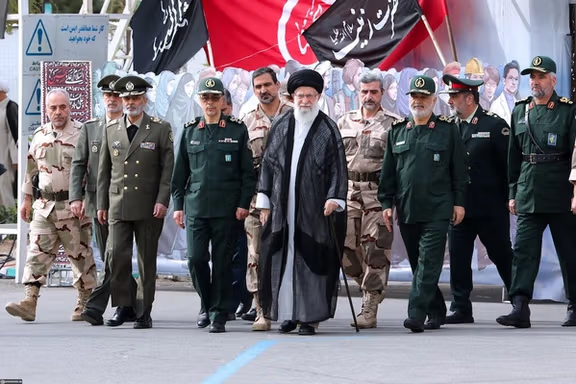
Iran's Supreme Leader Ayatollah Ali Khamenei attends a graduation ceremony for student officers and guard trainees in Tehran, Iran September 13, 2019.
Iran's newly published budget law reveals the Islamic Revolutionary Guard Corps’ (IRGC) major share of oil revenues and public funds—and opens the door for the IRGC and Supreme Leader–linked institutions to take control of state assets.
In the past Iranian year, which ended on March 20, a portion of the country’s oil exports was allocated to the armed forces—particularly the IRGC—under the pretext of “strengthening national defense.” This year not only has the military’s share of oil export revenues grown significantly, but direct government budget allocations to the armed forces have also sharply increased. Additionally, the law expands the authorization for crude oil transfers to other entities, including those involved in nuclear programs.
Meanwhile, the budget law allows IRGC-affiliated entities—such as Khatam al-Anbiya Construction Headquarters—as well as institutions linked to Supreme Leader Ali Khamenei’s office, like the Execution of Imam Khomeini’s Order (EIKO), to acquire state assets as a means of settling government debt owed to them.
Military's share of oil
President Masoud Pezeshkian’s government has projected daily oil exports of 1.85 million barrels for the current fiscal year, which began on March 21. Of this, one-third—valued at $12.4 billion—will be directly allocated to the armed forces and their specialized military projects, a figure that has tripled compared to the previous year. The remaining oil revenues, along with total gas export earnings, estimated at $33.5 billion, will be divided among the government budget, the National Development Fund, and the National Iranian Oil Company.
Another key point is that the government has set the exchange rate for oil allocated to the armed forces at roughly 600,000 rials per euro—while the euro trades at around 1.14 million rials on the open market. This disparity creates a major financial windfall for the military, enabling them to sell the oil and convert the proceeds at market rates, effectively pocketing the difference.
Moreover, the military has priority in oil sales, meaning any decline in national exports will primarily impact the government’s share. If the armed forces are unable to export their allocated share, the government is obligated to compensate them with equivalent cash payments.
Despite the government’s target of exporting 1.85 million barrels of oil per day this fiscal year, data from commodities intelligence firm Kpler—obtained by Iran International—shows that the average daily delivery of Iranian crude to Chinese ports, Iran’s sole oil customer, stood at approximately 1.34 million barrels in the first quarter of 2025. That’s down from a daily average of 1.5 million barrels in 2024.
Additionally, the Trump administration has launched a campaign to reduce Iran’s oil exports to “zero”, and several tanker tracking and energy consulting firms previously told Iran International that Iranian oil exports could drop by about half a million barrels per day in the coming months.
Kpler also reported this week that Chinese independent refineries, known as "teapots," appear to be pausing new orders of Iranian crude oil following Washington's first imposition of sanctions on a Chinese refinery, Shandong-based Shouguang Luqing Petrochemicals.
In addition to the armed forces, the Iranian government has authorized five other entities—including those involved in “nuclear energy projects”—to sell oil directly.
At least part of these funds will likely be directed toward nuclear activities unrelated to electricity production, like sensitive and controversial uranium enrichment that the US and its allies object to.
Moreover, beyond revenues from direct oil sales under the so-called “strengthening national defense” initiative, the military and security forces are also set to receive 10% of the government’s general budget for personnel salaries.
Transfer of state assets to the military and supreme leader's office
Amid a lack of transparency surrounding the economic activities of the IRGC and institutions under the Supreme Leader’s control, unofficial reports suggest these entities dominate roughly half of Iran’s informal or “shadow” economy. Over the past two decades, much of the government’s privatization program has veered off course—rather than transferring assets to the true private sector, state-owned properties have been handed over at heavily discounted rates to the IRGC and Supreme Leader–affiliated institutions.
These entities also play a major role in Iran’s infrastructure development. Yet the exact amount the government owes them for state-assigned construction projects remains unclear. What is clear, however, is that the 2025 budget law specifically authorizes the IRGC-linked Khatam al-Anbiya Construction Headquarters and the Supreme Leader–controlled Execution of Imam Khomeini’s Order (EIKO) to receive up to two quadrillion rials (approximately $2 billion) worth of state assets as repayment for outstanding government debts.
This year, the government plans to sell 15.8 quadrillion rials in state-owned assets, of which 13% is earmarked for transfer to the military and institutions tied to the Supreme Leader—if budget targets are met. Given the weakness of Iran’s private sector, it is widely expected that, once again, entities under the IRGC and Supreme Leader’s control will acquire the lion’s share of these assets.
Small Chinese non-state refineries—known as “teapots”—appear to be holding off on new orders of Iranian crude following Washington’s recent sanctions on Shouguang Luqing Petrochemicals, a refinery based in Shandong.
According to market intelligence cited by maritime data firm Kpler, no fresh deals for Iranian crude have been reported since March 20.
Iran’s main oil customers are small Chinese refineries, officially not linked to state structures, most of which are based in Shandong, where 90% of Iranian oil cargoes is discharged.
Refiners are assessing the risks associated with continuing to purchase Iranian crude and are closely monitoring the repercussions faced by the sanctioned Shouguang Luqing Petrochemicals, which has a refining capacity of 60,000 barrels per day.
While there are currently no indications that banks have cut off financing for Luqing, the refinery's ability to secure financing and maintain operations could influence the decisions of other teapots, particularly those heavily reliant on Iranian crude as their primary feedstock, according to Kpler.
Despite the cautious approach to new orders, China's imports of Iranian crude are still projected to show a significant month-on-month increase in March.
As of March 26, Iranian cargoes transported by vessels not listed under US Office of Foreign Assets Control (OFAC) sanctions appeared to have discharged successfully in Chinese ports, suggesting that ports have not yet turned away Iranian crude despite the tighter US sanctions.
Iran’s oil sales to China dropped sharply in January. Data from Kpler shows that Iran’s oil deliveries to China fell below 850,000 barrels per day in the period, compared to over 1.8 million barrels per day in October last year.
However, the recent US move to sanction Huizhou Huaying, an oil terminal in southern China, may prompt some ports to re-evaluate the risks of accepting sanctioned vessels in the future.
Data indicates that two Aframax tankers blacklisted by OFAC earlier this year managed to discharge Iranian crude at the ports of Yangshan and Dongying this week.
The US sanctions on the Chinese refinery come as part of Washington's efforts to maximize economic pressure on Iran to disrupt its access to financial resources. Iran's oil sales are a key target of these sanctions.
Remarks by a senior adviser to Iran’s Supreme Leader warning of Iran being pushed to produce nuclear weapons by US threats have sparked intense debate in Iran.
In a televised interview on Monday, Ali Larijani suggested that if Iran were attacked and public demand for nuclear weapons emerged, even the Supreme Leader’s religious decree (fatwa) against weapons of mass destruction could be reconsidered. Nonetheless, he insisted that Iran is not pursuing nuclear arms and remains committed to cooperating with the International Atomic Energy Agency (IAEA).
Khamenei’s ruling was presented by Iranian officials at the International Conference on Nuclear Disarmament in April 2010. But such religious decrees could be altered or overturned given the ‘requirement of time and place’ as many historical instances prove.
Many hardliners and ultra-hardliners in Tehran—typically staunch critics of the moderate conservative Larijani—have embraced his remarks on social media.
“Had any other political figure raised the possibility of the Islamic Republic moving toward nuclear weapons, they would have been accused of warmongering or bluffing. Dr. Larijani’s decision to bring it up was a wise move and a timely act of sacrifice,” wrote Vahid Yaminpour, a prominent ultra-hardliner and former state television executive, on X.
“The Iranian nation wants nuclear weapons,” declared Seyed Komail, an ultra-hardliner social media activist with 27,000 followers, in response to Larijani’s remarks.
Abdollah Ganji, former editor of the IRGC-linked Javan newspaper, dismissed concerns over potential US or Israeli strikes, arguing that Iran’s nuclear facilities are too deeply fortified to be destroyed. He warned that an attack could lead to Iran's withdrawal from the Non-Proliferation Treaty (NPT) and retaliation against US military bases and Israel.
However, Larijani’s remarks stand in contrast to official government positions. Soon after his interview, Iran’s Foreign Minister Abbas Araghchi reaffirmed on X that Iran “under no circumstances” would seek, develop, or acquire nuclear weapons, emphasizing that diplomacy remains the best course of action.
Nour News, an online outlet believed to be affiliated with Iran’s Supreme National Security Council (SNSC), also weighed in, questioning whether the US is prepared to face the consequences of further escalation.
Larijani’s statements have drawn strong criticism as well. Detractors argue that such rhetoric provides the US and Israel with an excuse to justify pre-emptive military action. “The Leader’s fatwa prohibiting nuclear weapons is absolute and without exceptions,” posted cleric Saeed Ebrahimi on X, adding that raising the prospect of nuclear bombs would only give Iran's enemies justification for aggression.
Mohammad Rahbari, a prominent political commentator in Tehran, suggested that Larijani’s remarks signaled Iran may be alarmingly close to nuclear capability—precisely the kind of pretext Israel has been seeking for a preemptive strike. Senior reformist journalist Mohammad Sahafi also warned that such nuclear posturing could alienate potential allies who might otherwise support Iran in the face of Western pressure.
“Larijani's comment was unprofessional and came from a position of weakness; it had no merit. It also gave the other side an excuse to have strong reasons for pre-emptive action and to shape a global consensus. In short, if we are concerned about our homeland, we should not take such a reckless stance,” Hemmat Imani, an international relations researcher in Iran, wrote.
Others speculate that Larijani’s remarks are part of ongoing indirect negotiations with Washington. “Ali Larijani’s ‘warning’ should be seen as a calculated move in high-level negotiations,” suggested Iranian environmental journalist Sina Jahani.
Describing Larijani’s remarks as “a form of nuclear blackmail the Islamic Republic has used as a tool of threat for years,” Arvand Amir-Khosravi, a Norway-based academic and monarchist, wrote on X that the threat was “nothing more than a propaganda ploy to gain leverage in potential negotiations,” adding that pursuing nuclear weapons would invite military retaliation rather than enhance Iran’s security.
The United States Office of the Director of National Intelligence reported in November 2024 that, as of September 26, Iran was not actively building a nuclear weapon. However, last month, Rafael Grossi, director general of the International Atomic Energy Agency (IAEA), described Iran’s nuclear program as extremely ambitious and wide-ranging. He warned that the country's uranium enrichment had reached near weapons-grade levels and was alarmingly close to the threshold for acquiring nuclear weapons.
In his Eid al-Fitr sermon, Ali Khamenei once again voiced concern about the possible resurgence of anti-government protests in Iran, using his signature rhetoric to warn of a "new sedition."
But the fundamental question remains: who is the real seditionist? Is it the Iranian people protesting the country’s dire conditions—or is it Khamenei himself, who has held power for over three decades? Who is responsible for the current state of affairs that has him so worried? Who has ruled the country and made all major decisions over the past 36 years—ordinary citizens or Khamenei himself?
Khamenei labeling public protests as "sedition" and dismissing demonstrators as seditious is nothing new. This has always been his approach. He has never been willing to acknowledge that Iranian citizens are reacting to the country's deteriorating conditions, which are a direct result of his policies as supreme leader. He has consistently refused to recognize these protests as legitimate, branding them as riots in order to justify their suppression.
He views the citizens who took to the streets in dozens of cities during the 2017, 2019, and 2022 uprisings as being influenced by foreign enemies. But is this really plausible? Khamenei refuses to accept that these protests are domestic and popular in nature. He uses the label of unrest to delegitimize them.
If Khamenei is worried about new protests, he should understand that this fear stems from his own actions. The country’s current state—one that the majority of people reject—is the product of 36 years under his rule, and a decade before that under Khomeini.
Khamenei with top security and military officials. File photo
For 46 years, no one else has governed Iran. Even the monarchy, which the Islamic Republic continues to criticize and compare itself to, fares better in many metrics. In contrast, the Islamic Republic has dragged the country backward.
After 46 years in power, it is no longer acceptable for the Islamic Republic to measure itself against a government from half a century ago. And even when this comparison is made, in the minds of many Iranians, the Pahlavi era wins, while the Islamic Republic is clearly the loser.
While other nations have advanced in less time, Iran under the Islamic Republic has stagnated or regressed. Dubai and Qatar have achieved modern prosperity in under 46 years. China, now an economic superpower, began its development path after the Islamic Republic came to power—but unlike Iran, it made real progress. The Islamic Republic squandered these decades, pushed the country into ruin, and sacrificed three generations in the process—yet refuses to step aside. Meanwhile, those who object to these conditions are called seditious.
When Khamenei assumed power in 1989, the exchange rate was 1,200 rials to the US dollar. After 36 years of his leadership, it has surpassed one million—a depreciation of 87,000 percent. This isn't mere exaggeration; it’s verifiable with a basic calculation. And still, he labels public protests as sedition and threatens suppression—though such threats have long lost their force.
In just the past four years, the dollar has surged from around 200,000 rials to 1,040,000—more than a fivefold increase. So why wouldn’t people expect the currency to plunge further, possibly hitting one billion rials, if the current trajectory and war-driven policies continue?
Iran's government keeps printing money to make up for lack of revenues, fueling inflation.
Given this economic collapse—and the fact that widespread poverty and dissatisfaction are direct consequences of Khamenei’s rule—how can he possibly justify calling protesters seditious?
Even some of Khamenei’s own allies, like former deputy parliament speaker Mohammadreza Bahonar, have admitted that inflation has hovered at 40 percent for the past seven years. Inflation, in essence, is a legalized form of theft by the state—citizens go to sleep at night and wake up to find their savings eroded.
Even former president Hassan Rouhani, a figure deeply entrenched in Iran’s security apparatus, has openly stated that the people are unhappy.
When individuals who played key roles in cracking down on the 2017 and 2019 protests now speak of widespread dissatisfaction, how can Khamenei still claim these movements are foreign-led?
Many Islamic Republic officials have warned that the public will once again take to the streets—an outcome of the government’s own policies. If anything needs to change, it is the behavior of those in power, not the people.
Numerous insiders have acknowledged the failures of the Islamic Republic’s domestic and foreign policies, especially regarding the US and Israel. Khamenei and the Revolutionary Guard’s staunch anti-American and anti-Israeli stance has not only devastated the economy but also edged the country closer to a potentially catastrophic war.
Sanctions, largely driven by Tehran’s belligerent foreign policy, have primarily harmed ordinary Iranians—while enriching commanders of the Revolutionary Guard.
Mohammad Hossein Adeli, a former Central Bank governor, revealed that in just one year, efforts to circumvent sanctions—managed by the Revolutionary Guard—cost the country $50 billion.
Where did that money go? Beyond international middlemen, much of it ended up in the hands of IRGC commanders and oil smuggling networks. They call it “bypassing sanctions,” but in practice, it’s looting the nation while claiming sacrifice and heroism.
Naturally, the Guard will seek to protect this $50 billion racket—so it continues echoing anti-American policies. After all, it’s the people who pay the price, not the IRGC.
The reality is that through flawed domestic and foreign policies, the Islamic Republic has pushed Iran into a full-blown crisis. Public frustration and anger towards the ruling system is undeniable. The responsibility for this crisis rests squarely on Ali Khamenei and the government he leads.
Ultimately, public protests driven by economic collapse, corruption, and authoritarianism cannot be ignored—and they will inevitably erupt again. But the core question remains: in a country where even officials acknowledge the people's dissatisfaction, who is the real source of sedition—the people, or Ali Khamenei?
Tehran and Washington have taken their exchange of threats to a new level, with the US president raising the prospect of bombing Iran and Tehran not only vowing to retaliate but also threatening to build nuclear weapons.
Iran’s threats have also included the far-fetched idea of targeting the US base at Diego Garcia in the Indian Ocean—a claim dismissed by military analysts, who argue that Iran lacks the capability to strike such distant targets. Still, Iran’s defense doctrine is rooted in asymmetrical warfare, and its commanders have often warned they could strike in unexpected ways.
Following Khamenei’s sharp response to Trump’s threat, Iran’s air force commander Amir Ali Hajizadeh noted that there are dozens of US targets within close range in the Persian Gulf region.
As tensions rose further, senior Khamenei adviser Ali Larijani suggested that Trump’s threats could push Iran toward building nuclear weapons. That message was quickly echoed by hardline MP Ahmad Naderi, a member of the parliament’s presidium, who argued that nuclear weapons have secured North Korea’s safety—and questioned why Iran should not follow the same path.
Larijani’s statement, however, carried a different weight. He has long been seen as a measured political figure—unlike the more impulsive military commanders or obscure ultraconservative lawmakers. As speaker of Iran’s parliament (Majles) for 12 years and one of the key architects of the 2015 nuclear deal with the West, Larijani played a central role in shaping Iran’s diplomacy. Hardliners still recall, often with resentment, how he pushed the JCPOA agreement through a predominantly hardline parliament in just 20 minutes.
At the same time, Larijani is a US-educated politician and a former IRGC officer, trusted by Khamenei both for his background and his lineage—he is the son of one of Iran’s highest-ranking clerics. He once oversaw Tehran’s nuclear file and only stepped down as Secretary of the Supreme National Security Council due to a personality clash with ultraconservative former President Mahmoud Ahmadinejad.
By allowing someone like Larijani to voice support for building nuclear weapons, Khamenei revealed one of the key complexities of Iranian politics. He is signaling to both Trump and the Iranian public that pressure to pursue the bomb is coming not just from hardline agitators in parliament, but also from figures seen as moderate and pragmatic. In doing so, he effectively sidelines his much-publicized fatwa banning nuclear weapons—though few ever believed it was an absolute or irreversible stance.
At the same time, Larijani’s statement—as a politician who often echoes Khamenei’s broader policy positions—renders previous threats about Iran leaving the Non-Proliferation Treaty (NPT) largely redundant. Once a country openly talks about building a nuclear bomb, it effectively signals its departure from the NPT, regardless of any formal announcement.
In a commentary on Larijani’s statement, Nour News—a media outlet affiliated with Iran’s Supreme National Security Council—wrote on Tuesday that Trump’s talk of bombing Iran has triggered serious concerns about national security. According to the commentary, this growing anxiety could shift public opinion in favor of changing Iran’s nuclear policy. It added that the United States should be held accountable for accelerating Iran’s potential turn toward developing nuclear weapons.
Nour News quoted Larijani as warning that any US or Israeli military strike aimed at ending Iran’s nuclear program could instead push Tehran toward the very path it has so far avoided.
The outlet also claimed that with the backing of Russia and China, Iran is no longer isolated on the international stage. Echoing Larijani’s remarks, it suggested that Yemen is now capable of responding to US aggression in ways that would prove costly for Washington and its allies.
According to Nour News, “The United States now faces two choices: either continue its hostile behavior and drag the region into an unprecedented security crisis, or change course to ease rising tensions.” The commentary added that Trump’s threats risk further complicating the situation, noting that “Iran has many options to defend its national security.” It concluded by stating that “Iran’s final decision will depend on future US actions.”
Meanwhile, Larijani’s brother-in-law, Ali Motahari, told the press that “there is nothing wrong with negotiating with the United States.” He went further, saying that “President Massoud Pezeshkian should have accepted Trump’s offer to negotiate”—though he did not mention that Pezeshkian lacked Khamenei’s approval to do so at the time.
Tehran will implement 12-hour water supply cuts for people with excessively high consumption who disregard government warnings and text message alerts to reduce water use amid a national crisis.
According to Revolutionary Guards news agency Tasnim, the measure comes as Tehran faces water shortages due to five consecutive years of drought and a sharp drop in rainfall, posing challenges to supplying the metropolis that houses over 10% of Iran's population during the upcoming summer season.
Authorities aim to curb what they call excessive water use, particularly among the 5% of the population classified as "badly consuming" who can use up to ten times more than the average household, with the majority of these located in affluent districts of the capital.
In previous years, water cuts for such high users lasted between two and four hours during peak consumption times and only on a single day.
The extended 12-hour cuts will be enforced for those who fail to heed warnings, with the possibility of repeated cuts if consumption patterns deemed wasteful by authorities continue.
Iran’s water reserves have fallen to critical levels, accelerating the risk of shortages and forcing officials to consider rationing months before peak summer demand.
Iran’s water worries are not limited to the capital. Last week, protests over water shortages in central Iran escalated after demonstrators set fire to a key water transfer station in Isfahan province, disrupting the supply line that channels water to hundreds of thousands of Iranians in the province of Yazd.
Footage received by Iran International showed smoke rising from the pumping station early Saturday, following a rally by farmers demanding access to Zayandeh Rud water — a long-promised resource they say has been diverted elsewhere.