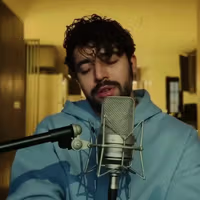
The Islamic Republic will seek a new lease on life in US talks, former Iranian diplomat Hossein Alizadeh told the Eye for Iran podcast, adding that Iran's rulers will never abandon their hardline ideology against the West.
“It is ideology, flexible ideology. Extremist, but flexible,” Alizadeh said. “Using lies, creating lies—that’s part of their strategy.”
Alizadeh, who served in Iran’s Ministry of Foreign Affairs for 22 years, said Tehran’s current posture is motivated by a desire to stay afloat amid both internal unrest and external pressure.
Despite having defected, Alizadeh says he remains in contact with individuals inside Iran’s Ministry of Foreign Affairs and remains familiar with official policy thinking.
He offered insight into the mindset of Supreme Leader Ayatollah Ali Khamenei, calling him a revolutionary who clings to the vision of his predecessor, Ayatollah Ruhollah Khomeini, to export the Islamic Revolution.
“The reality is dictating to Khamenei that in this situation—internally because of the economic problems inside Iran, and tension with many parts of the world, particularly with Israel and the United States, and now with the European Union,” he said.
According to Alizadeh, pressure is mounting: Israel’s strikes on Iran’s regional proxies, economic hardship, domestic dissent, and the looming threat of “snapback” sanctions from the E3 (Britain, France, and Germany) are all pushing Tehran toward tactical concessions.
Despite its defiant stance, he said, Iran will most likely cave to US demands—but only temporarily.
Flipping his lights on and off, Alizadeh emphasized: “The nuclear program is like this: switch on. Switch off."
Iran permits nuclear inspectors into the country, he added, but blocks human rights monitors because Tehran can pause nuclear activities but cannot hide rights abuses.
Alizadeh served as a diplomat in Finland during the 2009 contested elections, when Mahmoud Ahmadinejad’s declared victory sparked mass protests.
Supporters of opposition candidate Mir Hossein Mousavi claimed the vote was rigged, leading to a nationwide crackdown.
•
•
That moment, Alizadeh said, shattered his lifelong beliefs.
“When the Green Movement erupted in Iran was a moment that I always describe it as rebirth for myself,” he said.
Alizadeh pointed to the lack of public outrage from Iran’s hardliners in the face of renewed diplomacy—even with President Donald Trump whom the detest for ordering the killing of military leader Qasem Soleimani and withdrew from an earlier nuclear deal during his first term.
“Trump is in office—the Trump who killed Qasem Soleimani and the Trump who withdraw his country out of the JCPOA,” Alizadeh said. “None of the hardliners are saying anything against the talks. So, in fact, it's a matter of survival. They know this is a real game.”
Alizadeh said he advises American officials that Iranian diplomacy should not be compared to the Western model. In Iran’s case, it’s a calculated tool to manipulate perception.
“For Khamenei, diplomacy is a tool. He used it as instrument to trick people that, I am a rational person. Iran under me is a normal country like all the others,” Alizadeh said.
To hear more from Hossein Alizadeh, watch the full episode of Eye for Iran on YouTube or listen on Spotify, Apple Podcasts, Castbox, or Amazon.
Some Iranian media appear frustrated with unreliable and contradictory reports on the ongoing Iran-US negotiations, while the official narrative has struggled to gain traction with the public.
On Thursday, the moderate conservative outlet Khabar Online questioned the credibility of reports based on unnamed "informed sources," describing such coverage as “destructive” and driven by factional interests. The website criticized “political celebrities” who allegedly fabricate news to maintain their public profile and called out media outlets publishing such content as “unprofessional.”
In particular, Khabar Online targeted Tehran Times, a hardline English-language daily, for its report ahead of the Oman talks, which quoted anonymous sources as claiming the Americans were only wasting time. The article labeled Tehran Times’ reporting as "irrelevant." The same paper also quoted a source who said the US had no intention of holding constructive negotiations with Iran—an assertion later contradicted by both Tehran and Washington, which described the talks as “positive and constructive.”
Tehran Times is affiliated with the Islamic Propagation Office, a body dominated by hardliners. During the 2014–2015 negotiations that led to the nuclear deal, similar tactics were observed. Press TV, Iran’s English-language state news channel, frequently aired misleading stories intended to undermine the talks. At the time, Press TV was headed by Peyman Jebelli—now the head of state broadcasting, overseeing dozens of Persian and foreign-language channels that continue to distort news about the current negotiations.
Back then, deputy foreign minister Abbas Araghchi publicly criticized Press TV’s reliance on so-called informed sources, saying: “Whoever gives fake news to Press TV as an 'informed source' is certainly not an informed person.” Later, former presidential chief of staff Mahmoud Vaezi blamed Ali Shamkhani and Nour News, a media outlet linked to him, for deliberately trying to derail the talks. Shamkhani was then serving as secretary of Iran’s Supreme National Security Council.
He and his family have been implicated with involvement in operations to sell Iranian oil in contravention of current US sanctions.
More recently, conservative commentator Mohammad Mohajeri remarked that “around 90 percent of what is attributed to 'informed sources' is fabricated.” He added that such individuals often blend truth with fiction and lack the courage to identify themselves.
Media activists in Iran have long accused state television and hardline outlets like the Kayhan daily—closely linked to Supreme Leader Ali Khamenei—of manipulating the news. As a result, public trust has eroded. According to several domestic and international surveys, Iranians now rely more heavily on social media and foreign-based Persian-language broadcasters for news.
Amid this credibility gap, some officials have sought to exploit the confusion. Following widespread rumors on social media that Deputy Foreign Minister Kazem Gharibabadi had taken a valuable golden pen from the negotiating table in Oman, he dismissed the story days later as a fabrication by foreign-based opposition groups. But by then, the narrative had already taken root and spread widely.
A similar pattern emerged in the episode surrounding the change of venue for the second round of talks—from Oman to Rome. Foreign Ministry spokesman Esmail Baghaei initially reacted with a post on X accusing the US of lacking seriousness and commitment. Days later, Gharibabadi attempted to downplay the shift, calling it a “minor development.” But by then, the damage was done. The episode also revealed what Iranian officials appeared keen to conceal: that it was the United States, not Iran, that ultimately determined the venue of the talks.
Iran has indicated a willingness to open its markets to American investors if a nuclear deal is reached, but some experts argue that expecting not only US investment but any significant foreign investment is highly unrealistic.
“Speaking of a trillion-dollar investment from the United States is nothing but a dream and fantasy,” said Ferial Mostofi, head of the Investment Services Center at the Tehran Chamber of Commerce, in an interview with Shargh daily. “How can we expect foreign investors to come to Iran when domestic investors move their capital out of the country?”
In its article titled “Foreign Investment: Mirage or Reality?”, Shargh referred to a claim circulating in Iranian circles that Tehran is seeking an agreement with the United States to guarantee $1 trillion in US investment over twenty years. “This claim means the United States would have to invest $50 billion in Iran annually.”
Shargh also recalled past official claims that China had pledged $400 billion in investments in Iran’s oil, gas, petrochemical, and transport sectors, while Russia’s Gazprom was expected to invest $40 billion in Iran’s gas industry. The article pointed out that none of those promised investments ever materialized.
“[A trillion-dollar US investment] is exactly like the much-discussed $400 billion investment from China [over twenty-five years],” the article said, arguing that China has not—and likely will not—invest such a large sum in Iran due to several factors, including inadequate hard infrastructure in transportation and energy, lack of transparency, and political risks.
Iran is in urgent need of foreign investment to revitalize its aging oil and gas infrastructure and to support other key sectors, including its large but struggling automotive industry.
According to the 2024 report of the UN Trade and Development (UNCTAD), Iran attracted $1.4 billion in foreign direct investment (FDI) in 2023. The meager figures stood at $1.5 billion in 2022 and $1.4 billion in 2021. The highest recorded FDI level was over $5 billion in 2017, following the implementation of the 2015 JCPOA nuclear deal which lifted UN economic sanctions against Iran.
President Masoud Pezeshkian said recently that Supreme Leader Ali Khamenei has no objection to American investment in Iran. Foreign minister Abbas Araghchi, writing in a Washington Post op-ed, put the onus on Washington to allow American companies to access what he described as a “trillion-dollar opportunity” in Iran. Neither Pezeshkian nor Araghchi provided specific details.
The Revolutionary Guards (IRGC) linked Javan newspaper appeared to support the idea of American investment in Iran in an article it published one day before the first round of Tehran-Washington talks in Muscat on April 8. “It is possible that we accept that some American companies have the opportunity to invest or sell their products, if Iran's economic interests are met. If sanctions are lifted, these companies will be eager to invest, and Iran will be unlikely to object.”
While Khamenei has not officially banned American or other foreign investment, he has consistently advocated for stronger economic ties with Eastern countries such as Russia and China, expressing deep mistrust toward the West.
Despite publicly distancing himself from economic policymaking, Khamenei is widely believed to exert substantial control over Iran’s economy through political influence, economic entities under his authority, and the IRGC’s involvement. In one notable instance, he banned imports of South Korean electronics brands LG and Samsung in August 2021 to pressure Seoul over Iran's frozen funds.
Iranian President Masoud Pezeshkian said on Friday that Tehran's military strength enabled it to confidently seek peace in the region, a day before talks with arch-foe the United States were due to resume.
“With the army behind us, we can express our positions on peace, stability, and regional cooperation from a position of strength,” Pezeshkian said during a ceremony marking Army Day.
He added that the armed forces have helped position Iran as a regional power and said the country now produces its own military equipment. “We build what we need on land, in the air, and at sea,” he said.
Pezeshkian praised the army’s role in responding to national crises and described it as a reliable force alongside the government and people.
The Iranian army, reliant on conscription, is equipped mainly with older generation weapons, many produced during the Soviet Union.
His comments came days after the first round of talks between Iranian and US officials in Oman. Following the talks, Supreme Leader Ali Khamenei told military commanders that Iran’s armed forces must maintain maximum readiness to counter external threats. He described the military as the country’s shield and accused foreign powers of trying to weaken public trust in it.
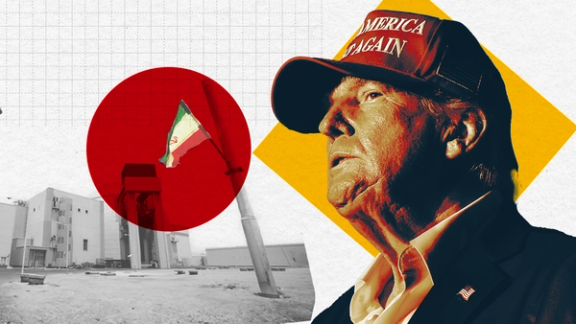
President Donald Trump has threatened strikes if Iran fails to come to an agreement with the United States to curtail or dismantle its nuclear program.
“Armies that lack conviction, courage, and trust in their cause have collapsed, no matter how heavily equipped they were,” Khamenei said.
Khamenei also called for upgrades in weapons, logistics, and personnel support, alongside a continued focus on ideological commitment. Senior military officials echoed the message, saying Iran’s armed forces remain fully prepared and supported by the public.
Iran proposed a three-stage plan to the US delegation during talks in Oman on Saturday envisioning a cap on their uranium enrichment in exchange for the lifting of US sanctions, three diplomatic sources in Tehran told Iran International.
The plan was presented by Iran’s foreign minister Abbas Araghchi in writing to US President Donald Trump’s special envoy Steve Witkoff during the three-hour talks.
Tehran proposed that in the first stage, it would temporarily reduce its uranium enrichment level to 3.67% in exchange for access to financial assets frozen by the United States and permission to export its oil, the diplomatic sources told Iran International.
In the second phase, the sources added, Iran would permanently end high-level enrichment and restore the United Nations nuclear watchdog's inspections if the United States lifts further sanctions on Iran and persuades Britain, Germany and France to refrain from triggering the so-called snapback of UN sanctions on Tehran.
In this phase, Iran would also commit to implementing the Additional Protocol, a supplementary agreement that allows the UN nuclear watchdog to carry out surprise inspections at sites not declared to the agency.
Tehran ended that compliance in February 2021 after Trump in his first term withdrew from a previous international deal over Iran's nuclear program in 2018.
The third and final stage calls for the US congress to approve the nuclear agreement and for Washington to lift both primary and secondary sanctions, while Iran would transfer its highly enriched uranium stockpiles to a third country.
Iran denies seeking a nuclear weapon and the US intelligence assesses that Tehran has not yet resolved to build one, but the Trump administration has warned Iran it must come to a nuclear deal or face attack.
A second round due to be held in Rome on Saturday could prove more rocky than the amicable first round in which Iran submitted its plan for a deal.
Washington toughened its public stance on Tuesday, with both the White House and Witkoff saying that the US goal in negotiations would be the wholesale end of Iran's nuclear program, a notion Iran has repeatedly called a non-starter.
Iran's proposal welcomed by Witkoff
US envoy Witkoff welcomed the proposals presented by the Iranian side, the sources told Iran International, surprising the Iranian delegation in Muscat.
Iranian officialdom appeared cheered by the first round of talks, with Supreme Leader Ali Khamenei remarking in a meeting with senior military commanders on Tuesday that "the initial steps have been implemented well".
A diplomatic source outside Tehran expressed skepticism to Iran International of the Islamic Republic's intentions in the talks and said it seeks to delay a foreign attack by staggering an agreement over several complex phases.
“One of the reasons Iran’s Supreme Leader agreed to allow the resumption of negotiations is the need to buy more time, because he knows Iran currently lacks the ability to defend itself against another airstrike," the source said.
“Iran is mainly stalling to buy time to rebuild its air defense capabilities, which were all destroyed by Israel in late October, and to restore its capacity to produce surface-to-surface missiles which were damaged in that same Israeli attack,” the source added.
Israeli Prime Minister Benjamin Netanyahu’s office said on Thursday that his actions had previously thwarted Iran's ability to build a bomb, appearing to respond to a New York Times report that President Trump had halted Israeli plans to attack Iran.
"Netanyahu has led countless secret and open actions in the campaign against Iran's nuclear program that only thanks to them Iran does not have a nuclear arsenal today," the statement said.
Rafael Grossi, the director general of the International Atomic Energy Agency (IAEA), said on Wednesday Iran was "not far" from possessing an atomic bomb.
"It's like a puzzle: they have the pieces and maybe one day they could put them back together. There's still a long way to go before we get there. But they're not far away, we have to admit that," he said in an interview with Le Monde.
"It's not enough to tell the international community 'we don't have nuclear weapons' for them to believe it. We have to be able to verify it," Grossi said.
In its latest report in March, the IAEA warned that over the past three months, Iran had significantly expanded its reserves of highly enriched uranium, and if this trend continues, its stockpile could theoretically be enough to produce six nuclear bombs.
The shift in the United States from Special Envoy Steve Witkoff's soft stances about Iran's nuclear program to the administrations tougher stance this week seems to have convinced Tehran that it would not be easy to insist on its demands.
At the beginning of the week, Witkoff seemed to suggest that Washington would accept low-level uranium enrichment with Iran, but the following day he retreated, and the rest of the Trump administration began to emphasize that all of Iran’s nuclear program should be stopped
The change came after President Donald Trump said he held meetings with groups of politicians and officials in Washington about the matter. Those politicians could have possibly been individuals who warned Trump that the deal as explained by Witkoff looks more like an Obama deal rather than a Trump deal.
In Tehran, an article published on the Fararu website suggested that two types of unexpected developments could arise at any moment, potentially reshaping the course of the negotiations and broader regional dynamics. One could seriously disrupt the talks, while the other might lead to a sudden breakthrough.
According to Fararu, the first possibility involves a dramatic escalation by Israel—such as a fatal attack on Iranian officials, particularly those directly involved in the negotiations. The second potential surprise, the article argues, could come from an abrupt shift in President Trump’s stance, should he decide to strike a quick deal with Iran in order to claim a diplomatic win on a high-profile international issue.
At the same time, Iranian Foreign Minister Abbas Araghchi declared that President Donald Trump had crossed Tehran’s red line by stating that Iran must halt all uranium enrichment—a core point of contention in the nuclear talks.
Several Iranian analysts, including Iran International’s Ali Hossein Ghazizadeh, argued that Araghchi’s statement could effectively bring the negotiations with Washington to an end.
His remarks came just one day before a planned meeting with Russian President Vladimir Putin in Moscow, and less than three days before his scheduled second meeting with US envoy Steve Witkoff—whose venue had still not been finalized at the time.
To the dismay of Iran’s Foreign Ministry, Iranian and US media reported on Wednesday afternoon that the next round of talks would take place in Rome. The ministry’s spokesperson reacted angrily to the announcement, calling it a sign that “the United States is not serious or committed to the negotiations.”
Interestingly, it was Iran that initially agreed to Rome as the venue. Italian officials welcomed the decision, but Tehran later reversed course and announced that the meeting should instead be held in Oman. According to reporters, two factors may have contributed to this shift: concerns that Iranian opposition groups abroad were planning protests in Rome, and Araghchi’s reported apprehension about a possible encounter with US Vice President J.D. Vance, who is also expected to visit the Italian capital on Saturday.
Meanwhile, the Italian government has expressed its desire to host the meeting at the Italian Foreign Ministry and has reportedly sought to involve other European countries in the talks. Iran, however, has insisted that the meeting be held at the Omani Foreign Minister’s residence in Rome—possibly to keep protesters and reporters at a distance.
Despite Araghchi’s recent critical remarks, conservative commentator Nasser Imani told the Nameh News website in Tehran that Iran might ultimately agree to direct talks with US officials if circumstances require it.
From President Trump’s perspective, only direct negotiations are meaningful. Araghchi, on the other hand, has maintained that the first round of talks was conducted indirectly, with the Omani foreign minister acting as an intermediary. Nevertheless, Araghchi acknowledged greeting Steve Witkoff for about five minutes at the end of the meeting—while reporters claim the two actually held face-to-face talks lasting around 45 minutes.
In his latest speech in Tehran, Supreme Leader Ali Khamenei struck an unusually upbeat tone regarding the talks with the United States, though he cautioned that he was “neither too optimistic nor too pessimistic.” On Thursday night, when Russian President Vladimir Putin receives Khamenei’s message, he will be among the first to glimpse which direction the Supreme Leader is now leaning.