Iranian official sees US ties as key to oil and gas growth
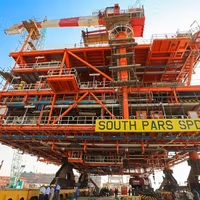
A gas production platform in Iran's South Pars field in the Persian Gulf.
Iran needs $200-250 billion dollars in investments to bring stability to its oil and gas sectors, an official in the chamber of commerce said, reiterating previous comments by the oil minister.
Arash Najafi, head of the energy commission at Iran’s Chamber of Commerce told local media, "In recent years, due to sanctions, we have been deprived or had limited access to many of the world’s latest technologies. At present, we need modern technology, up-to-date equipment, and serious investment to tap into the country’s underground resources, increase gas reservoir pressure, and revive oil fields."
While Iran struggles to increase oil production, its gas output is steadily declining due to loss of pressure in its main South Pars gas field in the Persian Gulf. Only multinational Western energy companies have the technology to install very large gas platforms to boost production.
"We need more than $200 to $250 billion in investment to bring the country’s oil and gas sector to a stable state. Investment is essential for energy transmission to refineries and petrochemical plants, as well as for infrastructure and related facilities,” Najafi added.
Iran's oil minister Javad Owji has also said in the past that Iran needs a minimum of $200 billion investment in its energy sector.
Tehran and Washington are currently negotiating over Iran’s nuclear program and other issues with the hope of reaching an agreement that can gradually reduce or eliminate tough US sanctions. Only then Iran can freely export oil and receive the proceeds through normal banking channels. Currently 95% of shipments go to China and it is not clear how much cash Tehran receives.
Najafi expressed hope that if relations improve with the US Iran can benefit in the energy sector. "The United States is currently a leader in the oil sector, and if we engage in economic cooperation with the US and establish an economic corridor between the two countries, we could benefit not only from its technologies but also from its investment to help develop our oil and gas fields.”
He added that Iran could also attract capital from multinational companies and move toward a stable position in the oil and gas sector.
Iran proposed a three-stage plan to the US delegation during talks in Oman on Saturday envisioning a cap on their uranium enrichment in exchange for the lifting of US sanctions, three diplomatic sources in Tehran told Iran International.
The plan was presented by Iran’s foreign minister Abbas Araghchi in writing to US President Donald Trump’s special envoy Steve Witkoff during the three-hour talks.
Tehran proposed that in the first stage, it would temporarily reduce its uranium enrichment level to 3.67% in exchange for access to financial assets frozen by the United States and permission to export its oil, the diplomatic sources told Iran International.
In the second phase, the sources added, Iran would permanently end high-level enrichment and restore the United Nations nuclear watchdog's inspections if the United States lifts further sanctions on Iran and persuades Britain, Germany and France to refrain from triggering the so-called snapback of UN sanctions on Tehran.
In this phase, Iran would also commit to implementing the Additional Protocol, a supplementary agreement that allows the UN nuclear watchdog to carry out surprise inspections at sites not declared to the agency.
Tehran ended that compliance in February 2021 after Trump in his first term withdrew from a previous international deal over Iran's nuclear program in 2018.
The third and final stage calls for the US congress to approve the nuclear agreement and for Washington to lift both primary and secondary sanctions, while Iran would transfer its highly enriched uranium stockpiles to a third country.
Iran denies seeking a nuclear weapon and the US intelligence assesses that Tehran has not yet resolved to build one, but the Trump administration has warned Iran it must come to a nuclear deal or face attack.
A second round due to be held in Rome on Saturday could prove more rocky than the amicable first round in which Iran submitted its plan for a deal.
Washington toughened its public stance on Tuesday, with both the White House and Witkoff saying that the US goal in negotiations would be the wholesale end of Iran's nuclear program, a notion Iran has repeatedly called a non-starter.
Iran's proposal welcomed by Witkoff
US envoy Witkoff welcomed the proposals presented by the Iranian side, the sources told Iran International, surprising the Iranian delegation in Muscat.
Iranian officialdom appeared cheered by the first round of talks, with Supreme Leader Ali Khamenei remarking in a meeting with senior military commanders on Tuesday that "the initial steps have been implemented well".
A diplomatic source outside Tehran expressed skepticism to Iran International of the Islamic Republic's intentions in the talks and said it seeks to delay a foreign attack by staggering an agreement over several complex phases.
“One of the reasons Iran’s Supreme Leader agreed to allow the resumption of negotiations is the need to buy more time, because he knows Iran currently lacks the ability to defend itself against another airstrike," the source said.
“Iran is mainly stalling to buy time to rebuild its air defense capabilities, which were all destroyed by Israel in late October, and to restore its capacity to produce surface-to-surface missiles which were damaged in that same Israeli attack,” the source added.
Israeli Prime Minister Benjamin Netanyahu’s office said on Thursday that his actions had previously thwarted Iran's ability to build a bomb, appearing to respond to a New York Times report that President Trump had halted Israeli plans to attack Iran.
"Netanyahu has led countless secret and open actions in the campaign against Iran's nuclear program that only thanks to them Iran does not have a nuclear arsenal today," the statement said.
Rafael Grossi, the director general of the International Atomic Energy Agency (IAEA), said on Wednesday Iran was "not far" from possessing an atomic bomb.
"It's like a puzzle: they have the pieces and maybe one day they could put them back together. There's still a long way to go before we get there. But they're not far away, we have to admit that," he said in an interview with Le Monde.
"It's not enough to tell the international community 'we don't have nuclear weapons' for them to believe it. We have to be able to verify it," Grossi said.
In its latest report in March, the IAEA warned that over the past three months, Iran had significantly expanded its reserves of highly enriched uranium, and if this trend continues, its stockpile could theoretically be enough to produce six nuclear bombs.
The shift in the United States from Special Envoy Steve Witkoff's soft stances about Iran's nuclear program to the administrations tougher stance this week seems to have convinced Tehran that it would not be easy to insist on its demands.
At the beginning of the week, Witkoff seemed to suggest that Washington would accept low-level uranium enrichment with Iran, but the following day he retreated, and the rest of the Trump administration began to emphasize that all of Iran’s nuclear program should be stopped
The change came after President Donald Trump said he held meetings with groups of politicians and officials in Washington about the matter. Those politicians could have possibly been individuals who warned Trump that the deal as explained by Witkoff looks more like an Obama deal rather than a Trump deal.
In Tehran, an article published on the Fararu website suggested that two types of unexpected developments could arise at any moment, potentially reshaping the course of the negotiations and broader regional dynamics. One could seriously disrupt the talks, while the other might lead to a sudden breakthrough.
According to Fararu, the first possibility involves a dramatic escalation by Israel—such as a fatal attack on Iranian officials, particularly those directly involved in the negotiations. The second potential surprise, the article argues, could come from an abrupt shift in President Trump’s stance, should he decide to strike a quick deal with Iran in order to claim a diplomatic win on a high-profile international issue.
At the same time, Iranian Foreign Minister Abbas Araghchi declared that President Donald Trump had crossed Tehran’s red line by stating that Iran must halt all uranium enrichment—a core point of contention in the nuclear talks.
Several Iranian analysts, including Iran International’s Ali Hossein Ghazizadeh, argued that Araghchi’s statement could effectively bring the negotiations with Washington to an end.
His remarks came just one day before a planned meeting with Russian President Vladimir Putin in Moscow, and less than three days before his scheduled second meeting with US envoy Steve Witkoff—whose venue had still not been finalized at the time.
To the dismay of Iran’s Foreign Ministry, Iranian and US media reported on Wednesday afternoon that the next round of talks would take place in Rome. The ministry’s spokesperson reacted angrily to the announcement, calling it a sign that “the United States is not serious or committed to the negotiations.”
Interestingly, it was Iran that initially agreed to Rome as the venue. Italian officials welcomed the decision, but Tehran later reversed course and announced that the meeting should instead be held in Oman. According to reporters, two factors may have contributed to this shift: concerns that Iranian opposition groups abroad were planning protests in Rome, and Araghchi’s reported apprehension about a possible encounter with US Vice President J.D. Vance, who is also expected to visit the Italian capital on Saturday.
Meanwhile, the Italian government has expressed its desire to host the meeting at the Italian Foreign Ministry and has reportedly sought to involve other European countries in the talks. Iran, however, has insisted that the meeting be held at the Omani Foreign Minister’s residence in Rome—possibly to keep protesters and reporters at a distance.
Despite Araghchi’s recent critical remarks, conservative commentator Nasser Imani told the Nameh News website in Tehran that Iran might ultimately agree to direct talks with US officials if circumstances require it.
From President Trump’s perspective, only direct negotiations are meaningful. Araghchi, on the other hand, has maintained that the first round of talks was conducted indirectly, with the Omani foreign minister acting as an intermediary. Nevertheless, Araghchi acknowledged greeting Steve Witkoff for about five minutes at the end of the meeting—while reporters claim the two actually held face-to-face talks lasting around 45 minutes.
In his latest speech in Tehran, Supreme Leader Ali Khamenei struck an unusually upbeat tone regarding the talks with the United States, though he cautioned that he was “neither too optimistic nor too pessimistic.” On Thursday night, when Russian President Vladimir Putin receives Khamenei’s message, he will be among the first to glimpse which direction the Supreme Leader is now leaning.
The UN watchdog must be part of nuclear negotiations between Iran and the United States, said International Atomic Energy Agency chief Rafael Grossi, calling its involvement essential to any future deal’s credibility.
Grossi spoke during his visit to Tehran on Thursday, following talks with senior Iranian officials ahead of a new round of US-Iran diplomacy expected to continue in Rome.
US President Donald Trump has threatened to bomb Iran if the negotiations fail.
“I am also in contact with the American negotiator to see how the agency can be a bridge between Iran and the US, and help achieve a positive outcome in the negotiations,” Grossi said. He added that IAEA verification would be required for any agreement to be considered valid.
Grossi has been invited to Rome for the occasion of the second round of Iran-US talks, Reuters reported citing a diplomatic source. However, Iran's deputy FM says it's too soon to engage the IAEA in the talks.
In February, the agency warned that Iran was enriching uranium to near weapons-grade levels, calling the situation “of serious concern.” Tehran has consistently denied seeking nuclear arms.
Iranian Foreign Minister Abbas Araghchi and nuclear chief Mohammad Eslami met Grossi during his trip.
“Had useful discussion with visiting IAEA chief Grossi,” Abbas Araghchi wrote in a post on X. “In the coming months, the Agency can play a crucial role in peaceful settlement of the Iranian nuclear file.”
Araghchi also warned of potential domestic spoilers in the process, adding: “We need a Director General of Peace.”
The agency’s position has gained traction with US officials, who have made broader inspections a central demand.
On Monday, Trump's Envoy Steve Witkoff said in an interview with Fox News that “This is going to be much about verification on the enrichment program, and then ultimately verification on weaponization. That includes missiles—the type of missiles that they have stockpiled there—and it includes the trigger for a bomb.”
If Iran's uranium enrichment is curtailed or banned altogether, strict monitoring would become necessary. Witkoff also mentioned Iran's ballistic missile program as part of any potential nuclear weaponization and urged inspections.
Tehran media outlets controlled by hardliners warned the government on Thursday not to place hope in the outcome of renewed talks with the United States, set to resume in Rome on Saturday.
The commentaries follow five days of speculation over the venue for the second round of talks, along with a considerable degree of public negotiations in which both sides voiced at times contradictory positions.
Kayhan, a daily overseen by Supreme Leader Ali Khamenei’s office, warned that portraying negotiations as the solution to Iran’s economic problems is both misleading and dangerous. This view aligns with Khamenei’s longstanding position since 2018, when President Donald Trump withdrew from the JCPOA nuclear deal and reimposed sanctions. At the time, Khamenei rejected negotiations with Trump and insisted that Iran could endure the pressure without making concessions.
“A tainted and mission-driven current inside the country promotes the idea that 100 percent of our economic troubles stem from sanctions, and that negotiations are the only way to remove them,” the paper wrote.
“This viewpoint was already tested during the JCPOA and yielded nothing but ‘sheer loss’.”
Kayhan did not reject talks outright but insisted they should remain limited.
“We must not abandon negotiations altogether,” the editorial continued. “But we must not put all our eggs in that basket either. At most, 30 percent of our economic problems are due to sanctions, and negotiations should be treated as just one of several tools—not the only one.”
Calling for a wartime posture across government institutions, Kayhan urged officials to invest in domestic capabilities.
“When the enemy, led by the US, threatened us with gasoline sanctions, we could have negotiated,” the paper wrote. “But what proved durable and reliable was relying on domestic capabilities… In the end, the gasoline sanctions were rendered ineffective through trust in revolutionary youth and round-the-clock efforts.”
Javan, a publication linked to the Revolutionary Guard, echoed the skepticism, warning against polarizing discourse.
“Extreme optimism or pessimism about talks risks fueling a false political dichotomy in foreign policy,” the paper wrote.
“A realistic approach strengthens the negotiating team’s resolve, avoids sending weak signals to the opponent, and builds the dignity and prudence necessary for successful diplomacy,” Javan concluded.
Iran and the US held the first round of nuclear talks in Muscat last Saturday, with both sides calling the exchange constructive. But remarks by the US representative—who initially said Iran could retain limited enrichment but later demanded a complete halt to nuclear activity—have heightened tensions.
An Iranian-American man who worked as a contractor for the Federal Aviation Administration (FAA) pleaded guilty on Wednesday to acting as an agent of the Iranian government without notifying US authorities, the Justice Department said.
Abouzar Rahmati, 42, a naturalized US citizen and resident of Great Falls, Virginia, admitted to conspiring to work with Iranian officials and intelligence operatives from at least December 2017 through June 2024. He faces up to 10 years in prison for acting as an agent of a foreign government and five years for conspiracy.
According to court documents, Rahmati offered his services to Tehran in 2017 and later traveled to Iran, where he met with intelligence officers and agreed to obtain information for them about the US solar energy sector. He also gained employment with a US company contracting for the FAA, where he downloaded at least 172 gigabytes of sensitive access-controlled data.
The files included documents related to the National Aerospace System (NAS), airport surveillance radar, and radio frequency data. The DOJ said Rahmati took the data to Iran and handed it over to Iranian officials in April 2022.
Abouzar Rahmati
"Rahmati agreed to obtain information about the US solar energy industry and FAA data, and deliver it to Iranian officials," prosecutors said in a statement. He also used a cover story involving academic research to hide his contacts.
"This defendant knowingly acted on behalf of the Government of Iran and took steps to place sensitive information into its hands," said Assistant Attorney General Sue Bai, who leads the Justice Department’s National Security Division.
Rahmati’s sentencing is scheduled for August 26. The FBI and FAA's counterintelligence division were involved in the investigation.
"The Iranian government continues to target American institutions for infiltration," said US Attorney Edward Martin Jr. for the District of Columbia. "We will hold accountable anyone who puts our national security at risk."