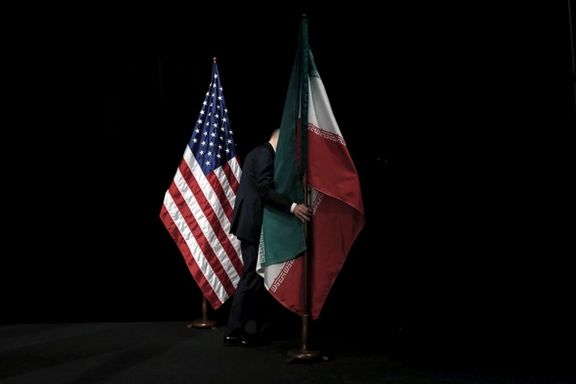
A staff member removes the Iranian flag from the stage after a group picture during the Iran nuclear talks, Vienna, Austria July 14, 2015
Several Tehran outlets defied a state-imposed ban on Wednesday by publishing commentary on ongoing nuclear talks with Washington, some striking an optimistic tone that diverged from the Supreme Leader’s skeptical message a day earlier.
In a speech on Tuesday, Ali Khamenei questioned the likelihood of a deal with the United States under President Donald Trump. Within hours, Iran’s Supreme National Security Council issued a directive prohibiting the country’s press from commenting on the negotiations.
Still, major reformist dailies Etemad and Sharq carried pieces backing the talks the next day—one commentator even letting his imagination sail into uncharted territory.
“Not only will Iran and the United States reach an agreement, but they will also pave the way for the reopening of the US embassy in Tehran and consulates in other Iranian cities,” former MP Esmail Gerami Moghaddam said in an interview with Etemad.
“Trump has never said Iran should stop enrichment—only that Iran cannot have nuclear weapons,” he asserted, arguing that Trump’s recent trade agreements with neighboring Arab nations prove he is not seeking escalation in the region.
Sharq’s editorial—titled Does Diplomacy Still Have a Chance?—was not as rosy, denouncing what it called Washington’s excessive demands.
“Iran does not want to participate in talks that collapse before they even begin,” it quoted an unnamed official as saying, arguing that the “zero enrichment” red line advanced by Trump and his team threatens Iran’s sovereignty.
Nevertheless, the editorial ended on a hopeful note that the talks would continue.
Sharq also quoted former nuclear negotiator Hossein Mousavian—now at Princeton University, where he faces a campaign by Iranian dissidents calling for his removal.
“These problems would not have arisen had there been more direct negotiations with the U.S.,” Mousavian told Sharq, accusing U.S. officials of posturing that, in his words, undermines trust.
This echoed Foreign Minister Abbas Araghchi, who on Tuesday accused officials in Washington of leaking sensitive information and called for confidentiality.
In another piece, Sharq highlighted Qatar’s mediation efforts alongside Oman’s as a potential breakthrough. The duo’s involvement, it argued, could help establish a peaceful framework and restore regional stability.
“Qatar, as an experienced mediator, can build upon Oman’s initiatives,” the editorial said, noting that recent statements from Doha about bridging the gap between Washington and Tehran had raised hopes among diplomats.
By offering to mediate between Iran and the U.S., it concluded, Qatar is sending a clear message to President Trump: that his allies in the region prefer diplomacy over confrontation.
Iran’s hardline Kayhan newspaper, closely aligned with Supreme Leader Ali Khamenei, warned on Thursday that indirect talks with the United States are heading toward a “pre-designed dead-end,” accusing Washington of seeking Iran’s total capitulation on nuclear enrichment.
An editorial warned that the diplomatic process to reach a new nuclear deal is heading toward a “pre-designed dead-end,” accusing Washington of seeking Iran’s total capitulation on nuclear enrichment.
The article came on the eve of the fifth round of negotiations mediated by Oman as Iranian officials expressed growing skepticism over the value of continuing the process.
“The Americans have brought the talks to a dead-end not due to misunderstandings or technical disagreements, but as a direct result of their excessive demands,” Kayhan wrote.
“Their goal is to empty Iran’s hands of nuclear capability and impose their will on a nation that has resisted domination for four decades.”
The remarks echoed comments made earlier this week by Khamenei himself, who publicly rebuked US demands that Iran halt all uranium enrichment and expressed pessimism about the outcome of the diplomatic process.
“We don’t think these talks will succeed, and we don’t know what will happen,” Khamenei said during a speech marking the anniversary of former President Ebrahim Raisi’s death.
Officials from across Iran’s political establishment – including the foreign minister, the parliament, and the first vice president – reiterated that uranium enrichment remains a red line.
Iran is the only non-nuclear weapon state enriching uranium to 60% U-235, a level that causes "serious concern," according to International Atomic Energy Agency (IAEA) Director General Rafael Mariano Grossi.
The IAEA has consistently maintained that there is no credible civilian use for uranium enriched to this level, which is a short technical step from weapons-grade 90% fissile material.
Iran's stockpile of 60% enriched uranium had increased to 275 kg, enough to theoretically make about half a dozen weapons if Iran further enriches the uranium.
Foreign Minister Abbas Araghchi told reporters on Wednesday: “Enrichment will continue in Iran, with or without an agreement. If the other side wants more transparency, we’re open to that, but they must lift sanctions in return.”
He added, “If they want to enter into areas of our peaceful nuclear activities and deprive us of what is our right under the NPT, there will be no room for agreement.”
Iran’s parliament also issued a statement declaring it would “never retreat from the nuclear rights of the Iranian people,” accusing the United States of acting as a “criminal regime” with no legitimacy to dictate terms.
Iranian Foreign Minister Abbas Araghchi has called on the United Nations to respond to Israeli threats against Iran’s nuclear facilities, warning that Tehran will take “special measures” to defend its infrastructure if necessary.
In a letter to UN Secretary-General António Guterres, the UN Security Council president, and International Atomic Energy Agency (IAEA) chief Rafael Grossi, Araghchi cited a recent CNN report that said US intelligence indicates Israel is preparing for possible attacks on Iranian nuclear infrastructure.
“Iran will take all necessary measures to protect and defend its citizens, interests, and facilities against any terrorist or sabotage actions,” Araghchi wrote. “As in the past, we strongly warn the Israeli regime against any adventurism, and Iran will respond decisively to any threats or violations.”
A CNN report this week cited US intelligence officials quoted as saying military movements had been observed suggesting a potential attack on Iran's nuclear facilities in addition to intercepted communications.
Araghchi added that Iran considers the United States responsible for any potential Israeli attack, understanding that any such operation would need the tacit approval of Washington. “In the event of any strike against Iran’s nuclear facilities, the US government will share responsibility,” he said.
Araghchi reiterated Iran's position, in which it maintains that its nuclear program is peaceful and fully under IAEA monitoring, and cited multiple UN and IAEA resolutions prohibiting attacks on civilian nuclear infrastructure.
He warned that, in light of ongoing threats, “the Islamic Republic of Iran will be compelled to adopt special protective measures for its nuclear facilities and materials,” with details to be shared with the IAEA in due course.
Araghchi flags US intel leak on Israeli threats 'alarming'
Following the letter, Araghchi reiterated his message in a post on X, calling it a “serious pre-action warning.”
“Threats from the rogue Israeli regime are nothing new,” he wrote. “But the recent leak citing US officials as divulging Israeli plans for an unlawful attack on Iran and its nuclear facilities is alarming and warrants immediate and serious condemnation from the UN Security Council and the IAEA.”
He added: “The nature, content, and extent of our actions will correspond and be proportionate to preventive measures taken by these international bodies.”
Separately, Iran’s Revolutionary Guards warned that Israel would face a “devastating and decisive response” if it attacked Iran. “They are trying to frighten us with war but are miscalculating, as they are unaware of the powerful popular and military support the Islamic Republic can muster in war conditions,” Guards spokesperson Alimohammad Naini said, according to state media.
Iran’s top nuclear negotiator said uranium enrichment remains the key stumbling block to a breakthrough in talks on the eve of the fifth round of indirect negotiations between Iran and the United States set for Friday in Rome.
“On many issues, we have achieved a better understanding of each other ... However, disagreements remain in some areas, particularly over uranium enrichment. Until that is resolved, I don’t think we can reach an agreement," Iranian Foreign Minister Abbas Araghchi told the Al Sharq news network.
The Oman-mediated talks faced a setback this week after Supreme Leader Ali Khamenei firmly rejected the US demand to end uranium enrichment, the sticking point in the negotiations.
Iran has since expanded its nuclear program. It remains the only non-nuclear weapon state enriching uranium to 60% purity—just a short technical step from the 90% weapons-grade level.According to IAEA figures, Iran now possesses a stockpile of approximately 275 kilograms of 60%-enriched uranium—enough, if further refined, for roughly half a dozen nuclear weapons.
On Tuesday, Khamenei was skeptical about the outcome of the ongoing negotiations. “Saying things like ‘we won’t allow Iran to enrich uranium’ is way out of line,” Khamenei said. “We do not think the talks would yield results now.”
Despite this, Araghchi emphasized that diplomacy remains active and ongoing. “The talks will continue until we reach a result,” he said. “Neither the United States nor the Islamic Republic can unilaterally halt the negotiations.”
Tehran’s strategy to skirt sanctions
Araghchi also addressed the broader strategy behind Iran’s diplomatic and economic posture. Speaking at a regional summit on economic diplomacy in Shiraz on Thursday, he said Iran’s resistance to sanctions—through internal resilience and trade networks—had bolstered its negotiating position.
“The more successful we are at neutralizing sanctions, the more the sanctioning parties will be disappointed—and that will help us in the negotiations,” he said. “If they were certain sanctions would bring us to our knees, they wouldn’t be negotiating with us.”
Araghchi argued that Iran’s ability to withstand pressure was largely due to “the resistance of the Iranian people and the capabilities of our business sector,” which he said prevented sanctions from having a “paralyzing effect.”
However, Iran's currency has been at record lows and over one third of the population is now forced below the poverty line amid the worst economic crisis since the founding of the Islamic Republic with global sanctions levied against Iran not only for its nuclear program but over human rights and its support of Russia's war on Ukraine.
Iranian oil exports reached 2.8 million barrels per day (bpd) in May 2018 and hit a low of just 150,000 bpd in May 2020, before steadily recovering to an average of around 1.65 million bpd so far in 2025, according to analytics firm Kpler. Trump aims to cut the exports to zero. The highest ever exports occurred in 1974 with a peak of 6.02 bpd.
Araghchi further elaborated on the role of the Foreign Ministry in supporting economic resilience, saying it should not be seen as engaging in trade itself, but as a facilitator.
“We do not sell goods or oil at the Foreign Ministry,” he said. “Our job is to open paths, remove obstacles, identify new markets, and connect businesspeople.”
Describing the Ministry’s role as akin to an “icebreaker ship,” he said: “The icebreaker doesn’t carry cargo, but it opens the frozen route so that other ships can pass. Without that route, commercial vessels get stuck.”
Araghchi stressed that bypassing sanctions is a necessary part of Iranian foreign policy. “It’s our responsibility to both lift sanctions and neutralize them,” he said. “Removing obstacles to trade isn’t only about ending sanctions—it’s also about outmaneuvering them.”
As Iran prepares to enter the fifth round of talks, it remains unclear whether the enrichment dispute can be resolved. Both sides continue to hold firm on core issues, with time running short for diplomacy to succeed.
Reports show Israel is preparing for military action against Iran's nuclear facilities if the talks collapse and CNN reported that US President Donald Trump's 60-day deadline to reach an agreement before the threat of military action against Iran becomes a reality, may now have passed.
The US State Department has appointed Iran hawk Xiyue Wang, held prisoner in Tehran for over three years on spy charges, as a senior adviser for Iran, Politico reported on Wednesday.
Wang, who has been outspoken about opposing nuclear negotiations with Iran, recently joined the Bureau of Near Eastern Affairs.
Wang was held for 1,216 days in Tehran’s Evin Prison and released in 2019 in exchange for an Iranian scientist convicted in the US of violating sanctions.
He had traveled to Iran as a Princeton graduate student with permission from the Iranian foreign ministry before being arrested and imprisoned on espionage charges.
In a 2021 lawsuit, Wang accused Princeton University of failing to support him during his detention and of pressuring his family to stay quiet. “They sent me to Iran and left me there,” Wang said at the time.
The US and Iran are set to begin a fifth round of indirect talks in Rome on Friday in spite of remarks from Iran's Supreme Leader this week doubting they will be able to reach an agreement if US terms remain set on stopping Iran's uranium enrichment.
An ad displayed in Tehran’s metro cars that many perceived as a bizarre attempt to criticize birth control has stirred controversy over Iran's official measures to combat shrinking population growth.
“The nurse who healed my mother’s wounds, you are a great lady,” read the caption over an image that many observers at first interpreted as a condom crinkled over a phallic shape.
Below was written: “The nurse who was never born” and “Giving an opportunity to future heroes to be born.”
Social media posts suggested the ad was understood as an anti-condom message promoted by the hardline-dominated municthey have
“Looks like they have seriously used an image of a broken condom in the metro to campaign for childbirth. Since when have they become so open-minded,” user @nah__r asked on X.
The controversial ad in Tehran metro cars
“This ad is dangerously misleading! Condom use is not just for preventing pregnancy, it plays a much more vital role in maintaining sexual health and preventing sexually transmitted diseases,” London-based Iranian hemato-oncologist Dr. Shahram Kordasti weighed in in a post on X.
“Incomplete information is harmful and a sign of the utter irresponsibility of its publishers.”
Design misfire
But the apparent message was due to a misfire in design. Some social media users later clarified that the graphic was intended to show a hospital bed with a bedsheet—not a condom.
The ad, other images bore out, was part of a broader campaign to warn about a future shortage of critical workforce—such as firefighters, emergency responders, and border guards—if Iran’s birth rate continues to fall.
Other versions showed the same shape variously pocked with bullet holes, burnt and frozen, praising the heroism of 'unborn' border patrols, firefighters and rescue workers.
“I realized that that (the opaque covering) was supposed to represent hospital sheets, not condoms after I investigated the ad,” @adameaval posted on X, blaming the campaign’s designers for the confusion.
Towards a pro-birth policy
Iran’s first condom factory was launched in 1987 by the Ministry of Health, part of a wider effort to curb explosive population growth that had exceeded five percent in the early 1980s.
In the 1990s, Iran’s family planning program was considered among the most effective globally, providing free contraceptives through public health services and promoting smaller families.
But over the past decade, authorities have reversed that approach in response to a steep drop in birth rates. According to the latest official statistics, the population growth rate is now just 0.7 percent.
In 2022, the Health Ministry banned free distribution of contraceptives and required a prescription for purchases. Yet demand continues, and illegally imported condoms and contraceptives are still available—sold discreetly through online shops and some pharmacies.
At the same time, abortion crackdowns have intensified. Abortions in Iran are only allowed during the first four months of pregnancy and only in cases of severe fetal abnormalities or when the mother’s life is at risk. Screening kits for congenital anomalies that may encourage abortions have also been banned.
Babies with benefits
The government is now offering financial and other incentives to encourage childbearing, including bonuses for childbirth, free land and extended maternity leave.
In a bid to support infertile couples, the government recently expanded insurance coverage. On April 27, Iran’s Health Insurance Organization announced it would cover 90% of costs for IVF and ICSI in public hospitals, and 70% in private ones.
Speaking at a National Population Day event on May 19, Mohammad-Jafar Ghaempanah, executive deputy to President Masoud Pezeshkian, warned that the recent 7.4 percent drop in births compared to the previous year is a “serious alarm.”
He added that reversing the trend would require “economic stability, improved livelihoods, and job security.”
However, Iran’s struggling economy complicates these ambitions. The Misery Index—defined as the combined rate of unemployment and inflation—has jumped from 19.3 percent in 2016 to 40.3 percent in 2024, with inflation hovering above 32.5 percent for years.
“A government that hasn’t been able to provide welfare or at least the minimum of it for its current population is not well-positioned ethically to tell its people to have more children,” sociologist Saeed Payvandi told Iran International TV from Paris.