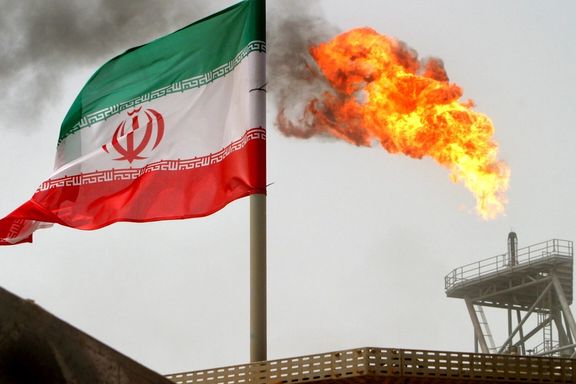
A gas flare on an oil production platform is seen alongside an Iranian flag in the Persian Gulf
While suffering from severe gas shortages, Iran wastes a staggering volume of natural gas during production and transmission—equal to Spain’s annual consumption or about half of what Turkey or Italy use each year.
In regional markets, the wasted gas would be worth over $10 billion per year. It amounts to 40% of the gas used annually by Iranian households.
This massive loss stems from underinvestment in gas recovery infrastructure at oil fields and an aging transmission network.
Most recent data from the International Energy Agency (IEA) shows methane leaks from Iran’s oil and gas facilities exceeded 8 billion cubic meters in 2023.
Iran also flares over 20 billion cubic meters annually due to the lack of gas-capturing systems at oil production sites, according to the World Bank estimates.
Leaks and flaring
Iran ranks fourth globally in methane emissions from fossil fuel operations. Despite this, Iran has made little progress in cutting emissions.
IEA data shows most methane leaks originate from production facilities, with the rest linked to transmission infrastructure.
When it comes to gas flaring, Iran ranks second worldwide. For two decades, the government has done virtually nothing to capture associated gas—the byproduct of oil extraction—opting instead to burn it off at the wellhead.
This alone releases 38 million tons of greenhouse gases annually, nearly matching the total yearly emissions of Sweden or Norway.
Iran’s Oil Ministry estimates it would cost $5 billion to capture the flared gas. Yet investment in oil and gas fields has fallen sixfold in two decades and now stands at just $3 billion, according to the parliament’s Research Center.
As a result, flaring continues unabated, and gas production growth has slowed to a third of its pace a decade ago. Iran now faces gas shortages in all seasons.
Authorities often blame consumers for excessive use, overlooking the fact that losses during production and transmission account for 40% of the gas consumed by households.
•
•
Turning to imports
With domestic solutions stalled, Iran has increasingly looked abroad to cover its shortfall. But solving the crisis will take more than money—it also requires advanced technology and cooperation with international energy firms.
Recent efforts have focused on non-binding memoranda of understanding with Russian companies, none of which have led to concrete outcomes. Ironically, Russia itself suffers from even greater gas losses and lacks the technological capability to fix the problem at home or in Iran.
Iran has also tried to import gas from Turkmenistan and Russia. Turkmenistan, however, halted exports years ago over debt dispute. Russia recently agreed to supply small volumes via Azerbaijan, but pipeline capacity on that route is a fraction of peak deficit in winter.
Despite these shortages, Iran continues to export gas to Turkey and Iraq, often at the expense of domestic industries and power plants.
The reason? Price disparities. Exporting just 7% of its gas earns more revenue than selling the remaining 93% at heavily subsidized domestic rates, offering critical budgetary relief.
In its current budget, Iran projects gas exports of 16 billion cubic meters worth $5 billion—a 14% increase over last year.
But the future is uncertain. The 25-year gas deal with Turkey expires in 2026, and Iraq has announced plans to phase out Iranian gas imports within three years.
Without urgent investment, technological cooperation, and sweeping infrastructure reforms, Iran’s energy sector risks permanent decline—trapped in a cycle of waste, environmental damage, and economic self-sabotage.
Iran is increasingly blending hazardous petrochemicals into its gasoline supply to address a growing shortfall in domestic fuel production, risking environmental damage and endangering public health, according to confidential documents reviewed by Iran Open Data (IOD).
Among the additives is methyl tert-butyl ether (MTBE), a chemical known for its role in groundwater contamination and listed as a potential carcinogen.
Though banned or heavily restricted in numerous countries such as the US, MTBE is reportedly being used in substantial volumes—even in gasoline marketed under European emissions standards, such as Euro 4 and Euro 5.
Unacknowledged chemicals in ‘euro-standard’ fuel
The documents reviewed by IOD detail a system-wide reliance on off-site chemical additives to raise the octane rating of base gasoline. These include MTBE and aromatic octane boosters, which are not derived from conventional refining processes.
Iran’s Shazand refinery, the country’s largest producer of Euro-grade gasoline, blends approximately 350,000 liters of MTBE daily, while the Esfahan refinery adds 325,000 liters per day, according to the data. Both refineries label their fuel as Euro 4 or Euro 5 compliant.
The use of restricted additives contradicts environmental standards associated with the Euro classification, which are designed to reduce emissions and limit pollutants.
Production gap and fuel demand
Iran produced an average of 101 million liters of base gasoline per day in 2024, rising to 121 million liters per day after incorporating roughly 20 million liters of off-site additives. However, daily domestic demand stands at 123.5 million liters, leaving a shortfall of 2.5 million liters.
The shortfall, coupled with economic constraints and sanctions limiting imports and refinery upgrades, has prompted a quiet return to petrochemical-derived gasoline—first adopted during international sanctions in 2010.
Refining limitations and aging infrastructure
In spite of owning the world's second largest natural gas reserves, Iran’s refining infrastructure remains massively underdeveloped resulting from both sanctions and macroeconomic policies in Iran. No new refinery has been commissioned since 2017, and six of the ten major facilities predate the 1979 Islamic Revolution.
The Persian Gulf Star refinery, Iran’s largest by volume, produces 39 million liters/day, but none of its output qualifies for Euro-grade certification.
According to IOD, one-third of Iran’s gasoline is officially labeled Euro 4 or Euro 5, but internal documents indicate that even these fuels often contain high-risk chemical additives.
Health and environmental risks
MTBE is widely banned in Europe, the US, and other countries due to its high solubility in water and persistence in the environment. Even trace contamination of groundwater can lead to environmental damage and health risks for the population, making its use in consumer fuels controversial.
In 2014, a Tehran city health official warned that non-standard fuels could increase airborne benzene levels up to 35 times the safe limit.
A 2023 environmental review by Iranian authorities said that just 38% of gasoline met domestic quality standards. The IOD report suggests the problem has since worsened.
Iran maintains one of the world’s lowest gasoline prices—second only to Libya—due to heavy state subsidies, currency depreciation, and the impact of international sanctions.
Officials frequently cite low fuel prices as a driver of excessive consumption and cross-border smuggling, but attempts to increase prices have been shelved amid fears of social unrest.
The government has not publicly addressed the use of MTBE or other additives, and internal reports avoid naming specific chemicals, instead using general terms such as “aromatic octane boosters” or “off-site petrochemical inputs.”
Iran Open Data warns that Iran’s increasing dependence on petrochemical additives, without parallel investment in refining capacity, poses significant long-term risks to public health, environmental safety, and economic sustainability.
“The growing reliance on high-risk additives has become a cornerstone of fuel supply, in the absence of refinery upgrades,” the report said. “This strategy could carry severe health, environmental, and economic consequences.”
Officials from Iran’s Ministry of Petroleum and the Department of Environment did not immediately respond to requests for comment.
Iran and France traded barbs after dissident filmmaker Jafar Panahi won cinema’s most coveted prize at Cannes, but the diplomatic rift between the two countries runs far deeper than red carpets and celebrity politics.
“There have been many transgressions making a mockery of France’s ‘human rights activism,’” Abbas Araghchi wrote on X, posting a screenshot of a Common Dreams headline from November 2024: “‘Pathetic’: France Says It Will Not Enforce ICC Arrest Warrant for Netanyahu.”
“But perhaps nothing has made the hypocrisy as stark as the French approach to the Israeli regime and its war crimes,” he wrote.
Iran summoned the French embassy's chargé d'affaires on Sunday after French foreign minister Jean-Noël Barroti called Panahi a symbol of resistance against what he said was Iran's oppressive policies.
Nuclear disagreements
France is one of the three European signatories to the 2015 nuclear deal—known as the E3—alongside Germany and the UK. It has the power to trigger the snapback mechanism, which would reimpose UN sanctions lifted under the agreement.
The deadline for this is October 18, as set by UN Security Council Resolution 2231.
According to The Jerusalem Post, senior E3 officials have privately warned Washington that Tehran is deliberately dragging its feet in nuclear talks, potentially weakening the ability of the Europeans to reimpose UN sanctions if negotiations collapse.
Some state-linked outlets in Iran have long accused France of adopting the toughest stance within the P5+1 group.
“France has long played the role of a ‘pressure actor’ in Iran’s nuclear dossier,” a Nour News commentary argued last month. “In effect, Paris acted as the ‘bad cop’ in the negotiations, assuming the tactical role of a disruptor within the P5+1 mechanism,” the piece said.
French firms exit Iran
Tensions are also rooted in economic fallout.
Following the reimposition of US secondary sanctions in 2018, several major French companies exited Iran, abandoning multibillion-dollar ventures launched after the 2015 deal.
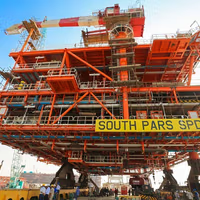
In 2017, TotalEnergies signed a $4.8 billion agreement to develop Phase 11 of Iran’s South Pars gas field—then the largest Western energy investment in Iran since the nuclear deal. The company withdrew in 2018.
France’s auto sector was similarly hit. PSA Group (Peugeot-Citroën) suspended joint ventures with Iran in June 2018, despite a 2016 deal with SAIPA to invest €300 million. Renault also pulled out of a project to produce 150,000 vehicles annually with plans to expand to 300,000.
Detained citizens
France has repeatedly accused Iran of “hostage diplomacy”—detaining foreign nationals as leverage in negotiations.
On May 16, Paris filed a case against Iran at the International Court of Justice over the detention of two French citizens and Tehran’s refusal to grant consular access for more than a year.
Cécile Kohler, a teacher, and her partner Jacques Paris were arrested in 2022 and later appeared on Iranian state TV making what France says were coerced confessions.
French Foreign Minister Barrot warned in January that the release of detained French nationals would directly affect bilateral ties and potential sanctions.
Tehran, meanwhile, accuses Paris of politically motivated arrests of its citizens.
In April, France arrested dual national Shahin Hazamy over alleged support for Hezbollah and Palestinian groups online. In February, French authorities detained Mahdieh Esfandiari, a language teacher, on charges of inciting violence and defending terrorism. Iran says it has been denied consular access in both cases.
In February, French authorities also arrested Mahdieh Esfandiari, a language teacher and translator, on charges of publicly defending terrorism and inciting violence online.
Iran's foreign ministry spokesman Esmail Baghaei said on April 7 that Iran was denied consular access to her.
Sanctions over rights, Ukraine war
France has sanctioned dozens of Iranian individuals and entities—either unilaterally or with EU partners—for Tehran’s crackdown on popular protests and its provision of drones and missiles to Russia for the war in Ukraine.
Those targeted include senior IRGC figures and executives of state-affiliated media.
The clash over Jafar Panahi may have brought tensions into the spotlight, but the grievances on both sides point to a relationship under sustained and widening strain.
A nationwide truck drivers’ strike in Iran entered its fourth day on Sunday, with protests spreading to dozens of cities and major highways despite a police crackdown and arrests.
The Union of Iranian Truckers and Heavy Vehicle Drivers said in a statement on Sunday that police used pepper spray on protesting drivers and arrested several of them.
Launched on May 22 in the southern port city of Bandar Abbas, the coordinated protest has since spread widely across the country, with truckers pledging to hold out for a full week or longer if their demands remain unmet.
Drivers are demanding better working conditions, higher freight rates, and relief from high insurance costs and fuel restrictions.
On Sunday, drivers in the southeastern cities of Jiroft and Sirjan, the western cities of Shabab in Ilam province and Asadabad in Hamadan province, and several locations in Tehran province, including Pakdasht, joined the strike.
Videos show parked freight trucks, drivers refusing cargo, and protest actions such as horn-blaring. The strike has disrupted traffic on key highways and industrial zones.
Footage received by Iran International on Sunday showed strikes continuing in cities across the provinces of South Khorasan, Ardabil, Bushehr, Sistan and Baluchestan, Gilan, Fars, Isfahan, Qazvin, West Azarbaijan, Yazd, and Razavi Khorasan.
Government response
Despite state media efforts to portray freight operations as normal, the scale of the strike has prompted responses from senior officials.
Parliament speaker Mohammad Bagher Ghalibaf on Sunday called truckers a “key link in the production and supply chain” and urged the government to act quickly. He cited high costs of vehicles and spare parts, insurance burdens, and unfair freight distribution.
Mehdi Khezri, deputy head of the Road Maintenance and Transportation Organization, said base fuel quotas would remain unchanged and that the issue was under review.
He added that meetings were being held with the Social Security Organization and the interior ministry, and that a cabinet-level proposal to reduce insurance costs was under discussion.
Khezri acknowledged that a 45% rise in insurance premiums earlier this year had triggered discontent.
Mohammad Mohammadi, deputy head of the Social Security Organization, said the government continues to pay 50% of the 27% insurance contribution for truckers and that this had not changed.
The IRGC-affiliated Fars News Agency called reports of steep insurance hikes “rumors.”
Previous truckers' strikes
Iran’s truck drivers have staged several large-scale strikes in the past.
In 2018, drivers across dozens of cities stopped work for several weeks over low freight rates, high insurance costs, and access to parts, leading to arrests and government warnings.
In 2022, truckers again walked off the job in solidarity with nationwide protests following the death of Mahsa Amini, who died in police custody over an alleged hijab violation.
Truck drivers across Iran staged a third consecutive day of strikes on Saturday, with videos sent to Iran International showing a broad and coordinated stoppage from Isfahan and Borujerd to Mashhad and ports in the south.
The strike, called by the national union of truckers and drivers, has emptied highways, halted freight movement, and drawn in voices from across the country demanding action on long-standing sector grievances.
In a video from Kaveh Industrial City in Markazi province, a driver said: “Please respect each other. These men have debts, they have loans, but they stood their ground so we can fix things.”
Another video from Firoozkouh showed drivers refusing to take loads, stating: “Not a single truck moved freight today. Every driver is on strike.”
Protesters cite steep insurance costs, delays in diesel quota refills and low cargo rates as key reasons for the strike.
A driver from Dezful sent a message saying, “These trucks’ freight rates are too low. They either don’t get fuel or the diesel fuel cards are topped up late. Why has truck and driver insurance gotten so expensive?”
The scale of the action was visible in near-empty transport corridors. A driver on the Tehran-Isfahan highway filmed the road devoid of freight trucks, saying: “Today is Saturday, May 24. This is the Tehran–Isfahan highway, and there’s not a single trailer or truck in sight.”
Another video from Sabzevar showed trailers honking in unison.
In Kazerun, farmers were seen protesting the lack of available transport for their produce.
A driver from Zarand, Kerman, urged others to maintain discipline: “This video is from Zarand. No one should enter the city until we can support each other. Stand together.”
The drivers’ union, which earlier announced, “Our trucks are silent, but our voices are louder than ever,” said the strike would continue until authorities formally commit to resolving their demands.
“We won’t be deceived again,” the union said in a statement. “No driver will turn on the engine until our demands are officially recognized and enforced.”
Exiled prince Reza Pahlavi expressed support for the truckers’ nationwide strike on Friday, writing on X: “As one of the country’s vital economic pillars, your protest against unjust working and living conditions gives voice to the shared suffering of millions of Iranians crushed for years under injustice, incompetence, and corruption.”
Launched on May 18 in Bandar Abbas, the coordinated protest has since spread to over 35 cities, with truckers pledging to hold out for a full week or possibly longer if their demands remain unmet.
The resumption of diplomatic relations between Canada and Iran—severed by Ottawa in 2012—remains unlikely, statements this week from both governments indicated, as tensions and mutual distrust fester.
Responding to a query from Iran International TV on Thursday, Canada’s foreign ministry stated that Iran must undergo “significant changes to its behavior both domestically and internationally” before the restoration of diplomatic ties can be considered.
Iranian Foreign Ministry Spokesman Esmail Baghaei on Tuesday put the onus on Canada to make the first move to restore relations.
“I think the first step they need to take is to unravel the many sanctions and restraints they have imposed on themselves and on our bilateral relations,” Baghaei told CBC News at a press briefing in Tehran on Tuesday.
In its sharply worded statement, however, Canada condemned Iran for what it called Tehran's destabilizing activities in the Middle East, proliferation of drone and ballistic missile technologies, and lack of transparency surrounding its nuclear program.
Ottawa also expressed “deep concern about Iran's failure to uphold its international human rights obligations” and said it will continue to increase pressure on Iran and implement further measures “for as long it continues its unacceptable conduct.”
Canada further called on Iran to fulfill its legal non-proliferation obligations, honor its political commitments under the nuclear agreement framework, and fully cooperate with the International Atomic Energy Agency (IAEA).
At the same press briefing, Baghaei accused Ottawa of turning a blind eye to Israel’s actions while portraying Iran as a threat.
“Is Iran committing genocide? Has Iran occupied another country? Is Iran enjoying the full support of Canada and other Western countries to commit the colonial erasure of a whole nation?” he said.
Designation of Iran's Revolutionary Guards and sanctions
Canada has sanctioned numerous Iranian entities and individuals since 2012 for human rights violations, support for terrorism, ballistic missile and nuclear programs and the IRGC’s downing of Ukraine’s Flight PS75 in January 2020.
Ottawa officially designated Iran’s Islamic Revolutionary Guard (IRGC) as a terrorist organization in June 2024, over a decade after designating its foreign operations branch the Quds Force as a terrorist entity.
On March 7 Canada slapped fresh sanctions on several individuals and entities in connection with the IRGC’s weapons production and sales.
Strained relations for decades
Canada’s relations with Iran took a major hit in 2003 following the death of Canadian-Iranian photojournalist Zahra Kazemi in Iranian custody under suspicious circumstances.
Evidence suggested she had been tortured, but Iran rejected Canada’s demand for an independent investigation by international observers.
A turning point came in September 2012 when Canada closed its embassy in Tehran and expelled all Iranian diplomats from Ottawa.
At the time, Canada cited Iran’s support for Syria’s Bashar al-Assad, its non-compliance with nuclear obligations, threats against Israel, support for terrorism, human rights violations and disregard for the safety of foreign diplomats.
The move came a few months after the 2011 vigilante attack and vandalization of the British embassy and its residential complex in Tehran in reaction to UK’s decision to impose further economic sanctions on Iran over its nuclear program.
After the 2015 election of Prime Minister Justin Trudeau’s Liberal government, there was cautious optimism about re-engagement, especially following the Iran nuclear deal (JCPOA). Canada eased some sanctions in alignment with the agreement.
However, hopes of rapprochement were dashed in January 2020, when the IRGC shot down Flight PS752, killing 55 Canadian citizens and 30 permanent residents.
Iran said it had unintentionally downed the civilian aircraft amid heightened tensions with the US following the assassination of IRGC Quds Force Commander Qasem Soleimani.
Canada officially banned the entry of senior Iranian government officials in November 2022, cancelling dozens of visas and visa applications. The ban was expanded in September 2024 by retroactively applying the inadmissibility to any senior official who served in the Iranian government since June 23, 2003 when Zahra Kazemi was killed in Iranian custody.
Iranian-Canadians
Baghaei also told CBC that the lack of diplomatic ties harms the hundreds of thousands of Iranians living in Canada and contributing to its economy.
In the 2021 Canadian Census, over 280,000 individuals, or around 0.8 percent of the total Canadian population, identified themselves as Iranian or Persian.
The Iranian dissident diaspora in Canada frequently organizes protests in major cities to denounce the Iranian government and the IRGC, and to express solidarity with political prisoners and pro-democracy movements in Iran.