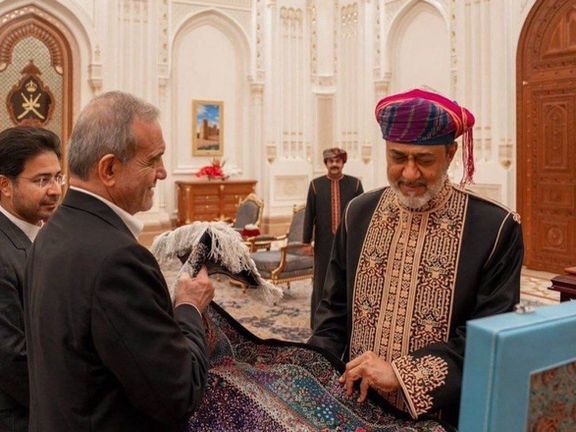
Iran's President Masoud Pezeshkian offering a gift to the Sultan of Oman in Muscat on May 27, 2025
The path forward in Tehran-Washington nuclear negotiations remains uncertain, but Oman has reportedly made two separate proposals to Iran that could provide a potential breakthrough in the stalled talks.
Although neither Iranian nor Omani authorities have officially announced the proposals' content, Iran's Foreign Minister Abbas Araghchi has said they are currently under review.
During his meeting with the Sultan of Oman this week, Iranian President Masoud Pezeshkian praised Muscat’s “active and constructive role in indirect negotiations,” reaffirming that “Iran fully trusts Oman.”
Observers widely believe that Pezeshkian’s visit went beyond the expansion of bilateral ties, as publicly stated, and was primarily focused on Oman’s initiatives.
Consortium or Freeze?
Ahead of Pezeshkian’s visit, conservative lawmaker Ahmad Bakhshayesh Ardestani revealed to Didban Iran news website that Oman had proposed either forming a consortium with Arab nations or implementing a period of freeze in enrichment.
Ardestani, who serves on the Parliament’s National Security and Foreign Policy Committee, said Iran had not accepted either plan, warning: “Past experience has shown that the other side tends to make additional demands after receiving concessions.”
The interview was later removed from the website. The outlet may have been instructed by security bodies to remove the interview because Ardestani claimed Iran could produce several nuclear bombs — a remark viewed as highly provocative.
According to media reports and analysts, the proposed consortium could include regional countries such as Saudi Arabia, Oman, the UAE, Qatar, and the United States.
The arrangement would aim to supply Iran with enriched uranium for civilian use in exchange for partial sanctions relief on Iran’s oil exports, central bank, and the shipping sector.
“Members of this consortium could monitor the process and report on it in order to build US trust,” Seyed Jalal Sadatian, former Iranian ambassador to the UK, told Shargh Daily on Tuesday.
“Evidence suggests that the Omani foreign minister is emphasizing this idea, stating that it is the best way to prove the civilian nature of Iran’s nuclear program without forcing Iran to completely halt uranium enrichment — which has always been a red line for Tehran. Furthermore, Iran insists that any action taken must be step-by-step and reciprocal,” he added.
The consortium idea had previously been floated by former Iranian nuclear negotiator Seyed Hossein Mousavian in a post on X ahead of the April 11 talks in Muscat.
Others have also discussed the possibility of a temporary freeze lasting from six months to three years.
“A temporary agreement would mean that Iran suspends uranium enrichment for a limited period, and in return, the United States eases some of the economic restrictions on Iran,” Iran newspaper quoted political analyst Ebrahim Mottaghi as saying.
What Might Tehran Accept?
Iranian media and observers have widely discussed both claimed proposals, ruling out one or both.
“What has been emphasized by Tehran so far is that it will not accept any consortium and, based on its legal rights under the NPT, it will not relinquish uranium enrichment carried out independently and on Iranian soil,” an editorial published by hardline Kayhan newspaper on Tuesday stated.
The idea of a three-year halt in enrichment “is also unacceptable to our country; even a short-term suspension of enrichment is a trick and a trap that must be strictly avoided,” the editorial added.
The IRGC-affiliated Javan newspaper, too, has dismissed the idea of a three-year freeze as “a unilateral proposal, not a middle-ground one.
Mottaghi, however, told Iran newspaper that a temporary agreement appeared to be more viable for both sides. “The reality is that Iran faces fewer challenges in accepting this option in comparison to the United States’ unilateral approaches, which are often marked by signs of maximalism.”
In a commentary for Ham-Mihan newspaper, political commentator Ahmad Zohdabadi argued that the consortium proposal may have lost traction due to disputes over its location, which echo the broader disagreement over recognition of Iran’s right to enrich uranium on its soil.
“Omani officials have taken on an extremely difficult task. Proposing a solution that simultaneously satisfies Iran, the United States, and other stakeholders appears highly improbable,” he wrote.
After five rounds of talks, Tehran and Washington project cautious optimism while persisting on their shared red line: Uranium enrichment inside Iran. But is the program worth the price it has exacted from ordinary Iranians?
The core dispute is enrichment.
While Iran has signalled willingness to eliminate its stockpile of highly enriched Uranium (HEU) and accept more intrusive inspections, it insists on its right to enrich Uranium to low levels (LEU) for peaceful use.
Trump argues that even this capability leaves Iran with a latent weapon option.
Iran’s enrichment programme has long served as a symbol of national pride. But beyond its political value lies a costly, outdated infrastructure with limited technological merit and major economic consequences.
This article examines the evolution and efficiency of Iran’s programme, its global standing, and the burden it has imposed on the country’s economy and people.
Missed chances and escalation
Iran’s Uranium enrichment began in 1987, amid the Iran–Iraq War, with help from Pakistan’s A.Q. Khan network. The programme’s roots, however, go back to the Shah era of the 1970s, when Iran pursued a civilian nuclear project under the US-led Atoms for Peace initiative.
In the 1990s and 2000s, Iran partnered with China and Russia on development of nuclear power plants while covertly constructing enrichment facilities like Natanz and Fordow, later exposed to the IAEA.
In the early 2000s, Iran had an opportunity to demonstrate transparency. But the concealment of facilities and obstruction of inspections—combined with no clear economic rationale—fuelled suspicion.
Iran had a covert nuclear program that saw it build the controversial facility at Natanz In the late 1990s and early 2000s
Years of negotiations led to the 2015 JCPOA, which capped Uranium purity and stockpiles, reduced centrifuge numbers, and expanded IAEA oversight in exchange for sanctions relief.
The deal also aimed to reintegrate Iran into the global economy. Although President Hassan Rouhani supported limited engagement, the Supreme Leader blocked foreign investment and rejected deeper ties with the US.
Trump’s 2018 withdrawal from the JCPOA marked the collapse of that effort. Iran responded by breaching its commitments gradually, leading to the reimposition of sanctions.
Powerful actors – especially the IRGC, which benefits from sanctions and thrives under isolationism or a “Protection for Sale” framework – opposed the deal from the outset.
Ultimately, the enrichment programme became a political tool rather than an energy strategy, a token of pride pursued at the cost of people’s welfare.
An outdated, inefficient program
Iran’s programme relies heavily on IR-1 centrifuges, based on 1970s Pakistani designs. These machines are inefficient and prone to malfunction. By contrast, advanced enrichment facilities in the West use high-output centrifuges that deliver more work per unit of energy.
Although exact figures remain classified, estimates suggest Iran’s enrichment costs per Separative Work Unit (SWU) – a standard measure of enrichment effort—range from $200 to $300, compared to roughly $40 in advanced economies.
Iran’s Uranium mining is equally inefficient. According to IAEA data and Iran’s own reporting, the production cost of Uranium oxide (U₃O₈) stands at around $1,750 per kilogram, compared to $60 in Canada.
Iran’s commitment to nuclear self-sufficiency – while politically expedient – has become economically self-defeating.
Worse, there is little domestic demand for Iranian-enriched Uranium. The Bushehr nuclear plant operates on Russian fuel under contract. No Iranian reactor uses domestic LEU. Globally, most countries import nuclear fuel rather than enrich it – making Iran’s programme economically irrational and strategically symbolic.
Sanctions: a decade of economic pain
Iran’s nuclear stance has exacted a high price.
Since 2011, sanctions have devastated trade, investment, and GDP growth. Oil exports dropped from 2.5 million barrels per day in 2011 to under 400,000 during Trump’s first term. Though they rebounded to 1.5 million in 2024, levels remain far below that of pre-sanctions era.
Iran’s real GDP shrank by 13% in 2011. It has yet to recover to its 2010 GDP per capita level. Had Iran maintained its pre-2011 trend line with an average growth rate of 5.9%, 2024 GDP would be more than double current levels – roughly $828 billion versus $400 billion today.
Even after adjusting for global shocks like COVID-19 and commodity price spikes, the opportunity cost of the nuclear programme and associated sanctions is estimated at $399-414 billion.
Quarterly GDP data from the Statistical Centre of Iran, originally reported according to the Iranian fiscal calendar, is adjusted to correspond with Gregorian calendar quarters. GDP per capita is calculated in constant 2016 prices, using the most recent $ exchange rate reported by the Central Bank of Iran
The rial has collapsed, from IRR 14,200 per US dollar in 2011 to over IRR 818,000 in 2025. Inflation has averaged 40% annually for six years. Real wages have stagnated, fixed-income households have been hit hardest, and inequality has deepened.
Iran’s exclusion from the SWIFT banking system and refusal to comply with FATF standards have further hampered trade, including humanitarian imports. Capital formation has turned negative, and core industries have withered.
The state’s rhetoric of "resistance economy" offers little comfort to citizens facing chronic hardship.
Sanctions have also undercut Iran’s scientific and industrial base. Universities and research institutes face brain drain. Industrial firms struggle to access spare parts, software, or global partnerships. From car production to pharmaceuticals, entire sectors have regressed.
State survival vs people’s welfare
Iran’s enrichment program today serves political survival, not public welfare. It allows the supreme leader to project defiance, enriches the IRGC through sanctions arbitrage, and sustains the state’s ideological base in times of unrest.
But the cost is immense: capital flight, brain drain, and widespread emigration of Iran’s educated youth. Investments in clean energy, digital infrastructure, and global commerce could have transformed Iran’s economy. Instead, resources are wasted on a technology with minimal strategic gain and substantial economic isolation.
Iran’s future cannot rest on symbolic resistance.
The enrichment programme, as currently structured, has brought little benefit and enormous cost – economically, politically, and socially. It has deprived the country of trade, investment, global legitimacy, and, most importantly, the welfare of its people.
Iran's president Masoud Pezeshkian visiting a nuclear facility, accompanied by atomic agency chief Mohammad Eslami, Spring 2025
The fifth round of Iran–US talks ended without progress. But continued engagement suggests both sides see value in a deal. For Iran, enrichment no longer offers strategic or economic gain. It remains only as a political prop.
Several proposals are under discussion.
One envisions a Persian Gulf regional consortium to oversee enrichment in Iran. This idea lacks a concrete and substantive foundation, but it may open a path to preserve enrichment in principle without allowing full implementation. Another suggests recognising Iran’s theoretical NPT right to enrich while freezing domestic activities. A third offers financial compensation for dismantling facilities.
More creative proposals may yet be found. What matters now is avoiding war.
Iran’s leaders must choose between entrenched defiance and a future grounded in rational diplomacy. The enrichment program has cost far too much – not just in lost GDP, but in the lives and futures of ordinary Iranians.
Symbolic pride is no substitute for real prosperity. It is time to move on.
Mahdi Ghodsi is an Economist at The Vienna Institute for International Economic Studies
Behrooz Bayat is Senior Fellow at the Center for Middle East and Global Order (CMEG)
US President Donald Trump said on Thursday that a new nuclear agreement with Iran was close despite persistent public disagreement over enrichment, though media reports citing sources close to the talks suggested various novel ways out of the impasse.
“We are very close to a solution,” Trump said on Wednesday. “If we can make a deal, I’d save a lot of lives," adding that Iran appears willing to engage seriously and that they had constructive discussions.
The talks mediated by Oman have entered crunch time with no date and location yet announced for a sixth round.
The United States and Iran are nearing a broad agreement on the future of Tehran’s nuclear program, CNN reported on Wednesday, with talks progressing in recent weeks toward a framework that could be finalized at a future meeting.
Washington and Tehran are considering a potential multinational consortium—possibly including regional partners and the International Atomic Energy Agency—to produce nuclear fuel for Iran’s civilian reactors and may include US investment, CNN reported citing source familiar with the talks.
A White House official, speaking to Fox News, said nothing had yet been agreed on Iran’s nuclear energy program.
Iran denies enrichment freeze proposal
Tehran says its nuclear program is purely peaceful but Western countries and its Mideast adversary Israel doubt its intentions.
Iran says it is keen to reach a nuclear deal but has maintained a right to domestic enrichment despite US demands to shutter it.
Iran on Thursday denied a Reuters report citing two Iranian officials saying they were mulling a proposal to halt uranium enrichment for a year and ship part of its highly enriched stockpile abroad or convert it into fuel plates for civilian nuclear purposes.
“The continuation of enrichment in Iran is a non-negotiable principle,” Foreign Ministry spokesman Esmaeil Baghaei said Wednesday.
The suggestion mulled by Iranian officials, according to the sources cited by Reuters, envisions the disbursement of funds frozen by Washington and the recognition of Tehran's right to enrich uranium for civilian use in return for the pause.
Meant as a political deal that could pave the way for a broader accord, the proposal not yet been floated in the talks, Reuters cited the Iranian sources as saying.
Austria on alleged Iranian nuclear arms ambitions
Austria’s domestic intelligence agency released a report this week saying Iran's program to develop nuclear arms is far advanced, in wording which appeared to outstrip that of its Western counterparts.
"Nuclear weapons are intended to make the regime untouchable and to expand and consolidate its dominance in the Near and Middle East and beyond," the Austrian Federal Office for the Protection of the Constitution said in its annual report.
"The Iranian program for the development of nuclear weapons is far advanced."
The United States has publicly assessed that Iran has not yet decided to build a nuclear weapon but maintains that its nuclear program is aimed at becoming a nuclear threshold state to deter foreign attack.
The Austrian report further alleged that Tehran aims to develop long-range ballistic missiles capable of delivering nuclear warheads, without citing any evidence.
"An arsenal of ballistic missiles is ready to carry nuclear warheads over long distances."
Iran open to US inspectors
In an apparent policy shift, the head of Iran’s Atomic Energy Organization said Tehran may reconsider its longstanding ban on US nuclear inspectors if current talks with Washington lead to a successful agreement.
Mohammad Eslami said American inspectors affiliated with the International Atomic Energy Agency (IAEA) could be allowed into Iranian sites under a future deal, despite current restrictions on personnel from adversary states.
“It is normal that inspectors from hostile countries are not allowed, but if a nuclear deal is reached, we might allow American inspectors,” Eslami said.
Later on Wednesday, IAEA chief Rafael Grossi said any deal between Tehran and Washington that would impose fresh nuclear curbs on Iran should include very robust inspections by the UN nuclear watchdog.
"My impression is that if you have that type of agreement, a solid, very robust inspection by the IAEA ... should be a prerequisite," he said.
"I'm sure it will be, because it would imply a very, very serious commitment on the part of Iran, which must be verified."
US officials have repeatedly said that any new nuclear deal with Iran to replace a lapsed 2015 accord between Tehran and six world powers must include a commitment to halt enrichment, viewed as a potential pathway to developing nuclear bombs.
Iran's stockpile of 60% enriched uranium had increased to 275 kg, enough to theoretically make about half a dozen weapons if Iran further enriches the uranium.
Trump has previously warned that if no agreement is reached, military options remain on the table. “We can blow up a lab,” he said, referring to a hypothetical enforcement scenario under a possible inspection regime, “but nobody’s going to be in the lab.”
Trump, speaking to reporters, also confirmed that he warned Israeli Prime Minister Benjamin Netanyahu not to interfere with ongoing US-Iran negotiations.
The comments followed a New York Times report citing Israeli officials saying the Jewish State was preparing for a potential strike on Iranian nuclear sites even if Tehran and Washington clinch a deal.
The Islamic Republic has entered a new phase of security governance—one where control is no longer maintained solely through arrests and bullets, but through data analysis, surveillance, and information engineering.
This shift from overt violence to algorithmic discipline is framed in official discourse as “smartification” and “psychological security”—buzzwords that mask a deeper objective: building a more efficient, anticipatory system of social control.
As Iran negotiates with the United States abroad, it is preparing for a future at home without a deal. Figures once tainted by high-level corruption—such as Babak Zanjani—are now rhetorically rehabilitated as symbols of national resilience, reflecting a broader effort to rebrand dysfunction as discipline.
Authorities are deploying everything from internet monitoring and mobile signal tracking to facial recognition, shop surveillance, and even mandatory in-home cameras to build a digital control society. The goal: neutralize dissent before it begins.
This new architecture of repression aims to present a softer, even “benevolent” face of policing—one nearly invisible thanks to smart technologies. The result is a seamless, predictive regime designed not only to watch citizens, but to sort, anticipate, and contain them.
Policing internet, profiling people
In recent years, the Islamic Republic has adopted a more systematized and technical approach to digital control.
A clear marker of this trend was the resolution passed by the Supreme Council of Cyberspace in January 2025. While billed as a plan to “lift filtering,” the directive in practice expands regulation of online activity.
It authorizes the government, along with the Ministry of Culture and the Judiciary, to police “criminal content,” restrict VPNs, and penalize the spread of so-called “fake news.”
This legislative tightening is matched by tactical enforcement. During protests in Izeh in March 2024, authorities imposed localized internet shutdowns that left hundreds of thousands offline. These quiet, surgical disruptions have become a recurring method of quelling unrest.
In parallel, authorities deactivated SIM cards of journalists, activists, and political users—targeting not speech, but connection itself.
The same tools are now used to enforce dress codes. In Isfahan, authorities reportedly use contactless payment readers and surveillance cameras to identify women who defy compulsory hijab.
Threatening messages are sent not only to the women, but to their families—a form of psychological policing that leverages fear and shame.
Urban surveillance, algorithmic control
These measures show no sign of slowing. In May 2025, traffic police announced plans to use facial recognition for pedestrian violations—a tool once limited to license plates now trained on people.
In October 2024, the national police (FARAJA) began equipping 50,000 officers with body cameras that livestream to command centers, turning patrols into mobile surveillance nodes.
Surveillance is also extending into the private sector. Under the “Septam” system launched in late 2024, businesses must install cameras linked to law enforcement to receive operating licenses.
In April 2025, building codes were updated to require surveillance cameras in any residential or commercial complex with four or more units. The state now watches not just public streets but the thresholds of private homes.
These initiatives fall under the “Police Smartification” plan outlined in the FARAJA Architecture Document. Though couched in the language of public service, its purpose is unmistakable: to restructure digital and urban life for maximum predictability and control.
Pre-empting dissent
The driver behind this system is not technological ambition—it is fear. Officials anticipate the return of mass protests, spurred by economic hardship, power outages, and the possible failure of negotiations.
In response, they are building a pre-emptive framework of repression, where law and policing blur, and surveillance becomes the default mode of governance.
This strategy does not merely suppress resistance—it aims to erase the very possibility of it. By severing communication, dissolving public and digital spaces, and inducing despair, the state hopes to prevent disobedience not just in action, but in thought.
If realized, Iran will not merely be a surveillance state—it will be an anticipatory one. A state where individuals are profiled, categorized, and neutralized before they act.Where repression no longer wears a uniform, but operates silently—to predict and pre-empt dissent.
Iran may reconsider its longstanding ban on US nuclear inspectors if ongoing negotiations with Washington result in a successful agreement, the head of Iran’s Atomic Energy Organization said on Wednesday.
Nuclear chief Mohammad Eslami told reporters in Tehran that inspectors from the United States — currently excluded due to what Tehran views as hostile policies — could be allowed access to Iranian nuclear sites under the auspices of the UN nuclear watchdog, the International Atomic Energy Agency (IAEA), if a deal is finalized.
“It is normal that inspectors from hostile countries are not allowed, but if a nuclear deal is reached, we might allow American inspectors working for the International Atomic Energy Agency to visit our nuclear sites,” Eslami said.
The remarks come as Iran and the United States are expected to enter a sixth round of talks aimed at reviving diplomacy over Tehran’s nuclear program. US President Donald Trump, who withdrew from the 2015 nuclear agreement during his first term, said earlier this month that he expects “good news” from the negotiations.
Enrichment still a red line
Eslami said that uranium enrichment remains a red line for Tehran, speaking of its significance to the country’s nuclear infrastructure.
“Enrichment is the foundation and pillar of the country's nuclear industry,” he said, comparing Western proposals to allowing a country access to a power grid while denying it the ability to generate electricity.
Daily electricity consumption in Iran can vary, with peaks reaching over 72,000 megawatt (MW), exceeding the actual power generation capacity of 60,000 MW during the summer. The capacity of Bushehr nuclear power plant, Iran’s biggest, is currently 1,000MW.
Western powers, led by Washington, have demanded Iran halt uranium enrichment over fears it could lead to nuclear weapons development. Tehran says its program is purely civilian and that it has no plans to build a nuclear bomb.
Iran’s nuclear chief also expressed hopes for what he called greater professionalism from the IAEA and urged the agency to resist outside political pressures, particularly from what he described as “Zionist influence.”
IAEA deputy director allowed to visit sites
He said IAEA Deputy Director General Massimo Aparo is currently in Tehran to inspect two remaining sites as part of an earlier agreement signed in March 2023.
“We hope the agency will act professionally and reduce the influence of the Zionist current,” Eslami said, adding that Iran is fully transparent and operates under full IAEA oversight.
No official proposal on consortium
Addressing reports of a potential nuclear fuel enrichment consortium involving Persian Gulf states, Eslami said Iran has not yet received an official proposal on the matter.
“Our position is legal and based on our rights. Enrichment is the essence of our nuclear industry. We are committed not to pursue nuclear weapons,” he said.
Eslami also dismissed recent allegations from opposition groups and Israeli intelligence about secret nuclear activities, calling them recycled accusations aimed at undermining Iran’s nuclear program.
“Such claims have always been made, but they are baseless. Whenever inspections occur, the truth emerges,” he said.
Oversight of Iran's nuclear facilities has been increasingly challenging for the IAEA. In 2022, Iran removed IAEA cameras and in September 2023, Iran banned a third of the IAEA's inspectors.
Washington is more open to agreeing an interim set of principles for a final nuclear deal with Tehran to break a diplomatic impasse in talks and forestall a potential Israeli attack on Iran, the New York Times reported on Wednesday.
The newspaper, which reported last month that US President Donald counseled Israeli Prime Minister Benjamin Netanyahu against an attack on Iranian nuclear facilities, cited sources familiar with the talks and Israeli thinking.
The United States has become more open to an interim declaration of common principles on a final deal to preempt such an attack, according to the paper.
Mediator Oman and the United States are also discussing creative ways to keep the talks from running aground over the main sticking point of Iranian enrichment.
These include a regional venture to produce fuel for nuclear powers that would involve Iran, Saudi Arabia, and other Arab states, with participation from the United States—though the details of such a plan remain unclear.
A fifth round of negotiations between the US special envoy Steve Witkoff and Iranian foreign minister Abbas Araghchi wrapped up on Friday in Rome with little public sign of progress.
Washington has repeatedly insisted Iran commit to ending domestic enrichment of uranium in a move Tehran has called a non-starter.
Witkoff, the New York Times cited participants in the talks, has dropped an initial rejection of any interim set of understandings on an ultimate deal, in a formula which might fall afoul of Israel and Iran hawks within the US congress.
Israeli officials, according to the sources cited by New York Times, have informed US counterparts that Israel could launch an attack on Iranian nuclear sites even after a deal should it deem the agreement unsatisfactory.
Netanyahu has publicly insisted that Iran suspend all its nuclear activity, in demands which far outpace US insistence on ending enrichment.
The Israeli premier's office issued a statement on Wednesday in response to the article which said simply: "Fake news".
Iran sees domestic uranium enrichment as a national achievement enshrined by international covenants and has accused Washington of being beholden to maximalist Israeli goals.
Some military experts have doubted whether Israel alone can knock out Iranian nuclear capabilities by itself and see its chances of success as much improved with American participation.