Europe backs Israel, blames Iran for instability

The European Union opened the G7 in Canada on Sunday by chiding Iran as a destabilizing force in the Middle East and urging diplomacy while backing what it called Israel’s right to defend itself.
Iran International

The European Union opened the G7 in Canada on Sunday by chiding Iran as a destabilizing force in the Middle East and urging diplomacy while backing what it called Israel’s right to defend itself.
“Iran is the principal source of instability in the Middle East,” said Ursula von der Leyen, President of the European Commission.
Von der Leyen warned that Iran’s destabilizing actions aren’t confined to the Middle East.
“The same type of Iranian-designed drones and ballistic missiles are indiscriminately hitting civilians in Ukraine and now in Israel,” she said. “They must be addressed together.”
The European Commission president called for a unified response to both crises, arguing that any solution must take into account the broader threat posed by Iran’s weapons exports and regional aggression.
“Iran can never have nuclear weapons."
Von der Leyen said she spoke by phone with Israeli Prime Minister Benjamin Netanyahu on Sunday to discuss the need for a lasting solution through negotiation, but said Israel “has a right to defend itself.”
US President Donald Trump also spoke by phone with Van der Leyen to discuss the economic fallout of the Iran-Israel war, focusing on potential safeguards to stabilize global energy markets.
The conflict, which saw both countries target each other’s energy infrastructure over the weekend, has already sent oil prices surging and disrupted tanker traffic and supply flows across the region—threatening to push the global economy into deeper volatility.
“The time to give diplomacy a chance is now,” said António Costa, President of the European Council. “We must step up our efforts in the Middle East.”

Israel has targeted Iran’s energy infrastructure in a major escalation that could unleash deep suffering for millions facing fuel and gas shortages.
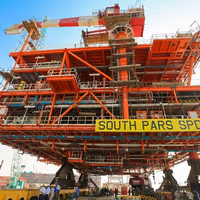
According to Iran’s Ministry of Petroleum, Israeli missiles hit a gas sweetening unit at Phase 14 of the South Pars gas field and the vast Fajr Jam gas processing complex—both in southern Iran—as well as three major fuel storage depots in Tehran.
South Pars accounts for roughly 75% of Iran’s total natural gas output. The damaged facilities alone supply around 10% of the country’s gas consumption.
The full extent of the damage remains unclear, but Iranian media report serious harm to Fajr Jam’s gas intake and processing infrastructure. The plant, with a capacity of 50 million cubic meters per day, may have been forced offline.
The Petroleum Ministry also confirmed that 60% of Phase 14’s 20 million cubic meters-per-day output has been halted.
Israel had previously warned it would target Iran’s energy sector if Iranian forces struck Israeli civilians.
Tehran fuel depot also hit
Saturday’s strikes extended to Tehran, where Israeli forces reportedly hit the Shahran, Kan and Rey fuel depots—facilities that supply nearly all the capital’s gasoline and diesel.
Tehran’s total storage capacity is estimated at one billion liters, a quarter of Iran’s national fuel reserves.
A confidential Ministry of Petroleum document obtained by Iran International indicated that, as of late March, the country held 1.56 billion liters of gasoline and 1.28 billion liters of diesel in storage—barely enough for ten days of nationwide use.
Tehran alone consumes over 20 million liters of gasoline and 7.5 million liters of diesel per day.
With those storage hubs damaged, the capital now faces a looming fuel crisis, with more Israeli strikes likely on Iran’s energy infrastructure, as Iranian missiles hit targets in Israel.
So far, at least 14 Israeli civilians have been killed in Iranian attacks, while Iran’s health ministry has reported more than 200 killed.
Closing the Strait of Hormuz?
As strikes hit southern gas infrastructure, Iran’s Foreign Minister Abbas Araghchi warned that “spreading the war to the Persian Gulf could drag the entire world into conflict.” He gave no specifics, but lawmaker Esmail Kowsari said Tehran is considering closing the Strait of Hormuz.
Data provided to Iran International by commodity tracker Kpler shows Iran exported 2.2 million barrels of crude oil per day in the first 10 days of this month, and 1.8 million barrels daily on average last month—all through terminals in the Persian Gulf that rely on the strait.
Iran’s only alternative is the Jask terminal, inaugurated on the Sea of Oman in 2020. It was briefly used last October—amid fears of an Israeli strike—but averaged under 200,000 barrels per day and is currently inactive, according to TankerTrackers data.
Because Jask is over 1,000 kilometers from Iran’s main oil fields and has limited capacity, closing the strait would effectively halt Iran’s own oil exports.
The economic fallout wouldn’t stop there: according to Iran’s Ports and Maritime Organization, 80% of Iran’s non-oil trade also passes through the Persian Gulf and the Strait of Hormuz.
The partially developed Chabahar port—built with Indian assistance—handles less than 4% of the country’s total cargo throughput.

Israel continued its military campaign against Iran through the weekend and into Monday, launching new strikes across multiple cities, especially the capital Tehran, forcing residents to flee.
Here's a brief summary of major events and developments so far.
Israel escalates strikes, hits multiple cities
Iran strikes back with new missile barrage
Casualties mount on both sides
Israel unveils psychological pressure plan
Khamenei under fire from within and abroad
Talks with US in jeopardy as blame mounts
Washington's role
Nuclear risk remains high, says IAEA

Heavy traffic was seen on major highways leading out of Tehran on Sunday, including roads toward Saveh in the southwest and Mashhad in the east, as residents appeared to flee the capital, according to videos received by Iran International.
One video showed congestion on the Tehran–Saveh road, while another, captured similar scenes on the Tehran–Mashhad route.
The apparent exodus follows reports by Israel’s Channel 14 that the Israeli military has launched a strike plan designed to trigger mass civilian evacuations from Tehran.
According to the report, the operation, approved by Prime Minister Benjamin Netanyahu and Defense Minister Yoav Katz, involves targeting sites linked to the Iranian government in an effort to apply pressure through psychological and logistical disruption.

G7 leaders are arriving today in Alberta, Canada, against the dramatic backdrop of the Rocky Mountains—and an escalating war between Iran and Israel.
The summit, hosted by Canada under its current G7 presidency, brings together the world’s seven major economies along with guest nations including Ukraine and South Africa.
But what was expected to be a forum for long-standing economic discussions and global trade tensions is now being overshadowed by urgent geopolitical turmoil.
US President Donald Trump told reporters before heading to the summit that he hoped for a peaceful resolution to the Iran-Israel clash but the two enemies may have to keep fighting.
"Well I hope there's going to be a deal. I think it's time for a deal and we'll see what happens but sometimes they have to fight it out but we're going to see what happens. I think there's a good chance there will be a deal," he said.
Trump declined to say if he requested Israel pause its attacks on Iran but said Washington would continue to aid Israel's defense against Iranian missiles.
Conversations that were originally expected to focus on peace efforts in Ukraine and Gaza have now pivoted sharply to the Iran-Israel conflict. The G7 agenda has been thrown into disarray as leaders scramble to respond to the escalating violence between Tehran and Tel Aviv.
“We do have longstanding concerns about the nuclear program Iran has," said British Prime Minister Keir Starmer speaking on a flight to Canada Sunday.
"We do recognize Israel’s right to self-defense, but I’m absolutely clear that this needs to de-escalate. There is a huge risk of escalation for the region and more widely,”
Trump earlier told ABC News he believes peace between Iran and Israel is likely, and that recent military strikes could pressure Tehran into agreeing to a nuclear deal in the near future.
"Something like this had to happen because I think even from both sides, but something like this had to happen. They want to talk, and they will be talking," Trump said.
Trump also expressed optimism about a potential Russian mediation between the two sides.
The president said the US will continue to support Israel but declined to confirm or deny if he asked Israel to pause strikes, he said speaking to reporters as he left for the G7 summit in Canada.
French President Emmanuel Macron said Sunday he hoped tensions between Iran and Israel would de-escalate “in the coming hours,” and urged a return to nuclear negotiations with Tehran.
Talks in limbo
Negotiations between the United States and Iran, previously scheduled for Sunday, were abruptly derailed after several members of Iran’s delegation were allegedly killed in an Israeli airstrike.
The G7 has the ability to help close the cycle of violence in the Middle East, said Iran analyst Behnam Ben Taleblu of the Foundation for Defense of Democracies (FDD).
World leaders need to remind Tehran "the sharp choice it faces: trade away your nuclear program or watch it, and perhaps the rest of your military capabilities, be taken away from you," Taleblu told Iran International.
President Trump has said the US may consider direct involvement in Israeli military efforts, though he also expressed openness to Russian mediation as a possible diplomatic solution. Meanwhile, Washington has committed to deploying additional warships and military assets to the Middle East.

Iran's Supreme Leader Ali Khamenei was moved to an underground bunker in Lavizan in northeastern Tehran hours after Israel began its attacks on Tehran early Friday, two informed sources inside Iran told Iran International.
All members of Khamenei's family including his son Mojtaba are with him, the sources said.
According to the sources, during the previous operations against Israel, True Promise 1 and True Promise 2, the Supreme Leader’s family was also taken to the bunker.
At that time, Mojtaba was by his side, but two of his sons, Masoud and Mostafa, were not with him.
Iran’s first direct attack on Israel, Operation True Promise 1, took place on April 13, 2024, and involved over 300 missiles and drones targeting military installations. The strike was in retaliation for the killing of two Iranian generals in Damascus.
Operation True Promise 2 followed on October 1, 2024, with approximately 200 missiles aimed at Israeli military facilities in response to the assassination of Iran-aligned militant leaders, including former Hezbollah chief Hassan Nasrallah.
Warning to Khamenei
On Sunday, Israel targeted the city of Mashhad, located 2,300 kilometers from the Jewish State, for the first time.
A diplomatic source in the Middle East told Iran International that the Israeli airstrike on Mashhad was a warning to Iran’s Supreme Leader that he is not safe anywhere in the country.
The diplomatic source added that Israel could have eliminated Khamenei on the first night of the operation, but the Israeli government chose to keep him alive to give him a final chance to decide on completely dismantling the Islamic Republic’s uranium enrichment program.
Trump had given Khamenei a two-month deadline to agree to dismantle Iran’s enrichment program. However, the Supreme Leader ignored both his and Israel’s warnings.
With the start of Israel’s airstrikes, that opportunity has been offered once again — this time for him to realistically assess Israel’s military capability and order the dismantling of the enrichment program, the sources said.