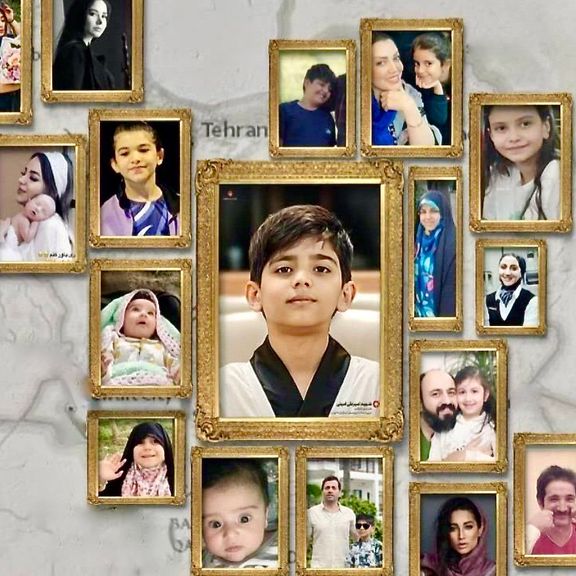
Some of the civilian victims of Israeli strikes on Iran
Israel’s twelve days of air attacks on Iran killed hundreds of civilians—among them an eight-year-old gymnast in a red dress whose last joyful dance has become a symbol of the war’s human cost.
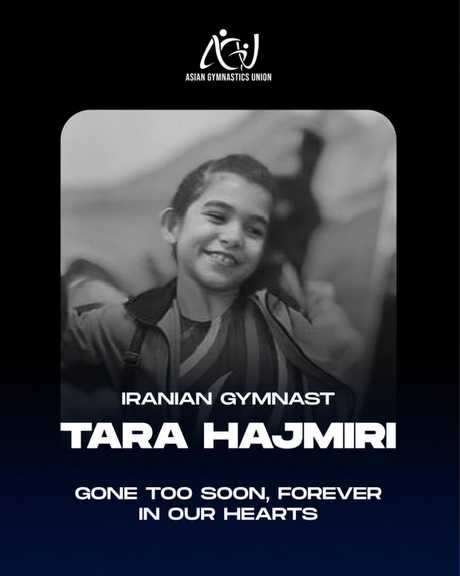
A video posted on Instagram by a relative appears to show Tara Hajmiri dancing in a dentist’s office. Her black ponytail sways behind her as she beams with joy and glides toward the treatment chair. Hours later, her short life was over.
Tara died alongside her parents when Israeli missiles struck three six-story residential buildings on Patrice Lumumba Street in central Tehran in the early hours of June 13.
Her father, an estate agent, and her mother were found in the rubble. Israel's military later said the buildings were targeted to eliminate an unnamed nuclear scientist.
Tara's name spread quickly across Iranian social media, where she came to represent innocence lost in war.
Asian Gymnastics Union's tribute to Tara Hajmiri
The war's youngest victim appeared to be Rayan Ghasemi, a two-month-old infant, who succumbed to burn injuries after an Israeli strike on June 19.
His parents, Behnam Ghasemian, an engineer, and Dr. Zohreh Rasouli, a gynecologist, were also killed. His older brother, Kian, remains hospitalized with serious injuries.
A poet’s last verse
Another victim whose story and face became an instant icon was 23-year-old Parnia Abbasi—a poet and English teacher who loved Coldplay, Italian food and mountain climbing.
She was one of the very few to grab attentions outside Iran, her smile and her verses touching hearts.
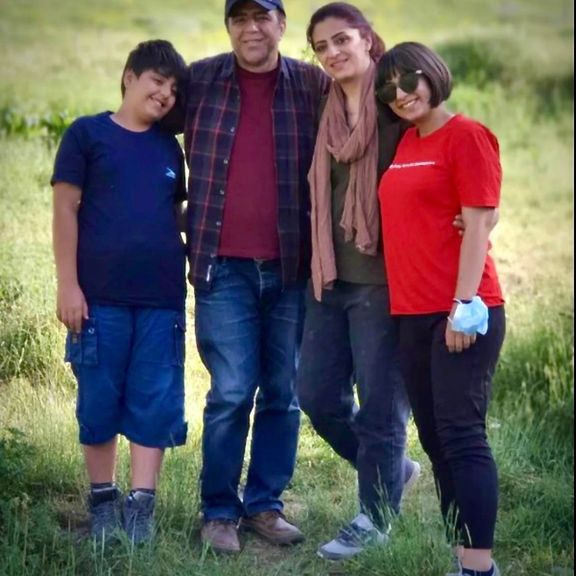
Young poet Parnia Abbasi and her family
Her family said she often wrote about love and longing. One poem, Returning to You, was widely shared after her death:
You crash upon my shore
the rhythmic pearl of your body bursts across the sand
•
•
I row toward your embrace
cast your smile like a hook
The fish are caught and I fall in love
all over again.
Parnia was killed with her entire family—father Parviz, a retired teacher, mother Masoumeh, a retired bank clerk and 14-year-old brother Parham—when their building was leveled.
Israeli authorities later said the intended target was Abdolhamid Minouchehr, head of nuclear engineering at Shahid Beheshti University.
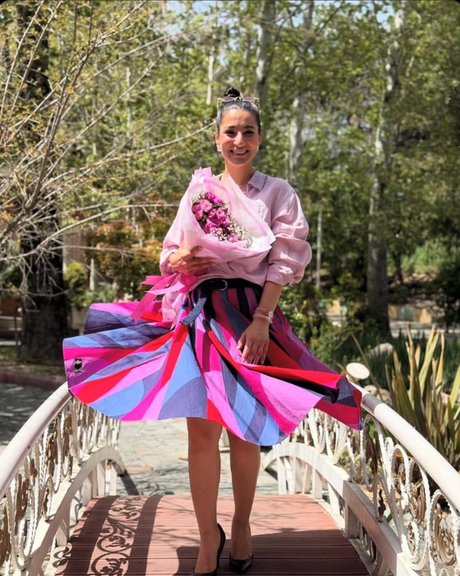
Sarvnaz Vaezzadeh, young business development expert killed in Tehran
Hundreds More
Another victim, graphic artist Saleh Bayrami, was killed while waiting in his car at a traffic light on June 15, en route to a job interview. The strike near Tehran’s Tajrish Square killed several others.
Iran’s Health Minister Mohammad Reza Zafarghandi said on June 23 that 606 people had been killed, without specifying how many were civilians.
Independent tallies put the toll higher—1,190 according to the US-based human rights group HRANA, which reported military deaths just above 400, with the rest either civilian or yet to be determined.
The Israeli government has defended its actions as pre-emptive strikes on Iran’s nuclear infrastructure. But the deaths of Tara, Rayan, Parnia, and Saleh have sparked grief—and questions.
Their names stand for the civilians caught in the crossfire of a conflict paused for now, but which could return with a vengeance at any moment.
Their faces—once full of promise—have become symbols of loss, of questions unanswered, of the cost of ideology and war.
Iranians speaking via Iran International's submission line doubted Supreme Leader Ali Khamenei’s declaration of victory over the United States and Israel in a televised speech on Thursday.
“If the killing of the Revolutionary Guards' top commanders in the first 10 minutes of war counts as a victory, then let Khamenei live in his delusions," said one person, whose identity was withheld for their safety.
"The people have seen and felt the Islamic Republic’s defeat and humiliation"
Comments were submitted by viewers of the Persian-language broadcaster.
“The fact that Netanyahu walks among his people without bodyguards, and this shameless coward is sending videos from a rat hole says everything,” said another. “Even a 13-year-old can analyze what really happened.”
Khamenei appeared in a pre-recorded video aired Thursday, speaking from what observers believe is a fortified underground facility in an undisclosed location. The video setting matched hisprevious wartime address.
The veteran leader declared Israel had been “brought to its knees” and the United States had “gained nothing.”
Many Iranians expressed anger at his absence as average people fretted and fled.
“You disappeared for twelve days. Now you crawl out and call this 'victory'? Not a word for the people who were terrified," another person wrote."Not even an image, not a sentence for those who were dying."
“During those twelve days, mothers hugged their children so the last missile wouldn’t take them,” one woman added. “Now you return like some fake hero and say ‘we won’? Won what—destroyed cities? Dead children in Tehran? Protesters arrested for nothing?”
The US-based human rights website HRANA reported on Wednesday that 823 Iranian citizens had faced political or security-related charges since the outbreak of the war.
According to the report, 286 people were detained for their online activities, including sharing content about Israel’s attack on Iran.
Say 'I beat them'
Another viewer sarcastically referenced a line from one of the most iconic soliloquies in a so-called Film-Farsi movie from before the Islamic Revolution to describe Khamenei's claim of victory.
In the scene, a character recounts a fight in which he was badly beaten and collapsed before he could even draw his knife—but still boasts about winning.
He said, half-pleading, half-boasting: “Now, I told everyone I beat them. You say I did too; it doesn’t look good.”
Some also directly criticized Khamenei’s personal safety measures: “If he’s telling the truth, let him come out and speak. He’s still hiding in the sewers. These cowards only speak from a distance.”
Some replies even mocked the Supreme Leader’s physical appearance. “He looked pale and shaken,” one person wrote.
“He says 90 million Iranians are standing behind the armed forces. I’d like him to come out of his bunker and see for himself how many people actually support this regime.”
Massive costs
One of the most repeated themes in the reactions dwelt on the costly destruction the war wrought. Many commenters pointed to the toll on ordinary Iranians, saying the only outcome had been ruin.
“Nothing has come out of this except the destruction of Iran, massive costs and making life even worse for the people — and nothing else ever will,” read one message.
“All this destruction, all these deathsxand now they talk peace?” another said. “Khamenei wasn’t crushed? Just look at his voice—shaky, scared. He’s hiding underground, while we’re left in the rubble.”
Accountability
Another recurring theme was frustration over the perceived lack of accountability.
“The country is in ruins," one person said. "Did you even offer condolences for your own commanders who died overnight? You only care about those close to you. The rest of us don’t matter.”
The responses also reflected exhaustion with decades of problems.
One viewer said: “It’s been forty years of war, sanctions, and lies. Enough. We can’t breathe anymore.”
Another emotional message said: “We’ve been living in this Islamic Republic for half a century. We’ve learned to reverse whatever they say. If they say Israel was crushed, it means we were.”
A cleric and his wife carry Iranian and Hezbollah flags as they attend a gathering to support Iran's Armed Forces after US President Donald Trump announced a ceasefire between Israel and Iran, in Tehran, Iran, June 24, 2025.
Call for referendum
Some viewers called for a referendum to determine whether Iranians truly support continued conflict with Israel or financial support for proxy groups abroad.
“They’ve gotten so used to privilege and plundering public wealth that they refuse to let go, no matter what," one message read. "Enough is enough — for God’s sake, hold a referendum and see how many people actually support this regime.”
“Conduct a free and independent poll and find out how many Iranians really want to fight Israel or support Hezbollah and others. We don’t want war, we don’t want disaster — what are we supposed to do now? Just sit and wait for them to build a nuclear bomb and officially turn us into another North Korea?”
Others condemned what they described as the Islamic Republic's weaponization of Shia identity and historical symbols, accusing it of betraying the values of Imam Hussein by taking the Iranian people hostage.
“Imam Hussein didn’t use the people of Mecca and Medina as human shields to fight Yazid,” one viewer said. “Why are we being held hostage for your battles? You’re not fighting tyranny—you are the tyranny.”
Iran’s Supreme Leader Ali Khamenei was not involved in the negotiations or approval of the recent ceasefire agreement between Iran and Israel, according to information obtained by Iran International.
Decision-making regarding the truce was handled instead by Iran’s Supreme National Security Council and President Masoud Pezeshkian, who moved swiftly to respond to a ceasefire proposal from US President Donald Trump.
A source familiar with the details of the deliberations told Iran International that the council intended to respond quickly to the American proposal. However, at the time, there was no opportunity to contact Khamenei. The ceasefire was therefore approved and communicated without the supreme leader’s knowledge.
In recent days, Khamenei’s communication capabilities have been severely limited due to security concerns, particularly fears of an attack on his location.
Iran International previously reported that Khamenei and close family members, including his son Mojtaba, were relocated to a secure bunker in Lavizan, northeast Tehran, soon after the conflict began.
Earlier this month, Iran International reported that Khamenei had transferred key decision-making powers to the Supreme Council of the Islamic Revolutionary Guard Corps (IRGC) shortly after the start of the attacks by Israel. The transfer of authority was viewed as a precautionary step to ensure continuity of command in the event of an escalation or direct threat to the leader’s safety.
Iran has not officially confirmed the location of the Supreme Leader or the details of the internal deliberations surrounding the ceasefire.
First message after ceasefire
Earlier in the day, Khamenei released his first public message since the ceasefire took effect on Tuesday, delivering a televised address in which he declared victory over Israel and said the United States was dealt a blow during the conflict.
“The Zionist regime, with all its noise and claims, was nearly brought to its knees,” he said. “The United States gained nothing and received a harsh slap in return.”
The setting of Thursday’s video matched earlier wartime messages, suggesting he remains in the same secure location.
Trump had previously posted on Truth Social that the US knew where Khamenei was hiding, describing him as an “easy target” and warning that American patience was “wearing thin.”
However, in remarks following the ceasefire announcement, Trump adopted a more measured tone, suggesting that “regime change takes chaos,” and adding, “we don’t want to see so much chaos, so we’ll see how it does.”
He also confirmed that the US is preparing for a new round of talks with Iran in the coming week.
The ceasefire between Iran and Israel brought relief to millions—but also sharpened fractures within the Islamic Republic and among its opponents.
Hardliners have declared it a strategic victory—some even lamenting that it ended too soon to deliver a heavier blow. Moderates, as ever, are trying to frame the moment as a chance for national reconciliation—“reform” in their lexicon.
“Have you seen the dignity, courage, authenticity, and patriotism of the Iranian people in the face of Israel’s aggression?” journalist Ehsan Bodaghi asked the leadership.
“The most important ceasefire is a ceasefire with your own people. Any path that doesn’t go through that leads to ruin.”
But hardliners have little patience for voices like Bodaghi’s. For them, the war reaffirmed Tehran’s regional standing—and the ceasefire, if anything, came too soon.
“Let’s say hello to a new Middle East!” declared Ezzatollah Zarghami, former head of state TV. “The courage and resistance of the Iranian people changed global equations.”
Ultraconservatives went further, rejecting the truce altogether.
“You can surrender if you like, but we will continue to fight,” said cleric Mohammad Mehdytabar. “It’s just the beginning of a new phase of war,” MP Amir-Hossein Sabeti posted on X.
Relief meets suspicion
Outside the halls of power, the mood is more weary than triumphant. Many Iranians are grateful for the pause—but skeptical that anything will change.
“Mark my words: when the war ends, they will arrest women for hijab again, the internet will be filtered, cronyism and corruption will thrive,” warned entrepreneur Nima Namdari, predicting a return to the regime’s “default mode.”
The warning appears timely: judiciary officials have already proposed amendments expanding espionage laws and widening the powers of security agencies.
Others voiced frustration with exiled opposition figures who, they say, ignored the human toll in pursuit of collapse.
“It’s shameful how some Iranians abroad have reacted after the ceasefire,” wrote Mani Ghassemi, founder of tech outlet Digiato. “They’re upset the war didn’t achieve the outcome they envisioned, yet say nothing about the 700 dead—according to Iran’s health ministry.”
During the war, state media briefly softened its tone. A patriotic song by Moein—an exiled LA-based pop icon—aired on national TV for the first time in decades. Billboards swapped religious slogans for Iran’s pre-Islamic heroes like Arash the Archer.
Some moderate insiders saw in this a cue to shift course.s
“Israel is not an actor with whom one can remain in a decades-long state of ceasefire like with Iraq,” wrote former diplomat Hamid Aboutalebi, urging Tehran to rethink—or face escalation.
Polarization by design
Hours before the truce, exiled prince Reza Pahlavi announced his readiness to return and lead a peaceful transition, calling the moment the “final phase” of Iran’s struggle.
But the day after, Donald Trump made clear he does not support regime change, citing the risk of chaos. For royalists and anti-regime activists, it was a bitter reversal.
Monarchist Alireza Kiani responded by calling for more—not less—polarization.
“Revolutionary moments require it,” he wrote. “On one side are Iran nationalists seeking to overthrow the regime. On the other are its unashamed—and ashamed—supporters. This divide must be continually reinforced.”
But journalist and human rights activist Kambiz Ghafouri warned against placing hope in foreign firepower.
“The Islamic Republic will fall—sooner or later—but by the hands of the Iranian people, not through foreign attack,” he wrote.
“Neither Trump nor Netanyahu is genuinely interested in regime change. For them, a battered Islamic Republic is preferable to a strong, democratic Iran.”
Iranian authorities said they have executed three men accused of smuggling equipment allegedly used in the assassination of Mohsen Fakhrizadeh, a senior figure in Iran's nuclear program who was assassinated in 2020.
The judiciary’s official news outlet, Mizan, reported on Wednesday that Edris Aali, Azad Shojaei, and Rasoul Ahmad Mohammad were put to death at Urmia Central Prison in northwest Iran.
The three were charged with "corruption on earth" and "enmity against God," accusations often levied in cases involving alleged collaboration with foreign governments.
Authorities said the men had worked to smuggle components hidden in shipments of alcoholic beverages, which they claim were ultimately used in the assassination of a high-ranking Iranian official.
While Iranian state media did not name Fakhrizadeh directly in its recent coverage, the allegations correspond with earlier reports linking the men to his killing.
Fakhrizadeh, a senior officer in Iran’s Revolutionary Guards and a prominent figure in its nuclear development efforts, was shot dead in an attack east of Tehran in November 2020. Iran has blamed Israel for orchestrating the assassination.
Edris Aali, Azad Shojaei, and Rasoul Ahmad Mohammad
Contested confessions and accusations of torture
Human rights organizations have raised concerns about the case. According to an exclusive report by Iran International, all three men—reportedly Kurdish cross-border porters known as kolbars—were convicted based on confessions obtained under severe duress.
Aali and Shojaei were reportedly detained for months in Ministry of Intelligence facilities before being transferred to Urmia Prison.
Family members told media outlets the men denied involvement and said their televised confessions were extracted under torture. Ahmad Mohammad, an Iraqi national from the Kurdish city of Sulaimaniyah, was arrested two years after the killing, allegedly after his phone number was found in Aali’s contact list.
Israel has not officially claimed responsibility for the assassination, though officials have not denied involvement. In the years following the incident, Israeli media and intelligence sources have described it as a remote-controlled, AI-assisted operation using a weapon smuggled into Iran in parts and reassembled inside the country.
An Israeli intelligence officer told Channel 12 in 2022 that the operation relied on facial recognition to avoid harming Fakhrizadeh’s wife, who was in the car with him, and took less than three minutes to carry out.
Iran’s former Intelligence Minister Mahmoud Alavi said in 2022 that efforts to apprehend the main perpetrators had failed, with several suspects fleeing the country shortly after the attack.
Fakhrizadeh, long described by Western intelligence agencies as the architect of Iran’s nuclear weapons program, was sanctioned by the United Nations and had survived previous assassination attempts.
Iranian intelligence forces have arrested more than 700 Iranians accused of acting as agents for Israel over the past 12 days, the IRGC-affiliated Fars News Agency reported on Tuesday.
According to the report, the arrests targeted what authorities described as an “active espionage and sabotage network” that intensified operations after Israel’s attack on June 12, which killed several senior Iranian military and nuclear figures.
Those killed included IRGC commanders Hossein Salami and Mohammad Bagheri, nuclear scientist Ali Akbar Tehranchi, and former nuclear chief Fereydoon Abbasi, the report said.
Those detained are accused of conducting intelligence operations for Israel, including controlling micro aerial vehicles (MAVs) and suicide drones, building improvised explosives, photographing sensitive military installations, and transmitting data to Israeli forces. Fars said more than 10,000 MAVs were seized in Tehran alone.
The arrests were based on public tips and security operations and were concentrated in the provinces of Kermanshah (126), Isfahan (76), Khuzestan (62), Fars (53), Lorestan (49), and the capital Tehran, where exact figures have not been released. The official numbers exclude detained foreign nationals.
The US-based human rights website HRANA reported on Wednesday that 823 Iranian citizens were on political or security-related charges since the outbreak of the war.
According to the report, 286 people were detained for their online activities, including sharing content about Israel’s attack on Iran.
The total number of arrests made by Iranian security and law enforcement forces on national security grounds has reached 537, HRANA said.
Iran’s judiciary announced that three men convicted of espionage for Israel — Majid Mosayebi, Esmail Fekri, and Mohammad Amin Mahdavi-Shayesteh — were executed over the past two weeks.
Mohammad Amin Mahdavi-Shayesteh
Emergency bill for war espionage
Iran’s parliament passed an emergency bill this week to increase penalties for espionage and collaboration with “hostile states,” allowing suspects to be tried under wartime conditions.
Judiciary chief Gholamhossein Mohseni-Ejei said those arrested in the context of Israel’s recent attacks would be prosecuted under “wartime legal provisions.”
Judiciary spokesperson Asghar Jahangir said on state TV that current espionage laws are “too general” and inadequate for addressing recent cases, adding that legal reforms are needed to handle detainees linked to the conflict with Israel.