Iranian trade cratered during Israel conflict, data shows

New data shows Iran’s foreign trade took a sharp hit during last month’s 12-day war with Israel, despite officials’ claims that it remained stable.
Oil, gas and Iran economic analyst

New data shows Iran’s foreign trade took a sharp hit during last month’s 12-day war with Israel, despite officials’ claims that it remained stable.
According to Iranian customs statistics, non-oil exports in June totaled just $3.4 billion—a 34% drop compared to the same month last year.
Meanwhile, data from tanker tracking firm Kpler, shared with Iran International, shows Iran’s average daily crude oil offloading in China—its sole major customer—fell to 1.36 million barrels per day in June, a 16% decrease from the year before.
It wasn’t only exports that suffered. Imports also dropped 17% year-on-year, despite repeated government assurances that markets were stable.
In the aftermath of the conflict, the price of essential goods and food rose sharply across Iran.
While officials insist there is no shortage, the numbers tell a different story. With essential items accounting for 75% of Iran’s imports—and total imports down sharply—the government’s denials appear increasingly tenuous.
Iran’s customs chief Foroud Asgari asserted this week that clearance of essential goods increased by 87% during the war. His assertion appears to be inconsistent with available data, given the overall 17% drop in imports and the dominant share of essential items in the import basket.
Trade down across the quarter
While customs data points to a dramatic drop in June exports, Kpler’s oil tracking suggests Iran’s oil income fell even more steeply.
Iran’s official customs report shows non-oil exports for the first quarter of the current fiscal year (starting March 21) reached only $11.6 billion—a 14% decline year-on-year.
Over the same period, Iran’s daily crude oil deliveries to Chinese ports dropped 17%, falling below 1.3 million barrels per day. Compounding this, global oil prices were roughly 13% lower this spring compared to the same period in 2023.
Taken together, Iran’s oil revenue fell by an estimated 30% compared to the first quarter of the previous fiscal year.
Bleak outlook for oil revenues
New assessments from international bodies this week confirm Iran’s declining energy income.
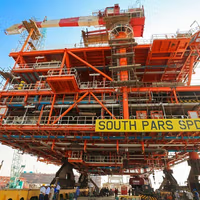
According to the U.S. Energy Information Administration (EIA), Iran earned $43 billion from crude oil and condensate exports in 2024—just $1 billion more than in 2023.
OPEC’s estimate, which includes petroleum products such as fuel oil, places Iran’s total oil export revenues at $46.7 billion.
These totals, however, exclude the heavy costs Iran pays to circumvent U.S. sanctions—estimated at more than 20% of gross revenues.
These costs stem from steep discounts to Chinese buyers (around $6–$7 per barrel, according to Kpler), the leasing of expensive "ghost fleet" tankers, and clandestine tactics such as ship-to-ship transfers, document forgery, and the use of intermediaries in countries like Malaysia to disguise the oil’s origin.
OPEC’s statistical bulletins show Iran earned just $160 billion from oil exports between 2019 and 2024. In sharp contrast, in the five years before U.S. sanctions were reimposed in 2018, Iran’s oil export revenues exceeded $400 billion.

Tucker Carlson's interview with Iran’s president Masoud Pezeshkian was all Tehran could wish for, experts told Iran International: a global stage, no pushback, and a direct line to Donald Trump’s base.
“This was a major victory for Iranian information warfare operations,” said Marcus Kolga, a leading expert on foreign disinformation. “Whether intentionally or not, Carlson is acting as a significant conduit and amplifier for Iranian government information operations.”
The interview was recorded remotely, unlike the one Carlson did with Russia's president Vladimir Putin in February 2024.
"(Carlson) offers Pezeshkian and the Iranian regime a platform—without context or pushback—allowing Tehran to shape the record to Carlson’s viewers and listeners unopposed,” Kolga added.
A moment highlighted by many critics was when Pezeshkian asserted that Israel had tried to assassinate him without offering any evidence.
“He was trying to... put forward the message that this is Israel tricking America into getting involved in this. This really isn't America's war. Iran and America, we have nothing to fight about.” director of the Yorktown Institute's Turan Research Center Joseph Epstein said.
Epstein argued the interview fit Carlson’s broader pattern of offering authoritarian figures a platform to rewrite narratives without scrutiny—an approach that often blurs the line between journalistic curiosity and ideological alignment.
MAGA :' forever wars'
That alignment, analysts say, extended deep into the language Pezeshkian used.
From “forever wars” to calls for dialogue, his remarks were crafted to appeal to Trump-aligned isolationists and feed growing calls for US disengagement from the Middle East.
The use of such language is no accident, said Holly Dagres, a senior fellow at the Washington Institute, who has long studied Iranian strategic messaging.
“One of the main goals of the Islamic Republic is to get the US out of the Middle East... and when you're pushing this isolationist rhetoric or America First, you're basically saying America needs to get out," Dagres told Iran International.
Dagres noted that Pezeshkian’s emphasis on business cooperation with the US and his softened tone on slogans like “Death to America” appeared to be an overture to Trump himself, even if the message didn’t land as clearly in today’s post-war political climate.
The interview was praised by Iran's moderates, but hardline voices slammed the president's for what they called 'appeasement'.
"A lot of conservatives condemned it because (they said) the US just bombed us. Why are you making these appeals to them?”
The messaging, several experts said, fits into a broader long-term goal: undermining the US-Israeli alliance.
“He used this as an opportunity to weaken and to increase America's skepticism of support for Israel,” said Casey Babb, senior fellow at the Macdonald-Laurier Institute. “In 50 years or 100 years, if America and Israel are not aligned the same way they are right now, Israel could be in a very precarious situation.”
Carlson, Babb said, handed that message a valuable platform by failing to press Pezeshkian on Iran’s human rights record, nuclear activities, or assassination plots.
“There were definitely softball questions with no follow-up,” said Dagres. “Carlson didn’t challenge Pezeshkian on well-documented plots to target American officials or on the regime’s broader ambitions.”
“In failing to counter these narratives,” Kolga said, “Carlson becomes a conduit for regime propaganda—allowing this high-profile ‘conversation’ to turn into a successful Iranian strategic disinformation operation.”

A nationwide internet outage likely imposed by the Tehran beginning just after midnight on July 6 has deepened concerns among a weary public over the already parlous state of the economy and access to information.
Confirmed by global observatory NetBlocks, the blackout caused a near-total loss of connectivity. Though partial access later returned, traffic remains just 20% of pre-conflict levels.
The latest shutdown follows a string of disruptions that began during the 12-day June conflict with Israel, when authorities restricted access under the guise of national security.
Iran’s Telecommunications Infrastructure Company has acknowledged the incident but offered no explanation. Meanwhile, accounts linked to officials remained active, fueling claims of selective, politically-driven censorship.
Economic shock, mass disruption
Prolonged outages are dealing vast damage to Iran’s digital economy.
The Iran Internet Businesses Guild Association estimated over $1.5 million in hourly losses and warned more than 400,000 small and mid-sized businesses are at risk.
The Tehran Union of Internet-Based Shops cited the vulnerability of small digital vendors and service providers.
“Every hour of blackout brings almost a $1.5 million loss to small businesses,” it said.
Sweden-based economist Ahmad Alavi called shutdowns “one of the most economically damaging decisions a government can make,” especially in a low-productivity economy where many rely on digital services.
“These blackouts drive both human and financial capital out of the country,” Alavi warned. “Freelancers, programmers, and entrepreneurs facing unstable access will increasingly emigrate or transfer assets abroad.”
“This is more than a technical glitch,” said Alavi. “It’s a full-blown economic shock affecting production, finance, investment, and public services.”
Mahtab Gholizadeh, a Berlin-based economic journalist, notes that with over 60% of the population under 30, Iran’s youngest and most connected generation, is being cut off from opportunity and global networks.
Resistance, risk and digital Control
Amid growing restrictions, some entrepreneurs have turned to Starlink satellite internet to stay connected—despite legal bans and the threat of imprisonment.
Mohammad, a small business owner, is one of them. “I know the risks,” he said, declining to use his full name due to likely official reprisals.
“But I’d rather face them than die in poverty.”
Many others, particularly in handicrafts and beauty, are redirecting efforts to regional export markets in the Persian Gulf.
Meanwhile, the government continues to promote domestic messaging platforms like Rubika, Baleh and Eitaa, but public uptake remains low. Users and businesses cite privacy concerns, limited features and poor engagement.
Shohreh, an entrepreneur in the beauty industry, tried moving some of her work to the Iranian app Soroush after international platforms were blocked but noted little customer traction.
“Many of our products are considered illegal on these networks,” she said. “Let alone finding proper channels to market or sell them.”
Unequal access, declining trust
The internet crisis has revived a controversial push for tiered access, giving preferential connectivity to state agencies and approved professionals while limiting the general public.
The idea has resurfaced through recent proposals from IT trade groups, but critics say it would formalize digital inequality. Tech outlet Zoomit called the idea “digital apartheid.”
Iran remains one of the world’s most censored internet environments. Around 84% of users rely on VPNs to get online, and over 90% engage with blocked global platforms.
Analysts warn that repeated shutdowns are fueling brain drain, startup collapse, and a crisis of investor confidence.
In an open letter, the Iran Internet Businesses Guild Association urged authorities to stop DNS tampering and bandwidth throttling, warning of systemic collapse.
“The normalization of blackouts,” said Alavi, “is isolating Iran from the global digital economy and destroying what little trust remains in its future.”

As air quality in Tehran and much of neighboring Alborz province reaches hazardous levels, medical experts are advising the vulnerable to stay indoors, with preparations underway for an emergency response.
In the capital, levels had reached 260 in the past 24 hours with other areas exceeding 300, entering the 'hazardous' category, the highest state of alert in the country's pollution indexes which range between zero and 500.
Health officials have advised people with existing medical conditions, children, and pregnant women to avoid outdoor exposure.
In neighboring Alborz province, conditions have worsened further. Kamran Haghi, acting head of the provincial meteorological office, confirmed that air quality in most areas had entered the hazardous category overnight.
“Pollution levels in parts of the province surpassed 300, and strong winds carrying dust will continue through the end of the week,” he said. He urged residents to keep windows shut and use filtered masks.
Mohammadreza Fallahnejad, acting director of Alborz’s crisis management office, linked the deterioration to low seasonal rainfall. “With reduced precipitation this year, the situation is intensifying each day,” he said.
The provincial environmental department has called on hospitals and emergency services to prepare for a rise in respiratory cases.
The recent dust affecting the country stems from both domestic and foreign sources, which operate independently of each other, said Behzad Raygani, acting secretary of the National Headquarters for Dust Storm Policy and Coordination, as reported by Tasnim.
“Part of this dust has entered from Syria and parts of Iraq, impacting our western provinces and parts of the central region. These sources have become particularly active in Syria,” he added.
“Aside from the western half and parts of central Iran, most provinces are dealing with dust due to internal and local sources.”

Iran is losing over $1.5 million every hour to internet restrictions, the Internet Business Association said in an open letter, as media linked to the Revolutionary Guards said the disruptions may signal an intensifying cyber war.
The group urged the Communications Ministry and the Infrastructure Company to “immediately end the deliberate disruptions to online access.
“Over 400,000 small and medium-sized enterprises, whose livelihoods millions of Iranians depend on, are facing complete collapse," the open letter dated July 2 said.
Internet access in Iran was disrupted on June 13, the first day of the 12-day war with Israel, and was completely cut on June 17. Partial service has since resumed, but connection speeds and access remain severely limited.
State media defends blackouts citing cyber war
On Saturday, the IRGC-affiliated Fars News Agency said the disruptions may reflect a large cyber war targeting national infrastructure, describing the attacks as organized and part of a “hidden battle growing more severe by the day.”
During the war, officials justified the shutdowns as a measure to block Israeli reconnaissance drones allegedly using Iranian SIM cards and to disrupt intelligence gathering via WhatsApp. But military and communications experts have dismissed those remarks.
“I categorically reject the Islamic Republic’s claims. No evidence has been presented to show that Israel uses SIM cards for drones," Mehdi Yahyanejad, an expert in internet technologies, told Iran International.
"Even if that were the case, a nationwide internet shutdown is not a logical solution," he said.
The daughter of top military commander Ali Shadmani—killed shortly after his appointment to lead Khatam-al-Anbia Central Headquarters—said her father carried no smart devices during the war, and that “Israel’s precision targeting went far beyond WhatsApp or traditional espionage.”
Her remarks followed accusations from Gholamreza Jalali, head of Iran’s Passive Defense Organization, who said WhatsApp was used to locate and kill Iranian commanders—a charge Meta has denied.
Layoffs, collapse feared in tech sector
The Internet Business Association, in its letter, cited ongoing disruptions—DNS tampering, throttling, protocol filtering, and loss of global access—as already triggering mass layoffs, stalled investment, and startup shutdowns.
“We are witnessing a broad wave of job cuts, halted investment in the startup ecosystem, and announcements of company closures—that is to say, bankruptcies,” the letter said.
The group warned that continued interference “threatens public trust, accelerates elite migration, and risks the death of Iran’s tech sector,” demanding an immediate end to all forms of service degradation.
Iran ranked near the bottom in global internet freedom last year. According to the Tehran Electronic Commerce Association, the country is placed among the lowest in speed and reliability out of 100 surveyed nations.
Surveys suggest 84% of Iranians rely on VPNs to access free internet.

The war has paused, but the collapse has not. Shaken by defeat in the streets, across the region, and from the skies, the Islamic Republic now stands weakened and exposed. The pillars that once held it up, ideology, reach, and fear, are cracking.
The Islamic Republic has begun sealing itself off from the world.
Today, Iranian state media announced that President Masoud Pezeshkian signed a law suspending cooperation with the United Nations’ nuclear watchdog, the IAEA. Inspectors will no longer be allowed access to Iran’s contested nuclear facilities. This decision comes just days after Israel and the United States inflicted unprecedented damage on those very sites during a 12-day campaign.
The move heightens the risk of war but also underscores a deeper truth: something irreversible is unfolding.
What began as a 12-day campaign of missile strikes, drone attacks, and air raids has paused, but only just. A ceasefire is in place, yet it may be more fragile than ever, liable to collapse at any moment. Most of Iran’s nuclear facilities were struck during the offensive, but the true extent of the damage remains unclear. If Iran still retains sufficient capacity, it may now accelerate uranium enrichment, not only to gain leverage in future negotiations but to reestablish deterrence in the face of overwhelming vulnerability. With inspectors barred under the new law, suspending cooperation with the IAEA, the next phase of this confrontation may shift from visible strikes to hidden centrifuges.
Yet, beneath this high-stakes brinkmanship, lies a regime already in retreat. The Islamic Republic’s collapse is no longer a distant scenario; it is underway. Over the past three years, Iran has suffered three strategic defeats: one from below, one abroad, and one from above. Each shattered a pillar of its power, ideological control, regional reach, and deterrent capacity.
Blow from above
The most recent blow came from the skies.
In a twelve-day campaign, Israel, joined in the final phase by the United States, inflicted the most severe damage the Islamic Republic has endured since its founding. Iran’s air defenses were dismantled, missile infrastructure crippled, and its nuclear program set back by years. Senior IRGC commanders and nuclear scientists were killed in strikes deep inside Tehran.
What shocked Iran wasn’t just Israel’s reach, it was Washington’s decision to join in. For decades, Tehran’s core strategic doctrine rested on the belief that the United States would avoid direct confrontation. That doctrine, built on proxy warfare, ambiguity, and the assumption of American restraint, has now collapsed. The red lines Iran once counted on no longer exist.
It wasn’t just military damage; it was a collapse of assumptions.
The Islamic Republic will attempt to rebuild. But its adversaries, having demonstrated their reach, might not allow it. The ceasefire is brittle. More fire will follow.
Symbolically, the clerical establishment is entering a new phase of uncertainty. During the war, Supreme Leader Ali Khamenei went underground and has only appeared through pre-recorded messages from undisclosed locations. Even if he reemerges, the precedent has been set: the threat to his personal safety is now constant. Israel has changed the rules of the game. Nowhere, and no one, is beyond reach.
That new reality is already reshaping how the Islamic Republic functions. Khamenei has quietly appointed a new commander to lead the Khatam al-Anbiya Central Headquarters, the central entity in the command chain of Iran's armed forces. Yet the Islamic Republic has withheld his name; two of his predecessors were killed within days of each other. For the IRGC, long accustomed to operating in the open, this marks a profound shift. At least for now, it must act like a force in hiding.
Collapse abroad
But the unraveling didn’t begin in the air.
In December 2024, Iran was forced to withdraw from Syria after the fall of its last meaningful ally, Bashar al-Assad. Years of investment, billions of dollars, thousands of fighters, and hundreds of IRGC casualties vanished in weeks. Israeli airstrikes, shifting Arab alliances, and regional backlash reversed a decade of expansion.
This was Iran’s Afghanistan moment.
Just as the Soviet retreat in 1989 exposed the limits of empire, Iran’s expulsion from Syria marked the collapse of its revolutionary reach. It wasn’t a tactical withdrawal. It was a reversal of ambition.
The retreat also delivered a psychological blow to the Islamic Republic’s support base. Analysts and ideologues who had long defended Iran’s presence in Syria as a strategic depth and moral imperative suddenly found themselves without a narrative. On state media and affiliated platforms, questions began to surface, not from critics, but from within: Why did we fail? What was the sacrifice for? This erosion of confidence among Islamic Republic loyalists has further hollowed out the ideological core that the system depends on to survive.
Revolt from within
But the deepest rupture came from inside.
In 2022, the death of Mahsa Jina Amini in custody sparked the Women, Life, Freedom movement. Since then, women across Iran have discarded the hijab in open defiance, and the Islamic Republic has not been able to stop them.
Today, unveiled women walk freely in major cities. The morality police, reactivated to enforce hijab laws, are failing. A regime built on obedience can no longer uphold one of its core pillars.
This wasn’t reform; it was rout.
Western governments largely missed it. Even amid the recent war, foreign correspondents in Tehran walked past unveiled women and reported nothing about it. Some even appeared on camera in hijab, respecting the Islamic Republic’s rules while ignoring the population’s defiance and a newly established norm.
But Iranians have not been silent.
During the Woman, Life, Freedom movement, the diaspora flooded the streets from Berlin to Washington. Berlin alone saw 100,000 protesters. These weren’t rallies about sanctions, they were calls for liberation. After the June strikes, Islamic Republic loyalists abroad attempted anti-Israel rallies. They failed. Iranians know the enemy isn’t Israel, it’s the Islamic Republic.
Inside Iran, the clerical establishment’s grip on public mourning has weakened. Funerals of IRGC commanders, once orchestrated as national rituals, drew subdued crowds. The state sought grief. It was met with apathy.
Still, in Western capitals, some continue to echo the Islamic Republic’s slogans. Cloaked in the language of “resistance,” they defend a system that even Iranians have rejected. As the Islamic Republic’s pillars crumble, these foreign sympathizers cling to a myth its own people have already abandoned.
A regime in freefall
Three defeats. Three broken pillars.
The clerical establishment has lost its ideological hold, its regional reach, and its deterrent capacity. It still censors, still imprisons, but no longer inspires fear or belief. What remains is brittle. What’s emerging is not reform. It’s freefall.
Diplomatically, Iran is more isolated than ever.
The suspension of cooperation with the IAEA may be aimed at gaining leverage, but it risks backfiring. A renewed referral of Iran’s nuclear file to the UN Security Council looms. European powers are considering triggering the snapback mechanism under the 2015 nuclear deal. Despite tough talk, Tehran is likely to return to negotiations with Washington, but from a position of historic weakness.
Its nuclear program is damaged. Its missiles have been exposed. Its leverage is gone.
This is not a regime to be recalibrated. It is one in structural decline, squeezed from above by military humiliation and from below by cultural revolt. To analyze today’s Iran using yesterday’s paradigms is to misread a rupture that is already underway.
Beyond Iran
The consequences won’t stop at Iran’s borders.
The 1979 Revolution reshaped the Middle East. It empowered political Islam, displacing secularism and nationalism. From Beirut to Baghdad, the Islamic Republic exported a militant, ideological model.
Its collapse could reshape the region again.
Today, Persian Gulf states are racing to modernize, digitize, and diversify their economies. Massive investments are flowing into infrastructure and artificial intelligence. Western governments are betting on a post-ideology Middle East. A transformed Iran could be the region’s missing piece.
Iran is not a failed state in waiting.
It is literate, urbanized, and cohesive. Islam shapes its culture but doesn’t define its identity. Even the Islamic Republic’s base lacks the fanaticism seen in other collapsing states. Iran is filled with engineers, doctors, and entrepreneurs, people who have thrived everywhere except at home.
They are not the risk. They are the alternative.
The fall of a repressive regime aligned with Moscow and Beijing would not bring chaos. It would bring renewal, for Iran, for the region, and for a world that has waited too long for both.