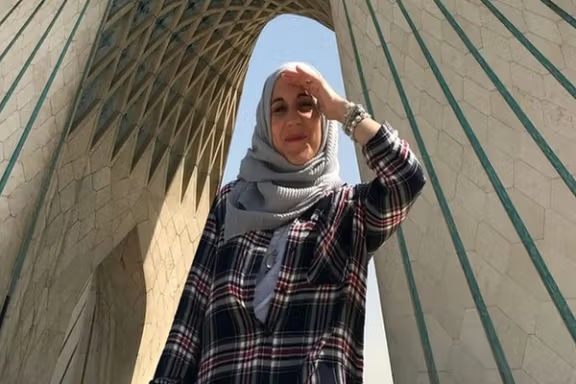
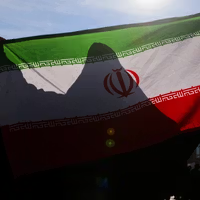
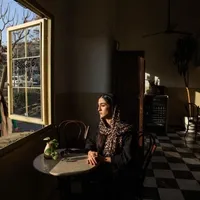
Catherine Perez-Shakdam in a photo next to Tehran's iconic Azadi tower
The curious case of Catherine Perez-Shakdam, a French-born Jewish woman who years ago met senior Iranian officials posing a sympathizer, has been revived in Tehran following a punishing war with Israel.
Iran is smarting from intelligence lapses in the 12-day war which allowed its arch-foe to assassinate top military figures and wreak havoc on bases and nuclear sites.
Hundreds of civilians were killed in the shock campaign last month.
The scale of the setback has sent bewildered officialdom searching for answers, and one Iranian lawmaker cited Shakdam's presence as a case study in infiltration.
Presenting herself as a Muslim convert and writer critical of Israel and the United States, Shakdam interviewed senior Iranian officials as a freelance journalist and attended various state-backed conferences on multiple visits up until 2017.
Iranian MP Mostafa Kavakebian said in a state TV interview last week that Shakdam was an Israeli spy who had slept with 120 senior officials, citing no evidence.
Speaking to Iran International, Shakdam was blunt about the remarks: “Not true, not possible, and completely absurd."
"They’re trying to destroy my character. I’ve got news for them — I do not give a shit. And you can quote me on this.”
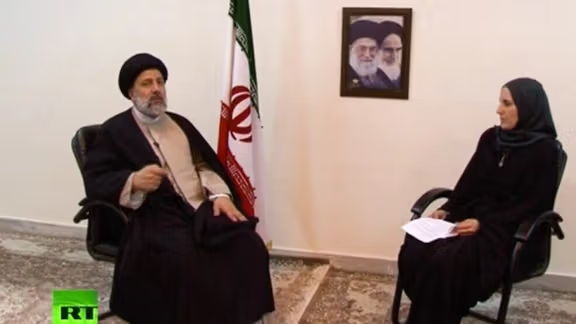
Catherine Perez-Shakdam, a French woman of Jewish heritage, interviews future Iranian President Ebrahim Raisi in Mashad in May 2017 (Screenshot: Russia Today)
Kavakebian's allegation drew fire online, where critics cited it as an example of poor logic, and even Iranian legal authorities who appeared eager to swiftly scotch discussion of the country's security failures.
Tehran’s prosecutor filed charges against Kavakebian for “disturbing public opinion,” calling the claims “unsupported" and summoned him to provide evidence.
State media outlet the West Asia News Agency (WANA), said the state had found no sign of espionage in Shakdam's case.
"Iran’s security and judicial bodies have explicitly stated that no documents or reports exist indicating immoral behavior, suspicious connections or illegal activities by Shakdam during her time in Iran."
Double life
Shakdam now works as a political analyst and spokesperson for an Israeli advocacy group We Believe In Israel.
She first drew the attention of Iranian authorities after publishing an opinion piece in the English-language Yemen Observer newspaper criticizing US intervention in Iraq. In 2009, she had moved to Yemen after marrying a Yemeni man.
The couple had two children before later divorcing. Her writings and public commentary eventually led to an invitation to appear on Iranian state TV as a Western voice critical of US foreign policy — a platform that opened the door to extraordinary access within Iran’s political elite.
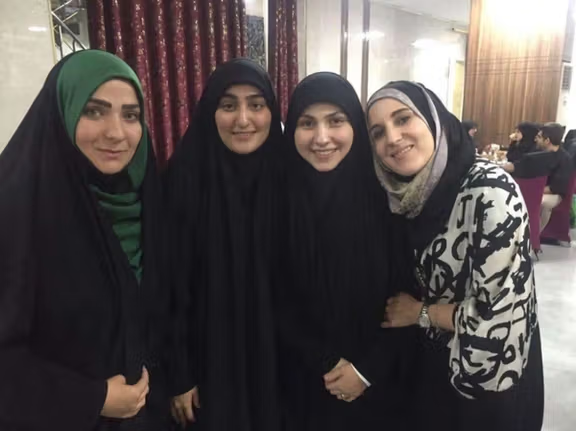
From right to left: Catherine Perez-Shakdam, Zaynab Mughniyeh, and Zaynab Soleimani (General’s Soleimani’s daughter)- Karbala, Iraq 2017
That access, she says, revealed a system obsessed with propaganda and deeply rooted anti-Semitism.
“If you want to call me a master spy — yes, of my own agency, okay?” she told Iran International. “I went there on my own two feet. No one asked me to do anything.”
Her mission, she says, was self-assigned — but it came at a steep personal cost.
“Ten years of hard work, ten years of pretending and playing the game, and ten years of almost losing myself — because you reach a point where you don't know where you begin and the lie ends.”
During her time in Iran, she says she met top figures including Ebrahim Raisi before he became president and later died in a helicopter crash, Revolutionary Guards Quds Force commander Qasem Soleimani and even Supreme Leader Ali Khamenei.
With dark humor, she recalled: “I had a little chat with Soleimani — obviously before he died because I don’t speak to ghosts. Raisi, obviously … Nader Talebzadeh many times. He died too. Not of my doing, okay. I had nothing to do with that.”
She joked that if she were a spy, she must be “00 Fluffy” — her own spin on 007, due to her owning many pet cats.
Warnings
The humiliation of Iran's military losses appears to be playing out in Iran's seemingly permanent power struggle between reformists and hardliners.
WANA characterized MP Kavakebian's TV outburst as an attempt to undermine hardliners who had welcomed Shakdam into their midst after foreign attacks last month failed to deliver the upheaval moderates supposedly seek in Iran.
"The lack of Iranian public support for Israel’s attack—even among those critical of the ruling system and governance quality in Iran—and the refusal to participate in street unrest, went against the expectations of pro-Western reformists inside the country."
"Perhaps the 'Mossad spy' story in Iran is not a bad place to start attacking a rival," WANA added. "Still, it must not be forgotten that the biggest beneficiaries of any internal division in Iran are those sitting in Tel Aviv."
Shakdam believes she was targeted because she is more visible and critical of Iran than ever following the 12-day war. Shakdam says the attack is rooted in the Islamic Republic’s deep-seated sexism and aimed at silencing outspoken women.
But after a decade of deception and backlash, she says she has no regrets.
“I just made a decision to do something with my life. And I did it. And I came out. And I’m proud of it.”
A Norwegian-operated oil field in Iraqi Kurdistan was hit by a drone strike on Thursday, in the second attack in as many days which local officials cited by Reuters blamed on Iran-backed groups.
The attack targeted a DNO-operated oil field in Tawke, located in the Zakho area. A day earlier, the US-based Hunt Oil facility at the Ain Sifni oilfield in the Dohuk region was also attacked.
No group has claimed responsibility, but local officials cited by Reuters blamed Iran-backed Iraqi militias.
No casualties were reported in either incident but the attacks dented oil production by 140,000 to 150,000 barrels per day (bpd) according to two energy officials cited by the news agency. The region’s total oil output is reportedly around 280,000 bpd.
On July 13, Iraqi media reported that the United States warned Iraq it could face sanctions over alleged Iranian oil smuggling and ties to armed groups, including threats to freeze millions in revenue and target the state oil firm SOMO.
The United States opposes the presence of Iranian-backed armed groups in Iraq's security apparatus.
These militias, including Kata'ib Hezbollah and Asa'ib Ahl al-Haq, are part of the Popular Mobilization Forces (PMF) grouping which joined forces with the Iraqi military to confront Islamic State militants in Iraq.
Washington accuses them of receiving support from the Revolutionary Guard Corps-Quds Force to attack US personnel in Iraq.
Iran's armed allies in the region have been dealt heavy blows as a region-wide conflict between Israel and Iran has seethed.
The armed Houthi group in Yemen resumed attacks on the high seas following a June 24 ceasefire ending a 12-day war between Israel and Iran.
Houthi forces sank a Liberian-flagged carrier on July 6 with rockets and explosive drone boats. The group, which controls most of Yemen's population centers, says its maritime attacks are in solidarity with Palestinians in Gaza.
Yemeni forces fighting the Houthis carried out their largest ever seizure of advanced Iranian conventional weapons bound for the group, US Central Command (CENTCOM) said on Wednesday.
A recent flurry of high-level meetings across Central Asia and the Middle East signals a quiet but marked shift: Iran and Russia are increasingly sidelined in the region’s political and economic realignments in favor of Arab states.
Once dominant mediators in the Armenia-Azerbaijan conflict, both were notably absent as the United Arab Emirates hosted direct talks between Armenian and Azerbaijani leaders late last week.
The meeting—described as positive by both sides—was the first time the two met face-to-face without intermediaries, according to Azerbaijani lawmaker Arzu Naghiyev.
Baku has long sought a way to connect the two territories of Azerbaijan separated by a tract of Armenian land. An existing plan for a 'corridor' is backed by Ankara but categorically rejected by Yerevan.
“Azerbaijan’s position on opening the Zangezur corridor to connect with Nakhchivan and Turkey is unequivocal,” Naghiyev told Iran International. “But the positions of Russia, Iran and others remain unclear.”
Tehran had previously threatened military action to prevent the corridor’s creation. But today, it appears unable to influence the outcome.
Tensions between Baku and Moscow have also escalated following the deaths of several Azerbaijani citizens in Russian custody.
In response, Azerbaijan shut down the Russian state-run Sputnik news bureau in Baku and arrested several of its staff. Meanwhile, Armenia’s pivot toward the West has further strained ties with Moscow.
Energy diplomacy
On July 4, the Nagorno-Karabakh region hosted an Economic Cooperation Organization (ECO) summit attended by leaders from Central Asia, Pakistan, Iran, and Turkey.
Russian officials were frustrated by Iranian President Masoud Pezeshkian’s participation, according to Israel’s Channel 12, especially as Azerbaijan was arresting Russian nationals.
Moscow made no public objection when Kazakhstan and Azerbaijan held joint drone drills days later.
Baku also hosted the head of Syria’s interim government last week, and reports suggest Israeli and Syrian officials held indirect discussions during the visit.
This followed Azerbaijan’s state oil company Socar acquiring a 10% stake in Israel’s Tamar gas field.
During the ECO summit, Turkish President Recep Tayyip Erdogan revealed Azerbaijan’s interest in exporting gas to Syria. A memorandum was signed on July 12 during the Syrian delegation’s visit to Baku.
Qatar has already begun supplying gas to Syria via Jordan, while Saudi Arabia and the United Arab Emirates are backing reconstruction efforts in opposition-held areas—bypassing the Assad regime and its traditional backers, Iran and Russia.
UAE leads the charge
Among Persian Gulf states, the UAE has emerged as the most active in regional diplomacy.
On July 13, Erdogan held a call with UAE President Sheikh Mohammed bin Zayed Al Nahyan, discussing the Kurdistan Workers Party (PKK) disarmament, the Armenia-Azerbaijan talks, and broader regional initiatives.
Trade reflects this deepening partnership: Turkish exports to the UAE surged 65% in the first half of 2025—the fastest growth among Turkey’s trade partners. Exports to Syria rose 46% in the same period.
Direct investment from Persian Gulf states abroad has jumped 50% since 2022, with 90% flowing to Central Asia, according to the Eurasian Development Bank.
Emirati firms manage all of Turkmenistan’s Caspian Sea oil production and own 30% of Azerbaijan’s Absheron gas field—the second-largest in the Caspian.
The UAE has invested more than $12 billion in Central Asia, with Saudi Arabia and Qatar accounting for almost $4 billion.
Arab states are stepping up across the region, increasingly appears to be at the expense of Iran and Russia.
Israel's police announced on Thursday it had arrested an Israeli soldier they say was in contact with Iranian operatives and took money in exchange for information.
“The investigation's findings revealed that the soldier knowingly maintained contact with Iranian elements and, in this context, carried out tasks for them, including transferring a video of interceptions and photographs of missile impacts and strikes in Israel," the police said in a statement.
"It should be noted that the information did not come to him by virtue of his military role,” it added.
The arrest comes on the back of a new ad campaign by the Israeli government warning citizens against spying for Iran.
Israeli authorities say they have uncovered more than 25 cases of Iranian recruitment over the past year, with more than 35 people indicted on serious security charges.
“The campaign carries significant national importance, especially in the aftermath of (the war with Iran), after which Iranian efforts to recruit operatives and execute missions inside Israel are expected to intensify,” said Israel's National Public Diplomacy Directorate, which along with domestic security service the Shin Bet, is behind the campaign.
“For 5,000 shekels, is it worth ruining your life or family?” reads one of the campaign's video adverts, referencing the reported amounts some individuals have received for passing information to Tehran.
Since the Gaza war, there has been a 400% surge in arrests related to alleged Iran-backed spy plots, according to the Israeli security services.
Iran’s top military commanders warned on Thursday that the armed forces are ready to resume fighting in the wake of the 12-day war with Israel amid a ceasefire brokered by the US.
“Our forces are fully prepared to resume combat from exactly where it stopped,” said Major General Mohammad Pakpour, commander-in-chief of the Islamic Revolutionary Guards Corps (IRGC), during a meeting in Tehran with Major General Amir Hatami, commander-in-chief of Iran’s army.
“The aggressors will not be spared,” he added. “The will and resolve of the Iranian people and our armed forces have triumphed. We stand together.”
Earlier in the day, a senior Iranian lawmaker also warned that Iran would respond to any future Israeli attack with a blow more severe than last month’s conflict.
“If the Zionist regime again makes the mistake of acting against the Islamic Republic, it will be hit even harder than it was in Operation True Promise 3,” Esmail Kowsari, a member of parliament’s national security and foreign policy committee, told reporters i Tehran.
Hatami said Iran would not wait for external threats to materialize. Last week, Israel's Prime Minister Benjamin Netanyahu warned that the war with Iran "is not over".
“The Zionist regime is a danger to regional and global peace,” Hatami said. “If given the opportunity, it would strike others in the region. We will not allow it.”
The commanders’ statements came amid Israel’s airstrikes on Damascus. Israel wants a demilitarised buffer zone in southern Syria.
US President Donald Trump expects Iran to return to nuclear negotiations, saying that diplomacy is in Tehran's best interest, according to the State Department Spokeswoman Tammy Bruce.
“I know that he expects them to begin to negotiate because that's in their best interest,” Bruce said in an interview with Fox News. “He has believed and continues to believe that diplomacy will work here."
Trump has warned that if Iran's nuclear program continues to pose a threat, he would "absolutely" consider more strikes, "without a question".
Just one of the three nuclear facilities struck by the US in Iran last month has been destroyed, according to a report by NBC News citing current and former US officials.
The latest assessment, which showed that Fordow was set back as long as two years, was briefed to US lawmakers, Defense Department officials and allied countries in recent days.
NBC also reported that an initial plan presented to US President Donald Trump involved three more sites, but the operation would have taken weeks, leading him to scale back the scope due to the risk of casualties on both sides and the fact that it was at odds with his foreign policy to extract the US from conflicts abroad.
“We were willing to go all the way in our options, but the president did not want to,” one of the sources with knowledge of the plan said.
The US strikes targeted three enrichment sites in Iran, Fordow, Natanz and Isfahan.
Trump was quick to call the strikes “a spectacular military success” and said, “Iran’s key enrichment facilities have been completely and totally obliterated."
A graphic showing Iran's Fordow Fuel Enrichment Plant is seen in this photograph released by the Pentagon in Washington, June 26, 2025.
Israel has not ruled out further attacks on the two less damaged sites. Israeli Prime Minister Benjamin Netanyahu told Fox News last week that “it’s not over”.
Iran is the only non-nuclear weapon state enriching uranium to 60% U-235, a level that causes "serious concern," according to International Atomic Energy Agency (IAEA) Director General Rafael Mariano Grossi.
The IAEA has consistently maintained that there is no credible civilian use for uranium enriched to this level, which is a short technical step from weapons-grade 90% fissile material.
Iran has always said its nuclear program is purely for peaceful, civilian purposes.
Iranian Foreign Minister Abbas Araqchi said the strikes on the Fordow nuclear site caused severe damage.
A former top UN nuclear official told Eye for Iran podcast that a nuclear Iran is still possible despite US and Israeli strikes on key nuclear sites as the whereabouts of Tehran's near-weapons grade uranium remains unknown.
Around 400 kilograms—more than 900 pounds—of uranium enriched to 60% purity is unaccounted for and now with the International Atomic Energy Agency (IAEA) barred from the country, it is unsure if the location can ever be known.
Former Deputy Director General of the IAEA, Olli Heinonen, warned: “One should not relax because this material as such is enough for 10 nuclear weapons if it is enriched further to 90%. So in a big picture, yes, Mr Trump was correct, but it should have had this caveat that it's not yet over.”