Former Iranian MP and war veteran Gholam Ali Jafarzadeh Imanabadi
A former Iranian lawmaker has launched a blistering attack on the country’s intelligence agencies, accusing them of catastrophic failure in the face of Israel’s military strikes in June that killed dozens of Iranian commanders.
In a wide-ranging interview with the reformist outlet Didar News, Gholam Ali Jafarzadeh Imanabadi said Iran’s security establishment had failed in its most basic duty—protecting lives—despite massive budgets and broad powers.
“Where were our intelligence agencies with all their hefty budgets? How did they fail to detect the spies?” he asked. “Commanders and nuclear scientists were murdered in their own bedrooms. The intelligence community must be held accountable.”
A war veteran and former MP for Rasht, Imanabadi has long used a wheelchair since being wounded in the Iran–Iraq war. Though no longer in office, he remains known for his blunt political style and ties to moderate factions.
Imanabadi, who was barred for seeking re-election by hardliner-dominated establishment, mused that security forces were totally penetrated by Israel's spy agency.
"A group of Mossad spies are looking for Mossad spies among Mossad spies."
Intel collapse, state silence
Imanabadi singled out the Intelligence Ministry and the intelligence apparatus of the Revolutionary Guards (IRGC), criticizing both for failing to anticipate the Israeli attack despite weeks of tension.
“I felt insulted when the head of IRGC Intelligence and four of his deputies were killed,” he said. “I expected resignations or dismissals after these disasters.”
He went on to mock the government’s surveillance priorities.
“We are lost. We have no idea where we’re headed,” he said. “The intelligence forces were busy arresting dog walkers and those without hijab. If they’re incompetent, they should step down.”
Despite mounting internal and external threats, Iran continues to dedicate substantial resources to controlling the private behavior and public expression of its citizens.
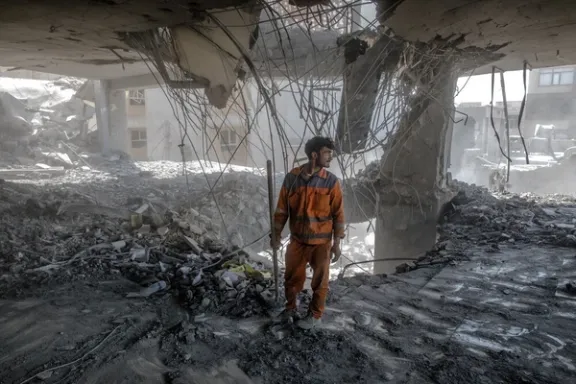
A worker standing amid the rubbles of a building destroyed in Israeli attacks, Tehran, Iran
Weak president, muted parliament
While the interview marked his harshest critique of Iran’s intelligence failures, Imanabadi also attacked the broader ruling system.
“Up to the night before the war, top officials—including Pezeshkian and military commanders—insisted there would be no war. They owe the public an explanation but refuse to speak,” he said.
“(Pezeshkian) has had absolutely no achievements in his first year in office. He lacks both the will and a plan to implement any change.”
Turning to the legislature, he asked: “Why hasn’t the Majles impeached the minister of intelligence? We no longer have a functioning parliament in Iran.”
‘Change course’
Israel’s unrelenting strikes on Iran not only exposed deep cracks in the state’s command and control structures but also disrupted the official narrative. More voices can now be heard challenging an embattled establishment.
A fundamental shift in tone is required to make up for past mistakes, Imanabadi suggested.
“Enemies are bad. Critics are good. During the 12-day war, it was the people—including critics and opposition figures—who passed the test. Only the officials failed.”
He cited the renewed prison sentence of veteran activist Mostafa Tajzadeh as a sign that the government was “slapping charges” on its critics instead of thanking them.
“They proved that people cannot rely on them,” he said.
A bomb was planted near the residence of Iran’s foreign minister during the 12-day war with Israel but was discovered before it could explode, Abbas Araghchi said in an interview.
Although the interview was scheduled to air on Iran's state TV, the broadcaster’s decision to withhold it has raised eyebrows among moderate and pro-government news outlets.
“A bomb was planted in a house across from ours, but it was discovered before it exploded," Araghchi said in the interview which is the latest episode of an online program titled The War Story.
He also said that during his overland trips, several drones were detected flying overhead. While Araghchi himself did not notice the drones, he said his security team identified them using specialized equipment and, on several occasions, had to turn off their mobile phones for security reasons.
On June 21, Araghchi visited Istanbul to attend the meeting of foreign ministers of the Organization of Islamic Cooperation (OIC). His trip to Turkey came after his visit to Geneva, Switzerland, where he met European powers in the middle of the Israel war.
ZDF reported at the time that Araghchi had informed Israeli officials that he would be flying to Geneva, as Israel controlled the Iranian airspace during the 12-day war that ended with a US-brokered ceasefire on June 23.
“It has been fully agreed by and between Israel and Iran that there will be a Complete and Total CEASEFIRE,” US President Donald Trump announced in a post on his Truth Social platform.
Araghchi confirmed at the time that Iran would halt military operations starting at 4:00 am Tehran time on June 24.
Ceasefire violation caused by 'misunderstanding'
In his recent interview, Araghchi revealed a misunderstanding between him and Iran's military forces, which led to continued Iranian strikes past the intended ceasefire time.
“There was a misunderstanding between me and the armed forces. Our friends had thought the ceasefire was in effect from 4 am GMT, so they continued attacks against the (Israeli) regime until 7:30 am Tehran time,” Araghchi said.
He said another misunderstanding occurred on the afternoon of June 24.
On the first afternoon of the ceasefire, Araghchi said, “the (Israeli) regime claimed Iran had launched missiles and violated the agreement, and they sent their jets to carry out attacks."
"I immediately messaged (Trump's envoy Steve) Witkoff and said Israel was making excuses, accusing Iran of violations that never happened. I warned that if they take action, we will respond immediately and more forcefully than before. Iran is not Lebanon — they can’t repeat what they did there.”
He said Trump then said in a social media post that he had ordered Israeli pilots to turn back, effectively halting the operation.
“This showed, once again, that everything had been coordinated with the Americans from the very beginning," Araghchi said.
The 12-day war was started by Israel and capped off by US strikes on Iranian nuclear sites. The United States had signaled it would join only if the campaign was going well, The Washington Post reported on Saturday citing Israeli and American officials involved in the operation.
Israel was preparing a final wave of attacks aimed at toppling Iran’s ruling system when Trump announced the ceasefire, the Post reported citing the officials.
Israel's surprise campaign of airstrikes and drone attacks killed hundreds of Iranians including civilians, military personnel and nuclear scientists. Iran's retaliatory missile strikes killed 27 Israeli civilians.
Iran has banned the use of mobile phones inside parliamentary chambers and committee meetings due to rising security concerns, state media reported on Sunday.
Parliament Speaker Mohammad Bagher Ghalibaf backed the decision, citing security issues as the main reason. “The matter of mobile phone use by lawmakers has been discussed by the parliamentary presidium. Regardless of security concerns, we are in the chamber to legislate, and mobile phone use is inappropriate,” Ghalibaf said during Sunday’s open session.
He added, “Even if the security issues are resolved, the presidium still opposes the use of mobile phones inside the chamber. Our dear people should know that when MPs are present in the chamber or in committees, they cannot use mobile phones.”
The restriction comes amid growing fears in Tehran over Israeli intelligence operations. In recent weeks, Iranian media and officials have warned of unprecedented Israeli surveillance capabilities.
A report by The Sunday Times saidon Saturday that Israeli intelligence had deeply infiltrated Iran’s military and nuclear infrastructure through complex operations over the past year.
Earlier this month, Abdollah Shahbazi, a former senior intelligence official and director of a state-affiliated research institute, warned on social media that Iranian officials should avoid carrying electronic devices for fear of being targeted. “It has now become clear that, in addition to drones and missiles, a highly active Mossad network is operating on the ground inside Iran,” Shahbazi wrote.
The ban has sparked criticism from some parliamentarians, who argue it hinders their ability to communicate with constituents.
Hamidreza Goudarzi, a lawmaker from Aligoudarz, said during Sunday’s session: “Not having our phones with us has become a problem. People expect us to be available and responsive, and this ban makes that difficult. I ask the presidium to step in and resolve this issue.”
Ghalibaf, however, said that the decision was made in consultation with security agencies. “Our colleagues in the security apparatus have specific views about mobile phone use after entering the chamber. We are following up with the presidium to make decisions accordingly,” he said.
The restriction appears to be part of broader efforts by Iranian authorities to tighten control over sensitive communications.
While the move has faced resistance from lawmakers concerned about accessibility, Ghalibaf said that constituents could still contact their MPs through office staff.“Citizens should understand that their representatives cannot speak on mobile phones while in the chamber, but their office teams can respond on their behalf,” he said.
Iranian President Masoud Pezeshkian on Saturday called for the return of Iranians living abroad and urged coordination between the judiciary and intelligence services to ease concerns, despite past detentions of returnees.
“We must create a framework for Iranians abroad to return comfortably and without fear, and this requires coordination with the judiciary and the Ministry of Intelligence,” Pezeshkian said during a meeting at the foreign ministry.
“These individuals are also assets of this land,” he added, appealing for their reintegration. His remarks followed a state media interview one day earlier in which Cultural Heritage, Tourism and Handicrafts Minister Reza Salehi Amiri said, “This land belongs to you, and we are rolling out the red carpet.”
Yet the government’s invitation comes against a record that has left many expatriates wary. In recent years, dual and foreign-based nationals returning to Iran have faced arrests, lengthy interrogations, and prison sentences often without formal charges being made public.
Nasrin Roshan, an Iranian-British dual citizen, was detained at Tehran’s Khomeini airport in November 2023 while trying to leave the country. She was held for 550 days before being freed in May, after repeated inquiries by rights groups and British officials.
In another case, Iranian-American journalist Reza Valizadeh returned to Iran in early 2024 after a 14-year absence. Within days, he was taken to Evin Prison’s Ward 209 and sentenced in December to 10 years by the Revolutionary Court. His family said he had returned only for a family visit.
The Iranian parliament last week passed the general outline of a bill titled “Support for Iranians Abroad,” backed by 209 lawmakers. The draft law includes measures such as easing entry and exit, offering consular support, reviewing dual citizenship policies, and facilitating academic and investment opportunities.
But critics in parliament questioned its likely impact.
“Until domestic issues such as administrative corruption, a weak banking system, and lack of meritocracy are resolved, this bill will not encourage Iranians to return,” MP Ahmad Fatemi of Babol said earlier this month.
Despite the doubts, Pezeshkian has consistently urged diaspora engagement. In a July 14 message, he told expatriates, “We must join hands and strive for the dignity of our country.”
A nationwide survey in December 2024 titled “Migration of Iranians: Causes and Motives” found that while 19 percent of 12,000 respondents lived abroad, only a fifth of them expressed any interest in returning.
Only 16 percent of Iranians are not considering emigration, according to this study.
The legacy of a 12-day war with Israel which ended last month will likely be yet more economic hardship, deteriorating living standards and intensifying public distrust.
While the government portrays the conflict as a strategic victory, mounting evidence suggests a society battered, exhausted and increasingly disillusioned.
Daily life has grown more difficult, strained by chronic water and electricity shortages. Yet, despite the hardship, protests remain rare.
While state media continue to glorify the armed forces and the Supreme Leader, many recall a different reality: missile strikes without bomb shelters, ineffective air defenses and a war waged without public support.
The Supreme Leader’s three-week stay in an underground shelter became a symbol of elite insulation. On the ground, thousands of homes were damaged or destroyed, with casualties still likely unreported.
The government’s support for reconstruction has been slow and unclear, evoking comparisons to Khorramshahr, a focus of combat in the Iran-Iraq war which remains mostly ruined decades after the Iran–Iraq War.
The official refrain that “Israeli homes were also destroyed” has brought little comfort.
A huge plume of smoke rises over Tehran with the iconic Milad Tower in the background, Iran, June 2025
Economic disruption, official deflection
At the end of the 12-day war, Iran’s Chamber of Commerce acknowledged the war’s serious impact: disrupted trade, blocked currency repatriation and shaken investor confidence.
“Government-led economics cannot improve the situation,” said Isa Mansouri, head of the Chamber’s Research Center.
The warning echoed the view from Tehran’s bazaar and stock exchange: that even limited geopolitical shocks can derail imports and daily commerce.
Pension delays are another flashpoint.
A July 23 report by state news agency ILNA revealed some retirees were still waiting for April payments. Infrastructure damage in Tehran is extensive—over 3,000 housing units were hit in District 4 alone, with no clear timeline for repairs.
To contain the crisis, authorities quietly declared unofficial “holidays” in Tehran, reducing strain on water and power utilities while avoiding transparency.
President Pezeshkian’s claim on Al Jazeera that Israel bombed water resources to deprive Iranians of access was widely ridiculed and seen as deflecting from decades of internal mismanagement.
War’s reach into private life
A study by academic Momeneh Baseri, "The Iran-Israel War and the Change in Iranians' Lifestyle", published June 21 by Azad University, highlights the war’s broad social effects—even among those far from the front lines.
Drawing on field research and crisis sociology, Baseri identified several trends:
A decline in travel despite official campaigns promoting domestic tourism.
Widespread stockpiling of food, fuel, and medicine, worsening shortages.
Spiking media use, especially of social platforms and foreign-based outlets
Fading optimism, with marriage, investment, and emigration all clouded by uncertainty.
Cinemas and concert halls remain empty. In their place: home-based religious rituals, streaming platforms, and a growing culture of isolation.
Three men sitting in the shade of a tree near Tehran's Azadi square, Iran, July 19, 2025
The illusion of normalcy
Even efforts to portray resilience have backfired.
A video recorded and published by moderate daily Ham-Mihan shortly after ceasefire showed quiet Tehran streets and shuttered shops.
Another report by moderate online publication Asr Iran featured returning residents—some relieved, many bracing for more strikes. “It felt good to return,” said one man on camera, “even to an unsafe home.”
Foreign observers confirm the unease.
Deutsche Welle’s Dan Hirschfeld described Tehran as “in a constant state of alert,” with many seeking to leave and economic stress visibly deepening.
Calls for fundamental change
Criticism of the government narrative is mounting.
Sociologist Taqi Azad Armaki, writing in Fararu, called for a transition “from ideological warfare to national reconstruction.”
A urged empowering the sidelined middle class and warned that the war had left Iran helpless and unable to meet basic needs.
Though cautiously framed, it marks the clearest sign yet of openness to structural change.
Despite claims of stability, the Islamic Republic may be at its most fragile point since the 1981 bombing that killed over 70 top officials claimed by the People's Mojahedin Organization of Iran or MEK.
Then, the system had a charismatic leader in Ruhollah Khomeini and revolutionary zeal. Now, it is led by a solitary, increasingly isolated Supreme Leader with no clear path forward.
Iran’s President Masoud Pezeshkian is facing an intense backlash over his government’s endorsement of a fast-tracked bill that critics say threatens freedom of expression and targets dissent.
The proposed legislation, titled “Combating the Dissemination of False Content in Cyberspace,” was originally drafted by the judiciary but reviewed and submitted to Parliament by Pezeshkian’s cabinet on July 20.
Widespread internet restrictions imposed during the country’s 12-day conflict with Israel remain largely in place.
Given Iran's parliament is dominated by hardliners, the bill is expected to face little resistance. Some lawmakers are reportedly pushing to make it even stricter.
Vague language, severe penalties
Many have sounded the alarm over the broad and ambiguous language of what they call the cyber censorship bill.
Legal expert Mohammad-Hossein Jafari told the moderate outlet Entekhab that its lack of clear definitions could empower security agencies to arbitrarily prosecute critics.
The bill includes harsh penalties, such as steep fines, bans on media activity, and prison terms ranging from 10 to 15 years if content deemed false is posted during a “crisis”—a sentence harsher than that for armed robbery under Iranian law.
The timing has drawn further scrutiny, coming just days after a fragile ceasefire between Iran and Israel and amid fresh arrests of citizens accused of spreading falsehoods on social media.
“The bill … is not designed to fight lies, but rather to eliminate independent narratives, restrict freedom of expression, and legally target journalists and critical users,” wrote journalist Alireza Rajaei.
Critics say the legislation will stoke public mistrust, entrench self-censorship, and undermine civil liberties. Former lawmaker Mahmoud Sadeghi argued the administration could have revised or blocked the judiciary’s draft instead of submitting it.
Legal expert Kambiz Norouzi and Reform Front head Azar Mansouri also called on Pezeshkian to withdraw the bill.
“This contradicts your stated principles and Chapter Three of the Constitution,” Mansouri wrote on X, referencing sections that guarantee citizens’ rights and the free flow of information.
Mounting personal criticism
An increasing number of critics are holding Pezeshkian personally responsible.
“The bill you submitted is a final blow to freedom of expression,” wrote IT professor and activist Ali Sharifi-Zarchi, noting that state media spreading false claims—such as the supposed downing of Israeli F-35s—remains untouched, while ordinary users are punished.
Lawyer Ali Mojtahedzadeh described the bill as “shameful and frightening,” adding in a pointed jab at the president:
“Even [ultra-hardliner Saeed] Jalili couldn’t have done more harm to free speech,” he posted on X.
Others have highlighted contradictions in Pezeshkian’s own rhetoric—including some who campaigned for him in last year’s election.
“How can you talk about dialogue,” journalist Ehsan Bodaghi asked on X, “when your government just backed legislation that silences citizens? Why didn’t you stand up to the Judiciary and protect what little freedom remains?”