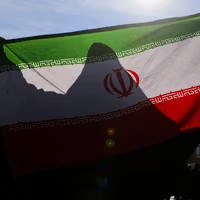
Young men set US flag ablaze in an event celebrating Iran's retaliatory strikes against Israel, June 15, 2025
A reformist call for renewed talks with the United States as a way out of Iran’s post-war troubles has laid bare deep divisions within the Islamic Republic, with hardliners accusing the letter’s authors of treason and appeasement.
In their public letter to President Masoud Pezeshkian, published July 28 in multiple outlets, the Reform Front warned that the ceasefire with Israel is fragile and a return of UN sanctions is imminent, urging a fundamental rethink of foreign policy.
“A comprehensive development strategy instead of a strategy of survival and confrontation requires negotiations with the United States and European governments to resolve mutual issues, lift sanctions, and obtain necessary security guarantees,” the letter read.
It warned that unless such a path is taken, Iran faces either a renewed war that would devastate the country’s vital infrastructure, or a prolonged state of neither war nor peace, marked by total isolation that would erode the Iran's capacity to function.
“Minor and piecemeal reforms will not solve the country’s problems,” the authors said. “Today, the nation needs bold and difficult choices.”
Mounting hardship, muted leadership
The call comes amid growing economic hardship, with chronic water and electricity outages fueling public anger and hampering an already strained economy.
The Reform Front accused Pezeshkian of failing to stand up to hardliner overreach, including the recent act of parliament requiring the administration to suspend cooperation with the International Atomic Energy Agency (IAEA).
“The president has remained silent in the face of a war-mongering foreign policy and the state broadcaster’s continuous attacks against his own government,” they wrote.
Hardline backlash was swift and scathing.
‘Discredited losers’
Javan, affiliated with the Revolutionary Guards, called the letter an echo of demands by the Islamic Republic’s opposition. Conservative commentator and former Javan chief Abdollah Ganji rejected the moderates’ advice as “a call for surrender” in daily Hamshahri.
But the harshest attack—as usual—came from Kayhan, whose editor-in-chief is appointed by Supreme Leader Ali Khamenei.
•
•
“What’s striking is that they don’t dare say … what exactly should be done now for these discredited political losers to consider it a ‘revision of policies’ or a ‘correct decision,’” read a Monday editorial.
“Should we hand over our defensive deterrent? Completely shut down the nuclear program? Release the arrested spies and traitors so they can commit more acts of treason?"
"If the CIA and Mossad had commissioned people to translate their unmet demands into Persian, would it have looked any different from this letter?” the editorial asked.
Iranian social media users have reported facing disconnection of their phone SIM cards and receiving what appear to be official conditions for regaining access including posting praise of the ruling system on social media.
Some users said that when requesting reasons for losing services from providers, they were advised to contact the Islamic Revolutionary Guard Corps Cyber Command or the Cybercrime Prosecution Office of the General Prosecutor's Office.
Upon contacting the offices, users received written instructions to verify their identity, sign a pledge not to criticize the state and post twenty messages of praise for the Islamic Republic on social media, Human Rights Activists News Agency (HRANA) reported on Tuesday.
The disconnection of SIM card services was implemented without prior warning or judicial order, it added.
One user shared a message from the Prosecutor’s Office identifying the service disruption and required actions.
“Your hostile and malicious activities on social media, contrary to the country's laws and interests, have been monitored and identified by the intelligent AI systems of the prosecutor's office. Accordingly, your internet account and SIM card services have been restricted or blocked,” the message to users read.
“To lift the restrictions and blocks, you are required to write the following pledge on a piece of paper, sign it, and provide your fingerprint. Additionally, you must publish at least twenty posts with positive content supporting the Islamic Republic of Iran on social media. These posts must not be shared simultaneously,” the message adds.
The pledge says that the "offending" individual accepts they will face legal prosecution if they repeat "malicious" activities, adding that all activities of such users will be under “constant AI monitoring,” HRANA said.
The report indicated the phenomenon was not new but appears to be becoming more widespread.
“They disconnect SIM cards with no due process, then force people to sign the pledge and remove content they don’t like," Iranian lawyer Mohsen Borhani warned this month on X. "Sadly, this is all illegal, but it’s becoming a common practice."
Iran's intelligence ministry issued a lengthy statement asserting alleged successes amid a punishing 12-day war with Israel last month which it said scotched elaborate regime change plans by an array of foreign and domestic enemies.
The ministry said it had thwarted assassinations plots against 35 officials, conducted raids and made arrests targeting the Baha'i religious minority, evangelical Christians, foreign-baed dissidents, Sunni Muslim jihadists, separatists, monarchists and media organizations acting in league with Israel.
Hundreds of military personnel, nuclear scientists and civilians were killed in Israel's surprise campaign last month including top commanders, in major intelligence lapses the statement appeared aimed at addressing.
"What happened during the 12-day imposed was a war plan with planning and full-scale utilization of combined military, security, intelligence, cognitive warfare, disruptive actions, assassination, sabotage, destabilization and incitement of internal unrest," the statement issued on Monday said.
The multifarious plots, it added, were "aiming for the delusion of subjugating and forcing Iran to surrender and overthrowing the sacred Islamic Republic,” it added.
Israel was able to launch deadly attack drones at senior military Islamic Revolutionary Guards Corps (IRGC) leaders from inside the country, killing the armed forces chief of staff, IRGC leader and the elite unit's commanders of aerospace and military operations.
An Iranian analyst alleged in a newspaper interview last week that Israel caused over 100 Iranian missile launchers to explode upon activation during the war last month and that it had hacked the country’s entire air defense system.
The daughter of a top Iranian military commander assassinated by Israel last month said her father was chased down and killed by Israeli agents in a hot pursuit in Tehran and not an airstrike as originally reported.
Not offering explanations for any lapses, the ministry said it "detected and neutralized" Israeli plots to assassinate 23 senior civilian and military officials during the conflict and 13 similar attempts in the months leading up to it.
'Thugs, rebels'
The ministry alleged that it had carried out successful intelligence operations inside Israel, saying its activities were ongoing.
"Numerous and varied offensive and intelligence measures (aggressive espionage) were carried out in various cities of the occupied territories against the interests of the Zionist regime and the criminal gang that rules it."
Israeli authorities say they have uncovered more than 25 cases of Iranian recruitment over the past year, with more than 35 people indicted on serious security charges.
"One of the approaches implemented was to recruit intelligence and operational agents from the regime’s innermost military and security layers," the ministry added. "The larger and more sensitive part of the missions is still ongoing."
The ministry said it had faced down threats from street thugs to the NATO alliance.
"The enemy sought to activate criminals, diverse terrorists in various guises, deploy awaiting spies, conduct assassinations and sabotage, and to mobilize mercenaries, monarchist remnants, thugs, rebel groups, and dormant hypocrite cells to inflame tensions, provoke dissatisfaction and professional protests, and turn conditions into uncontrolled street riots and chaos”, the statement said.
"We faced not only the petty Zionist regime but also the Western intelligence-security NATO,” it added.
A June 23 Israeli air attack on Evin Prison - known for housing dissidents and foreign detainees - was aimed at catalyzing a nationwide revolt, the ministry alleged. Iranian authorities said 80 people were killed in the attack and Amnesty International called for it to be investigated as a war crime.
“We detected and fully neutralized a Mossad-directed monarchist plot to launch and dispatch armed operational teams from across the country to Tehran on June 22 for terrorist actions the next day (during the Evin prison bombing) targeting nearby military and law enforcement centers," the ministry said.
“This monarchist-Zionist scenario was thwarted by identifying involved agents, striking enemy operational teams, and arresting 122 mercenaries across 23 provinces before any terrorist action in Tehran."
Iran’s state broadcaster (IRIB) is facing backlash after refusing to air an interview with Foreign Minister Abbas Araghchi that included politically sensitive disclosures about the 12-day war with Israel.
The hour-long interview, part of the “Story of the War” documentary series produced by the Islamic Propaganda Organization, was scheduled to air on Saturday. But to the public's surprise, it was rejected by the state broadcaster IRIB without explanation.
Instead, the segment was uploaded on Sunday to the organization’s YouTube channel, ON TV. Clips quickly spread across social media.
On X, Araghchi’s media adviser, Mehran Ranjbaran, confirmed IRIB had blocked the broadcast, validating widespread suspicions online.
What did Araghchi say about the war?
Araghchi made several notable disclosures—some politically sensitive. Perhaps most strikingly, he admitted to direct and ongoing contact with US negotiator Steve Witkoff throughout the conflict via messaging apps.
“I posted the tweet announcing the end of the war after coordinating with higher authorities. The system had already decided in advance that if the other side stopped the attacks, without any preconditions, we would stop as well,” he said.
In Iranian political jargon, the system (nezam) usually refers to the Supreme Leader Ali Khamenei.
He added that when confusion arose over ceasefire terms, “Right then and there, I messaged Witkoff and told him that Israel was making excuses and accusing Iran of violations—which hadn’t happened—and that if they took any action, we would respond immediately and more forcefully than before.”
Araghchi claimed that the US President Donald Trump then ordered Israeli pilots to stand down—proof, he said, that Israel had been acting in coordination with the US all along.
Khamenei has on several occasions confirmed that the foreign ministry only carries out the decision made by the Supreme National Security Council (SNSC). The council’s decisions can only be implemented after his endorsement. Araghchi's remarks, therefore, highlighted his responsibility for all decisions taken related to the war.
The retaliation debate
Araghchi also pushed back against hardliners’ claims that President Masoud Pezeshkian had opposed retaliatory action for the killing of Hamas leader Ismail Haniyeh in Tehran last year.
According to him, Iran’s Armed Forces Chief of Staff Mohammad Bagheri, who was killed in the war, firmly dismissed such allegations.
Bagheri, according to Araghchi, said he was responsible for defending the country and would carry out his duty the moment he was sure he could protect the country from the consequences of retaliation. “He said he hadn’t even asked the President yet,” he added.
Many believe the official who criticized Pezeshkian was IRIB’s head Peyman Jebelli who is sometimes invited to the SNSC’s sessions.
Araghchi’s disclosures have triggered strong responses from journalists, analysts, and online users. Many condemned IRIB’s refusal to broadcast the interview.
“Either Araghchi is not the foreign minister of the Islamic Republic of Iran, or the national broadcaster is not truly national. Logically, it can't be anything other than one of these two,” political analyst Erfan Pazhuhandeh wrote on X.
IT expert Mohammad Keshvari similarly criticized the IRIB in a post on X. “The untold stories of the war—told by the Foreign Minister—something any sensible TV network would jump at the chance to broadcast, ended up being aired by the online platform ON. These same people will then complain that they can't compete with online platforms.”
“It’s understandable why the national broadcaster didn’t air the interview—because it brings everything that they have said against the diplomatic apparatus into question,” journalist Ehsan Taghadosi remarked on X.
IRIB and the ultra-hardliners
IRIB is led by figures close to Iran’s ultra-hardline Paydari Party and former nuclear negotiator Saeed Jalili. The latter’s brother, Vahid Jalili, serves as the organization’s deputy head in cultural affairs.
Vahid Jalili,an official member of the Paydari Party, has considerable influence over IRIB’s editorial direction and programming decisions.
Under Jebelli and Vahid Jalili’s leadership, IRIB has become a mouthpiece for Paydari-aligned narratives, often downplaying diplomacy in favor of confrontation with the West and Israel.
The United States on Tuesday criticized Iran’s leadership over the ongoing nationwide water crisis, which have affected millions across the country, blaming it on mismanagement, corruption and neglect.
"Days without water in the scorching heat of July. There's no access to water for drinking, bathing, washing or cooling homes," the US State Department said in a post on its Persian X account, referring to the ongoing water crisis in Iran.
"The people of Iran continue to suffer the real consequences of the regime's greed, corruption, and mismanagement of water resources," the State Department said in the post accompanied by an image captioned, "Iranian people deserve better than this."
Officials in Tehran blame drought and public overuse for Iran’s worst water shortage in living memory.
Despite a UN “red warning” 25 years ago, Iran expanded hydropower rather than wastewater treatment. 80% of untreated wastewater is dumped into rivers, deserts and underground wells, contaminating key water sources.
Amid an unprecedented heatwave in Iran, many natural and engineered water reservoirs across the country particularly in Tehran, Alborz and Fars provinces are nearly depleted.
The Islamic Revolutionary Guard Corps (IRGC) has built over 60 dams in recent decades. More than half are now empty, with hydropower generation operating at just one-third of its nominal capacity.
A 12-day war with Israel has ushered Iran into a new phase where crisis is no longer episodic but structural—an unstable order held together by instability itself.
Though short-lived, the war inflicted deep symbolic and political damage on Tehran.
Strikes on strategic infrastructure, the killing of top commanders and damage to air defense systems raised serious doubts about the Islamic Republic’s capacity to provide security.
Far from healing old wounds, the war exposed and deepened the theocracy’s core weaknesses.
From water and power shortages to currency volatility, from political gridlock to widening social divides, nearly every facet of life in Iran bears the mark of dysfunction.
Instability is now normalized. It’s not the exception but the constant.
The new normal
Even before the war, Iran faced a web of interlocking crises: economic collapse, institutional decay, mass emigration, widespread social discontent, and deep political distrust.
Some political actors believed tactical flexibility or resource redistribution might restore order. Others foresaw collapse as inevitable. Both camps, in different ways, assumed that transformation—whether internal or external—was still possible.
The war has shifted that assumption.
Iran’s ruling establishment no longer appears capable of restoring legitimacy or reorganizing itself, but viable alternatives also seem more fractured than ever.
The opposition is scattered, the political class adrift, and grassroots movements are fragmented and organizationally thin.
Much of society is caught in a suspended state: disillusioned but not mobilized, angry but exhausted.
A firefighter sprays water on blazes of a shopping mall in Iran's northern city of Anzali, July 22, 2025
The Islamic Republic has tightened control—erecting checkpoints, increasing Revolutionary Guards and Basij presence and policing public spaces.
The message is blunt: We are still here. But this is not stability born of legitimacy. It is the visibility of power imposed on restless cities.
Today’s urban order rests not on consent, but on continuous police presence.
A collapsing narrative
The 12-day war exposed the hollowness of official narratives: deterrence, security and regional authority no longer carry weight.
Iran’s vulnerability wasn’t just military. It was discursive. The state’s security narrative took a direct hit.
Worse, the war ended without a lasting peace or credible guarantee against future conflict. Peace itself has become unstable. It’s more of an anxious interlude, not a resolution.
With explosions and air defense activity continuing in multiple regions, many expect a new, possibly more intense, confrontation.
Living With Crisis
The long-held notion that the Islamic Republic feeds on crisis is no longer sufficient.
In the past, crises were instrumental—tactics to manage society and consolidate power. Today, crisis is not just a means of rule but the system’s very foundation.
Crises are no longer resolved; they are extended, normalized, and embedded into daily life. The system doesn’t merely survive crisis—it is sustained by it.
This condition has been made possible by a combination of factors: the absence of a unifying alternative, the suppression of public discourse, the fragmentation of dissent, and the systematic blocking of political imagination.
Senior Revolutionary Guards commanders attending the funeral of Gholamhossein Gharibpour, commander of Imam Ali security brigade, July 25, 2025
The state has succeeded in minimizing mobilization through control—but it offers no vision for legitimacy in return.
Power has become form without content—a hollow repetition of authority sustained by imposed hopelessness.
Yet this persistence is not stability.
Chronic instability may appear contained—thanks to force and habituation—but the cracks are widening. The theocracy is more detached than ever from the economic, social and institutional foundations that once upheld it.
The drift into slow, grinding dysfunction leaves the country vulnerable to sudden shocks: social uprisings in neglected regions, systemic failures in water, health, or energy, or collective protests triggered by seemingly small sparks.
The Islamic Republic may still be standing—but the ground beneath it has never been shakier.