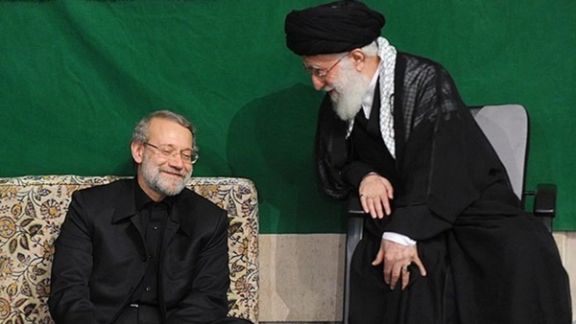
Ali Larijani next to Iran's supreme leader Ali Khamenei
Veteran powerbroker Ali Larijani has been reappointed as Secretary of Iran’s Supreme National Security Council (SCNS), returning to a role from which he resigned two decades ago after clashes with ultra-hardline President Mahmoud Ahmadinejad.
His comeback underscores not only his enduring relevance in Iran’s power circles but also a career defined by strategic shifts, navigating factions and consistent loyalty to the country’s ultimate authority Supreme Leader Ali Khamenei.
For much of his career, Larijani was known as a staunch conservative.
He vocally opposed reformist President Mohammad Khatami and the broader reform movement, using his position as head of the state broadcaster IRIB to discredit Iranian intellectuals.
The program Hoviat ("Identity") targeted cultural figures like poet Ali Akbar Saeedi Sirjani, some of whom were later victims of the Intelligence Ministry’s multiple targeted murders.
‘Problem solver’
Yet by 2015, Larijani emerged as a key supporter of the Iran nuclear deal, helping secure its approval in parliament in under 20 minutes despite conservative opposition. The move aligned him with then-president Hassan Rouhani and marked a dramatic pivot from his earlier hardline stance.
Khamenei publicly praised Larijani at the time as a "problem-solver," though his growing closeness to Rouhani reportedly raised eyebrows in the Supreme Leader’s inner circle.
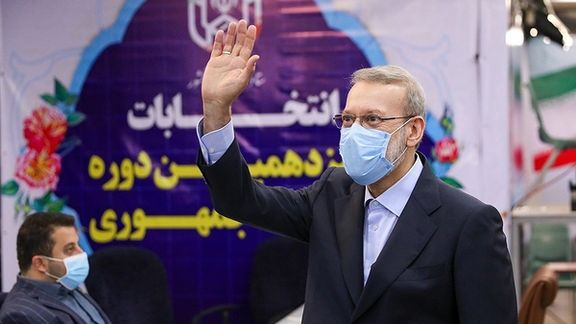
Larijani was blocked twice from running for president in 2021 and 2024
Throughout these shifts, Larijani remained attuned to the political winds.
His alliances with Presidents Akbar Hashemi Rafsanjani and Khatami cooled as soon as Khamenei distanced himself from them—underscoring a deeper, more consistent alignment with the Supreme Leader over any political faction.
Return to the fold
Despite being sidelined in recent presidential elections—disqualified by the Guardian Council in both 2021 and 2024 allegedly over his daughter studying abroad—Larijani has evidently regained the trust of Iran's theocrat.
Following President Ebrahim Raisi’s death last yer, he was handed two sensitive tasks: overseeing the Iran-China strategic accord and acting as an intermediary with Russia after Israeli strikes on Iranian soil.
While many establishment figures kept a low profile during the crisis, Larijani reemerged as a visible supporter of the Islamic Republic and its top leadership.
An operator without a party
Though courted by moderate conservatives to form a party during Rouhani’s presidency, Larijani resisted. One reason may be his limited popular base.
In parliament, he represented Qom, where a few thousand votes suffice to win a seat—far fewer than the million-plus votes typically needed in Tehran.
Larijani’s political instincts appear rooted more in elite maneuvering than popular mobilization, consistent with his background in a deeply clerical family tied to the seminaries of Qom and Najaf.
The Larijani legacy
Ali Larijani is part of one of Iran’s most influential political dynasties. His father, Hashem, was a respected cleric who steered clear of politics, but his sons embraced the Islamic Republic’s institutions.
Ali's four brothers have held senior roles across Iran’s judicial, legislative and security branches. Ali, the only full-time politician in the family, carved out a career that included 12 years as Speaker of Parliament, top roles in the media and culture ministries and ongoing membership in the Expediency Council.
Educated at the Qom Seminary and Tehran University—where he earned a PhD in Western philosophy—Larijani blends ideological training with technocratic credentials.
He is married to the daughter of Ayatollah Morteza Motahari, a key architect of the Islamic Republic, further cementing his position within Iran’s ruling elite.
A Loyal chameleon
While Larijani now often echoes hardline rhetoric against the United States, he has occasionally voiced cautious support for dialogue.
Deeply skeptical of Europe but pragmatic when necessary, he remains one of the few establishment figures with the credentials and adaptability to help steer Iran toward diplomatic de-escalation, should that path ever open.
Few Iranian politicians have changed stripes as fluidly as Larijani. Yet through all the turns—from hardliner to moderate broker, from sidelined veteran to high-level envoy—his loyalty to Khamenei has never wavered.
In a system where ideological purity is often less important than proximity to the Supreme Leader, Larijani has mastered the art of staying close to the only power that truly matters.
A high-profile conservative seen as close to Iran's Supreme Leader Ali Khamenei has been appointed to lead Iran’s newly revamped Supreme National Security Council, Tasnim News reported on Tuesday.
Ali Larijani replaces Ali Akbar Ahmadian, who is due to take on an unspecified new role in the administration of President Masoud Pezeshkian, Tasnim added.
Larijani previously served three terms as speaker of parliament, secretary of the Supreme National Security Council, head of the Islamic Republic of Iran Broadcasting (IRIB), Minister of Culture and Islamic Guidance and advisor to the Supreme Leader.
His appointment may signal a doubling down on Tehran's traditional confrontational stance with Israel and the United States after a punishing 12-day war with Israel in June capped off by US airstrikes on Iranian nuclear sites.
Still, Larijani registered three time to run for president in Iran but was disqualified on two occasions by Iran's hardliner-dominated Guardian Council. His political stances on diplomacy and domestic affairs appear to have softened in recent years.
Larijani ran as a candidate in the ninth presidential election of Iran, held in 2005. He lost the race, finishing sixth out of seven candidates.
The appointment comes with some institutional changes following a 12-day war with Israel in June.
President Pezeshkian will chair the council, which will include the heads of the executive, legislative and judiciary branches, as well as top military commanders and key cabinet ministers, the report added.
A son of a former Iranian intelligence chief has been charged with supporting Israel and was banned from using social media for three months, Hassan Younesi announced on his X account, amid a sweeping postwar crackdown by Iranian authorities.
"I have been banned from activity on social media for three months. Turns out that in addition to spreading ‘falsehoods and propaganda against the sacred system,’ I am also accused of ‘strengthening the Zionist regime,’” said Younesi, a former advisor to former president Hassan Rouhani.
His father Ali Younesi was intelligence minister during Mohammad Khatami’s presidency.
In past public remarks, Hassan Younesi had warned of deep infiltration by Israel’s Mossad in Iran, saying officials should be concerned for their personal safety.
Younesi, who is also a lawyer, was briefly detained in November 2022 amid Iran’s nationwide protests sparked by the death in custody of 22-year-old Mahsa Amini over an alleged hijab law violation.
The charge against Younesi comes amid a broader crackdown on dissent and alleged espionage during and after the 12-day war with Israel.
More than 700 people were arrested in the month after the ceasefire, mostly accused of working as agents for Israel in recent days.
The arrests reportedly targeted what authorities described as an “active espionage and sabotage network” that intensified operations following Israel’s June 12 strike, which killed several senior Iranian military and nuclear figures.
Tehran has requested the Taliban share a leaked list of Afghans who assisted British forces, including those linked to MI6, as part of a bid to identify and potentially detain some now in Iran for possible diplomatic leverage ahead of nuclear talks, The Telegraph reported.
An official from the Islamic Revolutionary Guard Corps (IRGC) in Tehran confirmed to The Telegraph on Monday that the IRGC has formally asked the Taliban for the list of nearly 25,000 Afghans.
The list, dubbed the “kill list” in British media was leaked in 2022 and contains the full names, emails, and phone numbers of people in Afghanistan who applied for relocation to the United Kingdom following the military withdrawal in 2021.
It includes personal data of Afghan soldiers, government employees, and their families, as well as around 100 British special forces members and intelligence operatives who had endorsed Afghan applicants.
People disembark the RAF Voyager aircraft, upon arrival from Afghanistan, at the RAF Brize Norton, in Oxfordshire, Britain, August 17, 2021
A Taliban official told The Telegraph that since discovering the value of the list, the group has been working to locate and detain those still in Afghanistan, intending to use them as leverage in diplomatic pressure on the UK.
"Taliban leadership in Kandahar has also ordered officers in Kabul to arrest as many individuals as possible from the leaked document to use them as leverage in exerting diplomatic pressure on London," according to the report.
The Telegraph says the IRGC appears to have similar intentions, particularly with renewed nuclear negotiations and the threat of snapback sanctions looming over Iran.
Since the June 25 ceasefire between Iran and Israel, Tehran has accelerated the deportation of Afghan nationals from Iran, citing an inability to continue hosting large numbers of migrants and asylum seekers.
On July 25, senior Iranian diplomats met with counterparts from the UK, France, and Germany in Istanbul to discuss the path forward. They agreed to continue negotiations.
European governments are pressing Iran to resume full cooperation with the International Atomic Energy Agency (IAEA), including the reinstatement of inspections and other obligations. Following the war with Israel, Iran has moved to further limit cooperation with the UN nuclear watchdog.
Under UN Security Council Resolution 2231, any party to the now-lapsed 2015 nuclear agreement—including France, Germany, the UK, Russia, or China—can file a complaint accusing Iran of non-compliance.
If no progress is made on Iran's nuclear dossier by August 30, the so-called snapback mechanism can reinstate UN sanctions removed under the 2015 deal.
“We have made it clear to the United Nations and the Security Council that such a step is a misuse of international mechanisms, and the Islamic Republic will respond decisively,” Iran’s Deputy Foreign Minister Kazem Gharibabadi said Sunday.
Iran’s Lake Urima, once the largest lake in the Middle East, is now all but dry, threatening mass displacement and environmental collapse amid the country’s worst drought in living memory.
Despite repeated government pledges over two decades, the lake’s revival plans have faltered due to chronic underfunding, bureaucratic turf wars, and weak enforcement.
Over 90 percent of the country is experiencing some level of drought, with rainfall plummeting and water reserves dwindling.
The drying of major water bodies like Lake Urmia and the Zayandeh Rud River has intensified Iran’s overlapping economic and ecological crises, as decades of mismanagement catches up with the theocratic establishment.
A mighty ecosystem in retreat
Lake Urmia was once the sixth-largest saltwater lake in the world, spanning over 5,000 square kilometers. It supported rich biodiversity and helped regulate the region’s climate.
But years of poor water management, over-extraction, and climate change have pushed it to the edge. On July 20, Hojjat Jabari, an environmental official in West Azerbaijan Province, issued a stark warning:
“If current conditions continue, Lake Urmia is likely to dry up completely by the end of the summer. We haven’t reached that stage yet—but we’re getting dangerously close.”
Recent satellite images confirm that more than 95% of the lakebed is now dry. Scientists warn that full ecological collapse may soon become irreversible.
What went wrong?
Since the early 2000s, Iran has constructed over 20 major dams and countless smaller ones that divert water from the lake’s main tributaries. Tens of thousands of deep wells—legal and illegal—also draw heavily from groundwater reserves that once fed the lake.
The situation has been worsened by state policies promoting water-intensive crops such as sugar beets, melons, and apples, far beyond the region’s ecological limits.
One of the most damaging interventions came in the early 2000s, when a causeway and bridge were built across the lake, splitting it in two. The structure disrupted natural water circulation and caused the southern basin to turn into a salt flat years before the northern section followed.
Salt storms and human costs
Estimates suggest the lake holds between 1 to 2 billion tons of salt. As the water disappears, winds pick up this salt and spread it across surrounding areas. Videos shared on social media show sweeping salt storms engulfing nearby villages.
If the lake fully dries up, the health and livelihoods of over five million people in cities like Oroumieh, Salmas, and Tabriz could be severely affected. Salt particles in the air can cause respiratory illnesses, destroy farmland, and contaminate water supplies.
In the worst-case scenario, experts warn, northwestern Iran could face mass migration as the region becomes increasingly uninhabitable.
Is there still hope?
Experts caution that without immediate and drastic intervention, the opportunity to revive the lake may be lost for good. But partial recovery is still possible—if bold reforms are enacted now.
These include halting dam expansions, reducing agricultural water consumption, switching to less water-intensive crops, and modernizing irrigation infrastructure.
The challenge is immense, but failing to act would mean not just the death of a lake, but the beginning of a wider environmental and human catastrophe.
Iran has arrested 20 people in a crackdown on a suspected bribery and influence network operating within Tehran’s judiciary system, a top official said on Monday.
According to judiciary intelligence chief Ali Abdollahi, those detained include six judicial staff, five lawyers, four notaries, and five legal consultants and experts. The arrests were made in connection with activities at a major judicial complex in the capital.
Authorities seized a significant amount of gold coins, jewelry, and foreign currency during raids on properties linked to the group.
Abdollahi said the network was involved in “structured bribery, corruption, and manipulation of legal outcomes.” The investigation, he added, is part of broader efforts to root out internal corruption and restore public trust in Iran’s legal institutions.
No names have been released, and judiciary officials say the case is ongoing.